Question
Generate a complete, print-ready paper with questions like this in minutes — across 16+ boards, with answer keys.
| Column I | Column II |
| 1. Vibrio | a. Rod-shaped |
| 2. Bacillus | b. Spherical |
| 3. Spirillum | c. Spiral shaped |
| d. Comma or kidney-shaped |
| ‘A’ Group | ‘B’ Group |
| 1. Muscle | (a) Perichondrium |
| 2. Bone | (b) Sarcolemma |
| 3. Nerve cell | (c) Periosteum |
| 4. Cartilage | (d) Neurilemma |
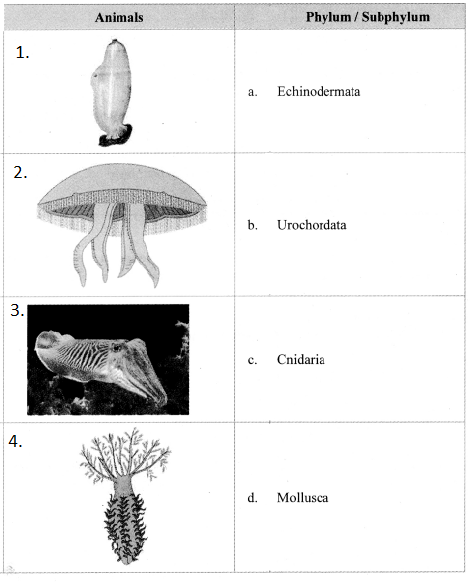
| 1. Pila | (P) Flame cells |
| 2. Bomby | (q) Comb plates |
| 3. Pleurobrachia | (r) Radula |
| 4. Taenia | (s) Malpighian tubules |
| Column – I | Column – II |
| 1. Saprophyte | (a) Symbiotic association of fungi with plants roots |
| 2. Parasite | (b) Decomposition of dead |
| 3. Lichens | (c) Living on living plants or animals |
| 4. Mycorrhiza | (d) Symbiotic association of algae and fungi |
| Column $I$ | Column $II$ | |
| $i.$ | Rennin | $a.$ Vitamin $B_{12}$ |
| $ii.$ | Enterokinase | $b.$ Facilitated transport |
| $iii.$ | Oxyntic cells | $c.$ Milk proteins |
| $iv.$ | Fructose | $d.$ Trypsinogen |
| Column I | Column II |
| 1. Prophase | (a) Chromatids moving to opposite poles. |
| 2. Metaphase | (b) Nuclear membrane starts disappearing. |
| 3. Anaphase | (c) Chromosomes at equatorial plane of the cell. |
| 4. Telophase | (d) Nuclear membrane reappears |
| Column I (Organism) | Column II (Characteristic Feature) |
| 1. Euplectella | (a) Exoskeleton formed of placoid scales |
| 2. Periplaneta | (b) Presence of mantle |
| 3. Sepia | (c) Water canal system |
| 4. Scoliodon | (d) Jointed appendages |
| 5. Clarias | (e) Exoskeleton formed of cycloid scales |