A healthy adult of height $1.7 \,m$ has an average blood pressure $( BP )$ of $100 \,mm$ of $Hg$. The heart is typically at a height of $1.3 \,m$ from the foot. Take, the density of blood to be $10^3 \,kg / m ^3$ and note that $100 \,mm$ of $Hg$ is equivalent to $13.3 \,kPa$ (kilo pascals). The ratio of $BP$ in the foot region to that in the head region is close to
KVPY 2019, Diffcult
Download our app for free and get started
(c)
Pressure at head level $=p_{\text {heart }}-\rho g h$
$=13.3-10^3 \times 10 \times 0.4$ $=9.3 \,kPa$
Pressure at foot level $=p_{\text {heart }}+\rho g h$
$=13.3+10^3 \times 10 \times 1.3$ $=26.3 \,kPa$
So, ratio $=\frac{26.3}{9.3} \approx 2.9$ or $3$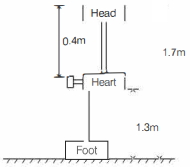

Download our appand get started for free
Experience the future of education. Simply download our apps or reach out to us for more information. Let's shape the future of learning together!No signup needed.*
Similar Questions
- 1$Assertion :$ Falling raindrops acquire a terminal velocity.View Solution
$Reason :$ A constant force in the direction of motion and a velocity dependent force opposite to the direction of motion, always result in the acquisition of terminal velocity. - 2A bubble of radius $R$ in water of density $\rho$ is expanding uniformly at speed $v$. Given that water is incompressible, the kinetic energy of water being pushed isView Solution
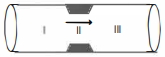
- 3The platelets are drifting with the blood flowing in a streamline flow through a horizontal artery as shown below Artery is contracted in region $II$. Choose the correct statement.View Solution
- 4A piston of cross-section area $100\, cm^2$ is used in a hydraulic press to exert a force of $107\, dynes$ on the water. The cross-sectional area of the other piston which supports an object having a mass $2000 \,kg$. isView Solution
- 5A spherical ball of density $\rho$ and radius $0.003$ $m$ is dropped into a tube containing a viscous fluid filled up to the $0$ $ cm$ mark as shown in the figure. Viscosity of the fluid $=$ $1.260$ $N.m^{-2}$ and its density $\rho_L=\rho/2$ $=$ $1260$ $kg.m^{-3}$. Assume the ball reaches a terminal speed by the $10$ $cm$ mark. The time taken by the ball to traverse the distance between the $10$ $cm$ and $20$ $cm$ mark isView Solution
( $g$ $ =$ acceleration due to gravity $= 10$ $ ms^{^{-2}} )$

- 6A metallic block of density $5\,gm \,cm^{-3}$ and having dimensions $5 cm × 5 cm × 5 cm$ is weighed in water. Its apparent weight will beView Solution
- 7Water flows in a stream line manner through a capillary tube of radius $a$. The pressure difference being $P$ and the rate of flow is $Q$. If the radius is reduced to $\frac{a}{4}$ and the pressure is increased to $4 P$. then the rate of flow becomes ................View Solution
- 8In an experiment, a small steel ball falls through a Iiquid at a constant speed of $10\, cm/s$. If the steel ball is pulled upward with a force equal to twice its effective weight, how fast will it move upward ? ......... $cm/s$View Solution
- 9A sphere of relative density $\sigma$ and diameter $D$ has concentric cavity of diameter $d$. The ratio of $\frac{D}{d}$, if it just floats on water in a tank is:View Solution
- 10A spherical ball of radius $1 \times 10^{-4} \mathrm{~m}$ and density $10^5$ $\mathrm{kg} / \mathrm{m}^3$ falls freely under gravity through a distance $h$ before entering a tank of water, If after entering in water the velocity of the ball does not change, then the value of $h$ is approximately:View Solution
(The coefficient of viscosity of water is $9.8 \times 10^{-6}$ $\left.\mathrm{N} \mathrm{s} / \mathrm{m}^2\right)$