A piston of cross-section area $100\, cm^2$ is used in a hydraulic press to exert a force of $107\, dynes$ on the water. The cross-sectional area of the other piston which supports an object having a mass $2000 \,kg$. is
Medium


Download our appand get started for free
Experience the future of education. Simply download our apps or reach out to us for more information. Let's shape the future of learning together!No signup needed.*
Similar Questions
- 1View SolutionA cork is submerged in water by a spring attached to the bottom of a bowl. When the bowl is kept in an elevator moving with acceleration downwards, the length of spring
- 2A concrete sphere of radius $R$ has a cavity of radius $ r$ which is packed with sawdust. The specific gravities of concrete and sawdust are respectively $2.4$ and $0.3$ for this sphere to float with its entire volume submerged under water. Ratio of mass of concrete to mass of sawdust will beView Solution
- 3View SolutionPressure head in Bernoulli's equation is
- 4A stream-lined body falls through air from a height $h$ on the surface of liquid. Let $d$ and $D$ denote the densities of the materials of the body and the liquid respectively. If $D > d$, then the time after which the body will be instantaneously at rest, isView Solution
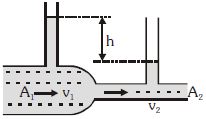
- 5A liquid flows through a horizontal tube. The velocities of the liquid in the two sections which have areas of cross-section $A_1$ and $A_2$ are $v_1$ and $v_2$ respectively. The difference in the levels of the liquid in the two vertical tubes is $h$ . The incorrect statement isView Solution
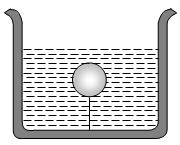
- 6A solid sphere of density $\eta$ $( > 1)$ times lighter than water is suspended in a water tank by a string tied to its base as shown in fig. If the mass of the sphere is m then the tension in the string is given byView Solution
- 7When a rubber ball is taken to a depth of $......\,{m}$ in deep sea, its volume decreases by $0.5\, \%$View Solution
(The bulk modulus of rubber $=9.8 \times 10^{8}\, {Nm}^{-2}$ Density of sea water $=10^{3} {kgm}^{-3}$
$\left.{g}=9.8\, {m} / {s}^{2}\right)$
- 8Water enters through end $A$ with speed ${v_1}$ and leaves through end $B$ with speed ${v_2}$ of a cylindrical tube $AB$. The tube is always completely filled with water. In case $I$ tube is horizontal and in case $ II$ it is vertical with end $ A $ upwards and in case $ III $ it is vertical with end $B$ upwards. We have ${v_1} = {v_2}$ forView Solution
- 9The relative velocity of two consecutive layers is 8 cm/s. If the perpendicular distance between the layers is $0.1\, cm$, then the velocity gradient will be ......... $sec^{-1}$View Solution
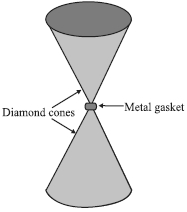
- 10Anvils made of single crystals of diamond, with the shape as shown in Figure, are used to investigate behaviour of materials under very high pressures. Flat faces at the narrow end of the anvil have a diameter of $0.50\; mm$, and the wide ends are subjected to a compressional force of $50,000 \;N$. What is the pressure at the tip of the anvil?View Solution