A heater coil connected to a supply of a $220\, V$ is dissipating some power ${P_1}.$ The coil is cut into half and the two halves are connected in parallel. The heater now dissipates a power ${P_2}.$ The ratio of power ${P_1}\,\,:\,\,{P_2}$ is
Medium
Download our app for free and get started
(c) $P = \frac{{{V^2}}}{R}$. If resistance of heater coil is $R$, then resistance of parallel combination of two halves will be $\frac{R}{4}$
So $\frac{{{P_1}}}{{{P_2}}} = \frac{{{R_2}}}{{{R_1}}} = \frac{{R/4}}{R} = \frac{1}{4}$
So $\frac{{{P_1}}}{{{P_2}}} = \frac{{{R_2}}}{{{R_1}}} = \frac{{R/4}}{R} = \frac{1}{4}$

Download our appand get started for free
Experience the future of education. Simply download our apps or reach out to us for more information. Let's shape the future of learning together!No signup needed.*
Similar Questions
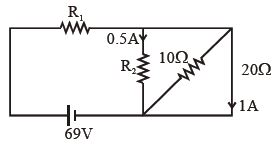
- 1In the circuit shown in the given figure the resistance $R_1$ and $R_2$ are respectivelyView Solution
- 2The current flowing through a lamp marked as $50\, W$ and $250\, V$ is ............. $amp$View Solution
- 3An electric bulb is designed to draw power $P_0$ at voltage $V_0$. If the voltage is $V$ it draws a power $P$. ThenView Solution
- 4The charge flowing in a conductor changes with time as $Q ( t )=\alpha t -\beta t ^2+\gamma t ^3$. Where $\alpha, \beta$ and $\gamma$ are constants. Minimum value of current is :View Solution
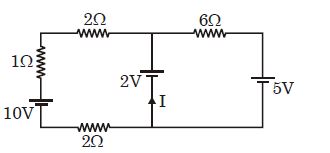
- 5Find the value of $I$ ?................ $\mathrm{A}$View Solution
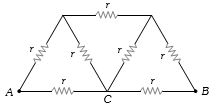
- 6In the circuit shown, the value of each resistance is $r$, then equivalent resistance of circuit between points $A$ and $B$ will beView Solution
- 7View SolutionConstantan wire is used in making standard resistances because its
- 8To get the maximum current from a parallel combination of $n$ identical cells each of internal resistance $r$ in an external resistance $R$, whenView Solution
- 9Heat produced in a wire of resistance $R$ due to current flowing at constant potential difference is proportional toView Solution
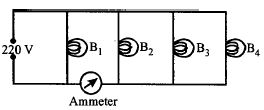
- 10Four bulbs $B_1 , B_2, B_3$ and $B_4$ of $100\, W$ each are connected to $220\, V$ main as shown in the figure. The reading in an ideal ammeter will be ............... $A$View Solution