An electric bulb is designed to draw power $P_0$ at voltage $V_0$. If the voltage is $V$ it draws a power $P$. Then
Easy
Download our app for free and get started
(b) $P \propto {V^2}$ $ \Rightarrow $ $\frac{P}{{{P_0}}} = {\left( {\frac{V}{{{V_0}}}} \right)^2} \Rightarrow P = {\left( {\frac{V}{{{V_0}}}} \right)^2}{P_0}$

Download our appand get started for free
Experience the future of education. Simply download our apps or reach out to us for more information. Let's shape the future of learning together!No signup needed.*
Similar Questions
- 1Two cells of emf $E_1$ and $E_2\left(E_1 > E_2\right)$ are connected individually to a potentiometer and their corresponding balancing length are $625 \,cm$ and $500 \,cm$, then the ratio $\frac{E_1}{E_2}$ is ...........View Solution
- 2The electric bulbs have tungsten filaments of same length. If one of them gives $60 \,watt$ and other $100\, watt$, thenView Solution
- 3A $200\,\Omega $ resistor has a certain color code. If one replaces the red color by green in the code, the new resistance will be .............. $\Omega$View Solution
- 4Equivalent resistance between $A$ and $B$ is ............ $\Omega$View Solution
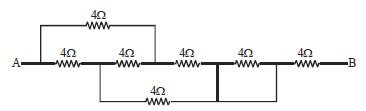
- 5In a potentiometer arrangement. $E_1$ is the cell establishing current in primary circuit. $E_2$ is the cell to be measured. $AB$ is the potentiometer wire and $G$ is a galvanometer. Which of the following are the essential condition for balance to be obtained.View Solution
- 6Resistance of tungsten wire at $150\,^oC$ is $133\,\Omega $. Its resistance temperature coefficient is $0.0045\,^oC$. The resistance of this wire at $500\,^oC$ will be .............. $\Omega$View Solution
- 7When current supplied by a cell to a circuit is $0.3 \,A$, its terminal potential difference is $0.9 \,V$. When the current supplied becomes $0.25 \,A$, its terminal potential difference becomes $1.0 \,V$. The internal resistance of the cell is ............ $\Omega$View Solution
- 8A copper wire of length $1\, m$ and radius $1\, mm$ is joined in series with an iron wire of length $2\, m$ and radius $3\, mm$ and a current is passed through the wires. The ratio of the current density in the copper and iron wires isView Solution
- 9Potential difference across the $40\,\Omega $ resistance will be ............ $V$View Solution
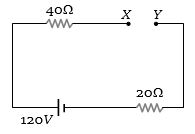
- 10If two bulbs of wattage $25$ and $30$, each rated at $220\, volts$, are connected in series with a $440$ $volt$ supply, which bulb will fuseView Solution