A heater coil connected to a supply of a $220\, V$ is dissipating some power ${P_1}.$ The coil is cut into half and the two halves are connected in parallel. The heater now dissipates a power ${P_2}.$ The ratio of power ${P_1}\,\,:\,\,{P_2}$ is
Medium


Download our appand get started for free
Experience the future of education. Simply download our apps or reach out to us for more information. Let's shape the future of learning together!No signup needed.*
Similar Questions
- 1When the current $i$ is flowing through a conductor, the drift velocity is $v$. If $2i$ current is flowed through the same metal but having double the area of cross-section, then the drift velocity will beView Solution
- 2A wire of diameter $0.02\,meter$ contains $10^{28}$ free electrons per cubic meter. For an electrical current of $100\, A$, the drift velocity of the free electrons in the wire is nearlyView Solution
- 3What equal length of an iron wire and a copper-nickel alloy wire, each of $2 \; {mm}$ diameter connected parallel to give an equivalent resistance of $3 \Omega ?$View Solution
(Given resistivities of iron and copper-nickel alloy wire are $12 \;\mu \Omega {cm}$ and $51\; \mu \Omega {cm}$ respectively) (in ${m}$)
- 4A potentiometer wire of length $100\, cm$ has a resistance of $10\, ohm.$ It is connected in series with a resistance and an accumulator of emf $2\,V$ and of negligible internal resistance. A source of emf $10\, mV$ is balanced against a length of $40\, cm$ of the potentiometer wire. What is the value of external resistance :- ................. $\Omega$View Solution
- 5In a Wheatstone's bridge, three resistances $P, Q$ and $R$ connected in the three arms and the fourth arm is formed by two resistances $S_1$ and $S_2$ connected in parallel. The condition for the bridge to be balanced will beView Solution
- 6What is the equivalent resistance between $A$ and $B$View Solution
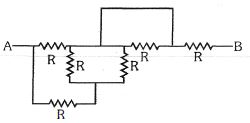
- 7$A$ wire of length $L$ and $3$ identical cells of negligible internal resistances are connected in series. Due to the current, the temperature of the wire is raised by $\Delta T$ in time $t. N$ number of similar cells is now connected in series with a wire of the same material and cross section but of length $2L$. The temperature of the wire is raised by the same amount $\Delta T$ in the same time $t$. The value of $N$ is :View Solution
- 8In the given circuit ' $a$ ' is an arbitrary constant. The value of $m$ for which the equivalent circuit resistance is minimum, will be $\sqrt{\frac{ x }{2}}$. The value of $x$ is ...........View Solution
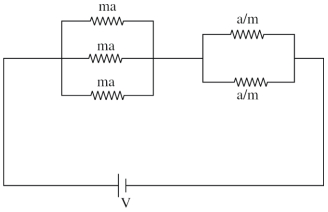
- 9In the figure, the potentiometer wire $AB$ of length $L$ and resistance $9r$ is joined to the cell $D$ of $emf$ $\varepsilon $ and internal resistance $r$. The cell $C's$ $emf$ is $\frac{\varepsilon }{2}$and its internal resistance is $2r$. The galvanometer $G$ will show no deflection when the length $AJ$ isView Solution
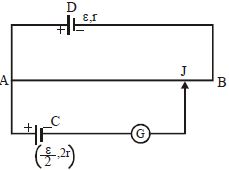
- 10View SolutionAssertion : In a simple battery circuit, the point of the lowest potential is positive terminal of the battery.
Reason : The current flows towards the point of the higher potential, as it does in such a circuit from the negative to the positive terminal.