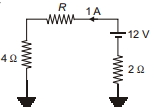
A heater is designed to operate with a power of $1000 \mathrm{~W}$ in a $100 \mathrm{~V}$ line. It is connected in combination with a resistance of $10 \Omega$ and a resistance $R$, to a $100 \mathrm{~V}$ mains as shown in figure. For the heater to operate at $62.5 \mathrm{~W}$, the value of $\mathrm{R}$ should be .................. $\Omega$.
JEE MAIN 2024, Diffcult
Download our app for free and get started
$R_{\text {heater }}=\frac{V^2}{P}=\frac{(100)^2}{1000}=10 \Omega$
For heater $P=\frac{V^2}{R} \Rightarrow V=\sqrt{P R}$
$\mathrm{V}=\sqrt{62.5 \times 10}$
$\mathrm{~V}=25 \mathrm{v}$
(Image)
$i_1=\frac{75}{10}=7.5 A, i_H=\frac{25}{10}=2.5 A$
$i_R=i_1-i_H=5$
$V=I R$
$R=\frac{25}{5}=5 \Omega$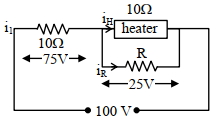

Download our appand get started for free
Experience the future of education. Simply download our apps or reach out to us for more information. Let's shape the future of learning together!No signup needed.*
Similar Questions
- 1The resistance of a wire is $R$. If the length of the wire is doubled by stretching, then the new resistance will beView Solution
- 2View SolutionThe resistance of a discharge tube is
- 3$A$ battery of $\mathrm{emf}$ $E$ and internal resistance $r$ is connected across a resistance $R$. Resistance $R$ can be adjusted to any value greater than or equal to zero. Agraph is plotted between the current $(i)$ passing through the resistance and potential difference $(V) $ across it. Select the correct alternative $(s)$.View Solution
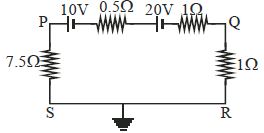
- 4View SolutionIn the circuit shown in figure, which of the statement is incorrect ?
- 5A wire has resistance $12\,\Omega $. It is bent in the form of a circle. The effective resistance between the two points on any diameter is equal to ................ $\Omega$View Solution
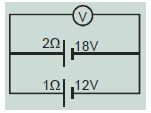
- 6Two batteries, one of $emf$ $18\, volts$ and internal resistance $2\,\Omega $ and the other of $emf$ $12\, volt$ and internal resistance $1\,\Omega $, are connected as shown. The voltmeter $V$ will record a reading of .............. $\mathrm{volt}$View Solution
- 7The resistance of a $5\, cm$ long wire is $10\, \Omega$. It is uniformly stretched so that its length becomes $20\, cm$. The resistance of the wire is ............. $\Omega$View Solution
- 8A piece of wire of resistance $4\, ohms$ is bent through $180^o$ at its mid point and the two halves are twisted together, then the resistance is ............ $ohms$View Solution
- 9$A$ wire of cross-section area $A$, length $L_1$, resistivity $\rho_1$ and temperature coefficient of resistivity $\alpha_1$ is connected to a second wire of length $L_2$, resistivity $\rho_2$ , temperature coefficient of resistivity $\alpha_1$ and the same area $A$, so that wire carries same current. Total resistance $R$ is independent of temperature for small temperature change if (Thermal expansion effect is negligible)View Solution
- 10Value of the resistance $R$ in the figure is .......... $\Omega$View Solution