MCQ
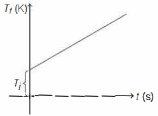
A heater supplying constant power $P$ watts is switched $ON$ at time $t=0 \,min$ to raise the temperature of a liquid kept in a calorimeter of negligible heat capacity. A student records the temperature of the liquid $T(t)$ at equal time intervals. A graph is plotted with $T(t)$ on the $Y$-axis versus $t$ on the $X$-axis. Assume that there is no heat loss to the surroundings during heating. Then,
  • A
    the graph is a straight line parallel to the time axis
  • the heat capacity of the liquid is inversely proportional to the slope of the graph
  • C
    if some heat were lost at a constant rate to the surroundings during heating, the graph would be a straight line but with a larger slope
  • D
    the internal energy of the liquid increases quadratically with time
Answer

Correct option: B.
the heat capacity of the liquid is inversely proportional to the slope of the graph
b
$(b)$ Assuming no heat loss,

Heat gained by liquid in calorimeter $=$

Heat supplied by heater

$\Rightarrow m S\left(T_{f}-T_{i}\right)=P t$

$\Rightarrow \quad T_{f}=\frac{P}{m S} t+T_{i}$

Comparing above equation with

$y=m x+c,$

Slope of line $=\frac{P}{m S}$

or $\operatorname{slope} \propto \frac{1}{S}$

So, graph of $T$ versus $t$ is as shown below.

Need a full question paper?

Generate a complete, print-ready paper with questions like this in minutes — across 16+ boards, with answer keys.

Start Generating Free

Similar questions

The length of the string of a musical instrument is $90 \;cm$ and has a fundamental frequency of $120 \;Hz$. Where (In $cm$) should it be pressed to produce fundamental frequency of $180 \;Hz ?$
The efficiency of the heat engine:
A small steel ball of radius $r$ is allowed to fall under gravity through a column of a viscous liquid of coefficient of viscosity $\eta $. After some time the velocity of the ball attains a constant value known as terminal velocity ${v_T}$. The terminal velocity depends on $(i)$ the mass of the ball $m$, $(ii)$ $\eta $, $(iii)$ $r$ and $(iv)$ acceleration due to gravity $g$. Which of the following relations is dimensionally correct
If $a, b, c$ are the percentage errors in the measurement of $A, B$ and $C$, then the percentage error in $ABC$ would be approximately
A liquid $X$ of density $3.36\  g/cm^3$ is poured in a $U-$ tube, which contains $Hg$. Another liquid $Y$ is poured in left arm with height $8\  cm$, upper levels of $X$ and $Y$ are same. What is density of $Y$ .......... $g/cc$
$STATEMENT-1$ A cloth covers a table. Some dishes are kept on it. The cloth can be pulled out without dislodging the dishes from the table. because

$STATEMENT- 2$ For every action there is an equal and opposite reaction.

When a ball is dropped into a lake from a height $4.9 \,m$ above the water level, it hits the water with a velocity $v$ and then sinks to the bottom with the constant velocity $v$. It reaches the bottom of the lake $4.0,s$ after it is dropped. The approximate depth of the lake is ............ $m$
Four identical rods are stretched by same force. Maximum extension is produced in
A tuning fork of frequency $480 Hz$ produces $10$ beats per second when sounded with a vibrating sonometer string. What must have been the frequency of the string if a slight increase in tension produces lesser beats per second than before ..... $Hz$
A cylindrical block of wood of base area $30\ cm^2$ , floats in a liquid of density $900\ kg/m^3$ . The block is depressed lightly and then released. The time period of the resulting oscillations of the block is equal to that of spring with block of same mass, then spring constant is equal to ........ $N/m$