Question
A heating element using nichrome connected to a 230 V supply draws an initial current of 3.2 A which settles after a few seconds to a steady value of 2.8 A. What is the steady temperature of the heating element if the room temperature is 27${ }^{\circ} C$ ? Temperature coefficient of resistance of nichrome averaged over the temperature range involved is $1.70 \times 10^{-4}{ }^{\circ} C ^{-1}$.
Answer

Given that :
Magnitude of supply voltage, V $=230 V$
Initial current, $I _1=3.2 A$
Room temperature $T _1=27^{\circ} C$
Constant current, $I _2=2.8 A$
Constant temperature $T _2=$ ?
Temperature coefficient of resistance
$\alpha=1.7 \times 10^{-4}{ }^{\circ} C ^{-1}$
If $R_1$ and $R_2$ are resistances of the wire at temperatures $T_1$ and $T_2$ respectively, then
Formula $\quad R _1=\frac{ V }{ I _1}=\frac{230}{3.2}=71.875 \Omega$
$R _2=\frac{ V }{ I _2}=\frac{230}{2.8}=82.143 \Omega$
Formula $\quad \alpha=\frac{ R _2- R _1}{ R _1\left(T_2- T _1\right)}$
$T _2- T _1=\frac{ R _2- R _1}{ R _1 \alpha}$
$\Rightarrow \quad T _2-27^{\circ} C =\frac{82.143-71.875}{71.875 \times 1.7 \times 10^{-4}}=\frac{10.268}{122.19 \times 10^{-4}}$
$\Rightarrow \quad T _2-27^{\circ} C =\frac{10.268}{122.19 \times 10^{-4}}=840.35$
$T _2=840.35+27=867.35^{\circ} C$

Need a full question paper?

Generate a complete, print-ready paper with questions like this in minutes — across 16+ boards, with answer keys.

Start Generating Free

Similar questions

How many time constants will elapse before the power delivered by a battery drops to half of its maximum value in an RC circuit?
A semicircular rod is joined at its end to a straight rod of the same material and the same cross-sectional area. The straight rod forms a diameter of the other rod. The junctions are maintained at different temperatures. Find the ratio of the heat transferred through a cross section of the semicircular rod to the heat transferred through a cross section of the straight rod in a given time.
When an object cools down, heat is withdrawn from it. Does the entropy of the object decrease in this process? If yes, is it a violation of the second law of thermodynamics stated in terms of increase in entropy?
A swimmer wishes to cross a 500m wide river flowing at 5km/h. His speed with respect to water is 3km/h.
  1. If he heads in a direction making an angle 0 with the flow, find the time he takes to cross the river.
  2. Find the shortest possible time to cross the river.
A transverse wave described by$\text{y}=(0.02\text{m})\sin\Big[(1.0\text{m}^{-1})\text{x}+(30\text{s}^{-1})\text{t}\Big]$
propagates on a stretched string having a linear mass density of $1.2 \times 10^{-4}kg/m$. Find the tension in the string.
Can an electromagnetic wave be deflected by an electric field or a magnetic field?
A spherical conductor of radius $12 \ cm$ has a charge of $1.6 \times 10–7C$ distributed uniformly on its surface. What is the electric field:
  1. Inside the sphere
  2. Just outside the sphere
  3. At a point $18 \ cm$ from the centre of the sphere?
For a CE-transistor amplifier, the audio signal voltage across the collector resistance of 2 k$\Omega$ is 2 V. suppose the current amplification factor if the transistor is 100, find the input signal voltage and base current if the base resistance is 1 k$\Omega$.

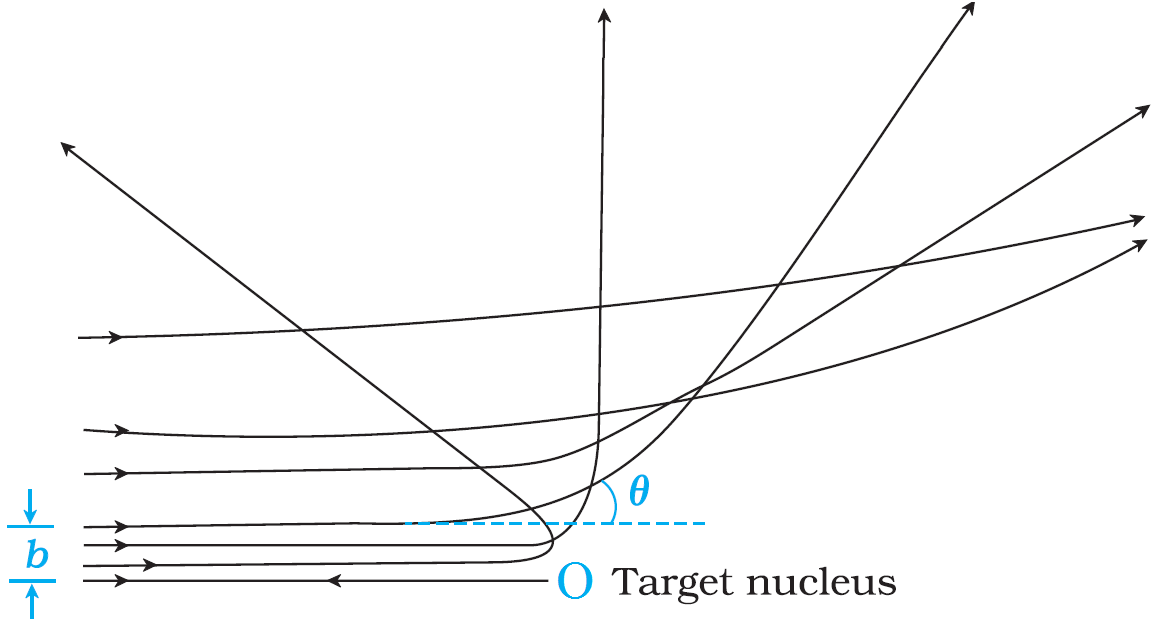
The trajectories, traced by different α-particles, in Geiger-Marsden experiment were observed as shown in the figure.
  1. What names are given to the symbols ‘b’ and $'\theta'$ shown here?
  2. What can we say about the values of b for (i) $\theta=0^{\circ}$ (ii) $\theta=\text{P}$ radians?
A convex lens produces a double size real image when an object is placed at a distance of 18cm from it. Where should the object be placed to produce a triple size real image?