Question
A transverse wave described by$\text{y}=(0.02\text{m})\sin\Big[(1.0\text{m}^{-1})\text{x}+(30\text{s}^{-1})\text{t}\Big]$
propagates on a stretched string having a linear mass density of $1.2 \times 10^{-4}kg/m$. Find the tension in the string.
Answer

$m =$ mass per unit length $=1.2\times10^{-4}\text{kg/mt}$$\text{y}=(0.02\text{m})\sin\Big[(1.0\text{m}^{-1})\text{x}+(30\text{s}^{-1})\text{t}\Big]$
Here, $\text{k}=1\text{m}^{-1}=\frac{2\pi}{\lambda}$$\omega=30\text{s}^{-1}=2\pi\text{f}$
$\therefore\ $velocity of the wave in the stretched string
$\text{v}=\lambda\text{f}=\frac{\omega}{\text{k}}=\frac{30}{\text{I}}=30\text{m/s}$
$\Rightarrow\text{v}=\sqrt{\frac{\text{T}}{\text{m}}}$
$\Rightarrow30\sqrt{\Big(\frac{\text{T}}{1.2}\Big)\times10^{-4}\text{N}}$
$\Rightarrow\text{T}=10.8\times10^{-2}\text{N}$
$\Rightarrow\text{T}=1.08\times10^{-1}\ \text{Newton}$

Need a full question paper?

Generate a complete, print-ready paper with questions like this in minutes — across 16+ boards, with answer keys.

Start Generating Free

Similar questions

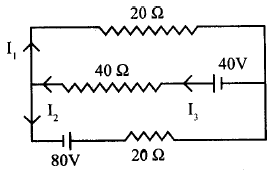
State Kirchhoff's rules of current distribution in an electrical network. Using these rules determine the value of the current I1 in the electric circuit given below.
A mobile phone is placed on the principal axis of a concave mirror. Show the formation of the image with a suitable ray diagram. Explain why the magnification is not uniform. Does the distortion of the image depend on the position of the phone relative to the mirror?
  1. Draw a graph showing variation of photocurrent with anode potential for a particular intensity of incident radiation. Mark saturation current and stopping potential.
  2. By how much would the stopping potential for a given photosensitive surface go up if the frequency of the incidentradiations were to be increased from $4\times10^{15}\text{ }\text{Hz}\text{ }\text{to}8\text{ }\times10^{15}\text{ }\text{Hz}$?
A conducting sphere of radius 10 cm has an unknown charge. If the electric field 20 cm from the centre of the sphere is $1.5 \times 10^3 N / C$ and directed radially inward, what is the net charge on the sphere?
A uniform chain of mass m and length l overhangs a table with its two third part on the table. Find the work to be done by a person to put the hanging part back on the table.
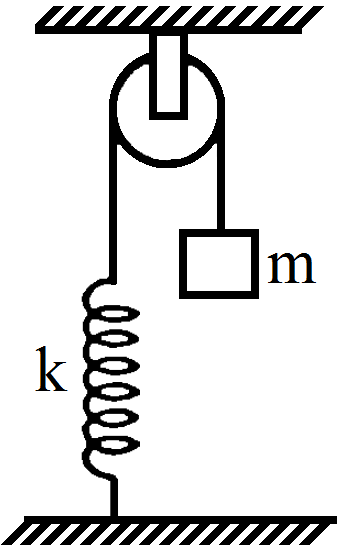
The string, the spring and the pulley shown in figure are light. Find the time period of the mass m.
A flint glass prism and a crown glass prism are to be combined in such a way that the deviation of the mean ray is zero. The refractive index of flint and crown glasses for the mean ray are 1.620 and 1.518 respectively. If the refracting angle of the flint prism is 6.0°, what would be the refracting angle of the crown prism?
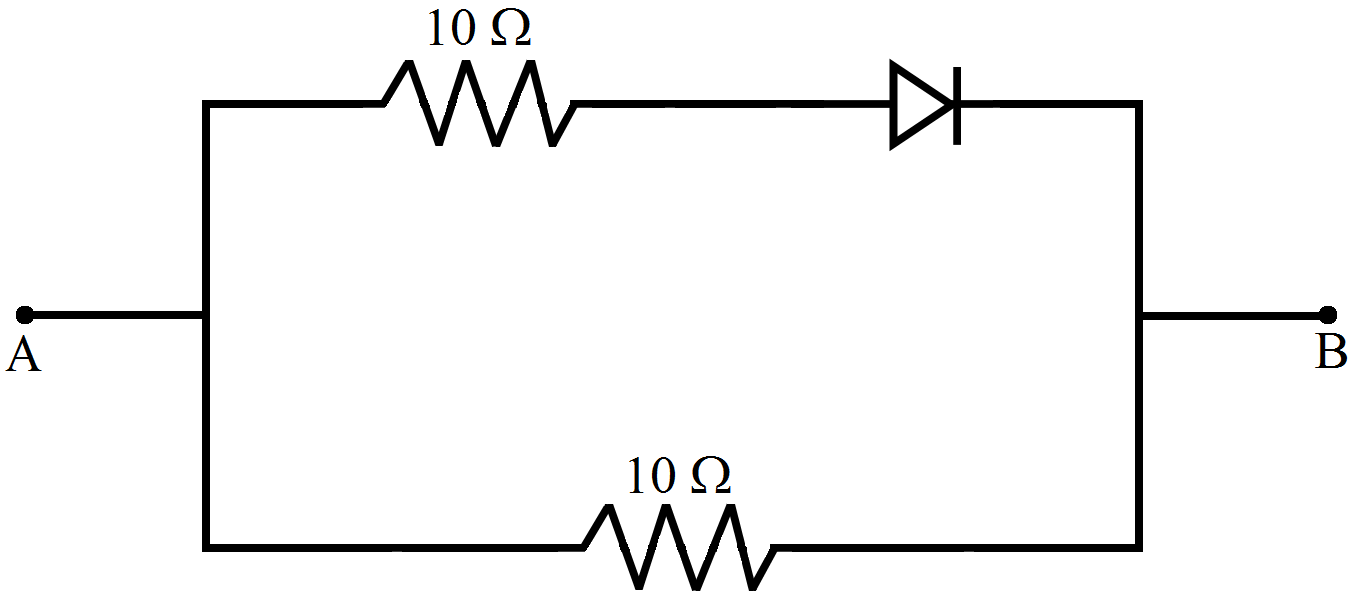
Find the equivalent resistance of the network shown in figure. between the points $A$ and $B$.
Write nuclear reaction equations for
  1. $\alpha\text{-decay of }\ ^{226}_{88}\text{Ra}$
  2. $\alpha-\text{decay of }\ ^{226}_{94}\text{Pu}$
  3. $\beta\text{-decay of }\ ^{32}_{15}\text{P}$
  4. $\beta\text{-decay of }\ ^{210}_{83}\text{Bi}$
  5. $\beta\text{-decay of }\ ^{11}_{6}\text{C}$
  6. $\beta^+\text{-decay of }\ ^{97}_{43}\text{Tc}$
  7. $\text{Electron capture of }\ ^{120}_{54}\text{Xe}$
A resistance R and a capacitor C are connected in series to a source $\text{V}=\text{V}_0\sin\omega\text{t}.$
Find:
  1. The peak value of the voltage across the (i) resistance and (ii) capacitor.
  2. The phase difference between the applied voltage and current. Which of them is ahead?