MCQ
A heavy ball of mass $M$ is suspended from the ceiling of car by a light string of mass $m (m << M)$. When the car is at rest, the speed of transverse waves in the string is $60\, ms^{-1}$. When the car has acceleration $a$ , the wave-speed increases to $60.5\, ms^{-1}$. The value of $a$ , in terms of gravitational acceleration $g$ is closest to
  • A
    $\frac{g}{{30}}$
  • B
    $\frac{g}{{10}}$
  • $\frac{g}{{5}}$
  • D
    $\frac{g}{{20}}$

Answer

Correct option: C.
$\frac{g}{{5}}$
c
$60=\sqrt{\frac{M g}{\mu}}$

$60.5=\sqrt{\frac{M\left(g^{2}+a^{2}\right)^{1 / 2}}{\mu}} \Rightarrow \frac{60.5}{60}=\sqrt{\sqrt{\frac{g^{2}+a^{2}}{g^{2}}}}$

$\left(1+\frac{0.5}{60}\right)^{4}=\frac{g^{2}+a^{2}}{g^{2}}=1+\frac{2}{60}$

$\Rightarrow g^{2}+a^{2}=g^{2}+g^{2} \times \frac{2}{60}$

$a=g \sqrt{\frac{2}{60}}=\frac{g}{\sqrt{30}}=\frac{g}{5.47}$

$\simeq \frac{g}{5}$

Need a full question paper?

Generate a complete, print-ready paper with questions like this in minutes — across 16+ boards, with answer keys.

Start Generating Free

Similar questions

Two vibrating strings of the same material but lengths $L$ and $2L$ have radii $2r$ and $r$ respectively. They are stretched under the same tension. Both the strings vibrate in their fundamental modes, the one of length $L$ with frequency $n_1$ and the other with frequency $n_2$. The ratio $n_1/n_2$ is given by
A highly viscous liquid of viscosity coefficient $\eta$ flows through a fixed horiwntal cylindrical tube (fixed from outer surface) of internal radius $r$, thickness $t (t << r)$ and length $l$. Volume of liquid flowing per;second is $Q$ and pressure difference across the tube is $P$. Modulus of rigidity of material of tube is $\beta$. Shear strain in the tube will be
Match the following columns.
Colum $I$ Colum $II$
$(A)$ $\frac{dv}{dt}$ $(p)$ Acceleration
$(B)$ $\frac{d|v|}{dt}$ $(q)$ Magnitude of acceleration
$(C)$ $\frac{dr}{dt}$ $(r)$ Velocity
$(D)$ $\left|\frac{d r }{d t}\right|$ $(s)$ Magnitude of velocity
The components of velocity of a particle are as follows:
$
v_x=(5 t) m / s, v_y=(7 t) m / s
$
The value of acceleration of the particle is :
A solid homogenous sphere of mass $M$ and radius $r$ is moving on a rough horizontal surface, partly rolling and partly sliding. During this kind of motion of this sphere
The kinetic energy force on the particle continuously increases with time.
Mark the wrong statement :-
The dimensions of the area $A$ of a black hole can be written in terms of the universal gravitational constant $G$, its mass $M$ and the speed of light $c$ as $A=G^\alpha M^\beta c^\gamma$. Here,
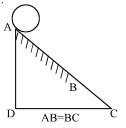
Portion $AB$ of the wedge shown in figure is rough and $BC$ is smooth. $A$ solid cylinder rolls without slipping from $A$ to $B$. The ratio of translational kinetic energy to rotational kinetic energy, when the cylinder reaches point $C$ is :
If a body is in equilibrium under a set of non-collinear forces, then the minimum number of forces has to be