A heavy body of mass $25\, kg$ is to be dragged along a horizontal plane $\left( {\mu = \frac{1}{{\sqrt 3 }}} \right).$ The least force required is ........ $kgf$
Difficult
Download our app for free and get started
Angle of friction $\theta=\tan ^{-1}(\mu)$
Or $\theta=\tan ^{-1}\left(\frac{1}{\sqrt{3}}\right)=30^{\circ}$
Suppose the body is dragged by a force $F$ acting at an angle $\alpha$ with horizontal. Then,
$\mathrm{N}=\mathrm{mg}-\mathrm{F} \sin \alpha$
and $\mathrm{F} \cos \alpha=\mu \mathrm{N}=\mu(\mathrm{mg}-\mathrm{F} \sin \alpha)$
$\therefore \quad \mathrm{F}=\frac{\mu \mathrm{mg}}{\cos \alpha+\mu \sin \alpha} \quad \cdots(i)$
$F$ is minimum when denominator is maximum or, $\frac{\mathrm{d}}{\mathrm{d} \alpha}(\cos \alpha+\mu \sin \alpha)=0$
or $\quad-\sin \alpha+\mu \cos \alpha=0$
or $\quad \tan \alpha=\mu=\frac{1}{\sqrt{3}}$
$\alpha=30^{\circ},$ the angle of friction $\theta$
At $\alpha=30^{\circ},$ force needed is minimum.
Substituting the values in Eq. $(i)$ we have,
$\mathrm{F}_{\min }=\frac{\left(\frac{1}{\sqrt{3}}\right)(25)(\mathrm{g})}{(\sqrt{3} / 2)+(1 / \sqrt{3})(1 / 2)}$
$=12.5 \mathrm{g}$
$=12.5 \mathrm{kgf}$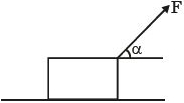

Download our appand get started for free
Experience the future of education. Simply download our apps or reach out to us for more information. Let's shape the future of learning together!No signup needed.*
Similar Questions
- 1A uniform chain of length $L$ changes partly from a table which is kept in equilibrium by friction. The maximum length that can withstand without slipping is $l$, then coefficient of friction between the table and the chain isView Solution
- 2A block of mass $m$ is on an inclined plane of angle $\theta$. The coefficient of friction between the block and the plane is $\mu$ and $\tan \theta>\mu$. The block is held stationary by applying a force $\mathrm{P}$ parallel to the plane. The direction of force pointing up the plane is taken to be positive. As $\mathrm{P}$ is varied from $\mathrm{P}_1=$ $m g(\sin \theta-\mu \cos \theta)$ to $P_2=m g(\sin \theta+\mu \cos \theta)$, the frictional force $f$ versus $P$ graph will look likeView Solution
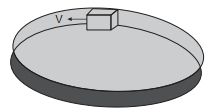
- 3A smooth circular groove has a smooth vertical wall as shown in figure. A block of mass $m$ moves against the wall with a speed $v$. Which of the following curve represents the correct relation between the normal reaction on the block by the wall $( N )$ and speed of the block $(v)$ ?View Solution
- 4View SolutionA box is placed on an inclined plane and has to be pushed down. The angle of inclination is
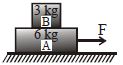
- 5Two blocks $A$ and $B$ of masses $6\, kg$ and $3\, kg$ rest on a smooth horizontal surface as shown in the figure. If coefficient of friction between $A$ and $B$ is $0.4$, the maximum horizontal force which can make them without separation is ........ $N$View Solution
- 6A block is projected upwards on an inclined plane of inclination $37^o$ along the line of greatest slope of $\mu = 0.5$ with velocity of $5 m/s$. The block $1^{st}$ stops at $a$ distance of .......... $m$ from starting pointView Solution
- 7A motor cyclist moving with a velocity of $72\, km/hour$ on a flat road takes a turn on the road at a point where the radius of curvature of the road is $20$ meters. The acceleration due to gravity is $10 m/sec^2$. In order to avoid skidding, he must not bend with respect to the vertical plane by an angle greater thanView Solution
- 8A block slides down an inclined plane of slope of angle $\theta $ with a constant velocity. It is then projected up the plane with an initial velocity $u$. The distance upto which it will rise before coming to rest isView Solution
- 9The tension $T$ in the string shown in figure is ..................... $N$View Solution
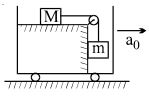
- 10Imagine the situation in which the given arrangement is placed inside a trolley that can move only in the horizontal direction, as shown in figure. If the trolley is accelerated horizontally along the positive $x$ -axis with $a_0$, then Choose the correct statement $(s)$.View Solution