Question
A heavy mass m is hanging from a string in equilibrium without breaking it. When this same mass is set into oscillation, the string breaks. Explain.

Answer

When the mass is at rest the tension on the string is lesser. But when is oscillates and is at its extreme position the string needs to support the mass and preventing it from going away thus the tension is much greater than rest motion.

Need a full question paper?

Generate a complete, print-ready paper with questions like this in minutes — across 16+ boards, with answer keys.
Start Generating Free

Similar questions

Explain the terms ‘depletion layer’ and ‘potential barrier’ in a p-n junction diode. How are the (a) Width of depletion layer, and (b) Value of potential barrier affected when the p-n junction is forward biased?
Explain the first law of reflection of light.
How does the energy stored in a capacitor change if after disconnecting the battery, the plates of a charged capacitor are moved farther?
A metre scale is graduated at every millimetre. How many significant digits will be there in a length measurement with this scale?
A small source of sound vibrating at frequency 500Hz is rotated in a circle of radius $\frac{100}{\pi}\text{cm}$ at a constant angular speed of 5.0 revolutions per second. A listener situates himself in the plane of the circle. Find the minimum and the maximum frequency of the sound observed. Speed of sound in air = 332m/s.
Define refractive index of a transparent medium.
A ray of light passes through a triangular prism. Plot a graph showing the variation of the angle of deviation with the angle of incidence.
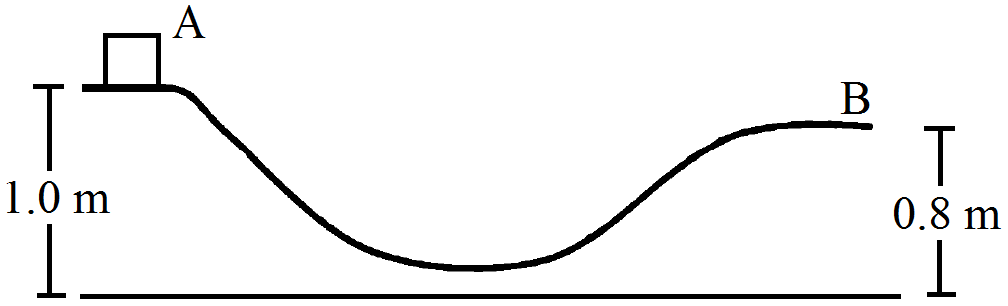
A block of mass 1kg is placed at the point A of a rough track shown in figure. If slightly pushed towards right, it stops at the point B of the track. Calculate the work done by the frictional force on the block during its transit from A to B.

The instantaneous voltage from an ac source is given by $\text{E}=300\sin314\text{t};$ what is the rms voltage of the source.
A uniformly charged conducting sphere of 2.4 m diameter has a surface charge density of 80.0 μC/m2.
  1. Find the charge on the sphere.
  2. What is the total electric flux leaving the surface of the sphere?
If the distance of the observation point from the central point of the small electric dipole is halved, then how many times will the intensity of the electric field increase?