Question
The instantaneous voltage from an ac source is given by $\text{E}=300\sin314\text{t};$ what is the rms voltage of the source.

Answer

Given equation is E $=300\sin314\text{t}$
Comparing with standard equation $\text{E = E}_0\sin\omega\text{t},$ we have
$\text{E}_0=300\text{volt}$
So, $\text{E}_{\text{rms}}=\frac{\text{E}_0}{\sqrt{2}}=\frac{300}{\sqrt{2}}=150\sqrt{2}\text{volt}$
$=150\times1.414=212\text{V}$

Need a full question paper?

Generate a complete, print-ready paper with questions like this in minutes — across 16+ boards, with answer keys.
Start Generating Free

Similar questions

Explain ray of light and beam of light.
A spherical conducting shell of inner radius r1 and outer radius r2 has a charge ‘Q’. A charge ‘q’ is placed at the centre of the shell.
  1. What is the surface charge density on the (i) inner surface, (ii) outer surface of the shell?
  2. Write the expression for the electric field at a point x > r2 from the centre of the shell.
Define magnetic susceptibility of a material. Name two elements, one having positive susceptibility and the other having negative susceptibility. What does negative susceptibility signify?
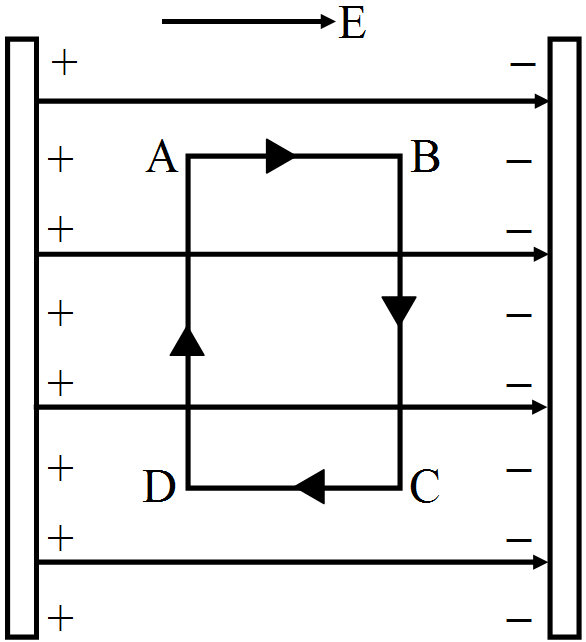
A uniform electric field exists between two charged plates as shown in the fig. What should be the work done in moving a charge q along the closed rectangular path ABCDA?

An inductor is connected to a battery through a switch. Explain why the emf induced in the inductor is much larger when the switch is opened as compared to the emf induced when the switch is closed.
Find the dimensions of Planck's constant h from the equation E = hv where E is the energy and v is the frequency.
A pivoted aluminium bar falls much more slowly through a small region containing a magnetic field than a similar bar of an insulating material. Explain.
Explain the unit of energy $e{V}$ (electron volt) and define 1 eV .
Assume that the magnetic field is uniform in a cubical region and is zero outside. Can you project a charged particle from outside into the field so that the particle describes a complete circle in the field?
Calculate the shortest wavelength in the Balmer series of hydrogen atom. In which region (infra-red, visible, ultraviolet) of hydrogen spectrum does this wavelength lie?