MCQ
A heavy object has .......  gravitational potential energy than a lighter one.
  • A
    Less
  • B
    More
  • C
    Same
  • D
    None of these

Answer

  1. More

Explanation:

Gravitational potential energy is given by

E P = mgh

where m is mass so heavy object means more mass and more mass means more potential energy.

Need a full question paper?

Generate a complete, print-ready paper with questions like this in minutes — across 16+ boards, with answer keys.
Start Generating Free

Similar questions

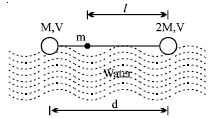
A dumbbell is placed in water of density $\rho$ . It is observed that by attaching a mass $m$ to the rod, the dumbbell floats with the rod horizontal on the surface of water and each sphere exactly half submerged as shown in the figure. The volume of the mass $m$ is negligible. The value of length $l$ is
For angles of projection of a projectile at angle $(45^o  +\theta)$ and $(45^o  -\theta ) $ , the horizontal range described by the projectile are in the ratio of 
The net external torque on a system of particles about an axis is zero. Which of the following are compatible with it?
On a long horizontal belt, a child runs to and fro with a speed of $9\,km/h$ (with respect to the belt) between his father and mother located $50\,m$ apart on the moving belt. The belt moves with a speed of $4\,km/h.$ For an observer on the platform the speed of the child in the direction of motion of the belt is.........$km/h$
A sphere is rotating about a diameter:
  1. The particles on the surface of the sphere do not have any linear acceleration.
  2. The particles on the diameter mentioned above do not have any linear acceleration.
  3. Different particles on the surface have different angular speeds.
  4. All the particles on the surface have same linear speed.
If a positive charge is shifted from a low-potential region to a high-potential region, the electric potential energy.
  1. Increases.
  2. Decreases.
  3. Remains the same.
  4. May increase or decrease.
If the work done in blowing a bubble of volume $V$ is $W$, then the work done in blowing the bubble of volume $2V$ from the same soap solution will be
For a moving body at any instant of time
A man throws balls with the same speed vertically upwards one after the other at an interval of $2\, seconds$. What should be the speed of the throw so that more than two balls are in the sky at any time (Given $g = 9.8\,m/{s^2}$)