MCQ
A man throws balls with the same speed vertically upwards one after the other at an interval of $2\, seconds$. What should be the speed of the throw so that more than two balls are in the sky at any time (Given $g = 9.8\,m/{s^2}$)
  • A
    At least $0.8 \,m/s$
  • B
    Any speed less than $19.6 \,m/s$
  • C
    Only with speed $19.6\, m/s$
  • More than $19.6 \,m/s$

Answer

Correct option: D.
More than $19.6 \,m/s$
d
(d) Interval of ball throw $= 2 \,sec$.

If we want that minimum three (more than two) ball remain in air then time of flight of first ball must be greater than $4\, sec$.

$T > 4\,sec$

$\frac{{2u}}{g} > 4\;sec \Rightarrow u > 19.6\;m/s$

for $u =19.6$. First ball will just strike the ground(in sky)

Second ball will be at highest point (in sky)

Third ball will be at point of projection or at ground (not in sky)

Need a full question paper?

Generate a complete, print-ready paper with questions like this in minutes — across 16+ boards, with answer keys.

Start Generating Free

Similar questions

Molar specific heats for oxygen gas will be as per:
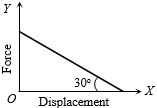
The value of force constant between the applied elastic force $F$ and displacement will be
A shell of mass $0.020\; kg$ is fired by a gun of mass $100\; kg$. If the muzzle speed of the shell is $80 \;m s^{-1}$, what is the recoil speed in $m/s$ of the gun ?
Answer the following by appropriately matching the lists based on the information given in the paragraph.

A musical instrument is made using four different metal strings, $1,2,3$ and $4$ with mass per unit length $\mu, 2 \mu, 3 \mu$ and $4 \mu$ respectively. The instrument is played by vibrating the strings by varying the free length in between the range $L _0$ and $2 L _0$. It is found that in string-$1$ $(\mu)$ at free length $L _0$ and tension $T _0$ the fundamental mode frequency is $f _0$.

$List-I$ gives the above four strings while $list-II$ lists the magnitude of some quantity.

$List-I$ $List-II$
$(I)$ String-1( $\mu$ ) $(P) 1$
$(II)$ String-2 $(2 \mu)$ $(Q)$ $1 / 2$
$(III)$ String-3 $(3 \mu)$ $(R)$ $1 / \sqrt{2}$
$(IV)$ String-4 $(4 \mu)$ $(S)$ $1 / \sqrt{3}$
  $(T)$ $3 / 16$
  $(U)$ $1 / 16$

($1$) If the tension in each string is $T _0$, the correct match for the highest fundamental frequency in $f _0$ units will be,

$(1)$ $I \rightarrow P , II \rightarrow R , III \rightarrow S , IV \rightarrow Q$

$(2)$ $I \rightarrow P , II \rightarrow Q , III \rightarrow T , IV \rightarrow S$

$(3)$ $I \rightarrow Q , II \rightarrow S , III \rightarrow R , IV \rightarrow P$

$(4)$ I $\rightarrow Q , II \rightarrow P , III \rightarrow R$, IV $\rightarrow T$

($2$) The length of the string $1,2,3$ and 4 are kept fixed at $L _0, \frac{3 L _0}{2}, \frac{5 L _0}{4}$ and $\frac{7 L _0}{4}$, respectively. Strings $1,2,3$ and 4 are vibrated at their $1^{\text {tt }}, 3^{\text {rd }}, 5^{\text {m }}$ and $14^{\star}$ harmonics, respectively such that all the strings have same frequency. The correct match for the tension in the four strings in the units of $T _0$ will be.

$(1)$ $I \rightarrow P , II \rightarrow Q , III \rightarrow T , IV \rightarrow U$

$(2)$ $I \rightarrow T , II \rightarrow Q , III \rightarrow R$, IV $\rightarrow U$

$(3)$ $I \rightarrow P , II \rightarrow Q , III \rightarrow R , IV \rightarrow T$

$(4)$ I $\rightarrow P , II \rightarrow R , III \rightarrow T , IV \rightarrow U$
The gap between any two rails, each of length $l$ laid on a railway track equal $x$ at $27\,^oC$ . When the temperature rises to $40\,^oC$ , the gap close up. The coefficient of linear expansion of the material of the rail is $\alpha $ . The length $l$ of a rail at $27\,^oC$ will be
The displacement of a particle is given by $y = a + bt + c{t^2} - d{t^4}$. The initial velocity and acceleration are respectively
Which one of the following substances possesses the highest elasticity
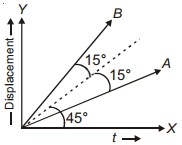
The displacement-time graph for two particles $A$ and $B$ is as follows. The ratio $\frac{v_A}{v_B}$ is
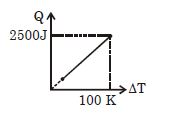
One mole of a gas mixture is heated under constant pressure, and heat supplied $Q$ is plotted against temperature difference acquired. Find the approximate value of $\gamma $ for mixture
In which of the following cases the centre of mass of a rod is certainly not at its centre?