MCQ
A heavy solid sphere is thrown on a horizontal rough surface with initial velocity $u$ without rolling. What will be its speed, when it starts pure rolling motion?
  • A
    $\frac{3 u}{5}$
  • B
    $\frac{2 u}{5}$
  • $\frac{5 u}{7}$
  • D
    $\frac{2 u}{7}$

Answer

Correct option: C.
$\frac{5 u}{7}$
c
(c)

Using angular momentum conservation

$m u r=m v r+\frac{2}{5} m r^2\left(\frac{v}{r}\right)$

$u=7 \frac{v}{5}$

$v=\frac{5 u}{7}$

Need a full question paper?

Generate a complete, print-ready paper with questions like this in minutes — across 16+ boards, with answer keys.

Start Generating Free

Similar questions

A fission reaction is given by ${ }_{92}^{236} U \rightarrow{ }_{54}^{140} Xe +{ }_{38}^{94} Sr + x + y$, where $x$ and $y$ are two particles. Considering ${ }_{92}^{236} U$ to be at rest, the kinetic energies of the products are denoted by $K _{ Xe }, K _{ Sr }, K _{ R }(2 MeV )$ and $K _7(2 MeV )$, respectively. Let the binding energies per nucleon of ${ }_{92}^{236} U ,{ }_{54}^{140} Xe$ and ${ }_{38}^{94} Sr$ be $7.5 \ MeV , 8.5 \ MeV$ and $8.5 \ MeV$ respectively. Considering different conservation laws, the correct option$(s)$ is(are)
The distance between two consecutive points with phase difference of $60^{\circ}$ in a wave of frequency $500\,Hz$ is $6.0\,m$. The velocity with which wave is traveling is $.........km / s$
(image) $\xrightarrow[Cold\,dil.]{KMn{{O}_{4}}/\overset{\Theta }{\mathop{O}}\,H}X\xrightarrow{HI{{O}_{4}}}Y\xrightarrow{\overset{\Theta }{\mathop{O}}\,H/\Delta }Z;\,Z$ is
The equation of $S.H.M.$ is $y = a\sin (2\pi nt + \alpha )$, then its phase at time $t$ is
A vibration magnetometer is placed at the south pole; then its the time period will be
Let $\omega$ be the angular velocity of the earth’s rotation about its axis. Assume that the acceleration due to gravity on the earth’s surface has the same value at the equator and the poles. An object weighed at the equator gives the same reading as a reading taken at a depth d below earth’s surface at a pole $(d < < R)$ The value of $d$ is
Two identical beakers $A$ and $B$ contain equal volumes of two different liquids at $60\,^oC$ each and left to cool down. Liquid in $A$ has density of $8 \times10^2\, kg / m^3$ and specific heat of $2000\, Jkg^{-1}\,K^{-1}$ while liquid in $B$ has density of $10^3\,kgm^{-3}$ and specific heat of $4000\,JKg^{-1}\,K^{-1}$ . Which of the following best describes their temperature versus time graph schematically? (assume the emissivity of both the beakers to be the same)
A nucleus of mass $M + \Delta m$ is at rest and decays into two  daughter nuclei of equal mass $\frac{M}{2}$ each. Speed of light is $c.$ The binding energy per nucleon for the parent nucleus is $E_1$ and that for the daughter nuclei is $E_2$ . Then
Due to addition of impurities, the modulus of elasticity
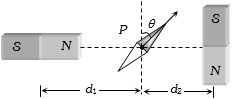
Two magnets $A$ and $B $ are identical and these are arranged as shown in the figure. Their length is negligible in comparison to the separation between them. A magnetic needle is placed between the magnets at point $P$ which gets deflected through an angle $\theta $ under the influence of magnets. The ratio of distance ${d_1}$ and ${d_2}$ will be