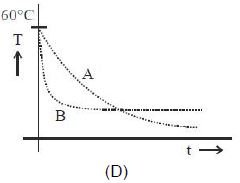
Two identical beakers $A$ and $B$ contain equal volumes of two different liquids at $60\,^oC$ each and left to cool down. Liquid in $A$ has density of $8 \times10^2\, kg / m^3$ and specific heat of $2000\, Jkg^{-1}\,K^{-1}$ while liquid in $B$ has density of $10^3\,kgm^{-3}$ and specific heat of $4000\,JKg^{-1}\,K^{-1}$ . Which of the following best describes their temperature versus time graph schematically? (assume the emissivity of both the beakers to be the same)
- A
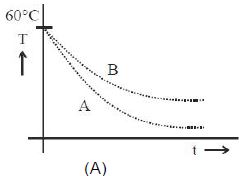
- B
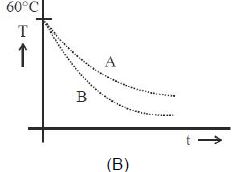
- C
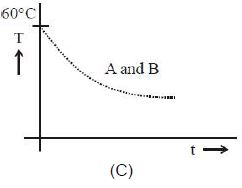
- D
JEE MAIN 2019, Diffcult


Download our appand get started for free
Experience the future of education. Simply download our apps or reach out to us for more information. Let's shape the future of learning together!No signup needed.*
Similar Questions
- 1If the temperature of a hot body is increased by $50\%$ then the increase in the quantity of emitted heat radiation will be ..... $\%$View Solution
- 2The ratio of radiant energies radiated per unit surface area by two bodies is $16 : 1$ , the temperature of hotter body is $1000K$ , then the temperature of colder body will be ....... $K$View Solution
- 3The temperature of a body falls from ${50^o}C$to ${40^o}C$ in $10$ minutes. If the temperature of the surroundings is ${20^o}C$ Then temperature of the body after another $10$ minutes will be ........ $^oC$View Solution
- 4The ratio of energy of emitted radiation of a black body at ${27^o}C$ and ${927^o}C$ isView Solution
- 5View SolutionWhich of the following factors affect the thermal conductivity of a rod?
- 6Temperature of water at the surface of lake is $ - {20^o}C$ Then temperature of water just below the lower surface of ice layer is ...... $^oC$View Solution
- 7$Assertion :$ A tube light emits white light.View Solution
$Reason :$ Emission of light in a tube takes place at a very high temperature. - 8View SolutionInfrared radiation is detected by
- 9A body cools from ${50.0^o}C$ to ${49.9^o}C$ in $5\;s$. How long will it take to cool from ${40.0^o}C$ to ${39.9^o}C$? Assume the temperature of surroundings to be ${30.0^o}C$ and Newton's law of cooling to be valid ....... $\sec$View Solution
- 10A rod $C D$ of thermal resistance $10.0\; {KW}^{-1}$ is joined at the middle of an identical rod ${AB}$ as shown in figure, The end $A, B$ and $D$ are maintained at $200^{\circ} {C}, 100^{\circ} {C}$ and $125^{\circ} {C}$ respectively. The heat current in ${CD}$ is ${P}$ watt. The value of ${P}$ is ... .View Solution