MCQ
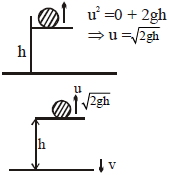
A helicopter reises from rest on the ground vertically upwards with a constant acceleration $g.$ A food packet is dropped from the helicopter when it is a height $h$. The time taken by the packet to reach the ground is close to $[ g$ is the acceleration due to gravity]
  • A
    $t =\sqrt{\frac{2 h }{3 g }}$
  • B
    $t=1.8 \sqrt{\frac{h}{g}}$
  • $t=3.4 \sqrt{\left(\frac{h}{g}\right)}$
  • D
    $t=\frac{2}{3} \sqrt{\left(\frac{h}{g}\right)}$
Answer

Correct option: C.
$t=3.4 \sqrt{\left(\frac{h}{g}\right)}$
c
$t_{0}=\sqrt{\frac{2 h}{g}}$

$\Rightarrow \quad u=\sqrt{\frac{2 h}{g}} \times g=\sqrt{2 g h}$

$\therefore \quad t_{1}=$time to reach top $=\frac{u}{g}=\sqrt{\frac{2 h}{g}}$

$\therefore \quad H=h+h^{\prime}=2 h$

$t_{2}=$ time of fall $=\sqrt{\frac{2 \times(2 h)}{g}}$

$\quad=2 \sqrt{\frac{h}{g}}$

Total time $=t_{1}+t_{2}$

$\quad=(2+\sqrt{2}) \sqrt{\frac{h}{g}}$

$\quad=3.4 \sqrt{\frac{h}{g}}$

Need a full question paper?

Generate a complete, print-ready paper with questions like this in minutes — across 16+ boards, with answer keys.

Start Generating Free

Similar questions

A shell of mass $m$ moving with velocity $v$ suddenly breaks into $2$ pieces. The part having mass $m/3$ remains stationary. The velocity of other part will be
$Assertion :$ Adiabatic expansion is always accompanied by fall in temperature.
$Reason :$ In adiabatic process, volume is inversely proportional to temperature.
If momentum of a body is increased by $20 \%$, then its kinetic energy increases by$....\%$
The mean kinetic energy of a gas at $300 K$ is $100 J.$ The mean energy of the gas at $450 K$ is equal to ...... $J$
What should be the velocity of earth due to rotation about its own axis so that the weight at equator become $3/5$ of initial value. Radius of earth on equator is $ 6400\, km$
In a process, temperature and volume of one mole of an ideal monoatomic gas are varied according to the relation $VT = K$, where $I$ is a constant. In this process the temperature of the gas is increased by $\Delta T$. The amount of heat absorbed by gas is ($R$ is gas constant)
The amplitude of an oscillating simple pendulum is $10\,cm$ and its period is $4\, sec$. Its speed after $1\, sec$ after it passes its equilibrium position, is ... $m/s$
A ball is thrown from ground at an angle $\theta$ with horizontal and with an initial speed $u_0$. For the resulting projectile motion, the magnitude of average velocity of the ball up to the point when it hits the ground for the first time is $V _1$. After hitting the ground, ball rebounds at the same angle $\theta$ but with a reduced speed of $u_0 / \alpha$. Its motion continues for a long time as shown in figure. If the magnitude of average velocity of the ball for entire duration of motion is $0.8 V _1$, the value of $\alpha$ is. . . . . .
A planet takes $200$ days to complete one revolution around the Sun. If the distance of the planet from Sun is reduced to one fourth of the original distance, how many days will it take to complete one revolution
A pendulum of length $2\,m$ lift at $P$. When it reaches $Q$, it losses $10\%$ of its total energy due to air resistance. The velocity at $Q$ is .... $m/sec$