MCQ
A highly rigid cubical block $A$ of small mass $M$ and side $L$ is fixed rigidly onto another cubical block $B$ of the same dimensions and of low modulus of rigidity $\eta $ such that the lower face of $A$ completely covers the upper face of $B$. The lower face of $B$is rigidly held on a horizontal surface. A small force $F$ is applied perpendicular to one of the side faces of $A$. After the force is withdrawn block $A$ executes small oscillations. The time period of which is given by
  • A
    $2\pi \sqrt {\frac{{M\eta }}{L}} $
  • B
    $2\pi \sqrt {\frac{L}{{M\eta }}} $
  • C
    $2\pi \sqrt {\frac{{ML}}{\eta }} $
  • $2\pi \sqrt {\frac{M}{{\eta L}}} $

Answer

Correct option: D.
$2\pi \sqrt {\frac{M}{{\eta L}}} $
d
(d) By substituting the dimensions of mass $[M]$, length $[L] $ and coefficient of rigidity $\left[ {M{L^{ - 1}}{T^{ - 2}}} \right]$ we get $T = 2\pi \sqrt {\frac{M}{{\eta L}}} $ is the right formula for time period of oscillations

$(a, b, c)$ Reynolds number and coefficient of friction are dimensionless.

Latent heat and gravitational potential both have dimension $[{L^2}{T^{ - 2}}]$.

Curie and frequency of a light wave both have dimension $[{T^{ - 1}}]$.

But dimensions of Planck's constant is $[M{L^2}{T^{ - 1}}]$ and torque is $\left[ {M{L^2}{T^{ - 2}}} \right]$

Need a full question paper?

Generate a complete, print-ready paper with questions like this in minutes — across 16+ boards, with answer keys.

Start Generating Free

Similar questions

The law of equipartition of energy is applicable to the system whose constituents are:
In an experiment to verify Stokes law, a small spherical ball of radius $r$ and density $\rho$ falls under gravity through a distance $h$ in air before entering a tank of water. If the terminal velocity of the ball inside water is same as its velocity just before entering the water surface, then the value of $h$ is proportional to :

(ignore viscosity of air)

Satellites orbiting the earth have finite life and sometimes debris of satellites fall to the earth. This is because,
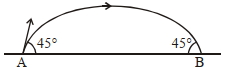
The projectile motion of a particle of mass $5\, g$ is shown in the figure.

The initial velocity of the particle is $5 \sqrt{2}\, ms ^{-1}$ and the air resistance is assumed to be negligible. The magnitude of the change in momentum between the points $A$ and $B$ is $x \times 10^{-2}\, kgms ^{-1} .$ The value of $x ,$ to the nearest integer, is ...... .

Three closed vessels $A, B$ and $C$ are at the same temperature $T$ and contain gases which obey the Maxwellian distribution of velocities. Vessel $A$ contains only ${O_2},\,B$ only ${N_2}$ and $C$ a mixture of equal quantities of ${O_2}$ and ${N_2}$. If the average speed of the ${O_2}$ molecules in vessel A is ${V_1}$, that of the ${N_2}$ molecules in vessel B is ${V_2}$, the average speed of the ${O_2}$ molecules in vessel $C$ is
A straight rod of length $L$ extends from $x = a$ to $x = L + a$. The gravitational force it exerts on a point mass $‘m’$ at $x = 0$, if the mass per unit length of the rod is $A + Bx^2$, is given by
The displacement of a particle, moving in a straight line, is given by $s = 2{t^2} + 2t + 4$ where $s$ is in metres and $t$ in seconds. The acceleration of the particle is........$ms^{-2}$
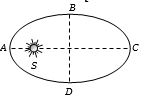
A planet is revolving around the sun as shown in elliptical path  the orbital velocity of the planet will be minimum at
An object is projected with a velocity of $20 m/s$ making an angle of $45^o$ with horizontal. The equation for the trajectory is $h = Ax -Bx^2$ where $h$ is height, $x$ is horizontal distance, $A$ and $B$ are constants. The ratio $A : B$ is ($g = 10 ms^{-2}$)
The displacement of a particle varies according to the relation $x = 3 \sin 100 \, t + 8 \cos ^2 50\,t $. Which of the following is/are correct about this motion .