MCQ 11 Mark
A force defined by $F=\alpha t^2+\beta t$ acts on a particle at a given time $t$. The factor which is dimensionless, if $\alpha$ and $\beta$ are constants, is:
- ✓
$\alpha t / \beta$
- B
$\alpha \beta t$
- C
$\alpha \beta / t$
- D
$\beta t / \alpha$
AnswerCorrect option: A. $\alpha t / \beta$
a
From principle of homogeneity
${[F]=\left[\alpha t^2\right]=[\beta t]}$
${[\alpha]=\frac{[F]}{\left[t^2\right]} \text { and }[\beta]=\frac{[F]}{[t]}}$
$\therefore \quad[\alpha][t]=[\beta]$
$\therefore \quad \frac{\alpha t}{\beta}=\text { dimensionless }$
View full question & answer→MCQ 21 Mark
The quantities which have the same dimensions as those of solid angle are:
Answerd
Solid angle $d \Omega=\frac{d A}{r^2}$ has dimensions $\left[\mathrm{M}^0\left\llcorner^0 \mathrm{~T}^0\right]\right.$
Strain $=\frac{\Delta l}{l}$ has dimensions $\left[\mathrm{M}^0 \mathrm{~L}^0 \mathrm{~T}^0\right]$
Angle measured in radians is also dimensionless $\left[\mathrm{M}^0 \mathrm{~L}^0 \mathrm{~T}^0\right]$
$\theta=\frac{l}{r}$
View full question & answer→MCQ 31 Mark
In a vernier callipers, $(N+1)$ divisions of vernier scale coincide with $N$ divisions of main scale. If $1 \mathrm{MSD}$ represents $0.1 \mathrm{~mm}$, the vernier constant (in $\mathrm{cm}$ ) is:
AnswerCorrect option: A. $\frac{1}{100(N+1)}$
a
$V \cdot C=M S D-V S D$
$\text { given }:(N+1) V S D=N M S D$ $........(1)$
$\text { VSD }=\left(\frac{N}{N+1}\right) M S D$
given : $(N+1) \mathrm{VSD}=N \mathrm{MSD}$ $........(2)$
From ($1$) and ($2$)
$V \cdot C=(M S D)-\frac{N}{N+1}(M S D)$
$=M S D\left(1-\frac{N}{N+1}\right)=\frac{M S D}{N+1}$
$=\frac{0.01}{N+1}=\frac{1}{100(N+1)}$
View full question & answer→MCQ 41 Mark
A metal wire has mass $(0.4 \pm 0.002)\,g$, radius $(0.3 \pm 0.001)\,mm$ and length $(5 \pm 0.02) \,cm$. The maximum possible percentage error in the measurement of density will nearly be $.......\%$
Answerd
$\rho=\frac{ M }{ V }$
$\rho =\frac{ M }{\pi r ^2 \ell}$
$\frac{\Delta \rho}{\rho} =\frac{\Delta M }{ M }+\frac{2 \Delta r }{ r }+\frac{\Delta l}{l}$
$\frac{\Delta \rho}{\rho} \%$ $=\left[\frac{0.002}{0.4}+\frac{2(0.001)}{(0.3)}+\frac{0.02}{5}\right] \times 100 \%$
$=\frac{1}{2} \%+\frac{2}{3} \%+\frac{2}{5} \%$
$=1.6 \%$
View full question & answer→MCQ 51 Mark
The errors in the measurement which arise due to unpredictable fluctuations in temperature and voltage supply are :
Answera
Error arise due to unpredictable fluctuation in temperature and voltage supply are $\rightarrow$ random errors.
View full question & answer→MCQ 61 Mark
The dimensions $\left[ MLT ^{-2} A ^{-2}\right]$ belong to the :
Answerb
$\left[ MLT ^{-2} A ^{-2}\right]=$ Magnetic permeability
View full question & answer→MCQ 71 Mark
Plane angle and solid angle have :
- A
- B
No units and no dimensions
- C
Both units and dimensions
- ✓
Answerd
Plane angle and solid angle are dimensionless but have units.
View full question & answer→MCQ 81 Mark
The physical quantity that has the same dimensional formula as pressure is :
- A
- B
- ✓
Young's modulus of elasticity
- D
AnswerCorrect option: C. Young's modulus of elasticity
c
$Y =\frac{\text { stress }}{\text { strain }} \text { (Strain is dimensionless) }$
$\therefore[ Y ]=[\text { stress }]=[\text { Pressure }]$
View full question & answer→MCQ 91 Mark
The area of a rectangular field (in $m ^{2}$) of length $55.3\,m$ and breadth $25 \;m$ after rounding off the value for correct significant digits is
- A
$1382$
- B
$1382.5$
- ✓
$14 \times 10^{2}$
- D
$138 \times 10^{1}$
AnswerCorrect option: C. $14 \times 10^{2}$
c
$Area=$ Length $\times$ Breadth
$\,\,\,\,\,\,\,\,\,\,\,\,\,=55.3 \times 25$
$\,\,\,\,\,\,\,\,\,\,\,\,\,=1382.5$
$\,\,\,\,\,\,\,\,\,\,\,\,\,=14 \times 10^{2}$
View full question & answer→MCQ 101 Mark
If $\mathrm{E}$ and $\mathrm{G}$ respectively denote energy and gravitational constant, then $\frac{\mathrm{E}}{\mathrm{G}}$ has the dimensions of :
- A
$[\mathrm{M}]\left[\mathrm{L}^{-1}\right]\left[\mathrm{T}^{-1}\right]$
- ✓
$\left[\mathrm{M}^{2}\right]\left[\mathrm{L}^{-1}\right]\left[\mathrm{T}^{0}\right]$
- C
$[\mathrm{M}]\left[\mathrm{L}^{0}\right]\left[\mathrm{T}^{0}\right]$
- D
$\left[\mathrm{M}^{2}\right]\left[\mathrm{L}^{-2}\right]\left[\mathrm{T}^{-1}\right]$
AnswerCorrect option: B. $\left[\mathrm{M}^{2}\right]\left[\mathrm{L}^{-1}\right]\left[\mathrm{T}^{0}\right]$
b
$E=$ energy $=\left[M L^{2} T^{-2}\right]$
$G=$ Gravitational constant $=\left[\mathrm{M}^{-1} L^{3} \mathrm{~T}^{-2}\right]$
So, $\frac{E}{G}=\frac{[E]}{[G]}=\frac{M L^{2} T^{-2}}{M^{-1} L^{3} T^{-2}}=\left[M^{2} L^{-1} T^{0}\right]$
View full question & answer→MCQ 111 Mark
If force $[F],$ acceleration $[A]$ and time $[T]$ are chosen as the fundamental physical quantities. Find the dimensions of energy.
- A
$[\mathrm{F}][\mathrm{A}][\mathrm{T}]$
- ✓
$[\mathrm{F}][\mathrm{A}]\left[\mathrm{T}^{2}\right]$
- C
$[F][\mathrm{A}]\left[\mathrm{T}^{-1}\right]$
- D
$[\mathrm{F}]\left[\mathrm{A}^{-1}\right][\mathrm{T}]$
AnswerCorrect option: B. $[\mathrm{F}][\mathrm{A}]\left[\mathrm{T}^{2}\right]$
b
$\mathrm{E} \propto \mathrm{F}^{\mathrm{a}} \mathrm{A}^{\mathrm{b}} \mathrm{T}^{\mathrm{c}}$
$\left[\mathrm{M}^{1} \mathrm{~L}^{2} \mathrm{~T}^{2}\right] \propto\left[\mathrm{M}^{1} \mathrm{~L}^{1} \mathrm{~T}^{-2}\right]^{\mathrm{a}}\left[\mathrm{LT}^{-2}\right]^{\mathrm{b}}[\mathrm{T}]^{\mathrm{c}}$
$\mathrm{a}=1$
$\mathrm{a}+\mathrm{b}=2 \Rightarrow \mathrm{b}=1$
$-2 \mathrm{a}-2 \mathrm{~b}+\mathrm{c}=-2$
$\Rightarrow \mathrm{c}=2$
$\mathrm{a}=1 \mathrm{~b}=1 \mathrm{c}=2$
$\mathrm{E} \propto[\mathrm{F}][\mathrm{A}]\left[\mathrm{T}^{2}\right]$
View full question & answer→MCQ 121 Mark
A screw gauge gives the following readings when used to measure the diameter of a wire
Main scale reading : $0 \,\mathrm{~mm}$
Circular scale reading $: 52$ $divisions$
Given that $1\, \mathrm{~mm}$ on main scale corresponds to $100\, divisions$ on the circular scale. The diameter of the wire from the above data is ...... $cm$
- A
$0.52$
- B
$0.026$
- C
$0.26$
- ✓
$0.052$
AnswerCorrect option: D. $0.052$
d
$L. C.$ $=\frac{\text { Pitch }}{C . S D}$
$=\frac{1 m m}{100}=0.01 \,\mathrm{~m}=0.001\, \mathrm{~cm}$
Radius $=\mathrm{M.S} .+\mathrm{n}(\mathrm{L}-\mathrm{I})$
$=0+52(0.001)$
$=0.052 \,\mathrm{~cm}$
View full question & answer→MCQ 131 Mark
Time intervals measured by a clock give the following readings :
$1.25 \;s , 1.24\; s , 1.27\; s , 1.21 \;s$ and $1.28\; s$
What is the percentage relative error of the observations?
Answera
The arithmetic mean of given values is taken as true value.
$t _{\text {mean }}=\frac{t_{1}+ t _{2}+ t _{3}+ t _{4}+ t _{5}}{5}$
$t_{\text {mean }}=\frac{1.25+1.24+1.27+1.21+1.28}{5}$
$t_{\text {mean }}=1.25 s$
$\Delta t_{\text {mean }}=\frac{\left|\Delta t_{1}\right|+\left|\Delta t_{2}\right|+\left|\Delta t_{3}\right|+\left|\Delta t_{4}\right|+\left|\Delta t_{5}\right|}{5}$
$\Delta t_{\text {mean }}=\frac{0+0.01+0.02+0.04+0.03}{5}=0.02 s$
Percentage error $=\frac{\Delta t_{\operatorname{mean}}}{t_{\text {mean }}} \times 100=\frac{0.02}{1.25} \times 100$
$=1.6 \%$
View full question & answer→MCQ 141 Mark
- ✓
$\left[ M L ^{-1} T ^{-2}\right]$
- B
$\left[ M L T ^{-2}\right]$
- C
$\left[ M L ^{2} T ^{-2}\right]$
- D
$\left[ M L ^{0} T ^{-2}\right]$
AnswerCorrect option: A. $\left[ M L ^{-1} T ^{-2}\right]$
a
stress $=\frac{\text { Force }}{\text { Area }}$
$=\frac{M^{1} L^{1} T^{-2}}{L^{2}}$
stress $= M ^{1} L ^{-1} T ^{-2}$
View full question & answer→MCQ 151 Mark
The angle of $1^{\prime}$ (minute of arc) in radian is nearly equal to
- A
$1.75 \times 10^{-2} \;rad$
- ✓
$2.91 \times 10^{-4} \;rad$
- C
$4.85 \times 10^{-4} \;rad$
- D
$4.80 \times 10^{-6} \;rad$
AnswerCorrect option: B. $2.91 \times 10^{-4} \;rad$
b
$\theta=1^{\prime}=\left(\frac{1}{60}\right)^{\circ}=\left(\frac{1}{60}\right) \frac{\pi}{180}$ radian
$=2.91 \times 10^{-4}$ radian
View full question & answer→MCQ 161 Mark
Taking into account of the slgnificant figures, what is the value of $9.99\, m -0.0099\, m ?$
- A
$9.9$
- B
$9.9801$
- ✓
$9.98$
- D
$9.980$
AnswerCorrect option: C. $9.98$
c
In subtraction the number of decimal places in the result should be equal to the number of decimal places of that term in the operation which contain lesser number of decimal places.
$9.99$
$-0.0099$
___________
$9.98 \quad \rightarrow 3$ siginificant flgures
View full question & answer→MCQ 171 Mark
A screw gauge has least count of $0.01\, mm$ and there are $50$ divisions in its circular scale. The pitch of the screw gauge is $........mm$
- A
$1.0$
- B
$0.01$
- C
$0.25$
- ✓
$0.5$
Answerd
$L.C.$ $=\frac{\text { Pitch }}{\text { Number of division on circular scale }}$
$\Rightarrow 0.01 mm =\frac{\text { Pitch }}{50}$
$\Rightarrow$ Pitch $=0.5 mm$
View full question & answer→MCQ 181 Mark
In an experiment, the percentage of error occurred in the measurment of physical quantities $A, B, C$ and $D$ are $1 \%, 2 \%, 3 \%$ and $4 \%$ respectively. Then the maximum percentage of error in the measurement $X,$
where $X = \frac{{{A^2}{B^{\frac{1}{2}}}}}{{{C^{\frac{1}{3}}}{D^3}}}$, will be
AnswerCorrect option: B. $16 \%$
b
$\mathrm{x}=\frac{\mathrm{A}^{2} \mathrm{B}^{1 / 2}}{\mathrm{C}^{1 / 3} \mathrm{D}^{3}}$
$\frac{\Delta x}{x}=\frac{2 \Delta A}{A}+\frac{1}{2} \frac{\Delta B}{B}+\frac{1}{3} \frac{\Delta C}{C}+3 \frac{\Delta D}{D}$
$\frac{\Delta x}{x} \times 100=2(1 \%)+\frac{1}{2}(2 \%)+\frac{1}{3}(3 \%)+3(4 \%)=16 \%$
View full question & answer→MCQ 191 Mark
The unit of thermal conductivity is
- A
$\mathrm{J} \mathrm{m} \mathrm{K}^{-1}$
- B
$\mathrm{Jm}^{-1} \mathrm{K}^{-1}$
- C
$\mathrm{W} \mathrm{m} \mathrm{K}^{-1}$
- ✓
$\mathrm{Wm}^{-1} \mathrm{K}^{-1}$
AnswerCorrect option: D. $\mathrm{Wm}^{-1} \mathrm{K}^{-1}$
d
$\frac{\mathrm{dQ}}{\mathrm{dt}}=-(\mathrm{K}) \mathrm{A} \frac{\mathrm{dT}}{\mathrm{dx}}$
$\frac{\mathrm{J}}{\mathrm{s}}=(\mathrm{K}) \mathrm{m}^{2} \frac{\mathrm{kelvin}}{\mathrm{m}}$
$(\mathrm{K})= watt \;\mathrm{m}^{-1} \mathrm{K}^{-1}$
View full question & answer→MCQ 201 Mark
The main scale of a vernier calliper has $n$ divisions/ $\mathrm{cm}$. $n$ divisions of the vernler scale coincide with $(\mathrm{n}-1)$ divisions of maln scale. The least count of the vernler calliper is,
- A
$\frac{1}{(n+1)(n-1)} \mathrm{cm} $
- B
$\frac{1}{n}\; \mathrm{cm}$
- ✓
$\frac{1}{n^2}\; \mathrm{cm}$
- D
$\frac{1}{n(n+1)}\; \mathrm{cm}$
AnswerCorrect option: C. $\frac{1}{n^2}\; \mathrm{cm}$
c
$\mathrm{n}(\mathrm{USD})=(\mathrm{n}-1) \mathrm{MSD} $$\Rightarrow 1 \mathrm{VSD}=\frac{(\mathrm{n}-1)}{\mathrm{n}} \mathrm{MSD}$
Least count $=1 \mathrm{MSD}-1 \mathrm{VSD}=\left[1-\frac{(\mathrm{n}-1)}{\mathrm{n}}\right] \mathrm{MSD}=\frac{1}{\mathrm{n}} \mathrm{MSD}$$=\frac{1}{\mathrm{n}}\left(\frac{1}{\mathrm{n}}\right) \mathrm{cm}=\frac{1}{\mathrm{n}^{2}} \mathrm{cm}$
View full question & answer→MCQ 211 Mark
A student measured the diameter of a small steel ball using a screw gauge of least count $0.001\, cm.$ The main scale reading is $5\, mm$ and zero of circular scale division coincides with $25$ divisions above the reference level. If screw gauge has a zero error of $-0.004 \,cm,$ the correct diameter of the ball is
- A
$0.521 \,cm$
- B
$\;$$0.525\, cm$
- ✓
$0.529\, cm$
- D
$\;$ $0.053\, cm$
AnswerCorrect option: C. $0.529\, cm$
c
Diameter of the ball
$= MSR \,+ \,CSR \times$ (Least count) $- Zero\, error$
$= 5\ mm + 25 \times 0.001\ cm - (-0.004)\ cm$
$= 0.5\ cm + 25 \times 0.001\ cm - (-0.004)\ cm = 0.529\ cm.$
View full question & answer→MCQ 221 Mark
A student performs an experiment of measuring the thickness of a slab with a vernier calliper whose $50$ divisions of the vernier scale are equal to $49$ divisions of the main scale. He noted that zero of the vernier scale is between $7.00\; cm$ and $7.05 \;cm$ mark of the main scale and $23^rd$ division of the vernier scale exactly coincides with the main scale. The measured value of the thickness of the given slab using the calliper will be
- A
$7.23$
- ✓
$7.023$
- C
$7.073$
- D
$7.73$
AnswerCorrect option: B. $7.023$
b
$a=$ Main Scale division
$b=$ vernier scale division
$L . C .=\left(\frac{ b - a }{ b }\right) M$
$=\frac{50-49}{50} M$ $M=$ Main scale reading
$L C =\frac{ M }{50}$ $M =7.05-7.00$
$L C \cdot=\frac{0.05}{50} \quad M =0.05$
L.C. $=0.001$
Reading $=7+0.001 \times 23=7.023 cm$
View full question & answer→MCQ 231 Mark
A physical quantity of the dimensions of length that can be formed out of $c, G$ and $\frac{e^2}{4\pi \varepsilon _0}$ is $[c$ is velocity of light, $G$ is the universal constant of gravitation and $e$ is charge $] $
- A
$\frac{1}{{{c^2}}}$$\sqrt {\frac{{{e^2}}}{{G4\pi \varepsilon_0}}} $
- B
$\frac{1}{{{c^{}}}}\frac{{G{e^2}}}{{4\pi \varepsilon_0}}$
- ✓
$\frac{1}{{{c^2}}}$$\sqrt {\frac{{G{e^2}}}{{4\pi \varepsilon_0}}} $
- D
${c^2}\;\sqrt {\frac{{G{e^2}}}{{4\pi \varepsilon_0}}} $
AnswerCorrect option: C. $\frac{1}{{{c^2}}}$$\sqrt {\frac{{G{e^2}}}{{4\pi \varepsilon_0}}} $
c
Dimensions of
$\frac{{{e^2}}}{{4\pi {\varepsilon _0}}} = \left[ {F \times {d^2}} \right] = \left[ {M{L^3}{T^{ - 2}}} \right]$
Dimensions of $G = \left[ {{M^{ - 1}}{L^3}{T^{ - 2}}} \right]$
Dimensions of $c = \left[ {L{T^{ - 1}}} \right]$
$ l\, \propto \,{\left( {\frac{{{e^2}}}{{4\pi {\varepsilon _o}}}} \right)^p}{G^q}{c^r}$
$\therefore \left[ {{L^1}} \right] = {\left[ {M{L^3}{T^{ - 2}}} \right]^p}{\left[ {{M^{ - 1}}{L^3}{T^{ - 2}}} \right]^q}{\left[ {L{T^{ - 1}}} \right]^r}$
On comparing both sides and solving we get
$P = \frac{1}{2},\,q = \frac{1}{2}\,and\,r = - 2$
$\therefore \,\,l = \frac{1}{{_c2}}{\left[ {\frac{{G{e^2}}}{{4\pi {\varepsilon _0}}}} \right]^{1/2}}$
View full question & answer→MCQ 241 Mark
Planck's constant $(h),$ speed of light in vacuum $(c)$ and Newton's gravitational constant $(G)$ are three fundamental constants. Which of the following combinations of these has the dimension of length $?$
- A
$\sqrt {\frac{{hc}}{G}} $
- B
$\;\sqrt {\frac{{Gc}}{{{h^{\frac{3}{2}}}}}} $
- ✓
$\frac{{\sqrt {hG} }}{{{c^{\frac{3}{2}}}}}$
- D
$\;\frac{{\sqrt {hG} }}{{{c^{\frac{5}{2}}}}}$
AnswerCorrect option: C. $\frac{{\sqrt {hG} }}{{{c^{\frac{3}{2}}}}}$
c
According to questions
$l \propto \,{h^p}{c^q}{G^r}$
$l = k\,\,{h^p}$ ..............($i$)
Writting dimensions of physical quantities on both sides
$\left[ {{M^0}L{T^0}} \right] = {\left[ {M{L^2}{T^{ - 1}}} \right]^p}{\left[ {L{T^{ - 1}}} \right]^q}{\left[ {{M^{ - 1}}{L^3}{T^{ - 2}}} \right]^r}$
Applying the principle of homogeneity of dimensions we get
$P - r = 0$ .........($ii$)
${2_p} + q + 3r = 1$ ............($iii$)
$ - P - q - 2r = 0$ ................($iv$)
Solving eqns. ($ii$), ($iii$), and ($iv$), we get
$P = r = \frac{1}{2},q = - \frac{3}{2}$
From eqn.$\left( i \right)\,l = \frac{{\sqrt {hG} }}{{_c3/2}}$
View full question & answer→MCQ 251 Mark
$Joule-second$ is the unit of
Answerd
(d) $\tau = \frac{{dL}}{{dt}}$
$⇒$ $dL = \tau \times dt$$ = r \times F \times dt$
i.e. the unit of angular momentum is joule-second.
View full question & answer→MCQ 261 Mark
The unit of potential energy is
- A
$gm\;(cm/{\sec ^2})$
- ✓
$gm\;{(cm/\sec )^2}$
- C
$gm\;(c{m^2}/\sec )$
- D
$gm\;(cm/\sec )$
AnswerCorrect option: B. $gm\;{(cm/\sec )^2}$
b
(b) Potential energy $ = mgh = g\left( {\frac{{cm}}{{{{\sec }^2}}}} \right)cm = g{\left( {\frac{{cm}}{{\sec }}} \right)^2}$
View full question & answer→MCQ 271 Mark
If the unit of length and force be increased four times, then the unit of energy is
- A
Increased $4$ times
- B
Increased $8$ times
- ✓
Increased $16$ times
- D
Decreased $16$ times
AnswerCorrect option: C. Increased $16$ times
c
(c) Energy = force $ \times $ distance, so if both are increased by $4$ times then energy will increase by $16 $ times.
View full question & answer→MCQ 281 Mark
Answerb
(b) $1$ Oerstead $= 1$ Gauss $=$ ${10^{ - 4}}Tesla$
View full question & answer→MCQ 291 Mark
The unit of specific resistance is
- A
$Ohm/c{m^2}$
- B
$Ohm/cm$
- ✓
$Ohm - cm$
- D
${(Ohm - cm)^{ - 1}}$
AnswerCorrect option: C. $Ohm - cm$
c
(c) $R = \rho \frac{L}{A} \Rightarrow \rho = \frac{{RA}}{L} = ohm \times cm$
View full question & answer→MCQ 301 Mark
If ${u_1}$ and ${u_2}$ are the units selected in two systems of measurement and ${n_1}$ and ${n_2}$ their numerical values, then
- ✓
${n_1}{u_1} = {n_2}{u_2}$
- B
${n_1}{u_1} + {n_2}{u_2} = 0$
- C
${n_1}{n_2} = {u_1}{u_2}$
- D
$({n_1} + {u_1}) = ({n_2} + {u_2})$
AnswerCorrect option: A. ${n_1}{u_1} = {n_2}{u_2}$
a
(a) Physical quantity $(p) =$ Numerical value $(n)$ $ \times $ Unit $(u)$
If physical quantity remains constant then $n \propto 1/u$
$\therefore n_1u_1 = n_2u_2$ .
View full question & answer→MCQ 311 Mark
Unit of moment of inertia in $MKS$ system
- A
$kg \times c{m^2}$
- B
$kg/c{m^2}$
- ✓
$kg \times {m^2}$
- D
$Joule \times m$
AnswerCorrect option: C. $kg \times {m^2}$
c
(c) As $ I = M{R^2} = kg - {m^2}$
View full question & answer→MCQ 321 Mark
Unit of Stefan's constant is
AnswerCorrect option: B. $J\,{m^{ - 2}}{s^{ - 1}}{K^{ - 4}}$
b
(b) $\frac{Q}{t} = \sigma A{T^4}$
$ \Rightarrow \sigma = J{m^{ - 2}}{s^{ - 1}}{K^{ - 4}}$
View full question & answer→MCQ 331 Mark
The unit of $e.m.f.$ is
Answerd
(d) Unit of $e.m.f.$ = volt = joule/coulomb
View full question & answer→MCQ 341 Mark
Which of the following is not the unit of time
MCQ 351 Mark
Unit of self inductance is
- A
$\frac{{Newton - second}}{{Coulomb \times Ampere}}$
- ✓
$\frac{{Joule/Coulomb \times Second}}{{Ampere}}$
- C
$\frac{{Volt \times metre}}{{Coulomb}}$
- D
$\frac{{Newton \times metre}}{{Ampere}}$
AnswerCorrect option: B. $\frac{{Joule/Coulomb \times Second}}{{Ampere}}$
View full question & answer→MCQ 361 Mark
To determine the Young's modulus of a wire, the formula is $Y = \frac{FL}{A\Delta L};$ where $L$ = length, $A = $area of cross-section of the wire, $\Delta L = $change in length of the wire when stretched with a force $F$. The conversion factor to change it from $CGS$ to $MKS$ system is .............. $10^{-1}\mathrm{N/m}^{2}$
Answerc
(c) $Y = \frac{F}{A}.\frac{L}{{\Delta L}}$= $\frac{{dyne}}{{c{m^2}}} = \frac{{{{10}^{ - 5}}N}}{{{{10}^{ - 4}}{m^2}}} = 0.1N/{m^2}$
View full question & answer→MCQ 371 Mark
Young's modulus of a material has the same units as
Answera
(a) $Y = \frac{{{\rm{Stress}}}}{{{\rm{Strain}}}} = \frac{{{\rm{Force/Area}}}}{{{\rm{Dimensionless}}}} \Rightarrow Y \equiv {\rm{Pressure}}$.
View full question & answer→MCQ 381 Mark
The unit of absolute permittivity is
AnswerCorrect option: B. $F{m^{ - 1}}$ (Farad/meter)
View full question & answer→MCQ 391 Mark
Match List-I with List-II and select the correct answer using the codes given below the lists
| List$-I$ |
List $-II$ |
| $I-$ Joule |
$A-$Henry $ \times $ Amp/sec |
| $ II-$ Watt |
$B-$Farad $ \times $ Volt |
| $ III-$ Volt |
$ C-$Coulomb $ \times $ Volt |
| $ IV-$ Coulomb |
$D-$ Oersted $ \times $ cm |
| |
$ E-$ Amp $ \times $ Gauss |
| |
$ F-$ $Am{p^2}$ $ \times $ Ohm |
- A
$I - A,\,II - F,\,III - E,\,IV - D$
- ✓
$I - C,\,II - F,\,III - A,\,IV - B$
- C
$I - C,\,II - F,\,III - A,\,IV - E$
- D
$I - B,\,II - F,\,III - A,\,IV - C$
AnswerCorrect option: B. $I - C,\,II - F,\,III - A,\,IV - B$
View full question & answer→MCQ 401 Mark
The equation $\left( {P + \frac{a}{{{V^2}}}} \right)$ $(V - b)$ constant. The units of $a$ are
- A
$Dyne \times c{m^5}$
- ✓
$Dyne \times c{m^4}$
- C
$Dyne/c{m^3}$
- D
$Dyne/c{m^2}$
AnswerCorrect option: B. $Dyne \times c{m^4}$
b
(b) Units of $a$ and $PV^2$ are same and equal to dyne $×$ $cm^4$.
View full question & answer→MCQ 411 Mark
Which is not a unit of electric field
- A
$N{C^{ - 1}}$
- B
$V{m^{ - 1}}$
- ✓
$J{C^{ - 1}}$
- D
$J{C^{ - 1}}{m^{ - 1}}$
AnswerCorrect option: C. $J{C^{ - 1}}$
c
$SI$ unit of electric field strength is newtons per coulomb $( N / C )$ or volts per meter $( V / m )$.
It is also expressed as $JC ^{-1} m ^{-1}$.
View full question & answer→MCQ 421 Mark
$Dyne/cm^2$ is not a unit of
View full question & answer→MCQ 431 Mark
The $SI$ unit of magnetic permeability is
- A
$Wb\;m ^{-2}\; A ^{-1}$
- B
$Wb\;m ^{-1}\; A$
- C
$Wb\;m\;A ^{-1}$
- ✓
$Wb\;m ^{-1} \;A ^{-1}$
AnswerCorrect option: D. $Wb\;m ^{-1} \;A ^{-1}$
d
$B =\frac{\mu_{0}}{4 \pi} \frac{{idlsin}(\theta)}{ r ^{2}}$
Now by putting Sl units of all measurable quantities in above formula
$\Rightarrow \frac{ W b }{ m ^{2}}=$ $\frac{ \mu_{0}Am }{ m ^{2}}$
$\Rightarrow \mu_0 =\frac{ W b }{ A \cdot m }$
View full question & answer→MCQ 441 Mark
The unit of the coefficient of viscosity in $S.I.$ system is
- A
$m/kg{\rm{ - }}s$
- B
$m{\rm{ - }}s/k{g^2}$
- C
$kg/m{\rm{ - }}{s^2}$
- ✓
$kg/m{\rm{ - }}s$
AnswerCorrect option: D. $kg/m{\rm{ - }}s$
d
(d) $[\eta ] = M{L^{ - 1}}{T^{ - 1}}$ so its unit will be $kg/m-sec.$
View full question & answer→MCQ 451 Mark
How many wavelength of $K{r^{86}}$ are there in one metre
- A
$1553164.13$
- ✓
$1650763.73$
- C
$652189.63$
- D
$2348123.73$
AnswerCorrect option: B. $1650763.73$
b
(b) According to the definition.
View full question & answer→MCQ 461 Mark
Which of the following pairs is wrong
- A
- ✓
Relative density-Pyrometer
- C
- D
Earthquake-SeismographDimensions
AnswerCorrect option: B. Relative density-Pyrometer
b
(b) Pyrometer is used for measurement of temperature.
View full question & answer→MCQ 471 Mark
Density of a liquid in $CGS$ system is $0.625 g/c{m^3}$. What is its magnitude in $SI $ system
- A
$0.625$
- B
$0.0625$
- C
$0.00625$
- ✓
$625$
Answerd
(d) $CGS$ $SI$
${N_1}{U_1} = {N_2}{U_2}$
${N_1}\left[ {{M_1}L_1^{ - 3}} \right] = {N_2}\left[ {{M_2}L_2^{ - 3}} \right]$
$\therefore $ ${N_2} = {N_1}\left[ {\frac{{{M_1}}}{{{M_2}}}} \right] \times {\left[ {\frac{{{L_1}}}{{{L_2}}}} \right]^{ - 3}}$ $ = 0.625\left[ {\frac{{1g}}{{1kg}}} \right] \times {\left[ {\frac{{1cm}}{{1m}}} \right]^{ - 3}}$
$ = 0.625 \times {10^{ - 3}} \times {10^6} = 625$
View full question & answer→MCQ 481 Mark
In a particular system the units of length, mass and time are chosen to be $10\;cm , 10 \;g$, and $0.1\;s$ respectively. The units of force in this system will be equal to?
Answera
$1 newton =1 kgm / s ^{2}$
$1 kg =10^{3}$ and $1 m =10^{2} cm$
$1 N =\frac{\left(10^{3} g \right)\left(10^{2} cm \right)}{ s ^{2}}$
$1 N =\frac{100 \times(10 g ) \times 10(10 cm )}{100 \times(0.1 s )^{2}}$
$=10 \times \frac{(10 g )(10 cm )}{(0.1 s )^{2}}$
$1 N =10 \times$ New unit of force Thus, New unit $=1 / 10=0.1 N$
View full question & answer→MCQ 491 Mark
One atomic mass units is equivalent to .............. $MeV$ energy.
AnswerCorrect option: D. $931.5$
d
$1\, a.m.u$ is defined as $1 / 12^{\text {th }}$ of the mass of an atom of $6^{ C ^{12}}$ isotope.
It can be shown that
1 a.m.u $=1.66 \times 10^{27}\,kg$.
According to Einstein, mass energy equivalence
$E = mc ^2$
Where $m =1.66 \times 10^{-27}\, kg$
$C =3 \times 10^8\, m / sec$, we get
$E =1.49 \times 10^{-10}\, J \left(1 Mev =1.6 \times 10^{-13}\, J \right)$
$E =\frac{1.49 \times 10^{-10}\, J }{1.6 \times 10^{-13}}\,Mev$
$E =931.25\,Mev$
Hence a change in mass of $1\,a. m.u$ (called mass defect) releases an energy equal to $931 \,Mev$.
$1\,amu =931\,Mev$ is used as a standard conversion.
View full question & answer→MCQ 501 Mark
Which of the following is unitless quantity ?
Answerc
Gradient of a quantity $Q$ is given as $\frac{\Delta Q}{\Delta x}$
Thus, a gradient will be unitless if its numerator has same dimensions as denominator, i.e. $x$ (which has the dimension $L$ ).
Thus, out of the options, Displacement has the dimension $L$ and hence its gradient will be dimensionless.
View full question & answer→MCQ 511 Mark
- A
- B
Always has a nonzero dimension
- ✓
Never has a nonzero dimension
- D
May have a nonzero dimension
AnswerCorrect option: C. Never has a nonzero dimension
c
Dimensions of a quantity are those power to which the fundamental quantities are raised and then multiplied among each other to become equal to the quantity which we are dealing. A unit less quantity is the one in which there are no fundamental quantities involved. It doesn't have any unit and hence it doesn't have any dimensions. The dimension is Zero. Examples are, angle, elastic strain, Poisson's ratio etc.
View full question & answer→MCQ 521 Mark
The equation of the stationary wave is
$y = 2A\,\,\sin \,\left( {\frac{{2\pi ct}}{\lambda }} \right)\,\cos \,\,\,\left( {\frac{{2\pi x}}{\lambda }} \right)$
Which statement is not true?
- A
The unit of $ct$ is same as that of $\lambda $
- B
The unit of $x$ is same as that of $\lambda $
- C
The unit of $2\pi c/\lambda $ is same as that of $2\pi x/\lambda t$
- ✓
The unit of $c/\lambda $ is same as that of $x/\lambda $
AnswerCorrect option: D. The unit of $c/\lambda $ is same as that of $x/\lambda $
d
$\,\left[ {\frac{{2\pi ct}}{\lambda }} \right]\, = \,\left[ {\frac{{2\pi x}}{\lambda }} \right]\, = {M^0}{L^0}{T^0}$
$(i) \ c t = \lambda (ii)\ x = \lambda$ $(iii) \,\left[ {\frac{{2\pi c}}{\lambda }} \right] = \left[ {\frac{{2\pi x}}{{\lambda \,t}}} \right]$
View full question & answer→MCQ 531 Mark
The conversion of $1 \;MW$ power in a new system having basic unit of mass, length and time as $10 \;kg , 1 \;dm$ and $1 \;minute$ respectively is:
- ✓
$2.16 \times {10^{12}}unit$
- B
$1.26 \times {10^{12}}unit$
- C
$2.16 \times {10^{10}}unit$
- D
$2 \times {10^{14}}unit$
AnswerCorrect option: A. $2.16 \times {10^{12}}unit$
a
$[P] = [M{L^2}{T^{ - 3}}]$
${n_2} = {n_1}{\left[ {\frac{{{M_1}}}{{{M_2}}}} \right]^x}\,{\left[ {\frac{{{L_1}}}{{{L_2}}}} \right]^y}\,{\left[ {\frac{{{T_1}}}{{{T_2}}}} \right]^z}$$ = 1 \times {10^6}\,{\left[ {\frac{{1\,kg}}{{10\,kg}}} \right]^1}\,{\left[ {\frac{{1m}}{{1\,dm}}} \right]^2}\,{\left[ {\frac{{1s}}{{1\min }}} \right]^{ - 3}}$ [$\,1MW = {10^6}W$]
$ = {10^6}\left[ {\frac{{1kg}}{{10kg}}} \right]\,{\left[ {\frac{{10\,dm}}{{1\,dm}}} \right]^2}\,{\left[ {\frac{{1sec}}{{60sec}}} \right]^{ - 3}}$$ = 2.16 \times {10^{12}}$unit
View full question & answer→MCQ 541 Mark
It is estimated that per minute each $cm^2$ of earth receives about $2\ cal (1\ cal = 4.18\ J)$ of heat energy from the sun. This is called Solar constant. In $SI$ units the value is :-
- A
$1060$
- B
$178.4$
- C
$17.84$
- ✓
$1393.33$
AnswerCorrect option: D. $1393.33$
d
Solar constant $=2 \mathrm{cal} / \mathrm{cm}^{2}-\mathrm{min}$
$2 \mathrm{cal} / \mathrm{cm}^{2}-\mathrm{min}=\mathrm{X} \mathrm{J} / \mathrm{m}^{2}-\mathrm{sec}$
$X=2$
$\left(\frac{c a l}{J}\right)\left(\frac{\sec }{\min }\right)\left(\frac{m^{2}}{c m^{2}}\right)$
$=2(4.18)\left(\frac{1}{60}\right)(10000)=1393.33$
View full question & answer→MCQ 551 Mark
Given that: $\lambda = a\,\cos \,\left( {\frac{t}{p} - qx} \right)$ , where $t$ represents time in second and $x$ represents distance in metre. Which of the following statements is true?
- A
The unit of $x$ is same as that of $q$
- B
The unit of $x$ is same as that of $p$
- C
The unit of $t$ is same as that of $q$
- ✓
The unit of $t$ is same as that of $p$
AnswerCorrect option: D. The unit of $t$ is same as that of $p$
d
In $\cos \left(\frac{t}{p}-q x\right),$ the expression $\left(\frac{t}{p}-q x\right)$ is dimensionless. Hence, $t / p$ is also dimensionless. This is possible when units of $t$ are same as that of $p$.
View full question & answer→MCQ 561 Mark
The density of a material is $CGS$ system of units is $4\,g/cm^3$. In a system of units in which unit of length is $10\,cm$ and unit of mass is $100\,g$, the value of density of material will be
Answerd
$4 \mathrm{g} \mathrm{cm}^{-3}=\frac{?}{\mathrm{n}_{2}} \mathrm{M}_{2} \mathrm{L}_{2}^{-3}$
$\mathrm{n}_{2}=4\left[\frac{\mathrm{g}}{\mathrm{M}_{2}}\right]\left[\frac{\mathrm{cm}}{\mathrm{L}_{2}}\right]^{-3}$
$=4\left[\frac{\mathrm{g}}{100 \mathrm{g}}\right]\left[\frac{\mathrm{cm}}{10 \mathrm{cm}}\right]^{-3}$
$=40$
View full question & answer→MCQ 571 Mark
$1$ $joule$ of energy is to be converted into new system of units in which length is measured in $10\, m$, mass in $10\, kg$ and time in $1$ $minute$ then numerical value of $1\, J$ in the new system is
- A
$36 \times 10^{-4}$
- B
$36 \times 10^{-3}$
- C
$36 \times 10^{-2}$
- ✓
$36 \times 10^{-1}$
AnswerCorrect option: D. $36 \times 10^{-1}$
d
$1 \mathrm{J}=2 \quad$ New system
$\mathrm{n}_{2}=\mathrm{n}_{1}\left[\frac{\mathrm{M}_{1}}{\mathrm{M}_{2}}\right]\left[\frac{\mathrm{L}_{1}}{\mathrm{L}_{2}}\right]^{2}\left[\frac{\mathrm{T}_{1}}{\mathrm{T}_{2}}\right]^{-2}$
$\quad=1\left[\frac{\mathrm{kg}}{10 \mathrm{kg}}\right]\left[\frac{\mathrm{m}}{10 \mathrm{m}}\right]^{2}\left[\frac{10}{60}\right]^{-2}$
$\quad=\left(\frac{1}{10}\right)^{1} \times\left(\frac{1}{10}\right)^{2} \times(60)^{2}=36 \times 10^{-1}$
View full question & answer→MCQ 581 Mark
The velocity of a particle depends upon the time $t$ according to the equation $v = \sqrt {ab} + bt + \frac{c}{{d + t}}$ The physical quantities which are represented by $a, b, c$ and $d$, are in the following order
- A
distance, distance, acceleration, time
- ✓
distance, acceleration, distance, time
- C
acceleration, distance, distance, time
- D
AnswerCorrect option: B. distance, acceleration, distance, time
b
$\mathrm{v} \rightarrow \mathrm{bt} \rightarrow \mathrm{bt}=\frac{\text { distance }}{\text { time }} \rightarrow \mathrm{b} =\frac{\text { distance }}{\text { time }^{2}}$
$=\text { acceration }$
$\mathrm{v} \rightarrow \sqrt{\mathrm{ab}} \Rightarrow \mathrm{v}^{2}=\mathrm{ab} \Rightarrow \mathrm{a}=\frac{\mathrm{v}^{2}}{\mathrm{b}}=\frac{\mathrm{v}^{2}}{\mathrm{acc}}=\frac{\frac{\mathrm{s}^{2}}{\mathrm{t}^{2}}}{\frac{\mathrm{s}}{\mathrm{t}^{2}}}=\mathrm{s}$
$=\mathrm{distance}$
$\mathrm{d}+\mathrm{t} \rightarrow \mathrm{t} \Rightarrow \mathrm{d} \rightarrow \,time$
$\mathrm{v} \rightarrow \frac{\mathrm{c}}{\mathrm{b}+\mathrm{t}}=\frac{\mathrm{c}}{\mathrm{t}} \Rightarrow \mathrm{c}=\mathrm{vt}=\frac{\mathrm{s}}{\mathrm{t}} \times \mathrm{t}=\mathrm{s} \Rightarrow \mathrm{c} \rightarrow \text { distance } $
View full question & answer→MCQ 591 Mark
Which of the following is not a unit of self-inductance
- A
$Weber / Ampere$
- B
$Ohm -Second$
- ✓
$Joule - Ampere$
- D
$oule - Ampere^{-2}$
AnswerCorrect option: C. $Joule - Ampere$
View full question & answer→MCQ 601 Mark
The unit of length, velocity and force are doubled. Which of the following is the correct change in the other units?
- A
- B
- ✓
Unit of momentum is doubled
- D
Unit of energy is doubled
AnswerCorrect option: C. Unit of momentum is doubled
c
(c)
$p=F \times t$
$p^{\prime}=2 F \times t$
$p^{\prime}=2 p$
View full question & answer→MCQ 611 Mark
The unit of "impulse per unit area" is same as that of
Answera
(a)
$\frac{\text { Impulse }}{\text { Area }}=\frac{M L T^{-1}}{L^2} \Rightarrow\left[ ML ^{-1} T ^{-1}\right]$
Coefficient of viscosity $\Rightarrow \eta=\left[ ML ^{-1} T^{-1}\right]$
So, $\frac{\text { Impulse }}{\text { Area }}=$ coefficient of viscosity
View full question & answer→MCQ 621 Mark
In a practical unit if the unit of mass becomes double and that of unit of time becomes half, then $8$ joule will be equal to .............. unit of work.
Answerc
(c)
$\text { Work } \rightarrow\left[ ML ^2 T ^{-2}\right]$
$n_1 V_1=n_2 V_2$
$\frac{(8) M _1 L _1^2 T _1^{-2}}{ M _2 L _2^2 T _2^{-2}}=n_2$
$\Rightarrow 8\left[\frac{ M _1}{ M _2}\right]\left[\frac{ L _1}{ L _2}\right]^2\left[\frac{ T _1}{ T _2}\right]^{-2}=n_2$
$\Rightarrow 8\left[\frac{ M _1}{2 M _1}\right]\left[\frac{ L _1}{ L _1}\right]^2\left[\frac{2 T _1}{ T _1}\right]^{-2}=n_2$
$\Rightarrow 8 \times \frac{1}{2} \times \frac{1}{4}=n_2$
$\Rightarrow n_2=1$
So, unit of 8 joule $=1 \times$ new units
View full question & answer→MCQ 631 Mark
In equation $y=x^2 \cos ^2 2 \pi \frac{\beta \gamma}{\alpha}$, the units of $x, \alpha, \beta$ are $m , s ^{-1}$ and $\left( ms ^{-1}\right)^{-1}$ respectively. The units of $y$ and $\gamma$ are
- ✓
$m ^2, ms ^{-2}$
- B
$m , ms ^{-1}$
- C
$m^2, m$
- D
$m , ms ^{-2}$
AnswerCorrect option: A. $m ^2, ms ^{-2}$
a
(a)
$y=x^2 \cos ^2 2 \pi\left(\frac{\beta \gamma}{\alpha}\right)$
The argument of a trigonometric ratio is always dimensionless.
$\frac{\beta \gamma}{\alpha}=\left[ M ^0 L ^0 T ^0\right] \text { or } \beta \gamma=\alpha \Rightarrow \gamma=\frac{ T }{ L ^2}$
$\text { and } y=x^2 \Rightarrow\left[ L ^2\right]$
$\alpha= s ^{-1} \Rightarrow\left[ T ^{-1}\right], \beta=\left[ LT ^{-1}\right]^{-1} \Rightarrow\left[ L ^{-1} T \right]$
$y=m^2$
$\gamma= ms ^{-2}$
View full question & answer→MCQ 641 Mark
The $SI$ unit of the inductance, the henry cannot be written as
- A
$weber/ampere$
- B
$volt-second/ampere$
- C
$joule/(ampere)^2$
- ✓
$ohm-meter$
AnswerCorrect option: D. $ohm-meter$
View full question & answer→MCQ 651 Mark
${\mu _0}$ and ${\varepsilon _0}$ denote the permeability and permittivity of free space, the dimensions of ${\mu _0}{\varepsilon _0}$ are
AnswerCorrect option: B. ${L^{ - 2}}{T^2}$
b
(b) $C = \frac{1}{{\sqrt {{\mu _0}{\varepsilon _0}} }}$
$⇒$ ${\mu _0}{\varepsilon _0} = \left( {\frac{1}{{{C^2}}}} \right)$ (where $C =$ velocity of light)
$[{\mu _0}{\varepsilon _0}] = {L^{ - 2}}{T^2}$
View full question & answer→MCQ 661 Mark
$M{L^{ - 1}}{T^{ - 2}}$ represents
- A
- B
- C
- ✓
All the above three quantities
AnswerCorrect option: D. All the above three quantities
d
Here stress $=f / A$
Pressure $=f / A$
So, $[$ stress $]=[$ Pressuue $]=\left[M L^{-1} T^{-2}\right]$
Hiso, $Y=\frac{\text { stress }}{\text { strain }}$ (strain is dimensionliss)
$\therefore Y=f / A=\left[M L^{-1} T^{-2}\right]$
$\therefore$ All the there has seme dimenion equals $\left[ HL ^{-1} T^{-2}\right]$
View full question & answer→MCQ 671 Mark
$M{L^3}{T^{ - 1}}{Q^{ - 2}}$ is dimension of
Answera
(a) Resistivity $[\rho ] = \frac{{[R]\,.\,[A]}}{{[l]}}$
${\rm{where }} [R] = [M{L^2}{T^{ - 1}}{Q^{ - 2}}]$
$\therefore $ $[\rho ] = [M{L^3}{T^{ - 1}}{Q^{ - 2}}]$
View full question & answer→MCQ 681 Mark
$ML{T^{ - 1}}$ represents the dimensional formula of
Answerb
(b) Momentum = $mv$ = $[ML{T^{ - 1}}]$
View full question & answer→MCQ 691 Mark
$Pascal-Second$ has dimension of
Answerd
Pascal is unit of pressure, hence its dimensional formula is
$\left[M L^{-1} T^{-2}\right]$
$\therefore$ Dimensional formula of Pascal-second is $\left[M L^{-1} T^{-1}\right]$
By the formula of coefficient of viscosity, we have
$\eta=\frac{F}{A(\Delta v / \Delta z)}$
where $F$ is force, $A$ is area and $\frac{\Delta v}{\Delta z}$ is velocity gradient.
$\therefore$ Dimensions of $\eta=\frac{\left[M L T^{-2}\right]}{\left[L^{2}\right]\left[L T^{-1} / L\right]}$
$=\left[M L^{-1} T^{-1}\right]$
Hence, Pascal-second has dimensions of coefficient of viscosity.
View full question & answer→MCQ 701 Mark
A dimensionally consistent relation for the volume $V$ of a liquid of coefficient of viscosity $\eta $ flowing per second through a tube of radius $r$ and length $l$ and having a pressure difference $p$ across its end, is
- ✓
$V = \frac{{\pi p{r^4}}}{{8\eta l}}$
- B
$V = \frac{{\pi \eta l}}{{8p{r^4}}}$
- C
$V = \frac{{8p\eta l}}{{\pi {r^4}}}$
- D
$V = \frac{{\pi p\eta }}{{8l{r^4}}}$
AnswerCorrect option: A. $V = \frac{{\pi p{r^4}}}{{8\eta l}}$
a
(a) Formula for viscosity $\eta = \frac{{\pi p{r^4}}}{{8Vl}} \Rightarrow V = \frac{{\pi p{r^4}}}{{8\eta l}}$
View full question & answer→MCQ 711 Mark
A dimensionally consistent relation for the volume V of a liquid of coefficient of viscosity ' $\eta$ ' flowing per second, through a tube of radius $r$ and length / and having a pressure difference $P$ across its ends, is
- ✓
$V=\frac{\pi P r^4}{8 \eta l}$
- B
$V=\frac{\pi \eta}{8 P r^4}$
- C
$V=\frac{8 P \eta}{\pi r^4}$
- D
$V=\frac{\pi P \eta}{8 r^4}$
AnswerCorrect option: A. $V=\frac{\pi P r^4}{8 \eta l}$
a
(a)
On checking the dimensionality the correct relation is
$V=\frac{\pi P r^4}{8 \eta l}$
View full question & answer→MCQ 721 Mark
A force $F$ is given by $F = at + b{t^2}$, where $t$ is time. What are the dimensions of $a$ and $b$
- A
$ML{T^{ - 3}}$ and $M{L^2}{T^{ - 4}}$
- ✓
$ML{T^{ - 3}}$ and $ML{T^{ - 4}}$
- C
$ML{T^{ - 1}}$ and $ML{T^0}$
- D
$ML{T^{ - 4}}$ and $ML{T^1}$
AnswerCorrect option: B. $ML{T^{ - 3}}$ and $ML{T^{ - 4}}$
b
(b) From the principle of dimensional homogenity $[a] = \left[ {\frac{F}{t}} \right] = [ML{T^{ - 3}}]$ and $[b] = \left[ {\frac{F}{{{t^2}}}} \right] = [ML{T^{ - 4}}]$
View full question & answer→MCQ 731 Mark
A physcial quantity $x$ depends on quantities $y$ and $z$ as follows: $x = Ay + B\tan Cz$, where $A,\,B$ and $C$ are constants. Which of the following do not have the same dimensions
- A
$x$ and $B$
- B
$C$ and ${z^{ - 1}}$
- C
$y$ and $B/A$
- ✓
$x$ and $A$
AnswerCorrect option: D. $x$ and $A$
d
(d) $x = Ay + B\,\tan Cz$
From the dimensional homogenity
$[x] = [Ay] = [B] \Rightarrow \left[ {\frac{x}{A}} \right] = [y] = \left[ {\frac{B}{A}} \right]$
$[Cz] = [{M^0}{L^0}{T^0}] = $Dimension less
$x$ and $B$; $C$ and ${Z^{ - 1}};y$ and $\frac{B}{A}$ have the same dimension but $x$ and $A$ have the different dimensions.
View full question & answer→MCQ 741 Mark
A small steel ball of radius $r$ is allowed to fall under gravity through a column of a viscous liquid of coefficient of viscosity $\eta $. After some time the velocity of the ball attains a constant value known as terminal velocity ${v_T}$. The terminal velocity depends on $(i)$ the mass of the ball $m$, $(ii)$ $\eta $, $(iii)$ $r$ and $(iv)$ acceleration due to gravity $g$. Which of the following relations is dimensionally correct
- ✓
${v_T} \propto \frac{{mg}}{{\eta r}}$
- B
${v_T} \propto \frac{{\eta r}}{{mg}}$
- C
${v_T} \propto \eta rmg$
- D
${v_T} \propto \frac{{mgr}}{\eta }$
AnswerCorrect option: A. ${v_T} \propto \frac{{mg}}{{\eta r}}$
a
$V_{T} \propto m^{\alpha} \eta^{\beta} r^{\gamma} g^{k}$
$M^{0} L^{1} T^{-1}=\left(M^{1}\right)^{\alpha}\left(M^{1} L^{-1} T^{-1}\right)^{\beta}\left(L^{1}\right)^{\gamma}\left(L T^{-2}\right)^{k}$
$0=\alpha+\beta \Rightarrow \alpha=1=k$
$1=-\beta+\gamma+k \beta=\gamma=-1$
$-1=-\beta-2 k$
$\Rightarrow V_{T} \propto \frac{m g}{\eta r}$
View full question & answer→MCQ 751 Mark
A system has basic dimensions as density $[D]$, velocity $[V]$ and area $[A]$. The dimensional representation of force in this system is
- ✓
$[AV^2D]$
- B
$[A^2VD]$
- C
$[AVD^2]$
- D
$[A^0VD]$
AnswerCorrect option: A. $[AV^2D]$
a
$\mathrm{F}=\mathrm{Ma}=$ volume $\times$ density $\times\left(\frac{\mathrm{L}}{\mathrm{T}^{2}}\right)$
$=(\text { Area } \times \text { length }) \times$ density $\times \frac{\mathrm{L}}{\mathrm{T}^{2}}$
$\left[\text { velocity } \mathrm{v}^{2}=\frac{\mathrm{L}^{2}}{\mathrm{T}^{2}}\right]$
$=\left[\mathrm{Av}^{2} \mathrm{D}\right]$
View full question & answer→MCQ 761 Mark
An athletic coach told his team that muscle times speed equals power. What dimensions does he view for muscle
- ✓
$ML{T^{ - 2}}$
- B
$M{L^2}{T^{ - 2}}$
- C
$ML{T^2}$
- D
$L$
AnswerCorrect option: A. $ML{T^{ - 2}}$
a
(a) According to problem muscle $×$ speed = power
muscle = $\frac{{{\rm{power }}}}{{{\rm{speed}}}} = \frac{{M{L^2}{T^{ - 3}}}}{{L{T^{ - 1}}}}$= $ML{T^{ - 2}}$
View full question & answer→MCQ 771 Mark
An object is moving through the liquid. The viscous damping force acting on it is proportional to the velocity. Then dimension of constant of proportionality is
- A
$M{L^{ - 1}}{T^{ - 1}}$
- B
$ML{T^{ - 1}}$
- C
${M^0}L{T^{ - 1}}$
- ✓
$M{L^0}{T^{ - 1}}$
AnswerCorrect option: D. $M{L^0}{T^{ - 1}}$
d
(d) $F \propto v \Rightarrow F = kv \Rightarrow [k] = \left[ {\frac{F}{v}} \right] = \left[ {\frac{{ML{T^{ - 2}}}}{{L{T^{ - 1}}}}} \right] = [M{T^{ - 1}}]$
View full question & answer→MCQ 781 Mark
Consider following statements
$(A)$ Any physical quantity have more than one unit
$(B)$ Any physical quantity have only one dimensional formula
$(C)$ More than one physical quantities may have same dimension
$(D)$ We can add and subtract only those expression having same dimension
Number of correct statement is
View full question & answer→MCQ 791 Mark
Dimension of electric current is
AnswerCorrect option: A. $[{M^0}{L^0}{T^{ - 1}}Q]$
a
(a) $I = \frac{Q}{t} = \frac{{[Q]}}{{[T]}} = [{M^0}{L^0}{T^{ - 1}}Q]$
View full question & answer→MCQ 801 Mark
Dimensional formula $M{L^{ - 1}}{T^{ - 2}}$ does not represent the physical quantity
- A
Young's modulus of elasticity
- B
- ✓
- D
Answerc
(c) Strain $ = \frac{{\Delta L}}{L} \Rightarrow $ dimensionless quantity
View full question & answer→MCQ 811 Mark
Dimensional formula $M{L^2}{T^{ - 3}}$ represents
Answerb
(b) Power $ = \frac{{{\rm{Work}}}}{{{\rm{Time}}}} = \frac{{M{L^2}{T^{ - 2}}}}{T} = M{L^2}{T^{ - 3}}$
View full question & answer→MCQ 821 Mark
Dimensional formula for pressure head is ............
- A
$[ M ^0 L ^0 T ^0]$
- B
$[ML^{-1}T ^{-2}]$
- C
$[ M ^0 L ^1 T ^{-2}]$
- ✓
$[ M ^0 L ^1 T ^0]$
AnswerCorrect option: D. $[ M ^0 L ^1 T ^0]$
d
$[\text { Presure head }]=\frac{[\text { Pressure }]}{[\text { Density }] \times[ g ]}$
Pressure $=\frac{\text { F orce }}{\text { Area }}$
But,Force $=$ Mass $\times$ Accelaration $=[ M ]\left[ LT ^{-2}\right]=\left[ MLT ^{-2}\right]$
Then,
$[\text { Pressure }]=\frac{\left[ MLT ^{-2}\right]}{\left[ L ^2\right]}=\left[ ML ^{-1} T ^{-2}\right]$
[Density $]=\frac{[ Mass ]}{[\text { V olume }]}=\frac{[ M ]}{\left[ L ^3\right]}= ML ^{-3}$
Now,
$[\text { Presure head }]=\frac{[\text { Pressure }]}{[\text { Density }] \times[ g ]}=\frac{\left[ ML ^{-1} T ^{-2}\right]}{\left[ ML ^{-3}\right]\left[ LT ^{-2}\right]}=\left[ M ^0 L ^1 T ^0\right]$
View full question & answer→MCQ 831 Mark
Dimensional formula for thermal conductivity is (here $K$ denotes the temperature)
- A
$MLT ^{-3} K$
- B
$MLT ^{-2} K$
- C
$ML T ^{-2} K ^{-2}$
- ✓
$MLT ^{-3} K ^{-1}$
AnswerCorrect option: D. $MLT ^{-3} K ^{-1}$
d
$\because \frac{ d Q}{ dt }= k A \frac{ d T }{ d x }$
$k =\frac{\left(\frac{ d Q}{ dt }\right)}{ A \left(\frac{ d T }{ d x }\right)}$
$[ k ]=\frac{\left[ ML ^{2} T ^{-3}\right]}{\left[ L ^{2}\right]\left[ KL ^{-1}\right]}=\left[ MLT ^{-3} K ^{-1}\right]$
View full question & answer→MCQ 841 Mark
Dimensional formula for volume elasticity is
- A
${M^1}{L^{ - 2}}{T^{ - 2}}$
- B
${M^1}{L^{ - 3}}{T^{ - 2}}$
- C
${M^1}{L^2}{T^{ - 2}}$
- ✓
${M^1}{L^{ - 1}}{T^{ - 2}}$
AnswerCorrect option: D. ${M^1}{L^{ - 1}}{T^{ - 2}}$
d
(d) Volume elasticity = $\frac{{{\rm{Force/Area}}}}{{{\rm{Volume strain}}}}$
Strain is dimensionless, so
= $\frac{{{\rm{Force}}}}{{{\rm{Area}}}} = \frac{{ML{T^{ - 2}}}}{{{L^2}}} = [M{L^{ - 1}}{T^{ - 2}}]$
View full question & answer→MCQ 851 Mark
Dimensional formula of resistivity is
- A
$\left[ {M{L^2}{A^{ - 2}}{T^{ - 3}}} \right]$
- ✓
$\left[ {M{L^3}{A^{ - 2}}{T^{ - 3}}} \right]$
- C
$\left[ {ML{A^{ - 2}}{T^{ - 3}}} \right]$
- D
$\left[ {M{L^3}{A^{ - 1}}{T^{ - 3}}} \right]$
AnswerCorrect option: B. $\left[ {M{L^3}{A^{ - 2}}{T^{ - 3}}} \right]$
b
Resistivity $=\frac{\text { Resistance } \times \text { Area }}{\text { Length }}$
$=\frac{M L^{2} T^{-3} A^{-2} \times L^{2}}{L}=\left[M L^{3} T^{-3} A^{-2}\right]$
View full question & answer→MCQ 861 Mark
Dimensional Formula of Universal Gas Constant is
- ✓
$[M{L^2}{T^{ - 2}}{\theta ^{ - 1}}]$
- B
$[{M^2}L{T^{ - 2}}\theta ]$
- C
$[M{L^3}{T^{ - 1}}{\theta ^{ - 1}}]$
- D
AnswerCorrect option: A. $[M{L^2}{T^{ - 2}}{\theta ^{ - 1}}]$
a
(a) $ R={\frac{PV}{T}} $ $ = \left[ {\frac{{M{L^{ - 1}}{T^{ - 2}} \times {L^3}}}{\theta }} \right] $ $= [M{L^2}{T^{ - 2}}{\theta ^{ - 1}}]$
View full question & answer→MCQ 871 Mark
Dimensions of kinetic energy are
- ✓
$M{L^2}{T^{ - 2}}$
- B
${M^2}L{T^{ - 1}}$
- C
$M{L^2}{T^{ - 1}}$
- D
$M{L^3}{T^{ - 1}}$
AnswerCorrect option: A. $M{L^2}{T^{ - 2}}$
a
(a) Kinetic energy = $\frac{1}{2}m{v^2} = M{[L{T^{ - 1}}]^2} = [M{L^2}{T^{ - 2}}]$
View full question & answer→MCQ 881 Mark
Dimensions of luminous flux are
- A
$M{L^2}{T^{ - 2}}$
- ✓
$M{L^2}{T^{ - 3}}$
- C
$M{L^2}{T^{ - 1}}$
- D
$ML{T^{ - 2}}$
AnswerCorrect option: B. $M{L^2}{T^{ - 3}}$
b
Luminous flux is nothing but power per unit time. Its dimension is equal to the dimension of
power.
luminous flux $=$ power $=\left[M L^{2} T^{-3}\right]$
View full question & answer→MCQ 891 Mark
Dimensions of magnetic field intensity is
- A
$[{M^0}{L^{ - 1}}{T^0}{A^1}]$
- B
$[ML{T^{ - 1}}{A^{ - 1}}]$
- ✓
$[M{L^0}{T^{ - 2}}{A^{ - 1}}]$
- D
$[ML{T^{ - 2}}A]$
AnswerCorrect option: C. $[M{L^0}{T^{ - 2}}{A^{ - 1}}]$
c
(c) $B = \frac{F}{{IL}} = \frac{{[ML{T^{ - 2}}]}}{{[A]\,[L]}} = [M{T^{ - 2}}{A^{ - 1}}]$
View full question & answer→MCQ 901 Mark
Dimensions of the following three quantities are the same
- A
- B
Velocity, momentum, impulse
- C
Potential energy, kinetic energy, momentum
- ✓
Pressure, stress, coefficient of elasticity
AnswerCorrect option: D. Pressure, stress, coefficient of elasticity
d
(d) [Pressure] = [Stress] = [coefficient of elasticity] = $[M{L^{ - 1}}{T^{ - 2}}]$
View full question & answer→MCQ 911 Mark
Force $(F)$ and density $(d)$ are related as $F\, = \,\frac{\alpha }{{\beta \, + \,\sqrt d }}$ then dimension of $\alpha $ are
- ✓
$[{M^{3/2}}\,{L^{ - 1/2}}\,{T^{ - 2}}]$
- B
$[{M^{3/2}}\,{L^{ 1/2}}\,{T^{ 2}}]$
- C
$[{M^{3/2}}\,{L^{ - 1/2}}\,{T^{2}}]$
- D
$[{M^{-3/2}}\,{L^{ - 1/2}}\,{T^{ 2}}]$
AnswerCorrect option: A. $[{M^{3/2}}\,{L^{ - 1/2}}\,{T^{ - 2}}]$
a
$[\mathrm{B}]=[\sqrt{\mathrm{d}}]=\left[\mathrm{M}^{1 / 2} \mathrm{L}^{-3 / 2}\right]$
$\Rightarrow\left[\mathrm{M}^{1} \mathrm{L}^{1} \mathrm{T}^{-2}\right]=\frac{[\alpha]}{\left[\mathrm{M}^{1 / 2} \mathrm{L}^{-3 / 2}\right]}$
$[\alpha]=\left[M^{3 / 2} L^{-1 / 2} T^{-2}\right]$
View full question & answer→MCQ 921 Mark
From the dimensional consideration, which of the following equation is correct
- ✓
$T = 2\pi \sqrt {\frac{{{R^3}}}{{GM}}} $
- B
$T = 2\pi \sqrt {\frac{{GM}}{{{R^3}}}} $
- C
$T = 2\pi \sqrt {\frac{{GM}}{{{R^2}}}} $
- D
$T = 2\pi \sqrt {\frac{{{R^2}}}{{GM}}} $
AnswerCorrect option: A. $T = 2\pi \sqrt {\frac{{{R^3}}}{{GM}}} $
a
(a) By substituting the dimensions in $T = 2\pi \sqrt {\frac{{{R^3}}}{{GM}}} $
we get $\sqrt {\frac{{{L^3}}}{{{M^{ - 1}}{L^3}{T^{ - 2}} \times M}}} = T$
View full question & answer→MCQ 931 Mark
Given that $\int {{e^{ax}}\left. {dx} \right|} = {a^m}{e^{ax}} + C$, then which statement is incorrect (Dimension of $x = L^1$) ?
Answerd
$[ax]$ must be dimensionless, dim $[a] = L^{-1}$ ; dim $[a^me^{ax}]$ $= L$
$\Rightarrow$ dim $(a^m)$ $= L$ $\Rightarrow m = -1$, dim $[C] = L$
View full question & answer→MCQ 941 Mark
Given that $v$ is speed, $r$ is the radius and $g$ is the acceleration due to gravity. Which of the following is dimensionless
- ✓
${v^2}/rg$
- B
${v^2}r/g$
- C
${v^2}g/r$
- D
${v^2}rg$
AnswerCorrect option: A. ${v^2}/rg$
a
(a) Angle of banking : $\tan \theta = \frac{{{v^2}}}{{rg}}$.
i.e. $\frac{{{v^2}}}{{rg}}$is dimensionless.
View full question & answer→MCQ 951 Mark
Identify the pair which has different dimensions
- A
Planck's constant and angular momentum
- B
Impulse and linear momentum
- ✓
Angular momentum and frequency
- D
Pressure and Young's modulus
AnswerCorrect option: C. Angular momentum and frequency
c
(c) Angular momentum = $[M{L^2}{T^{ - 1}}]$, Frequency = $[{T^{ - 1}}]$
View full question & answer→MCQ 961 Mark
If $\varepsilon_0$ is permittivity of free space, $e$ is charge of proton, $G$ is universal gravitational constant and $m_p$ is mass of a proton then the dimensional formula for $\frac{e^2}{4 \pi \varepsilon_0 G m_p{ }^2}$ is
- A
$\left[ M ^1 L ^1 T ^{-3} A ^{-1}\right]$
- ✓
$\left[ M ^0 L ^0 T ^0 A ^0\right]$
- C
$\left[ M ^1 L ^3 T ^{-3} A ^{-1}\right]$
- D
$\left[ M ^{-1} L ^{-3} T ^4 A ^2\right]$
AnswerCorrect option: B. $\left[ M ^0 L ^0 T ^0 A ^0\right]$
b
(b)
Gravitational force $F_1=\frac{G M_P^2}{r^2}$
Electrostatic force $F_2=\frac{1}{4 \pi \varepsilon_0} \frac{e^2}{r^2}$
$\frac{F_2}{F_1}=\frac{e^2}{4 \pi \varepsilon_0 G M_\rho^2}$
$\therefore$ Dimension less $\left[ M ^{\circ} L ^{\circ} T ^{\circ} A ^{\circ}\right]$
View full question & answer→MCQ 971 Mark
If $A$ and $B$ are two physical quantities having different dimensions then which of the following can't denote a physical quantity?
AnswerCorrect option: B. $\exp \,\left( { - \frac{A}{B}} \right)$
b
For $(1)$$: \mathrm{A}$ and $\frac{\mathrm{A}^{3}}{\mathrm{B}}$ may have same dimension.
For $( 2):$ As $A$ and $B$ have different dimen-
sion so $\exp \left(-\frac{\mathrm{A}}{\mathrm{B}}\right)$ is meaningless.
For $(3)$ $: \mathrm{AB}^{2}$ is meaningful.
For $4)$ $: \mathrm{AB}^{-4}$ is meaningful.
View full question & answer→MCQ 981 Mark
If $C$ and $L$ denote capacitance and inductance respectively, then the dimensions of $LC$ are
- A
${M^0}{L^0}{T^0}$
- ✓
${M^0}{L^0}{T^2}$
- C
${M^2}{L^0}{T^2}$
- D
$ML{T^2}$
AnswerCorrect option: B. ${M^0}{L^0}{T^2}$
b
(b) $f = \frac{1}{{2\pi \sqrt {LC} }} \Rightarrow LC = \frac{1}{{{f^2}}} = [{M^0}{L^0}{T^2}]$
View full question & answer→MCQ 991 Mark
If $L , C$ and $R$ denote the inductance, capacitance and resistance respectively, the dimensional formula for $C ^{2} LR$ is
AnswerCorrect option: B. $[{M^0}{L^0}{T^3}{I^0}]$
b
$[{C^2}LR]$ $= \left[ {{C^2}{L^2}\frac{R}{L}} \right]$ $=\left[ {{{(LC)}^2}\left( {\frac{R}{L}} \right)} \right]$
$f = \frac{1}{{2\pi }}\frac{1}{{\sqrt {LC} }}$
$LC = [{T^2}]\, \frac{L}{R} = [T]$. $\left[ {{{(LC)}^2}\left( {\frac{R}{L}} \right)} \right]\, $ $= \,{[{T^2}]^2}[{T^{ - 1}}] = [{T^3}]$ .
View full question & answer→MCQ 1001 Mark
If $L$ and $R$ are respectively the inductance and resistance, then the dimensions of $\frac{L}{R}$ will be
AnswerCorrect option: C. ${M^0}{L^0}T$
c
$E =\frac{1}{2} L i ^{2} \Rightarrow L =\frac{2 E }{ i ^{2}}$
dimension of $L=\frac{M L T^{-2}}{Q^{2}} \cdot T^{2}=M L T^{0} Q^{-2}$
$E = i ^{2} R T \Rightarrow R =\frac{ E }{ i ^{2} t }$
dimension of $R =\frac{ M L T ^{-2}}{ Q ^{2}} \cdot T ^{-1}= M L T ^{-1} Q ^{-2}$
$\left(\frac{L}{R}\right)=\frac{M L T^{0} Q^{-2}}{M L T^{-1} Q^{-2}}=[T]$
View full question & answer→MCQ 1011 Mark
If $L$ and $R$ are respectively the inductance and resistance, then the dimensions of $\frac{R}{L}$ will be
- A
${T^2}$
- B
$T$
- ✓
${T^{ - 1}}$
- D
${T^{ - 2}}$
AnswerCorrect option: C. ${T^{ - 1}}$
c
(c) $L/R$ is a time constant so $(R/L) = {T^{ - 1}}$
View full question & answer→MCQ 1021 Mark
If $L$ denotes the inductance of an inductor through which a current $i$ is flowing, the dimensions of $L{I^2}$ are
- ✓
$M{L^2}{T^{ - 2}}$
- B
Not expressible in $MLT$
- C
$ML{T^{ - 2}}$
- D
${M^2}{L^2}{T^{ - 2}}$
AnswerCorrect option: A. $M{L^2}{T^{ - 2}}$
a
(a) $\frac{1}{2}L{i^2}$ = Stored energy in an inductor = $[M{L^2}{T^{ - 2}}]$
View full question & answer→MCQ 1031 Mark
If $R$ and $L$ represent respectively resistance and self inductance, which of the following combinations has the dimensions of frequency
- ✓
$\frac{R}{L}$
- B
$\frac{L}{R}$
- C
$\sqrt {\frac{R}{L}} $
- D
$\sqrt {\frac{L}{R}} $
AnswerCorrect option: A. $\frac{R}{L}$
a
(a) $\frac{R}{L} = \frac{{V/I}}{{V \times T/I}} = \frac{1}{T} = $Frequency
View full question & answer→MCQ 1041 Mark
If $V$ denotes the potential difference across the plates of a capacitor of capacitance $C$, the dimensions of $C{V^2}$are
- A
Not expressible in $MLT$
- B
$ML{T^{ - 2}}$
- C
${M^2}L{T^{ - 1}}$
- ✓
$M{L^2}{T^{ - 2}}$
AnswerCorrect option: D. $M{L^2}{T^{ - 2}}$
d
(d) $\frac{1}{2}\,C{V^2} = $ Stored energy in a capacitor = $[M{L^2}{T^{ - 2}}]$
View full question & answer→MCQ 1051 Mark
If $w, x, y$ and $z$ are mass, length, time and current respectively, then $\frac{x^2w}{y^3z}$ has dimensional formula same as
Answera
$\left[\frac{\mathrm{x}^{2} \mathrm{w}}{\mathrm{y}^{3} \mathrm{z}}\right]=\frac{\mathrm{ML}^{2}}{\mathrm{T}^{3} \mathrm{A}}$
$\Rightarrow \quad\left[\frac{\mathrm{x}^{3} \mathrm{w}}{\mathrm{y}^{3} \mathrm{z}}\right]=\frac{\mathrm{ML}^{2} \mathrm{T}^{-2}}{\mathrm{AT}}=\frac{[\mathrm{Work}]}{[\mathrm{Charge}]}$
View full question & answer→MCQ 1061 Mark
If $x$ and $a$ stand for distance then for what value of $n$ is given equation dimensionally correct the eq. is $\int {\frac{{dx}}{{\sqrt {{a^2}\, - \,{x^n}} \,}}\, = \,{{\sin }^{ - 1}}\,\frac{x}{a}} $
Answerb
$\int \frac{d x}{\sqrt{a^{2}-x^{2}}}=\sin ^{-1} \frac{x}{a}$
terms in a equation or terms having arithematic operations of addition and subtraction should have same dimensions.
$\Rightarrow \ln a^{2}-x^{n}$
$\operatorname{dim}\left(a^{2}\right)=\operatorname{dim}\left(x^{n}\right)$
$L^{2}=L^{n} \Rightarrow[n=2]$
View full question & answer→MCQ 1071 Mark
If $y$ represents pressure and $x$ represents velocity gradient, then the dimensions of $\frac{d^2 y}{d x^2}$ are
- A
$\left[ ML ^{-1} T ^{-2}\right]$
- B
$\left[ M ^2 L ^{-2} T ^{-2}\right]$
- ✓
$\left[ ML ^{-1} T ^0\right]$
- D
$\left[ M ^2 L ^{-2} T ^{-4}\right]$
AnswerCorrect option: C. $\left[ ML ^{-1} T ^0\right]$
c
(c)
$\frac{d^2 y}{d x^2}$ will have dimensions of $\frac{y}{x^2}$
$y \rightarrow$ pressure, $x \rightarrow$ velocity gradient
$x \rightarrow \frac{V}{L} \Rightarrow \frac{ LT ^{-1}}{ L } \Rightarrow T ^{-1}$
$\frac{y}{x^2}=\frac{ ML ^{-1} T ^{-2}}{ T ^{-2}} \Rightarrow\left[ ML ^{-1}\right]$
View full question & answer→MCQ 1081 Mark
If energy $(E)$, velocity $(v)$and force $(F)$ be taken as fundamental quantity, then what are the dimensions of mass
- A
$E{v^2}$
- ✓
$E{v^{ - 2}}$
- C
$F{v^{ - 1}}$
- D
$F{v^{ - 2}}$
AnswerCorrect option: B. $E{v^{ - 2}}$
b
(b) Let $m \propto {E^x}{v^y}{F^z}$
By substituting the following dimensions :
$[E] = [M{L^2}{T^{ - 2}}],\,[v] = [L{T^{ - 1}}],\,[F] = [ML{T^{ - 2}}]$
and by equating the both sides
$x = 1,\,y = - 2,\,z = 0$. So $[m] = [E{v^{ - 2}}]$
View full question & answer→MCQ 1091 Mark
if Energy is given by $U = \frac{{A\sqrt x }}{{{x^2} + B}},\,$, then dimensions of $AB$ is
AnswerCorrect option: B. $M{L^{11/2}}{T^{ - 2}}$
b
$[{x^2}]\, = [B]$ $[B] = [L^2]$
$\left[ U \right] = \frac{{[A]\,[{x^{1/2}}]}}{{[{x^2}]\, + \,[B]}}$
$⇒ [M{L^2}{T^{ - 2}}] = \frac{{[A]\,[{L^{1/2}}]}}{{[{L^2}]}}$
$\therefore\,[A] = [M{L^{7/2}}{T^{ - 2}}]$
$[AB]\, = \,[M{L^{7/2}}{T^{ - 2}}] \times [{L^2}]$ $ = [M{L^{11/2}}{T^{ - 2}}]$
View full question & answer→MCQ 1101 Mark
If force $(F)$, length $(L) $ and time $(T)$ are assumed to be fundamental units, then the dimensional formula of the mass will be
- ✓
$F{L^{ - 1}}{T^2}$
- B
$F{L^{ - 1}}{T^{ - 2}}$
- C
$F{L^{ - 1}}{T^{ - 1}}$
- D
$F{L^2}{T^2}$
AnswerCorrect option: A. $F{L^{ - 1}}{T^2}$
a
(a) Let $m = K{F^a}{L^b}{T^c}$
Substituting the dimension of
$[F] = [ML{T^{ - 2}}],$ $[C] = [L]\;and\;[T] = [T]$
and comparing both sides, we get
$m = F{L^{ - 1}}{T^{ - 2}}$
View full question & answer→MCQ 1111 Mark
If force $F$ , velocity $V$ and time $T$ are taken as fundamental units then dimension of force in the pressure is
Answerd
$[\text { Pressure }]$
$=\left[\frac{\text { Force }}{\text { Area }}\right]=\left[\frac{\mathrm{F}}{(\mathrm{VT})^{2}}\right]=\left[\mathrm{F}^{1} \mathrm{V}^{-2} \mathrm{T}^{-2}\right]$
View full question & answer→MCQ 1121 Mark
If momentum $(P)$, area $(A)$ and time $(T)$ are taken to be fundamental quantities then energy has dimensional formula
- A
$\left[ {P{A^{ - 1}}T} \right]$
- B
$\left[ {{P^2}AT} \right]$
- C
$\left[ {P{A^{ - 1/2}}T} \right]$
- ✓
$\left[ {P{A^{1/2}}{T^{ - 1}}} \right]$
AnswerCorrect option: D. $\left[ {P{A^{1/2}}{T^{ - 1}}} \right]$
d
$\mathrm{E}=\mathrm{KP}^{\mathrm{a}} \mathrm{A}^{\mathrm{b}} \mathrm{T}^{\mathrm{c}}$
$\mathrm{ML}^{2} \mathrm{T}^{-2}=\left[\mathrm{MLT}^{-1}\right]^{\mathrm{a}}\left[\mathrm{L}^{2}\right]^{\mathrm{b}}[\mathrm{T}]^{\mathrm{c}}$
$\mathrm{ML}^{2} \mathrm{T}^{-2}=\left[\mathrm{M}^{3} \mathrm{L}^{\mathrm{a}+2 \mathrm{b}} \mathrm{T}^{-\mathrm{a}+\mathrm{c}}\right]$
$a=1 \quad a+2 b=2 \quad-2=-a+c$
$\mathrm{b}=1 / 2 \quad \mathrm{c}=-1$
$\mathrm{E}=\left[\mathrm{PA}^{1 / 2} \mathrm{T}^{-1}\right]$
View full question & answer→MCQ 1131 Mark
If pressure $P$, velocity $V$ and time $T$ are taken as fundamental physical quantities, the dimensional formula of force is
AnswerCorrect option: A. $P{V^2}{T^2}$
a
$F\,\, = \,\,{P^\alpha }{v^\beta }{T^\gamma }$
$\left[ {{M^1}{L^1}{T^{ - 2}}} \right]\,\, = \,\,{\left[ {{M^1}{L^{ - 1}}{T^2}} \right]^\alpha }\,{\left[ {L{T^{ - 1}}} \right]^\beta }{\left[ T \right]^\gamma }$
$\,\,\left[ {{M^1}{L^1}{R^{ - 2}}} \right]\,\, = \,\,\left[ {{M^\alpha }{L^{ - \alpha \, + \;\beta }}{T^{ - 2\alpha - \beta + \gamma }}} \right]$
$\alpha \,\, = \,\,1\,;\,\, - \alpha \,\, + \;\,\beta \,\, = \,\,1\,$
$\beta \,\, = \,\,\,2,\,\,2 - 2\alpha \,\, - \,\,\beta \,\, + \;\,\gamma \,\, = - 2$
$\therefore \,\, - 2\,\, - \,\,2\,\, + \;\,\gamma \,\, = - 2\,\,$
$\,\gamma \,\, = \,\,2$
$ \Rightarrow \,\,F\,\, = \,\,P{v^2}{T^2}$
View full question & answer→MCQ 1141 Mark
If the buoyant force $F$ acting on an object depends on its volume $V$ immersed in a liquid, the density $\rho$ of the liquid and the acceleration due to gravity $g$. The correct expression for $F$ can be
- ✓
$V \rho g$
- B
$\frac{\rho g}{V}$
- C
$\rho g V^2$
- D
$\sqrt{\rho g V}$
AnswerCorrect option: A. $V \rho g$
a
(a)
$F \propto V^a \rho^b g^c$
$F=\left[L^3\right]^a\left[ ML ^{-3}\right]^b\left[ LT ^{-2}\right]^c$
$\left[ ML ^{-2}\right]=F=\left[ M ^{ b } L ^{3 a -3 b +c} T ^{-2 c}\right]$
On comparing.
$b=1,$
$-2 c=-2$
$\Rightarrow c=1$
$3 a-3 b+c=1$
$\Rightarrow 3 a-3+1=1$
$\Rightarrow 3 a-2=1$
$\Rightarrow 3 a=3 \Rightarrow a=1$
So, on putting all these values,
$F=V \rho g$
View full question & answer→MCQ 1151 Mark
If the time period $(T)$ of vibration of a liquid drop depends on surface tension $(S)$, radius $(r)$ of the drop and density $(\rho )$ of the liquid, then the expression of $T$ is
- ✓
$T = k\sqrt {\rho {r^3}/S} $
- B
$T = k\sqrt {{\rho ^{1/2}}{r^3}/S} $
- C
$T = k\sqrt {\rho {r^3}/{S^{1/2}}} $
- D
AnswerCorrect option: A. $T = k\sqrt {\rho {r^3}/S} $
a
(a) Let $T \propto {S^x}{r^y}{\rho ^z}$
by substituting the dimension of $[T] = [T]$
$[S] = [M{T^{ - 2}}],\,[r] = [L],\,[\rho ] = [M{L^{ - 3}}]$
and by comparing the power of both the sides
$x = - 1/2,\,y = 3/2,\,z = 1/2$
so $T \propto \sqrt {\rho {r^3}/S} \Rightarrow T = k\sqrt {\frac{{\rho {r^3}}}{S}} $
View full question & answer→MCQ 1161 Mark
If velocity $v$, acceleration $A$ and force $F$ are chosen as fundamental quantities, then the dimensional formula of angular momentum in terms of $v,\,A$ and $F$ would be
- A
$F{A^{ - 1}}v$
- ✓
$F{v^3}{A^{ - 2}}$
- C
$F{v^2}{A^{ - 1}}$
- D
${F^2}{v^2}{A^{ - 1}}$
AnswerCorrect option: B. $F{v^3}{A^{ - 2}}$
b
(b) $L \propto {v^x}{A^y}{F^z}$ $ \Rightarrow $ $L = k{v^x}{A^y}{F^z}$
Putting the dimensions in the above relation
$[M{L^2}{T^{ - 1}}] = k{[L{T^{ - 1}}]^x}{[L{T^{ - 2}}]^y}{[ML{T^{ - 2}}]^z}$
$⇒$ $[M{L^2}{T^{ - 1}}] = k[{M^z}{L^{x + y + z}}{T^{ - x - 2y - 2z}}]$
Comparing the powers of $M,\,L$ and $T$
$z = 1$ …$(i)$
$x + y + z = 2$ …$(ii)$
$ - x - 2y - 2z = - 1$ …$(iii)$
On solving $(i)$, $(ii)$ and $(iii)$ $x = 3,\,y = - 2,\,z = 1$
So dimension of $L$ in terms of $v,\,A$ and $f$
$[L] = [F{v^3}{A^{ - 2}}]$
View full question & answer→MCQ 1171 Mark
In a new system of units energy $(E)$, density $(d)$ and power $(P)$ are taken as fundamental units, then the dimensional formula of universal gravitational constant $G$ will be .......
- A
$\left[E^{-1} d^{-2} P^2\right]$
- ✓
$\left[E^{-2} d^{-1} P^2\right]$
- C
$\left[E^2 d^{-1} P^{-1}\right]$
- D
$\left[E^{-1} d^{-2} P^{-2}\right]$
AnswerCorrect option: B. $\left[E^{-2} d^{-1} P^2\right]$
b
(b)
$G=\left[E^g d^b P^c\right]$
$E=\left[M^2 T^{-2}\right]$
$d=\left[ ML ^{-3}\right]$
$P=\left[ ML ^2 T ^{-3}\right]$
$G=\left[M^{-1} L^3 T^{-2}\right]$
$\left[ M ^{-1} L ^3 T ^{-2}\right]=\left[ ML ^2 T ^{-2}\right]^a\left[ ML ^{-3}\right]^b\left[ ML ^2 T ^{-3}\right]^c$
$a+b+c=-1$
$2 a-3 b+2 c=3$
$-2 a-3 c=-2 \Rightarrow 2 a+3 c=2$
On solving.
$a=-2$
$b=-1$
$c=2$
So, $G=\left[E^{-2} d^{-1} P^2\right]$
View full question & answer→MCQ 1181 Mark
In a system of units if force $(F)$, acceleration $(A) $ and time $(T)$ are taken as fundamental units then the dimensional formula of energy is
- A
$F{A^2}T$
- ✓
$FA{T^2}$
- C
${F^2}AT$
- D
$FAT$
AnswerCorrect option: B. $FA{T^2}$
b
(b) $E = K{F^a}{A^b}{T^c}$
$\left[ {M{L^2}{T^{ - 2}}} \right] = {\left[ {ML{T^{ - 2}}} \right]^a}{\left[ {L{T^{ - 2}}} \right]^b}{\left[ T \right]^c}$
$\left[ {M{L^2}{T^{ - 2}}} \right] = \left[ {{M^a}{L^{a + b}}{T^{ - 2a - 2b + c}}} \right]$
$\therefore $ $a = 1$, $a + b = 2$ $⇒$ $b = 1$
and $ - 2a - 2b + c = - 2\;\; \Rightarrow \;c = 2$
$\therefore $ $E = KFA{T^2}$.
View full question & answer→MCQ 1191 Mark
In the following list, the only pair which have different dimensions, is
- ✓
Linear momentum and moment of a force
- B
Planck's constant and angular momentum
- C
Pressure and modulus of elasticity
- D
Torque and potential energy
AnswerCorrect option: A. Linear momentum and moment of a force
a
(a) Linear momentum = Mass $ \times $ Velocity = $[ML{T^{ - 1}}]$
Moment of a force = Force $ \times $ Distance = $[M{L^2}{T^{ - 2}}]$
View full question & answer→MCQ 1201 Mark
Match the following two coloumns
| Column $-I$ |
Column $-II$ |
| $(A)$ Electrical resistance |
$(p)$ $M{L^3}{T^{ - 3}}{A^{ - 2}}$ |
| $(B)$ Electrical potential |
$(q)$ $M{L^2}{T^{ - 3}}{A^{ - 2}}$ |
| $(C)$ Specific resistance |
$(r)$ $M{L^2}{T^{ - 3}}{A^{ - 1}}$ |
| $(D)$ Specific conductance |
$(s)$ None of these |
- A
$A \to q, B \to s, C \to r, D \to p$
- ✓
$A \to q, B \to r, C \to p, D \to s$
- C
$A \to p, B \to q, C \to s, D \to r$
- D
$A \to p, B \to r, C \to q, D \to s$
AnswerCorrect option: B. $A \to q, B \to r, C \to p, D \to s$
View full question & answer→MCQ 1211 Mark
Number of particles is given by $n = - D\frac{{{n_2} - {n_1}}}{{{x_2} - {x_1}}}$ crossing a unit area perpendicular to X-axis in unit time, where ${n_1}$ and ${n_2}$ are number of particles per unit volume for the value of $x$ meant to ${x_2}$ and ${x_1}$. Find dimensions of $D$ called as diffusion constant
- A
${M^0}L{T^2}$
- B
${M^0}{L^2}{T^{ - 4}}$
- C
${M^0}L{T^{ - 3}}$
- ✓
${M^0}{L^2}{T^{ - 1}}$
AnswerCorrect option: D. ${M^0}{L^2}{T^{ - 1}}$
d
(d) $[n]$ = Number of particles crossing a unit area in unit time = $[{L^{ - 2}}{T^{ - 1}}]$
$\left[ {{n_2}} \right] = \left[ {{n_1}} \right] $= number of particles per unit volume $= [L-3]$
$[{x_2}] = [{x_1}]$= positions
$D = \frac{{[n]\;\left[ {{x_2} - {x_1}} \right]}}{{\left[ {{n_2} - {n_1}} \right]}} = \frac{{\left[ {{L^{ - 2}}{T^{ - 1}}} \right] \times [L]}}{{[{L^{ - 3}}]}}$ $ =\left[ {{L^2}{T^{ - 1}}} \right]$
View full question & answer→MCQ 1221 Mark
Out of the following which pair of quantities do not have same dimensions
- A
Planck's constant and angular momentum
- B
- C
Pressure and Young's modulus
- ✓
Torque & moment of inertia
AnswerCorrect option: D. Torque & moment of inertia
d
(d) Torque = $[M{L^2}{T^{ - 2}}]$, Moment of inertia = $[M{L^2}]$
View full question & answer→MCQ 1231 Mark
Out of the following, the only pair that does not have identical dimensions is
- A
Angular momentum and Planck's constant
- ✓
Moment of inertia and moment of a force
- C
- D
AnswerCorrect option: B. Moment of inertia and moment of a force
b
(b) ${\rm{Moment of inertia}} = m{r^2} = [M]\,\,[{L^2}]$
Moment of Force = Force $ \times $ Perpendicular distance
= $[ML{T^{ - 2}}]\,[L]\, = \,[M{L^2}{T^{ - 2}}]$
View full question & answer→MCQ 1241 Mark
Position of a body with acceleration '$a$' is given by $x = K{a^m}{t^n},$ here $t$ is time. Find dimension of $m$ and $n$.
- A
$m = 1$, $n = 1$
- ✓
$m = 1,\;n = 2$
- C
$m = 2,\;n = 1$
- D
$m = 2,\;n = 2$
AnswerCorrect option: B. $m = 1,\;n = 2$
b
(b) As $x = K{a^m} \times {t^n}$
$\left[ {{M^0}L{T^0}} \right] = {\left[ {L{T^{ - 2}}} \right]^m}{\left[ T \right]^n} = \left[ {{L^m}{T^{ - 2m + n}}} \right]$
$\therefore $ $m = 1$ and $ - 2m + n = 0$ $⇒$ $n = 2$.
View full question & answer→MCQ 1251 Mark
Pressure gradient has the same dimension as that of
Answerd
(d) Velocity gradient $ = \frac{v}{x} = \frac{{[L{T^{ - 1}}]}}{{[L]}} = [{T^{ - 1}}]$
Potential gradient$ = \frac{V}{x} = \frac{{[M{L^2}{T^{ - 3}}{A^{ - 1}}]}}{{[L]}}$$ = [ML{T^{ - 3}}{A^{ - 1}}]$
Energy gradient $ = \frac{E}{x} = \frac{{[M{L^2}{T^2}]}}{{[L]}} = [ML{T^{ - 2}}]$
and pressure gradient$ = \frac{P}{x} = \frac{{[M{L^{ - 1}}{T^{ - 2}}]}}{{[L]}} = [M{L^{ - 2}}{T^{ - 2}}]$
View full question & answer→MCQ 1261 Mark
Select the pair whose dimensions are same
Answera
(a) Pressure $ = \frac{{{\rm{Force}}}}{{{\rm{Area}}}} = M{L^{ - 1}}{T^{ - 2}}$
Stress $ = \frac{{{\rm{Restoring force}}}}{{{\rm{Area}}}} = M{L^{ - 1}}{T^{ - 2}}$
View full question & answer→MCQ 1271 Mark
The amount of heat energy $Q$, used to heat up a substance depends on its mass $m$, its specific heat capacity $(s)$ and the change in temperature $\Delta T$ of the substance. Using dimensional method, find the expression for $s$ is (Given that $\left.[s]=\left[ L ^2 T ^{-2} K ^{-1}\right]\right)$ is
- A
$Q m \Delta T$
- ✓
$\frac{Q}{m \Delta T}$
- C
$\frac{Q m}{\Delta T}$
- D
$\frac{m}{Q \Delta T}$
AnswerCorrect option: B. $\frac{Q}{m \Delta T}$
b
(b)
$Q=m^a s^b \theta^c$
$\left[ ML ^2 T ^{-2}\right]=\left[ M ^2\right]\left[ L ^{2 b} T ^{-2 b} K ^{-b}\right]\left[ K ^{ C }\right]$
$\Rightarrow a=1$,
$2 b=2 \Rightarrow b=1$
$-b+c=0$
$\Rightarrow b=c \Rightarrow c=1$
$Q=m s \Delta T$
$\Rightarrow s=\frac{Q}{m \Delta T}$
View full question & answer→MCQ 1281 Mark
The Bernoulli's equation is given by $p +\frac{1}{2} \rho v ^{2}+ h \rho g = k$
where $p =$ pressure, $\rho =$ density, $v =$ speed, $h =$ height of the liquid column, $g=$ acceleration due to gravity and $k$ is constant. The dimensional formula for $k$ is same as that for
Answerc
$[ k ]=[\rho]\left[ v ^{2}\right]=\left[ ML ^{-3}\right]\left[ L ^{2} T ^{-2}\right]= ML ^{-1} T ^{-2}$
$=\frac{\text { Force }}{\text { Area }}=$ Modulus of elasticity
View full question & answer→MCQ 1291 Mark
The dimension of $\frac{1}{{\sqrt {{\varepsilon _0}{\mu _0}} }}$ is that of
Answera
(a) $\frac{1}{{\sqrt {{\varepsilon _0}{\mu _0}} }} = C = $ velocity of light
View full question & answer→MCQ 1301 Mark
The dimension of the ratio of angular to linear momentum is
AnswerCorrect option: A. ${M^0}{L^1}{T^0}$
a
(a) $\frac{{{\rm{Angular\, momentum}}}}{{{\rm{Linear\,momentum}}}} = \frac{{mvr}}{{mv}} = r = [{M^0}{L^1}{T^0}]$
View full question & answer→MCQ 1311 Mark
The dimension of the ratio of magnetic flux and the resistance is equal to that of :
Answerb
$\phi=L I \Rightarrow \frac{\phi}{R}=\frac{L I}{R}$
$\frac{\phi}{R}=a m p-\sec =$ charge
$* \frac{L}{R}=$ time constant
View full question & answer→MCQ 1321 Mark
The dimension of $P = \frac{{{B^2}{l^2}}}{m}$ is
where $B=$ magnetic field, $l=$ length, $m =$ mass
- A
$ML{T^{ - 3}}$
- ✓
$M{L^2}{T^{ - 4}}I^{-2}$
- C
${M^2}{L^2}{T^{ - 4}}I$
- D
$ML{T^{ - 2}}{I^{ - 2}}$
AnswerCorrect option: B. $M{L^2}{T^{ - 4}}I^{-2}$
b
$F = BIL$
$\therefore \,\,{\rm{Dimension}}\,{\rm{of}}\,{\rm{[}}B{\rm{]}} = \frac{{{\rm{[}}F{\rm{]}}}}{{{\rm{[}}I{\rm{]}}\,{\rm{[}}L{\rm{]}}}} = \frac{{[ML{T^{ - 2}}]}}{{[I]\,[L]}}$=$[M{T^{ - 2}}{I^{ - 1}}]$
$[P] = \frac{{{B^2}{l^2}}}{m} = \frac{{{{[M{T^{ - 2}}{I^{ - 1}}]}^2} \times [{L^2}]}}{{[M]}}$ $ = [M{L^2}{T^{ - 4}}{I^{ - 2}}]$
View full question & answer→MCQ 1331 Mark
The dimensional formula $[ML^0T^{-3}]$ is more closely associated with
Answerc
Intensity $=\frac{\text { energy }}{\text { area } \times \text { time }}$
$=\frac{\left[\mathrm{ML}^{2} \mathrm{T}^{-2}\right]}{\left[\mathrm{L}^{2}\right][\mathrm{T}]}=\left[\mathrm{ML}^{\circ} \mathrm{T}^{-3}\right]$
View full question & answer→MCQ 1341 Mark
The dimensional formula ${M^0}{L^2}{T^{ - 2}}$ stands for
- A
- B
- ✓
- D
Coefficient of thermal conductivity
Answerc
Latent Heat $L = \frac{Q}{m} = \frac{{{\rm{Energy}}}}{{{\rm{mass}}}} = \frac{{[M{L^2}{T^{ - 2}}]}}{{[M]}} = [{L^2}{T^{ - 2}}]$
View full question & answer→MCQ 1351 Mark
The dimensional formula for young's modulus is
- ✓
$M{L^{ - 1}}{T^{ - 2}}$
- B
${M^0}L{T^{ - 2}}$
- C
$ML{T^{ - 2}}$
- D
$M{L^2}{T^{ - 2}}$
AnswerCorrect option: A. $M{L^{ - 1}}{T^{ - 2}}$
a
Young's modulus $Y =\frac{\text { stress }}{\text { strain }}$
Dimension of $Y =\frac{ M L ^{-1} T ^{-2}}{ M ^{0} L ^{0} T ^{0}}$$=\left[ M L ^{-1} T ^{-2}\right]$
View full question & answer→MCQ 1361 Mark
The dimensions of "time constant" $\frac{L}{R}$ during growth and decay of current in all inductive circuit is same as that of
Answerd
(d) $\frac{L}{R} = $ Time constant.
View full question & answer→MCQ 1371 Mark
The dimensions of $\frac{\alpha}{\beta}$ in the equation $F=\frac{\alpha-t^2}{\beta v^2}$, where $F$ is the force, $v$ is velocity and $t$ is time, is ..........
- A
$\left[ MLT ^{-1}\right]$
- B
$\left[ ML ^{-1} T ^{-2}\right]$
- ✓
$\left[M L^3 T^{-4}\right]$
- D
$\left[ ML ^2 T ^{-4}\right]$
AnswerCorrect option: C. $\left[M L^3 T^{-4}\right]$
c
(c)
$F=\frac{\alpha-t^2}{\beta v^2}$
Dimensionally, $\alpha=\left[ T ^2\right]$
$\left[M L T^{-2}\right]=\frac{\left[ T ^2\right]}{\beta\left[L^2 T^{-2}\right]}$
$\beta=\frac{ T ^2}{\left[ MLT ^{-2} \cdot L ^2 T ^{-2}\right]}$
$\Rightarrow \beta=\left[ M ^{-1} L ^{-3} T ^6\right]$
Dimensions of $\frac{\alpha}{\beta}=\frac{ T ^2}{ M ^{-1} L ^{-3} T ^6}=\left[ ML ^3 T ^{-4}\right]$
View full question & answer→MCQ 1381 Mark
The dimensions of $C{V^2}$ matches with the dimensions of
- A
${L^2}I$
- B
${L^2}{I^2}$
- ✓
$L{I^2}$
- D
$\frac{1}{{LI}}$
AnswerCorrect option: C. $L{I^2}$
c
(c) Both are the formula of energy . $\left( {E = \frac{1}{2}C{V^2} = \frac{1}{2}L{I^2}} \right)$
View full question & answer→MCQ 1391 Mark
The dimensions of $emf$ in $MKS$ is
- A
$M{L^{ - 1}}{T^{ - 2}}{Q^{ - 2}}$
- B
$M{L^2}{T^{ - 2}}{Q^{ - 2}}$
- C
$ML{T^{ - 2}}{Q^{ - 1}}$
- ✓
$M{L^2}{T^{ - 2}}{Q^{ - 1}}$
AnswerCorrect option: D. $M{L^2}{T^{ - 2}}{Q^{ - 1}}$
d
(d) $e = L\frac{{di}}{{dt}} \Rightarrow [e] = [M{L^2}{T^{ - 2}}{A^{ - 2}}]\,\left[ {\frac{A}{T}} \right]$
$[e] = \left[ {\frac{{M{L^2}{T^{ - 2}}}}{{AT}}} \right] = [M{L^2}{T^{ - 2}}{Q^{ - 1}}]$
View full question & answer→MCQ 1401 Mark
The dimensions of $K$ in the equation $W = \frac{1}{2}\,\,K{x^2}$ is
- ✓
${M^1}{L^0}{T^{ - 2}}$
- B
${M^0}{L^1}{T^{ - 1}}$
- C
${M^1}{L^1}{T^{ - 2}}$
- D
${M^1}{L^0}{T^{ - 1}}$
AnswerCorrect option: A. ${M^1}{L^0}{T^{ - 2}}$
a
(a) $W = \frac{1}{2}k{x^2} \Rightarrow [k] = \frac{{[W]}}{{[{x^2}]}} = \left[ {\frac{{M{L^2}{T^{ - 2}}}}{{{L^2}}}} \right] = [M{T^{ - 2}}]$
View full question & answer→MCQ 1411 Mark
The dimensions of calorie are
- ✓
$M{L^2}{T^{ - 2}}$
- B
$ML{T^{ - 2}}$
- C
$M{L^2}{T^{ - 1}}$
- D
$M{L^2}{T^{ - 3}}$
AnswerCorrect option: A. $M{L^2}{T^{ - 2}}$
a
(a) Calorie is the unit of heat i.e., energy.
So dimensions of energy $ = M{L^2}{T^{ - 2}}$
View full question & answer→MCQ 1421 Mark
The dimensions of couple are
- ✓
$M{L^2}{T^{ - 2}}$
- B
$ML{T^{ - 2}}$
- C
$M{L^{ - 1}}{T^{ - 3}}$
- D
$M{L^{ - 2}}{T^{ - 2}}$
AnswerCorrect option: A. $M{L^2}{T^{ - 2}}$
a
(a) Couple = Force $ \times $ Arm length = $[ML{T^{ - 2}}]\,[L]\, = \,[M{L^2}{T^{ - 2}}]$
View full question & answer→MCQ 1431 Mark
The dimensions of electric potential are
AnswerCorrect option: A. $[M{L^2}{T^{ - 2}}{Q^{ - 1}}]$
a
(a) $V = \frac{W}{Q} = [M{L^2}{T^{ - 2}}{Q^{ - 1}}]$
View full question & answer→MCQ 1441 Mark
The dimensions of inter atomic force constant are
- ✓
$M{T^{ - 2}}$
- B
$ML{T^{ - 1}}$
- C
$ML{T^{ - 2}}$
- D
$M{L^{ - 1}}{T^{ - 1}}$
AnswerCorrect option: A. $M{T^{ - 2}}$
a
(a) $K = Y \times {r_0}$= $[M{L^{ - 1}}{T^{ - 2}}] \times [L]$= $[M{T^{ - 2}}]$
$Y$= Young's modulus and ${r_0}$ = Interatomic distance
View full question & answer→MCQ 1451 Mark
The dimensions of Planck's constant and angular momentum are respectively
- A
$M{L^2}{T^{ - 1}}$ and $ML{T^{ - 1}}$
- ✓
$M{L^2}{T^{ - 1}}$ and $M{L^2}{T^{ - 1}}$
- C
$ML{T^{ - 1}}$ and $M{L^2}{T^{ - 1}}$
- D
$ML{T^{ - 1}}$ and $M{L^2}{T^{ - 2}}$
AnswerCorrect option: B. $M{L^2}{T^{ - 1}}$ and $M{L^2}{T^{ - 1}}$
View full question & answer→MCQ 1461 Mark
The dimensions of pressure is equal to
Answerb
(b) $\frac{{{\rm{Energy}}}}{{{\rm{Volume}}}} = \frac{{M{L^2}{T^{ - 2}}}}{{{L^3}}} = [M{L^{ - 1}}{T^{ - 2}}]$= Pressure
View full question & answer→MCQ 1471 Mark
The dimensions of resistivity in terms of $M,\,L,\,T$ and $Q$ where $Q$ stands for the dimensions of charge, is
- ✓
$M{L^3}{T^{ - 1}}{Q^{ - 2}}$
- B
$M{L^3}{T^{ - 2}}{Q^{ - 1}}$
- C
$M{L^2}{T^{ - 1}}{Q^{ - 1}}$
- D
$ML{T^{ - 1}}{Q^{ - 1}}$
AnswerCorrect option: A. $M{L^3}{T^{ - 1}}{Q^{ - 2}}$
a
(a) $\rho = \frac{{RA}}{l}$
i.e. dimension of resistivity is $[M{L^3}{T^{ - 1}}{Q^{ - 2}}]$
View full question & answer→MCQ 1481 Mark
The dimensions of shear modulus are
- A
$ML{T^{ - 1}}$
- B
$M{L^2}{T^{ - 2}}$
- ✓
$M{L^{ - 1}}{T^{ - 2}}$
- D
$ML{T^{ - 2}}$
AnswerCorrect option: C. $M{L^{ - 1}}{T^{ - 2}}$
c
(c) Shear modulus = $\frac{{{\rm{Shearing\, stress}}}}{{{\rm{Shearing\, strain }}}}$ $ = \frac{F}{{A\theta }} $ $= [M{L^{ - 1}}{T^{ - 2}}]$
View full question & answer→MCQ 1491 Mark
The dimensions of solar constant (energy falling on earth per second per unit area) are
- A
$\left[ M ^0 L ^0 T ^0\right]$
- B
$\left[ MLT ^{-2}\right]$
- C
$\left[ ML ^2 T ^{-2}\right]$
- ✓
$\left[ MT ^{-3}\right]$
AnswerCorrect option: D. $\left[ MT ^{-3}\right]$
d
(D)
Solar constant $[S]=\frac{\text { Energy }}{\text { Area } \times \text { Time }}=\frac{M^2 T^{-2}}{L^2 T} \Rightarrow\left[M T T^{-3}\right]$
View full question & answer→MCQ 1501 Mark
The dimensions of the product $\mu_{0} \varepsilon_{0}$ are related to those of velocity as
- A
$(velocity)^2$
- B
$velocity$
- C
$1/velocity$
- ✓
$1/(velocity)^2$
AnswerCorrect option: D. $1/(velocity)^2$
d
$C=\frac{1}{\sqrt{\mu_{0} \varepsilon_{0}}}$
$\mu_{0} \varepsilon_{0}=\frac{1}{\mathrm{C}^{2}}=\frac{1}{(\mathrm{velocity})^{2}}$
View full question & answer→MCQ 1511 Mark
The equation of state of some gases can be expressed as $\left( {P + \frac{a}{{{V^2}}}} \right)\,(V - b) = RT$. Here $P$ is the pressure, $V$ is the volume, $T$ is the absolute temperature and $a,\,b,\,R$ are constants. The dimensions of $'a'$ are
- ✓
$M{L^5}{T^{ - 2}}$
- B
$M{L^{ - 1}}{T^{ - 2}}$
- C
${M^0}{L^3}{T^0}$
- D
${M^0}{L^6}{T^0}$
AnswerCorrect option: A. $M{L^5}{T^{ - 2}}$
a
(a) By principle of dimensional homogenity $\left[ {\frac{a}{{{V^2}}}} \right] = \left[ P \right]$
$\therefore $ $[a] = [P]\;[{V^2}] = [M{L^{ - 1}}{T^{ - 2}}]\; \times [{L^6}]$ = $[M{L^5}{T^{ - 2}}]$
View full question & answer→MCQ 1521 Mark
The equation $\frac{{dV}}{{dt}} = At - BV$ is describing the rate of change of velocity of a body falling from rest in a resisting medium. The dimensions of $A$ and $B$ are
- A
$LT^{-3}, T$
- ✓
$LT^{-3}, T^{-1}$
- C
$LT, T$
- D
$LT, T^{-1}$
AnswerCorrect option: B. $LT^{-3}, T^{-1}$
b
Given, $\mathrm{dv} / \mathrm{dt}=\mathrm{At}-\mathrm{Bv}$
Here, dv/dt is rate of change of velocity, v is velocity and t is time.
So, dimension of $A=\left[L T^{-2}\right] /[T]=\left[L T^{-1}\right]$
$\therefore$ dimension of $\mathrm{A}=\left[\mathrm{L} T^{-3}\right]$
Dimension of $\mathrm{B}=\left[\mathrm{L} T^{-2}\right] /\left[\mathrm{L} T^{-1}\right]=\left[\mathrm{T}^{-1}\right]$
$\therefore$ dimension of $\mathrm{B}=\left[\mathrm{T}^{-1}\right]$
View full question & answer→MCQ 1531 Mark
The expression $[M{L^2}{T^{ - 2}}]$ represents
View full question & answer→MCQ 1541 Mark
The force $F$ is given in terms of time $t$ and displacement $x$ by the equation $F = A\,cos\,Bx + C\,sin\,Dt.$ The dimensional formulae of $D/B$ is
- A
${M^0}{L^0}{T^0}$
- B
${M^0}{L^0}{T^{ - 1}}$
- C
${M^0}{L^{ - 1}}{T^0}$
- ✓
${M^0}{L^1}{T^{ - 1}}$
AnswerCorrect option: D. ${M^0}{L^1}{T^{ - 1}}$
d
$F=A \cos B x+C \sin D t$
the argument, $\theta$ of cos or sin should be dimensionless.
therefore,
dimension of $\mathrm{Bx}=[M L T]$
$[B]\left[L^{\prime}\right]=[M L T]$
$[B]=\left[M L^{0} T\right]$
Similarly $[D]\left[T^{\prime}\right]=[M L T]$
$[D]=\left[M L T^{0}\right.$
dimension of $D/B=\frac{\left[M L T^{0}\right]}{\left[M L^{0} T\right]}$
$=\left[L^{1} T^{-1}\right]$
View full question & answer→MCQ 1551 Mark
The force $F$ on a sphere of radius $'a'$ moving in a medium with velocity $'v'$ is given by $F = 6\pi \eta av$. The dimensions of $\eta $ are
- ✓
$M{L^{ - 1}}{T^{ - 1}}$
- B
$M{T^{ - 1}}$
- C
$ML{T^{ - 2}}$
- D
$M{L^{ - 3}}$
AnswerCorrect option: A. $M{L^{ - 1}}{T^{ - 1}}$
a
(a) $\eta = \frac{F}{{av}} = \frac{{[ML{T^{ - 2}}]}}{{[L]\,[L{T^{ - 1}}]}} = [M{L^{ - 1}}{T^{ - 1}}]$
View full question & answer→MCQ 1561 Mark
The foundations of dimensional analysis were laid down by
MCQ 1571 Mark
The frequency of vibration of string is given by $\nu = \frac{p}{{2l}}{\left[ {\frac{F}{m}} \right]^{1/2}}$. Here $p$ is number of segments in the string and $l$ is the length. The dimensional formula for $m$ will be
- A
$[{M^0}L{T^{ - 1}}]$
- B
$[M{L^0}{T^{ - 1}}]$
- ✓
$[M{L^{ - 1}}{T^0}]$
- D
$[{M^0}{L^0}{T^0}]$
AnswerCorrect option: C. $[M{L^{ - 1}}{T^0}]$
c
(c) $\nu = \frac{P}{{2l}}{\left[ {\frac{F}{m}} \right]^{1/2}}$
$ \Rightarrow {\nu ^2} = \frac{{{P^2}}}{{4{l^2}}}\left[ {\frac{F}{m}} \right]$
$\therefore m \propto \frac{F}{{{l^2}{\nu ^2}}}$
$ \Rightarrow [m] = \left[ {\frac{{ML{T^{ - 2}}}}{{{L^2}{T^{ - 2}}}}} \right] = [M{L^{ - 1}}{T^0}]$
View full question & answer→MCQ 1581 Mark
The fundamental physical quantities that have same dimensions in the dimensional formulae of torque and angular momentum are
Answerc
(c) Torque = $[M{L^2}{T^{ - 2}}]$,
Angular momentum = $[M{L^2}{T^{ - 1}}]$
So mass and length have the same dimensions
View full question & answer→MCQ 1591 Mark
The fundamental unit which has the same power in the dimension formula of surface tension and viscosity is
Answera
Dimensions for coefficient of viscosity $=\left[ ML ^{-1} T ^{-1}\right]$
Dimensions for surface tension $=\left[ MLT ^{-2}\right]$
View full question & answer→MCQ 1601 Mark
The Martians use force $(F)$, acceleration $(A)$ and time $(T)$ as their fundamental physical quantities. The dimensions of length on Martians system are
AnswerCorrect option: D. $A{T^2}$
d
(d) Acceleration = $\frac{{{\rm{distan}}{\rm{ce}}}}{{{\rm{tim}}{{\rm{e}}^2}}}$ $⇒ A = L{T^{ - 2}} \Rightarrow L = A{T^2}$
View full question & answer→MCQ 1611 Mark
The pair having the same dimensions is
- A
- ✓
- C
Potential energy, linear momentum
- D
Answerb
(b) Dimension of work and torque = $[M{L^2}{T^{ - 2}}]$
View full question & answer→MCQ 1621 Mark
The physical quantity $'$Energy Density$'$ has same dimensional formula as
- A
- B
- C
Young's modulus of elasticity
- ✓
View full question & answer→MCQ 1631 Mark
The physical quantity which has dimensional formula as that of $\frac{{{\rm{Energy}}}}{{{\rm{Mass}} \times {\rm{Length}}}}$ is
Answerd
(d) $\frac{{{\rm{Energy}}}}{{{\rm{mass}} \times {\rm{length}}}} = \frac{{[M{L^2}{T^{ - 2}}]}}{{[M]\,[L]}} = [L{T^{ - 2}}]$
View full question & answer→MCQ 1641 Mark
The position of a particle at time $t$ is given by the relation $x(t) = \left( {\frac{{{v_0}}}{\alpha }} \right)\,\,(1 - {e^{ - \alpha t}})$, where ${v_0}$ is a constant and $\alpha > 0$. The dimensions of ${v_0}$ and $\alpha $ are respectively
- ✓
${M^0}{L^1}{T^{ - 1}}$ and ${T^{ - 1}}$
- B
${M^0}{L^1}{T^0}$ and ${T^{ - 1}}$
- C
${M^0}{L^1}{T^{ - 1}}$ and $L{T^{ - 2}}$
- D
${M^0}{L^1}{T^{ - 1}}$ and $T$
AnswerCorrect option: A. ${M^0}{L^1}{T^{ - 1}}$ and ${T^{ - 1}}$
a
(a) Dimension of $\alpha t$$=$ $[{M^0}{L^0}{T^0}]$ $\therefore [\alpha] = [{T^{ - 1}}]$
Again $\left[ {\frac{{{v_0}}}{\alpha }} \right] = [L]$so $[{v_0}] = [L{T^{ - 1}}]$
View full question & answer→MCQ 1651 Mark
The potential energy $u$ of a particle varies with distance $x$ from a fixed origin as $u=\frac{A \sqrt{x}}{x+B}$, where $A$ and $B$ are constants. The dimensions of $A$ and $B$ are respectively
- ✓
$\left[ ML ^{5 / 2} T ^{-2}\right],[ L ]$
- B
$\left[ MLT ^{-2}\right],\left[L^2\right]$
- C
$[L],\left[ ML ^{3 / 2} T ^{-2}\right]$
- D
$\left[L^2\right],\left[ MLT ^{-2}\right]$
AnswerCorrect option: A. $\left[ ML ^{5 / 2} T ^{-2}\right],[ L ]$
a
(a)
$u=\frac{A \sqrt{x}}{x+B}$
By the principle of homogeneity, $x=B$ (dimensionally)
$\Rightarrow B=[L]$
$\text { and }\left[ ML ^2 T ^{-2}\right]=\frac{A L^{1 / 2}}{L}$
${\left[ ML ^2 T ^{-2}\right]=A L^{-1 / 2}}$
$A=\left[ ML ^{3 / 2} T ^{-2}\right]$
View full question & answer→MCQ 1661 Mark
The potential energy of a particle varies with distance $x$ from a fixed origin as $U=\frac{A \sqrt{x}}{x^2+B}$, where $A$ and $B$ are dimensional constants then dimensional formula for $A B$ is
- ✓
$\left[ ML ^{11/2} T ^{-2}\right]$
- B
$\left[ ML ^{7 / 2} T ^{-2}\right]$
- C
$\left[M^2 L^{9 / 2} T^{-2}\right]$
- D
$\left[ ML ^{13 / 2} T ^{-3}\right]$
AnswerCorrect option: A. $\left[ ML ^{11/2} T ^{-2}\right]$
a
(a)
$x =$ distance from a fixed origin
$u =\frac{ A \sqrt{ x }}{ x ^2+ B }$
unit of $B$ is same as $x ^2$. Unit of $x ^2=\left[ L ^2\right]$
$B =\left[ L ^2\right]$
$u =\frac{\left[ x ^{1 / 2}\right] A }{ x ^2+ B }$
$A =\frac{ u \left( x ^2+ B \right)}{\sqrt{ x }}=\frac{ kgm }{ s ^2} \times \frac{ m ^2}{ m ^{1 / 2}}$
$A =\frac{ kgm }{ s ^2}$
$A =\left[ ML ^{7 / 2} T ^{-2}\right]$
Dimensions of $AB =\left[ ML ^{7 / 2} T ^{-2}\right]\left[ L ^2\right]$
Dimensions of $AB =\left[ ML ^{11 / 2} T ^{-2}\right]$
View full question & answer→MCQ 1671 Mark
The potential energy of a particle varies with distance $x$ from a fixed origin as $U\, = \,\frac{{A\sqrt x }}{{{x^2} + B}}$ Where $A$ and $B$ are dimensional constants then find the dimensional formula for $A/B$
- A
${M^2}{L^1}{T^{ - 2}}$
- ✓
${M^1}{L^{3/2}}{T^{ - 2}}$
- C
${M^0}{L^{1/5}}{T^{ - 3}}$
- D
${M^2}{L^{2/2}}{T^{ - 3}}$
AnswerCorrect option: B. ${M^1}{L^{3/2}}{T^{ - 2}}$
b
$[\mathrm{B}]=\left[\mathrm{x}^{2}\right]=\mathrm{L}^{2}$
$[\mathrm{U}]=\frac{[\mathrm{A}][\mathrm{x}]^{1 / 2}}{[\mathrm{x}]^{2}}=\frac{[\mathrm{A}]}{[\mathrm{x}]^{3 / 2}} \Rightarrow[\mathrm{A}]=[\mathrm{u}][\mathrm{x}]^{3 / 2}$
$=\mathrm{MI}^{2} \mathrm{T}^{-2} \times \mathrm{L}^{3 / 2}$
$[\mathrm{A}]=\mathrm{ML}^{7 / 2} \mathrm{T}^{-2}$
$\left[\frac{\mathrm{A}}{\mathrm{B}}\right]=\frac{\mathrm{ML}^{7 / 2} \mathrm{T}^{-2}}{\mathrm{L}^{2}}$
$[\mathrm{A} / \mathrm{B}]=\mathrm{ML}^{3 / 2} \mathrm{T}^{-2}$
View full question & answer→MCQ 1681 Mark
The quantities $A$ and $B$ are related by the relation, $m = A/B$, where $m$ is the linear density and $A$ is the force. The dimensions of $B$ are of
Answerc
(c) $m$ = linear density = mass per unit length = $\left[ {\frac{M}{L}} \right]$
$A= force =$ $[ML{T^{ - 2}}]\;$ [B]=$\frac{{[A]}}{{[m]}} = \frac{{[ML{T^{ - 2}}]}}{{[M{L^{ - 1}}]}}$$ = [{L^2}{T^{ - 2}}]$
This is same dimension as that of latent heat.
View full question & answer→MCQ 1691 Mark
The velocity of a freely falling body changes as ${g^p}{h^q}$ where g is acceleration due to gravity and $h$ is the height. The values of $p$ and $q$ are
AnswerCorrect option: B. $\frac{1}{2},\frac{1}{2}$
b
(b) $v \propto {g^p}{h^q}$ (given)
By substituting the dimension of each quantity and comparing the powers in both sides we get $[L{T^{ - 1}}] = {[L{T^{ - 2}}]^p}{[L]^q}$
$ \Rightarrow $ $p + q = 1,\,\, - 2p = - 1,\,$
$\therefore \,\,p = \frac{1}{2},\,q = \frac{1}{2}$
View full question & answer→MCQ 1701 Mark
The velocity of water waves $v$ may depend upon their wavelength $\lambda $, the density of water $\rho $ and the acceleration due to gravity $g$. The method of dimensions gives the relation between these quantities as
- A
${v^2} \propto \lambda {g^{ - 1}}{\rho ^{ - 1}}$
- B
${v^2} \propto g\lambda \rho $
- ✓
${v^2} \propto g\lambda $
- D
${v^2} \propto {g^{ - 1}}{\lambda ^{ - 3}}$
AnswerCorrect option: C. ${v^2} \propto g\lambda $
c
Dimension of Velocity is $LT ^{-1}$
Dimension of wavelength $\lambda$ is $L$
Dimension of acceleration due to gravity $g$ is $LT ^{-2}$
Dimension of Density of water $p$ is $ML ^{-3}$
Let $v \propto \lambda^{ a } g ^{ b } \rho^{ c }$
Using Dimensional method
$a+b-3 c=1$
$c =0$
$-2 b =-1$
$b =0.5$
Hence, $a =0.5$
$\therefore v \propto \sqrt{ g \lambda}$
$v ^{2} \propto g \lambda$
View full question & answer→MCQ 1711 Mark
Time period $T\,\propto \,{P^a}\,{d^b}\,{E^c}$ then value of $c$ is given $p$ is pressure, $d$ is density and $E$ is energy
- A
$ - \frac{5}{6}$
- B
$\frac{1}{2}$
- ✓
$\frac{1}{3}$
- D
$1$
AnswerCorrect option: C. $\frac{1}{3}$
c
$T \alpha p^{a} d^{b} E^{c}$
$T=M^{0} L^{-1}$
$P=\left[M L^{-1} T^{-2}\right]$
$d=\left[M L^{-3}\right]$
$E=\left[M L^{2} T^{-2}\right]$
$M^{0} \cdot T^{\prime}=\left[M L^{-1} T\right]^{a}\left[M L^{-3}\right]^{b}\left[M L^{2} T^{-2}\right]^{c}$
$a+b+c=0-(1)$
$-a-3 b+2 c=0-(2)$
$-2 a-3 b-2 c=0-(3)$
Solve $e q^{n}(1),(2) \Delta(3)$
$a=\frac{-5}{6}, b=\frac{1}{2}, c=\frac{1}{3}$
View full question & answer→MCQ 1721 Mark
Which of the following is dimensional formula for viscosity?
- A
$[ML^{-1}T^{-2}]$
- B
$[MLT^{-1}]$
- ✓
$[ML^{-1}T^{-1}]$
- D
$[ML^{-2}T^{-2}]$
AnswerCorrect option: C. $[ML^{-1}T^{-1}]$
c
$\eta = \frac{Fr}{Av}$
$\eta=\frac{[M^1L^1T^{-2}][M^0L^1T^0]}{ [M^0L^2T^0] [M^0L^1T^{-1}]} = [M^1L^{-1}T^{-1}]$
View full question & answer→MCQ 1731 Mark
Which of the following is dimensionally correct
- A
Pressure = Energy per unit area
- ✓
Pressure = Energy per unit volume
- C
Pressure = Force per unit volume
- D
Pressure = Momentum per unit volume per unit time
AnswerCorrect option: B. Pressure = Energy per unit volume
b
(b) Pressure = $\frac{{{\rm{Force }}}}{{{\rm{Area}}}} = \frac{{{\rm{Energy}}}}{{{\rm{Volume}}}}$= $M{L^{ - 1}}{T^{ - 2}}$
View full question & answer→MCQ 1741 Mark
Which of the following is dimensionally incorrect?
AnswerCorrect option: A. $u^2=2 a(g t-1)$
View full question & answer→MCQ 1751 Mark
Which of the following pairs of physical quantities has the same dimensions
MCQ 1761 Mark
Which of the following quantities has the same dimensions as that of energy
Answerd
(d) Energy = Work done [Dimensionally]
View full question & answer→MCQ 1771 Mark
Which of the following quantities is dimensionless
Answerd
$[G] = [{M^{ - 1}}{L^3}{T^{ - 2}}];\,[h] = [M{L^2}{T^{ - 1}}]$
Power = $\frac{1}{{{\rm{focal length}}}} = [{L^{ - 1}}]$
All quantities have dimensions
View full question & answer→MCQ 1781 Mark
Which of the following represents the dimensions of Farad
AnswerCorrect option: A. ${M^{ - 1}}{L^{ - 2}}{T^4}{A^2}$
a
(a) $C = \frac{Q}{V} = \frac{{[AT]}}{{[M{L^2}{T^{ - 3}}{A^{ - 1}}]}} = [{M^{ - 1}}{L^{ - 2}}{T^4}{A^2}]$
View full question & answer→MCQ 1791 Mark
Which of the following units denotes the dimensions $\frac{{M{L^2}}}{{{Q^2}}}$, where $Q$
denotes the electric charge?
- A
$weber $ $(Wb)$
- B
$\frac{{Wb}}{{{m^2}}}$
- ✓
$henry$ $(H)$
- D
$\;\frac{H}{{{m^2}}}$
AnswerCorrect option: C. $henry$ $(H)$
c
Mutual indenctance $=\frac{\phi}{I}= \frac{BA}{I}$
$\left[\right.$ Henry] $=\frac{\left[M T^{-1} Q^{-1} L^{2}\right]}{\left[Q T^{-1}\right]}= M L^{2} Q^{-2}$
View full question & answer→MCQ 1801 Mark
Which of the two have same dimensions
- A
- B
- ✓
Angular velocity and frequency
- D
AnswerCorrect option: C. Angular velocity and frequency
c
(c) $\omega = \frac{{d\theta }}{{dt}} = [{T^{ - 1}}]$ and frequency $[n] = [{T^{ - 1}}]$
View full question & answer→MCQ 1811 Mark
Which one of the following does not have the same dimensions
- A
- B
- C
Relative density and refractive index
- ✓
Planck constant and energy
AnswerCorrect option: D. Planck constant and energy
d
(d) [Planck constant] = $[M{L^2}{T^{ - 1}}]$ and [Energy] = $[M{L^2}{T^{ - 2}}]$
View full question & answer→MCQ 1821 Mark
Which pair has the same dimensions
- A
- B
Density and relative density
- ✓
- D
Answerc
(c) Impulse = change in momentum so dimensions of both quantities will be same and equal to $MLT^{-1}$
View full question & answer→MCQ 1831 Mark
Which physical quantities have the same dimension
- ✓
- B
- C
Latent heat and specific heat
- D
Answera
(a) Couple of force = $|\overrightarrow r \times \overrightarrow F | = [M{L^2}{T^{ - 2}}]$
Work = $[\vec F.\vec d] = [M{L^2}{T^{ - 2}}]$
View full question & answer→MCQ 1841 Mark
Whose dimensions is $M{L^2}{T^{ - 1}}$
Answerb
(b) Angular momentum = $mvr = ML{T^{ - 1}} \times L = M{L^2}{T^{ - 1}}$
View full question & answer→MCQ 1851 Mark
With the usual notations, the following equation ${S_t} = u + \frac{1}{2}a(2t - 1)$ is
- A
- B
Only dimensionally correct
- ✓
Both numerically and dimensionally correct
- D
Neither numerically nor dimensionally correct
AnswerCorrect option: C. Both numerically and dimensionally correct
c
(c) We can derive this equation from equations of motion so it is numerically correct.
${S_t}$= distance travelled in $t^{th}$ second $=\frac{{{\rm{Distance}}}}{{{\rm{time}}}} = [L{T^{ - 1}}]$
$u$ = velocity = $[L{T^{ - 1}}]$ and $\frac{1}{2}a(2t - 1) = [L{T^{ - 1}}]$
As dimensions of each term in the given equation are same, hence equation is dimensionally correct also.
View full question & answer→MCQ 1861 Mark
Write the dimensions of $a/b$ in the relation $P = \frac{{a - {t^2}}}{{bx}}$ , where $P$ is pressure, $x$ is the distance and $t$ is the time
AnswerCorrect option: B. ${M^1}{L^0}{T^{ - 2}}$
b
$P=\frac{a-t^{2}}{b x}$
$P=\left[M L^{-1} T^{-2}\right]$
$a$ will have same unit as $t^{2} .$ So, $a=\left[T^{2}\right]$
$b=\left[\frac{a-t^{2}}{p x}\right]=\frac{\left[T^{2}\right]}{\left[M L^{-1} T^{-2} L\right]}=\left[M^{-1} L^{0} T^{4}\right]$
$\frac{a}{b}=\frac{\left[T^{2}\right]}{\left[M^{-1} L^{0} T^{4}\right]}=\left[M L^{0} T^{-2}\right]$
View full question & answer→MCQ 1871 Mark
$1 \,g=$ …… $a.m.u.$
- A
$6.02 × 10^{-23}$
- ✓
$6.02 × 10^{23}$
- C
$1.66 × 10^{-24}$
- D
$1.66 × 10^{-27}$
AnswerCorrect option: B. $6.02 × 10^{23}$
b
$1\,amu\, = \,1.66 \times \,{10^{ - 27}}\,\,kg\,$
$\therefore \,\,\,1\,\,amu\, = \,1.66 \times \,{10^{ - 24}}\,g\,\,\,(\because \,\,\,1\,kg\, = \,{10^3}\,g)$
$\therefore \,1\,\,g\,\, = \,\frac{1}{{1.66 \times {{10}^{ - 24}}\,\,}}\,\,amu$
$\therefore \,1\,\,g\,\, = \,6.02\, \times \,{10^{23}}\,\,amu$
View full question & answer→MCQ 1881 Mark
$1$ joule of energy is to be converted into new system of units in which length is measured in $10$ metre, mass in $10 \,kg$ and time in $1$ minute. The numerical value of $1 \,J$ in the new system is
- ✓
$36 \times 10^{-1}$
- B
$36 \times 10^{-3}$
- C
$36 \times 10^{-2}$
- D
$36 \times 10^{-4}$
AnswerCorrect option: A. $36 \times 10^{-1}$
View full question & answer→MCQ 1891 Mark
$1kWh = $
- A
$1000W$
- ✓
$36 \times {10^5}J$
- C
$1000J$
- D
$3600\,J$
AnswerCorrect option: B. $36 \times {10^5}J$
b
(b) $1\,kWh = 1 \times {10^3} \times 3600\,W \times \sec = 36 \times {10^5}J$
View full question & answer→MCQ 1901 Mark
A cube has numerically equal volume and surface area. The volume of such a cube is ........... $units$
- ✓
$216 $
- B
$1000$
- C
$2000$
- D
$3000$
AnswerCorrect option: A. $216 $
a
(a) Volume of cube = ${a^3}$
Surface area of cube = $6{a^2}$
according to problem $a^3 = 6a^2 $ $⇒$ $ a = 6$
$V = {a^3} = 216\,units$.
View full question & answer→MCQ 1911 Mark
A quantity measured repeatedly many times with an instrument. The readings are shown in figure where $T$ represent true value of the measurement. Which of the following measurement is imprecise but accurate ?
Answerd
Accurate $\to $ average value of readings is near to true value
Imprecise $\to $ when variation in readings is more
View full question & answer→MCQ 1921 Mark
If the acceleration due to gravity is $10\,m{s^{ - 2}}$ and the units of length and time are changed in kilometer and hour respectively, the numerical value of the acceleration is
- A
$360000$
- B
$72000$
- C
$36000$
- ✓
$129600$
AnswerCorrect option: D. $129600$
d
(d) ${n_2} = {n_1}{\left[ {\frac{{{L_1}}}{{{L_2}}}} \right]^1}{\left[ {\frac{{{T_1}}}{{{T_2}}}} \right]^{ - 2}}$$ = 10{\left[ {\frac{{meter}}{{km}}} \right]^1}{\left[ {\frac{{\sec }}{{hr}}} \right]^{ - 2}}$
${n_2} = 10{\left[ {\frac{m}{{{{10}^3}m}}} \right]^1}{\left[ {\frac{{\sec }}{{3600\sec }}} \right]^{ - 2}}$$ = 129600$
View full question & answer→MCQ 1931 Mark
If the average life of a person is taken as $100 \,s$, the age of the universe on this scale is of the order ...... $s$
- ✓
$10^{10}$
- B
$10^8$
- C
$10^{17}$
- D
$10^9$
AnswerCorrect option: A. $10^{10}$
a
(a)
Time span of human life $=10^9 \,s$
Age of universe $=10^{17} \,s$
So, $\frac{\text { Age of universe }}{\text { Time of human }}=\frac{10^{17}}{10^9}=10^8$
If, $\frac{\text { Age of universe }}{100}=10^8$
$\Rightarrow \text { Age of universe }=10^{10}\,s$
View full question & answer→MCQ 1941 Mark
If the unit of force is $1$ kilo newton, the length is $1 \,km$, and time is $100$ second what will be the unit of mass .............. $kg$
- ✓
$10000$
- B
$1$
- C
$1000$
- D
$100$
AnswerCorrect option: A. $10000$
View full question & answer→MCQ 1951 Mark
In the context of accuracy of measurement and significant figures in expressing results of experiment, which of the following is/are correct
$(1)$ Out of the two measurements $50.14 \,cm$ and $0.00025$ ampere, the first one has greater accuracy
$(2)$ If one travels $478\, km$ by rail and $397\, m$. by road, the total distance travelled is $478\, km.$
- A
Only $(1)$ is correct
- B
Only $(2)$ is correct
- ✓
- D
Answerc
Since for $50.14\, cm$, significant number $= 4 $ and for $0.00025$, significant numbers $= 2$
View full question & answer→MCQ 1961 Mark
Match List-I with List-II and select the correct answer by using the codes given below the lists
| List - I |
List - II |
| $(A)$ Distance between earth and stars |
$(1)$ Microns |
| $(B)$ Inter-atomic distance in a solid |
$(2)$ Angstroms |
| $(C)$ Size of the nucleus |
$(3)$ Light years |
| $(D)$ Wavelength of infrared laser |
$(4)$ Fermi |
| |
$(5)$ Kilometres |
- A
$A - 5, B - 4, C - 2, D -1$
- ✓
$A - 3, B - 2, C - 4, D - 1$
- C
$A - 5, B - 2, C - 4, D - 3$
- D
$A - 3, B - 4, C - 1, D - 2$
AnswerCorrect option: B. $A - 3, B - 2, C - 4, D - 1$
View full question & answer→MCQ 1971 Mark
- A
$1650763.73 $ time periods of $Kr$ clock
- B
$652189.63$ time periods of $Kr$ clock
- C
$1650763.73$ time periods of $Cs$ clock
- ✓
$9192631770$ time periods of $Cs$ clock
AnswerCorrect option: D. $9192631770$ time periods of $Cs$ clock
d
(d) It is by standard definition.
View full question & answer→MCQ 1981 Mark
The photograph of a house occupies an area of $1.75\; cm^2$ on a $35\; mm$ slide. The slide is projected on to a screen, and the area of the house on the screen is $1.55\; m^2$. What is the linear magnification of the projector-screen arrangement
- A
$11.45$
- ✓
$94.11$
- C
$52.36$
- D
$78.36$
AnswerCorrect option: B. $94.11$
b
Area of the house on the slide $=1.75 cm ^{2}$
Area of the image of the house formed on the screen $=1.55 m ^{2}$
$=1.55 \times 10^{4} cm ^{2}$
Arial magnification, $m_{a}=\frac{\text { Area of image }}{\text { Area of object }}=\frac{1.55}{1.75} \times 10^{4}$
$\therefore$ Linear magnifications, $m_{l}=\sqrt{m_{\alpha}}$ $=\sqrt{\frac{1.55}{1.75} \times 10^{4}}=94.11$
View full question & answer→MCQ 1991 Mark
- A
$1 $ Calorie $ = 4.18$ Joules
- B
$1\,\mathring A$= ${10^{ - 10}}m$
- C
$1\,\,MeV = 1.6 \times {10^{ - 13}}Joules$
- ✓
$1\,Newton = {10^{ - 5}} Dynes$
AnswerCorrect option: D. $1\,Newton = {10^{ - 5}} Dynes$
d
(d) $1$ Newton $= 10^5$ Dyne
View full question & answer→MCQ 2001 Mark
The period of oscillation of a simple pendulum is given by $T = 2\pi \sqrt {\frac{l}{g}} $ where $l$ is about $100 \,cm$ and is known to have $1\,mm$ accuracy. The period is about $2\,s$. The time of $100$ oscillations is measured by a stop watch of least count $0.1\, s$. The percentage error in $g$ is ......... $\%$
Answerc
(c) $T = 2\pi \sqrt {l/g} $ $ \Rightarrow {T^2} = 4{\pi ^2}l/g$
$ \Rightarrow g = \frac{{4{\pi ^2}l}}{{{T^2}}}$
$Here \,\% \,error \,in \,l = \frac{{1mm}}{{100cm}} \times 100 = \frac{{0.1}}{{100}} \times 100 = 0.1\%$ and $\%\, error\, in\, T =\frac{{0.1}}{{2 \times 100}} \times 100 = 0.05\% $
$\% \,error\, in\, g = \% \,error\, in \,l + 2(\%\, error\, in \,T)$
$ = 0.1 + 2 \times 0.05= 0.2 \%$
View full question & answer→MCQ 2011 Mark
The random error in the arithmetic mean of $100$ observations is $x$; then random error in the arithmetic mean of $400$ observations would be
- A
$4x$
- ✓
$\frac{1}{4}x$
- C
$2x$
- D
$\frac{1}{2}x$
AnswerCorrect option: B. $\frac{1}{4}x$
b
Random error in $100$ observations $=x$
Random error in $400$ obsrvation $= ?$
If observation is increased by '$n$' times then random error decreases by $\frac{1}{ n }$ times therefore random error $=\frac{x}{4}$
Hence, the answer is $\frac{x}{4}$.
View full question & answer→MCQ 2021 Mark
The mean time period of second's pendulum is $2.00s$ and mean absolute error in the time period is $0.05s$. To express maximum estimate of error, the time period should be written as
- A
$(2.00 \pm 0.01) s$
- B
$(2.00 \pm 0.025) s$
- ✓
$(2.00 \pm 0.05) s$
- D
$(2.00 \pm 0.10) s$
AnswerCorrect option: C. $(2.00 \pm 0.05) s$
c
(c) Mean time period $T = 2.00 \,sec$
& Mean absolute error $ = \Delta T = 0.05\, sec$.
To express maximum estimate of error, the time period should be written as $(2.00 \pm 0.05)\,sec$
View full question & answer→MCQ 2031 Mark
A body travels uniformly a distance of $ (13.8 \pm 0.2) m$ in a time $(4.0 \pm 0.3)\, s$. The velocity of the body within error limits is
- A
$(3.45 \pm 0.2) ms^{-1}$
- ✓
$(3.45 \pm 0.3) ms^{-1}$
- C
$(3.45 \pm 0.4) ms^{-1}$
- D
$(3.45 \pm 0.5) ms^{-1}$
AnswerCorrect option: B. $(3.45 \pm 0.3) ms^{-1}$
b
(b) Here, $S = (13.8 \pm 0.2)\,m$ and $t = (4.0 \pm 0.3)\,sec$
Expressing it in percentage error, we have,
$S = 13.8 \pm \frac{{0.2}}{{13.8}} \times 100\% = 13.8 \pm 1.4\% $
and $t = 4.0 \pm \frac{{0.3}}{4} \times 100\% = 4 \pm 7.5\% $
$ = \frac{{13.8 \pm 1.4}}{{4 \pm 7.5}} = (3.45 \pm 0.3)\;m/s.$
View full question & answer→MCQ 2041 Mark
A body travels uniformly a distance of $ (13.8 \pm 0.2)\,m$ in a time $(4.0 \pm 0.3)\, s$. The percentage error is ......... $\%$
- A
$7$
- B
$5.95$
- ✓
$8.95$
- D
$9.85$
AnswerCorrect option: C. $8.95$
c
(c) $\%$ error in velocity$ = \%$ error in $L + \%$ error in $t$
$ = \frac{{0.2}}{{13.8}} \times 100 + \frac{{0.3}}{4} \times 100$
$= 1.44 + 7.5 = 8.94 \%$
View full question & answer→MCQ 2051 Mark
A thin copper wire of length l metre increases in length by $ 2\%$ when heated through $10^o C$. ......... $\%$ is the percentage increase in area when a square copper sheet of length $l$ metre is heated through $10^o C$
Answera
(a) Since percentage increase in length $= 2 \%$
Hence, percentage increase in area of square sheet $ = 2 \times 2\% $ $= 4\%$
View full question & answer→MCQ 2061 Mark
A physical parameter a can be determined by measuring the parameters $b, c, d $ and $e $ using the relation $a =$ ${b^\alpha }{c^\beta }/{d^\gamma }{e^\delta }$. If the maximum errors in the measurement of $b, c, d$ and e are ${b_1}\%$, ${c_1}\%$, ${d_1}\%$ and ${e_1}\%$, then the maximum error in the value of a determined by the experiment is
- A
(${b_1}\, + \,{c_1}\, + \,{d_1}\, + \,{e_1}$)$\%$
- B
(${b_{1\,}}\, + \,{c_1}\, - \,{d_1}\, - \,{e_1}$)$\%$
- C
($\alpha {b_1}\, + \,\beta {c_1}\, - \,\gamma {d_1}\, - \delta {e_1}$)$\%$
- ✓
($\alpha {b_1} + \,\beta {c_1}\, + \,\gamma {d_1}\, + \,\delta {e_1}$)$\%$
AnswerCorrect option: D. ($\alpha {b_1} + \,\beta {c_1}\, + \,\gamma {d_1}\, + \,\delta {e_1}$)$\%$
d
(d) $a = {b^\alpha }\,{c^\beta }/{d^\gamma }\,{e^\delta }$
So maximum error in a is given by
${\left( {\frac{{\Delta a}}{a} \times 100} \right)_{\max }} = \alpha \,.\,\frac{{\Delta b}}{b} \times 100 + \beta \,.\,\frac{{\Delta c}}{c} \times 100$
$ + \gamma \,.\,\frac{{\Delta d}}{d} \times 100 + \delta \,.\,\frac{{\Delta e}}{e} \times 100$
$ = \left( {\alpha {b_1} + \beta {c_1} + \gamma {d_1} + \delta {e_1}} \right)\% $
View full question & answer→MCQ 2071 Mark
The resistance $R =\frac{V}{I}$ where $V= 100 \pm 5 \,volts$ and $ I = 10 \pm 0.2$ amperes. What is the total error in $R$ ......... $\%$
- A
$5$
- ✓
$7$
- C
$5.2$
- D
$\frac{5}{2}$
Answerb
(b) $\therefore {\left( {\frac{{\Delta R}}{R} \times 100} \right)_{\max }} = \frac{{\Delta V}}{V} \times 100 + \frac{{\Delta I}}{I} \times 100$
$ = \frac{5}{{100}} \times 100 + \frac{{0.2}}{{10}} \times 100$
$ = (5 + 2)\% $
$= 7\%$
View full question & answer→MCQ 2081 Mark
The period of oscillation of a simple pendulum in the experiment is recorded as $2.63\, s, 2.56 s, 2.42\, s, 2.71\, s$ and $2.80 \,s$ respectively. The average absolute error is ......... $s$
- A
$0.1$
- ✓
$0.11$
- C
$0.01$
- D
$1.0$
AnswerCorrect option: B. $0.11$
b
(b) Average value $ = \frac{{2.63 + 2.56 + 2.42 + 2.71 + 2.80}}{5}$ $ = 2.62\,\sec $
Now $|\Delta {T_1}|\, = \,2.63 - 2.62 = 0.01$
$|\Delta {T_2}|\, = \,2.62 - 2.56 = 0.06$
$|\Delta {T_3}|\, = \,2.62 - 2.42 = 0.20$
$|\Delta {T_4}|\, = \,2.71 - 2.62 = 0.09$
$|\Delta {T_5}|\, = \,2.80 - 2.62 = 0.18$
Mean absolute error
$\Delta T = \frac{{|\Delta {T_1}| + |\Delta {T_2}| + |\Delta {T_3}| + |\Delta {T_4}| + |\Delta {T_5}|}}{5}$
$ = \frac{{0.54}}{5} = 0.108\, = 0.11sec$
View full question & answer→MCQ 2091 Mark
The length of a cylinder is measured with a meter rod having least count $0.1\, cm$. Its diameter is measured with vernier calipers having least count $0.01\, cm$. Given that length is $5.0 \,cm$. and radius is $2.0 \,cm$. The percentage error in the calculated value of the volume will be ......... $\%$
Answerc
(c) Volume of cylinder $V = \pi {r^2}l$
Percentage error in volume
$\frac{{\Delta V}}{V} \times 100 = \frac{{2\Delta r}}{r} \times 100 + \frac{{\Delta l}}{l} \times 100$
$ = \left( {2 \times \frac{{0.01}}{{2.0}} \times 100 + \frac{{0.1}}{{5.0}} \times 100} \right)$
$ = (1 + 2)\% $ =$3\% $
View full question & answer→MCQ 2101 Mark
In an experiment, the following observation's were recorded : $L = 2.820\, m, M = 3.00 \,kg, l = 0.087 \,cm$, Diameter $D = 0.041 \,cm$ Taking $g = 9.81$ $m/{s^2}$ using the formula , $Y=\frac{{4MgL}}{{\pi {D^2}l}}$, the maximum permissible error in $Y$ is ......... $\%$
- A
$7.96$
- B
$4.56$
- ✓
$6.5$
- D
$8.42$
Answerc
(c) $Y = \frac{{4MgL}}{{\pi {D^2}l}}$
So maximum permissible error in
$Y = \frac{{\Delta Y}}{Y} \times 100 $ $= \left( {\frac{{\Delta M}}{M} + \frac{{\Delta g}}{g} + \frac{{\Delta L}}{L} + \frac{{2\Delta D}}{D} + \frac{{\Delta l}}{l}} \right) \times 100$
$ = \left( {\frac{1}{{300}} + \frac{1}{{981}} + \frac{1}{{2820}} + 2 \times \frac{1}{{41}} + \frac{1}{{87}}} \right) \times 100$
$ = 0.065 \times 100 = 6.5\% $
View full question & answer→MCQ 2111 Mark
According to Joule's law of heating, heat produced $H = {I^2}\,Rt$, where I is current, $R$ is resistance and $t$ is time. If the errors in the measurement of $I, R$ and t are $3\%, 4\% $ and $6\% $ respectively then error in the measurement of $H$ is
- A
$ \pm 17\%$
- ✓
$ \pm 16\%$
- C
$ \pm 19\%$
- D
$ \pm 25\%$
AnswerCorrect option: B. $ \pm 16\%$
b
(b) $H = {I^2}R\,t$
$\therefore \,\,\,\frac{{\Delta H}}{H} \times 100 = \left( {\frac{{2\Delta I}}{I} + \frac{{\Delta R}}{R} + \frac{{\Delta t}}{t}} \right) \times 100$
$ = (2 \times 3 + 4 + 6)\% $ $ = 16\% $
View full question & answer→MCQ 2121 Mark
If there is a positive error of $50\%$ in the measurement of velocity of a body, then the error in the measurement of kinetic energy is .............. $\%$
Answerd
(d) Kinetic energy $E = \frac{1}{2}m{v^2}$
$\therefore \,\,\,\frac{{\Delta E}}{E} \times 100 = \frac{{{{v'}^2} - {v^2}}}{{{v^2}}} \times 100$
$ = [{(1.5)^2} - 1] \times 100$
$\therefore \,\,\frac{{\Delta E}}{E} \times 100 = 125\% $
View full question & answer→MCQ 2131 Mark
A physical quantity $A$ is related to four observable $a,b,c$ and $d$ as follows, $A = \frac{{{a^2}{b^3}}}{{c\sqrt d }}$, the percentage errors of measurement in $a,b,c$ and $d$ are $1\%,3\%,2\% $ and $2\% $ respectively. What is the percentage error in the quantity $A$ ......... $\%$
Answerd
$A =\frac{ a ^{2} b ^{3}}{ c \sqrt{ d }}$
$\frac{\Delta a }{ a } \times 100=1 \%,$$ \frac{\Delta b }{ b } \times 100=3 \%,$$ \frac{\Delta c }{ c } \times 100=2 \%$ and $\frac{\Delta d }{ d } \times 100=2 \%$
$\frac{\Delta A }{ A } \times 100=2 \frac{\Delta a }{ a } \times 100+3 \frac{\Delta b }{ b } \times 100+$$\frac{\Delta c }{ c } \times 100+\frac{1}{2} \times \frac{\Delta d }{ d } \times 100$
$\frac{\Delta A }{ A } \times 100=2 \times 1+3 \times 3+2+\frac{1}{2} \times 2=14 \%$
View full question & answer→MCQ 2141 Mark
The dimensional formula for a physical quantity $x$ is $\left[ M ^{-1} L ^{3} T ^{-2}\right]$. The errors in measuring the quantities $M , L$ and $T$ respectively are $2 \%, 3 \%$ and $4 \%$. The maximum percentage of error that occurs in measuring the quantity $x$ is
Answerd
$\,x\,\, = \,\,{M^{ - 1}}{L^3}{T^{ - 2}}$
$\frac{{\Delta x}}{x} \times 100 = \frac{{\Delta M}}{M} \times 100 + \frac{{3\Delta L}}{L} \times 100 + \frac{{2\Delta T}}{T} \times 100\,$
$ = 2\% + 3 \times 3\% + 2 \times 4\% = 2\% + 9\% + 8\% \,\,$
$ = 19\% $
View full question & answer→MCQ 2151 Mark
The length and breadth of a rectangle are $(5.7 \pm 0.1) cm$ and $(3.4 \pm 0.2) cm$, respectively. Calculate the area of rectangle with error limits.
- A
$(15.07 \pm 0.18) sq.cm$
- B
$(17.07 \pm 0.98) sq.cm$
- ✓
$(19.38 \pm 1.48) sq.cm$
- D
$(16.07 \pm 1.18) sq.cm$
AnswerCorrect option: C. $(19.38 \pm 1.48) sq.cm$
c
Here, $l=(5.7 \pm 0.1) cm , b =(3.4 \pm 0.2) cm$
Area, $A=l \times b=5.7 \times 3.4=19.38 cm ^{2}=19.0 cm ^{2}$
$\frac{\Delta A }{ A }=\pm\left(\frac{\Delta l }{ l }+\frac{\Delta b }{ b }\right)$$=\pm\left(\frac{0.1}{5.7}+\frac{0.2}{3.4}\right)=\pm\left(\frac{0.34+1.14}{5.7 \times 3.4}\right)$$=\pm \frac{1.48}{19.38}$
$\Rightarrow \triangle A =\pm \frac{1.48}{19.38} \times A =\pm \frac{1.48}{19.38} \times 19.38=\pm 1.48$
$\triangle A =\pm 1.5$
Area $=(19.0 \pm 1.5) cm ^{2}$
View full question & answer→MCQ 2161 Mark
The maximum percentage errors in the measurement of mass $(M)$, radius $(R)$ and angular velocity $(\omega)$ of a ring are $2 \%, 1 \%$ and $1 \%$ respectively, then find the maximum percentage error in the measurement of its angular momentum $(J=I \omega)$ about geometrical axis.
Answerb
Angular momentum $(J)=I \omega=\frac{1}{2} M R^{2} \omega$ $\therefore \frac{\Delta J}{J} \times 100=\frac{\Delta M}{M} \times 100+\frac{\Delta \omega}{\omega} \times 100$
$=2 \%+(2 \times 1 \%)+1 \%=5 \%$
View full question & answer→MCQ 2171 Mark
The least count of stop watch is $\frac{1}{5}\,second$. The time of $20$ oscillations of pendulum is measured to be $25\,seconds$. Then percentage error in the measurement of time will be.......... $\%$
Answerc
$\frac{\Delta \mathrm{t}}{\mathrm{t}} \times 100=\frac{0.2}{25} \times 100=0.8 \%$
View full question & answer→MCQ 2181 Mark
If error in measuring diameter of a circle is $4\%$, the error in circumference of the circle would be
Answerc
circumference $\left( {\text{s}} \right)\,\, = 2\pi r\,\, = 2\pi \frac{D}{2} = \pi D$
$\therefore \frac{{ds}}{s}\,\, \times 100\% = \frac{{dD}}{D} \times 100\% = 4\% $
View full question & answer→MCQ 2191 Mark
The maximum percentage errors in the measurement of mass (M), radius (R) and angular velocity $(\omega)$ of a ring are $2 \%, 1 \%$ and $1 \%$ respectively, then find the maximum percenta? error in the measurement of its rotational kinetic energy $\left(K=\frac{1}{2} I \omega^{2}\right)$
Answerb
Rotational kinetic energy $(K)=\frac{1}{2} I \omega^{2}=\frac{1}{2} M R^{2} \omega^{2}$
$\therefore \frac{\Delta K}{K} \times 100=\frac{\Delta M}{M} \times 100+2 \frac{\Delta R}{R} \times 100+2 \frac{\Delta \omega}{\omega} \times 100$
$=2 \%+(2 \times 1 \%)=6 \%$
View full question & answer→MCQ 2201 Mark
The maximum percentage errors in the measurement of mass (M), radius (R) and angular velocity $(\omega)$ of a ring are $2 \%, 1 \%$ and $1 \%$ respectively, then find the maximum percenta? error in the measurement of its moment of inertia $\left(I=\frac{1}{2} M R^{2}\right)$ about its geometric axis.
Answera
Moment of inertia ${\rm{(I) = M}}{{\rm{R}}^{\rm{2}}}{\rm{ }}$
$\therefore \,\,\frac{{\Delta I}}{I}\,\, \times \,\,100\,\, = \,\,\frac{{\Delta M}}{M}\,\, \times \,\,100\,\, + \;\;2\frac{{\Delta R}}{R}\,\, \times \,\,100$
$\, = \,\,2\% \,\, + \;\,\left( {2\,\, \times \,\,1\% } \right)\,\, = \,\,4\% $
the maximum percenta $\, = \,\,4\% $
View full question & answer→MCQ 2211 Mark
In a experiment to measure the height of a bridge by dropping a stone into water underneath, if the error in the measurement of times is $0.1\;s$ at the end of $2\;s$, then the error in the estimation of the height of the bridge will be
- A
$0.49$
- B
$0.98$
- ✓
$1.96$
- D
$2.12$
AnswerCorrect option: C. $1.96$
c
$s = {v_o}t + \frac{1}{2}a{t^2}$
$h = 0 + \frac{1}{2}(9.8){(2)^2} = 19.6\,m$
$\frac{{\Delta h}}{h} = \pm 2\left( {\frac{{\Delta t}}{t}} \right)$ $(\because {a = g}$ constant$)$
$ = \pm 2\left( {\frac{{0.1}}{2}} \right) = \pm 0.1\,$
$\therefore \Delta h= \pm \frac{h}{{10}} = \pm \frac{{19.6}}{{10}}= \pm 1.96\,m$
View full question & answer→MCQ 2221 Mark
Following observations were taken with a vernier callipers while measuring the length of a cylinder
$3.29 \,cm, 3.28\, cm, 3.29 \,cm, 3.31 \,cm,$ $ 3.28\, cm, 3.27 \,cm, 3.29 \,cm, 3.30\, cm$
Then find Absolute error in forth and eighth observation
- A
$0.02\, cm, 0.01 \,cm$
- B
$0.00\, cm, 0.01 \,cm$
- C
$-0.02 \,cm,-0.02 \,cm$
- ✓
$-0.02 \,cm, -0.01\, cm$
AnswerCorrect option: D. $-0.02 \,cm, -0.01\, cm$
View full question & answer→MCQ 2231 Mark
Two resistors of resistances $R_1 = (100 \pm 3) \,\Omega $ and $R_2 = (200 \pm 4)$ are connected in series. The maximm absolute error and percentage error in equivalent resistance of the series combination is
- ✓
$7\, \Omega , 2.3 \%$
- B
$1\, \Omega , 0.3 \%$
- C
$3\, \Omega , 1 \%$
- D
$4\, \Omega , 1.3 \%$
AnswerCorrect option: A. $7\, \Omega , 2.3 \%$
a
$R + \Delta R = R_1 + R_2 = (100 \pm 3) + (200 \pm 4) = (300 \pm 7) \Omega$
maximm absolute error $ = \,7 \Omega \,$
$ = \,\frac{{\Delta R}}{R} \times \,100\,\,\, = \,\,\,\,\frac{7}{{300\,}}\,\, \times \,\,100\,\, = \,\,2.3\,\% \,$ પ્રતિશત ત્રુટિ
View full question & answer→MCQ 2241 Mark
The length of a cylinder is measured with a metre rod having least count $0.1 \;cm$. Its diameter is measured with vernier calipers having least count $0.01\; cm$. If the length and diameter of the cylinder are $5.0\; cm$ and $2.00\; cm$, respectively, then the percentage error in the calculated value of volume will be
Answerc
Volume of cylinder $(V)=\pi r^{2} l$
$\frac{\Delta V}{V} \times 100=2 \times \frac{\Delta r}{r} \times 100+\frac{\Delta l}{l} \times 100$
$\frac{\Delta V}{V} \times 100=2 \times \frac{0.01}{2} \times 100+\frac{0.1}{5} \times 100$
$\frac{\Delta V}{V} \times 100=1 \%+2 \%=3 \%$
View full question & answer→MCQ 2251 Mark
In an experiment, the values of refractive indices of glass were found to be $1.54, 1.53,$$1.44,1.54,1.56$ and $1.45$ in successive measurements, then Mean absolute error is
- A
$0.004$
- ✓
$0.04$
- C
$0.4$
- D
$4$
AnswerCorrect option: B. $0.04$
b
Mean $\,\bar n = \frac{{1.54 + 1.53 + 1.44 + 1.54 + 1.56 + 1.45}}{6}\,\,$
$\,\therefore \,\bar n = 1.51$
$\Delta n_1 = 1.51 - 1.54 = -0.03,$
$\Delta n_2 = 1.51 - 1.53 = -0.02,$
$\Delta n_3 = 1.51 - 1.44 = +0.07$
$\Delta n_4 = 1.51 - 1.54 = -0.03,$
$\Delta n_5 = 1.51 - 1.56 = -0.05,$
$\Delta n_6 = 1.51 - 1.45 = +0.06$
$\Delta \bar n = \frac{{\left| {\,\Delta {{\text{n}}_{\text{1}}}\,} \right|{\text{ }} + \left| {\,\Delta {{\text{n}}_{{\text{2}}\,}}} \right| + .... + \left| {\,\Delta {{\text{n}}_{{\text{6}}\,}}} \right|}}{6}$
$\, = \,\,\frac{{\left| {\, - 0.03\,} \right|{\text{ }} + \left| {\, - 0.02\,} \right| + \left| {\,0.07\,} \right| + \left| {\, - 0.03\,} \right| + \left| {\, - 0.05\,} \right| + \left| {\,0.06\,} \right|}}{6}\,$
$ = \,\frac{{0.26}}{6}\, = \,0.043\,\, \approx \,0.04\,\,\,\therefore \,\,\Delta \bar n\, = \,0.04$
View full question & answer→MCQ 2261 Mark
A student performs an experiment for determination of $g \left(=\frac{4 \pi^{2} l }{ T ^{2}}\right), \ell =1 m$ and he commits an error of $\Delta \ell$. For $T$ he takes the time of $n$ oscillations with the stop watch of least count $\Delta T$ and he commits a human error of $0.1 s$ For which of the following data, the measurement of $g$ will be most accurate?
- A
$\Delta \ell = 5\,mm, \, \Delta T = 0.2s, n = 10$
- B
$\Delta \ell= 5mm, \Delta T = 0.2s, n = 20$
- C
$\Delta \ell = 5mm, \Delta T = 0.1s, n = 10$
- ✓
$\Delta \ell = 1mm , \Delta T = 0.1s, n = 50$
AnswerCorrect option: D. $\Delta \ell = 1mm , \Delta T = 0.1s, n = 50$
View full question & answer→MCQ 2271 Mark
The pressure on a square plate is measured by measuring the force on the plate and the length of the sides of the plate. If the maximum error in the measurement of force and length are respectively $4\%$ and $2\%$, The maximum error in the measurement of pressure is ....... $\%$
Answerd
(d) $P = \frac{F}{A} = \frac{F}{{{l^2}}},$ so maximum error in pressure $(P)$
${\left( {\frac{{\Delta P}}{P} \times 100} \right)_{\max }} = \frac{{\Delta F}}{F} \times 100 + 2\frac{{\Delta l}}{l} \times 100$
$=4\%+2×2\%=8\%$
View full question & answer→MCQ 2281 Mark
A physical quantity $A$ is dependent on other four physical quantities $p, q, r$ and $s$ as given below $A=\frac{\sqrt{pq}}{r^2s^3} .$ The percentage error of measurement in $p, q, r$ and $s$ $1\%,$ $3\%,\,\, 0.5\%$ and $0.33\%$ respectively, then the maximum percentage error in $A$ is .......... $\%$
Answerc
$\frac{\Delta \mathrm{A}}{\mathrm{A}}=\frac{1}{2} \frac{\Delta \mathrm{P}}{\mathrm{P}}+\frac{1}{2} \frac{\Delta \mathrm{q}}{\mathrm{q}}+\frac{2 \Delta \mathrm{r}}{\mathrm{r}}+3 \frac{\Delta \mathrm{s}}{\mathrm{s}}$
$=0.5+1.5+1+1=4 \%$
View full question & answer→MCQ 2291 Mark
The relative error in resistivity of a material where
resistance $= 1.05 \pm 0.01\, \Omega$
diameter $= 0.60 \pm 0.01\, mm$
length $= 75.3 \pm 0.1 \,cm$ is
- ✓
$0.04$
- B
$0.40$
- C
$0.08$
- D
$0.01$
AnswerCorrect option: A. $0.04$
a
$\mathrm{R}=\frac{\rho \ell}{\mathrm{A}}$
$\rho=\frac{\mathrm{RA}}{\ell}=\frac{\mathrm{R} \pi \mathrm{r}^{2}}{\ell}=\frac{\pi \mathrm{d}^{2} \mathrm{R}}{4 \ell}$
$\frac{\Delta \rho}{\rho}=\frac{\Delta \mathrm{R}}{\mathrm{R}}+\frac{\Delta \mathrm{d}}{\mathrm{d}}+\frac{\Delta \ell}{\ell}$
View full question & answer→MCQ 2301 Mark
A physical quantity $'x'$ is calculated from the relation $x = \frac{{{a^2}{b^3}}}{{c\sqrt d }}$ in $a$,$b$,$c$ and $d$ are $2\%$, $1 \%$, $3\%$ and $4\%$ respectively, what is the percentage error in $x$.
- A
$ \pm 11\%$
- B
$ \pm 13\%$
- ✓
$ \pm 12\%$
- D
$ \pm 14\%$
AnswerCorrect option: C. $ \pm 12\%$
c
$A =\frac{ a ^{2} b ^{3}}{ c \sqrt{ d }}$
$\frac{\Delta a }{ a } \times 100=1 \%,$$ \frac{\Delta b }{ b } \times 100=3 \%,$$ \frac{\Delta c }{ c } \times 100=2 \%$ and $\frac{\Delta d }{ d } \times 100=2 \%$
$\frac{\Delta A }{ A } \times 100=2 \frac{\Delta a }{ a } \times 100+3 \frac{\Delta b }{ b } \times 100+$$\frac{\Delta c }{ c } \times 100+\frac{1}{2} \times \frac{\Delta d }{ d } \times 100$
$\frac{\Delta A }{ A } \times 100=2 \times 2+3 \times 1+3+\frac{1}{2} \times 4=12 \%$
View full question & answer→MCQ 2311 Mark
Quantity $Z$ varies with $x$ and $y$ , according to given equation $Z = x^2y - xy^2$ , where $x = 3.0 \pm 0.1$ and $y = 2.0 \pm 0.1$ . The value of $Z$ is
- A
$6 \pm 1.1$
- B
$6 \pm 1.4$
- ✓
$6 \pm 1$
- D
$6 \pm 0.1$
AnswerCorrect option: C. $6 \pm 1$
c
$\delta \mathrm{Z}=\left|2 \mathrm{xy}-\mathrm{xy}^{2}\right| \delta \mathrm{x}+\left|\mathrm{x}^{2}-2 \mathrm{xy}\right| \delta \mathrm{y}=1.1$
$\mathrm{Z}=\mathrm{x}^{2} \mathrm{y}-\mathrm{x} \mathrm{y}^{2}=6$
So $Z=6 \pm 1$
View full question & answer→MCQ 2321 Mark
If $x = a -b,$ then percentage error in $x$ will be
- A
$\left( {\frac{{\Delta a}}{a} + \frac{{\Delta b}}{b}} \right) \times 100\,\% $
- B
$\left( {\frac{{\Delta a}}{a} - \frac{{\Delta b}}{b}} \right) \times 100\,\% $
- ✓
$\left( {\frac{{\Delta a}}{a-b} + \frac{{\Delta b}}{a-b}} \right) \times 100\,\% $
- D
$\left( {\frac{{\Delta a}}{a-b} - \frac{{\Delta b}}{a-b}} \right) \times 100\,\% $
AnswerCorrect option: C. $\left( {\frac{{\Delta a}}{a-b} + \frac{{\Delta b}}{a-b}} \right) \times 100\,\% $
c
Maximum absolute error is $\Delta a+\Delta b$
Therefore the percentage error $=\frac{\text { absolute error }}{\text { actual error }} \times 100$
$\therefore$ Percentage error $=\left(\frac{\Delta a}{a-b}+\frac{\Delta b}{a-b}\right) \times 100 \%$
View full question & answer→MCQ 2331 Mark
If there is an error of $1\%$ in calculation of mass of disc and $1.5\%$ error in radius, then $\%$ error in moment of inertia about an axis tangent to disc is .......... $\%$
Answerb
$I=\frac{5}{4} M R^{2}$
$\frac{\mathrm{dI}}{\mathrm{I}}=\frac{\mathrm{dM}}{\mathrm{M}}+2 \frac{\mathrm{d} \mathrm{R}}{\mathrm{R}}$
$=1 \%+2(1.5 \%)=1 \%+3 \%=4 \%$
View full question & answer→MCQ 2341 Mark
If a copper wire is stretched to make its radius decrease by $0.1\%$ , then percentage increase in resistance is approximately .......... $\%$
Answerc
${\rm{V}} = \pi {{\rm{r}}^2}l$
$\frac{{\Delta V}}{V} = 2\frac{{\Delta r}}{r} + \frac{{\Delta l}}{l}$
$0 = \frac{{2\Delta r}}{r} + \frac{{\Delta l}}{l} \ldots $ $(1)$
${\rm{R}} = \frac{{\rho l}}{{\pi {{\rm{r}}^2}}}$
$\frac{{\Delta {\rm{R}}}}{{\rm{R}}} = \frac{{\Delta l}}{l} - 2\frac{{\Delta {\rm{r}}}}{{\rm{r}}}$
Now from equation $(1)$
$\text { Hence, } \frac{\Delta \mathrm{R}}{\mathrm{R}} =-4 \frac{\Delta \mathrm{r}}{\mathrm{r}} $
$=0.4 \% $
View full question & answer→MCQ 2351 Mark
In an experiment of simple pendulum time period measured was $50\,sec$ for $25$ vibrations when the length of the simple pendulum was taken $100\,cm$ . If the least count of stop watch is $0.1\,sec$ . and that of meter scale is $0.1\,cm$ then maximum possible error in value of $g$ is .......... $\%$
Answera
${\rm{T}} = 2\pi \sqrt {\frac{l}{{\rm{g}}}} $
$ \Rightarrow {\rm{g}} = \frac{{4{\pi ^2}l}}{{{{\rm{T}}^2}}}$
$\frac{{\Delta g}}{g} = \frac{{\Delta l}}{l} + \frac{{2\Delta T}}{T}$
$=\left[\frac{0.1}{100}+2\left(\frac{0.1}{50}\right)\right] \times 100$
$=(0.1+0.4) \%=0.5 \%$
View full question & answer→MCQ 2361 Mark
The temperature of two bodies measured by a thermometer are $t_1 = 20\, ^oC + 0.5\, ^oC$ and $t_2 = 50\,^oC + 0.5\, ^oC$. The temperature difference and the error there in is
- ✓
$30{\,^o}C \pm 1{\,^o}C\,$
- B
$70{\,^o}C \pm 0.5{\,^o}C\,$
- C
$30{\,^o}C \pm 0.5{\,^o}C\,$
- D
$70{\,^o}C \pm 1{\,^o}C\,$
AnswerCorrect option: A. $30{\,^o}C \pm 1{\,^o}C\,$
a
Here,
$\mathrm{t}_{1}=20^{\circ} \mathrm{C} \pm 0.5^{\circ} \mathrm{C}$
$\mathrm{t}_{2}=50^{\circ} \mathrm{C} \pm 0.5^{\circ} \mathrm{C}$
The temperature difference of two bodies is
$\mathrm{t}=\mathrm{t}_{2}-\mathrm{t}_{1}=50^{\circ} \mathrm{C}-20^{\circ}=30^{\circ} \mathrm{C}$
The error in temperature differerence is given by
$\Delta \mathrm{t}=\left(\Delta \mathrm{t}_{1}+\Delta \mathrm{t}_{2}\right)$
$=\left(0.5^{\circ} \mathrm{C}+0.5^{\circ} \mathrm{C}\right)=1^{\circ} \mathrm{C}$
The temperature difference is $30^{\circ} \mathrm{C} \pm 1^{\circ} \mathrm{C}$
View full question & answer→MCQ 2371 Mark
The two specific heat capacities of a gas are measured as $C_P = (12.28 \pm 0.2)\, units$ and $C_V = (3.97 \pm 0.3)\, unit$. Find the value of the gas constant $(R)$
- A
$(8.31 ± 0.1)\, unit$
- ✓
$(8.31 ± 0.5)\, unit$
- C
$(16.25 ± 0.1)\, unit$
- D
$(16.25 ± 0.5)\, unit$
AnswerCorrect option: B. $(8.31 ± 0.5)\, unit$
b
$C_P -C_V = R$
$\Delta R = \Delta C_P + \Delta C_V$
View full question & answer→MCQ 2381 Mark
The mass of the body is $10.000\,g$ and its volume is $10.00\,cm^3$. If the measured values are expressed upto the correct significant figures, the maximum error in the measurement of density is
- ✓
$0.0011\,g\,cm^{-3}$
- B
$0.001\,g\,cm^{-3}$
- C
$0.0001\,g\,cm^{-3}$
- D
$0.021\,g\,cm^{-3}$
AnswerCorrect option: A. $0.0011\,g\,cm^{-3}$
a
$\frac{\Delta \rho}{\rho}= \frac{\Delta \mathrm{M}}{\mathrm{M}}+\frac{\Delta \mathrm{V}}{\mathrm{V}}=\left[\frac{0.001}{10.000}+\frac{0.01}{10.00}\right]=10^{-4}+10^{-3}$
$\quad=0.1 \times 10^{-3}+10^{-3} =1.1 \times 10^{-3}$
$\Delta \rho=1.1 \times 10^{-3} \times \frac{10.000}{10.00}$
$=1.1 \times 10^{-3}$
$=0.0011\,g\,cm^{-3}$
View full question & answer→MCQ 2391 Mark
The mass and volume of a body are found to be $(5.00 ± 0.05)\,kg$ and $(1.00 ± 0.05)\,m^3$ respectively. Then the maximum possible percentage error in its density is .......... $\%$
Answerc
$\rho=\frac{\mathrm{m}}{\mathrm{v}}$
$\frac{\Delta \rho}{\mathrm{o}} \%=\frac{\Delta \mathrm{m}}{\mathrm{m}} \times 100+\frac{\Delta \mathrm{v}}{\mathrm{y}} \times 100$
View full question & answer→MCQ 2401 Mark
In the expression for time period $T$ of simple pendulum $T=2 \pi \sqrt{\frac{l}{g}}$, if the percentage error in time period $T$ and length $l$ are $2 \%$ and $2 \%$ respectively then percentage error in acceleration due to gravity $g$ is equal to ......... $\%$
Answerd
$\mathrm{T}=2 \pi \sqrt{\frac{\ell}{\mathrm{g}}}$
$\mathrm{T}^{2}=4 \pi^{2} \frac{\ell}{\mathrm{g}} \Rightarrow \mathrm{g}=4 \pi^{2} \frac{\ell}{\mathrm{T}^{2}}$
$\frac{\Delta g}{g}=\frac{\Delta \ell}{\ell}+\frac{2 \Delta T}{T}$
$\frac{\Delta g}{g} \times 100=\frac{\Delta \ell}{\ell} \times 100+\frac{2 \Delta T}{T} \times 100$
View full question & answer→MCQ 2411 Mark
A physical quantity $X$ is given by $X = \frac{{2{k^3}{l^2}}}{{m\sqrt n }}$ The percentage error in the measurements of $k,\,l,\, m$ and $n$ are $1\%, 2\%, 3\%$ and $4\%$ respectively. The value of $X$ is uncertain by .......... $\%$
Answerc
$\quad \mathrm{X}=\frac{2 \mathrm{k}^{3} \ell^{2}}{\mathrm{m} \sqrt{\mathrm{n}}}$
$\Rightarrow \frac{\Delta \mathrm{X}}{\mathrm{X}}=\frac{3 \Delta \mathrm{k}}{\mathrm{k}}+\frac{2 \Delta \ell}{\ell}+\frac{\Delta \mathrm{m}}{\mathrm{m}}+\frac{1}{2} \frac{\Delta \mathrm{n}}{\mathrm{n}}$
$\Rightarrow \%$ uncertanity $=3(1)+2(2)+3+\frac{1}{2}(4)=12 \%$
View full question & answer→MCQ 2421 Mark
Measure of two quantities along with the precision of respective measuring instrument $A = 2.5\,m{s^{ - 1}} \pm 0.5\,m{s^{ - 1}}$, $B = 0.10\,s \pm 0.01\,s$ The value of $AB$ will be
- ✓
$\left( {0.25 \pm 0.08} \right)\,m$
- B
$\left( {0.25 \pm 0.5} \right)\,m$
- C
$\left( {0.25 \pm 0.05} \right)\,m$
- D
$\left( {0.25 \pm 0.135} \right)\,m$
AnswerCorrect option: A. $\left( {0.25 \pm 0.08} \right)\,m$
a
Error in $AB$
$=\pm\left(\frac{\Delta \mathrm{A}}{\mathrm{A}}+\frac{\Delta \mathrm{B}}{\mathrm{B}}\right) \mathrm{AB}=\pm\left[\frac{0.5}{2.5}+\frac{0.01}{0.10}\right][0.25]$
$=\pm 0.075=\pm 0.08$
Therefore $A B=(0.25 \pm 0.08) m$
View full question & answer→MCQ 2431 Mark
The length of a uniform rod is $100.0 \,cm$ and radius is $1.00 \,cm$. If length is measured with a meter rod having least count $1 \,mm$ and radius is measured with vernier callipers having least count $0.1 \,mm$, the percentage error in calculated volume of cylinder is ............. $\%$
View full question & answer→MCQ 2441 Mark
A public park, in the form of a square, has an area of $(100 \pm 0.2)\; m ^2$. The side of park is ............ $m$
- ✓
$(10 \pm 0.01)$
- B
$(10 \pm 0.1)$
- C
$(10 \pm 0.02)$
- D
$(10 \pm 0.2)$
AnswerCorrect option: A. $(10 \pm 0.01)$
a
Let the side length of the square park is 1 . The area of a square is given as,
$A=1^2$
$100=1^2$
$1=10\,m$
The error in length is given as,
$\frac{\Delta A }{ A }=2 \frac{\Delta l }{1}$
$\frac{0.2}{100}=2 \frac{\Delta l }{10}$
$\Delta l =0.01\,m$
Thus, the side of the park is $(10 \pm 0.01)\,m$.
View full question & answer→MCQ 2451 Mark
A public park, in the form of a square, has an area of $(100 \pm 0.2) m ^2$. The side of park is ......... $m$
- ✓
$(10 \pm 0.01)$
- B
$(10 \pm 0.1)$
- C
$(10 \pm 0.02)$
- D
$(10 \pm 0.2)$
AnswerCorrect option: A. $(10 \pm 0.01)$
a
(a)
$A=(100 \pm 0.2) \,m^2$
$100=l^2 \Rightarrow l=10 \,m$
$\frac{\Delta A}{A}=\frac{2 \Delta l}{I}$
$\frac{0.2}{100}=2 \times \frac{\Delta l}{10}$
$\Rightarrow \Delta=0.01 \,m$
So, length $=(10 \pm 0.01) \,m$
View full question & answer→MCQ 2461 Mark
The least count of a stop watch is $\frac{1}{5}$ second. The time of $20$ oscillations of a pendulum is measured to be $25$ seconds. The maximum percentage error ig the measurement of time will be ..... $\%$
Answerb
(b)
Least count $=\Delta T=\frac{1}{5} s =0.2 \,s$
$T=25 \,s$
Percentage error $=\frac{\Delta T}{T} \times 100 \%=\frac{0.2}{25} \times 100 \%=0.8 \%$
View full question & answer→MCQ 2471 Mark
The length, breath and thickness of a metal sheet are $4.234 \;m , 1.005\; m$, and $2.01\; cm$ respectively then the volume of the sheet is
- ✓
$8.72 m^{2}, 0.0855 m^{3}$
- B
$8.12 m^{2}, 0.0755 m^{3}$
- C
$7.82 m^{2}, 1.0855 m^{3}$
- D
$7.12 m^{2}, 0.3855 m^{3}$
AnswerCorrect option: A. $8.72 m^{2}, 0.0855 m^{3}$
a
$A =2 \times( L \times B + B \times T + T \times L )$
$\therefore A =2 \times(4.234 \times 1.005+1.005 \times 0.0201+0.0201 \times 4.234)$
$\therefore A =2 \times(4.2552+0.0202+0.0851)$
$\therefore A =8.721 m ^{2}$
$\therefore A =8.721 m ^{2}$ to correct significant digits
$V = L \times B \times T$
$\therefore V =4.234 \times 1.005 \times 0.0201$
$\therefore V =0.0855 m ^{3}$ to correct significant digits
View full question & answer→MCQ 2481 Mark
The radius of a thin wire is $0.16\; mm$. The area of cross-section taking significant figure into consideration in square millimeters is?
- A
$0.0804$
- ✓
$0.080$
- C
$0.08$
- D
$0.080384$
AnswerCorrect option: B. $0.080$
b
Area $=\pi r ^{2}=\pi \times 0.16^{2}=0.080384$
$0.16$ has 2 significant digits
So, answer should also have 2 significant digits.
So, the answer is $0.080 mm ^{2}$
View full question & answer→MCQ 2491 Mark
The length, breadth and thickness of a block are given by $l = 12\,cm,\,b = 6\,cm$ and $t = 2.45\,cm$ The volume of the block according to the idea of significant figures should be
- A
$1 \times {10^2}\,c{m^3}$
- ✓
$2 \times {10^2}\,c{m^3}$
- C
$1.763 \times {10^2}c{m^3}$
- D
AnswerCorrect option: B. $2 \times {10^2}\,c{m^3}$
b
(b) Volume $V = l \times b \times t$
$ = 12 \times 6 \times 2.45$$ = 176.4\;c{m^3}$
$V$ $ = 1.764 \times {10^2}\;c{m^3}$
since, the minimum number of significant figure is one in breadth, hence volume will also contain only one significant figure. Hence, $V = 2 \times {10^2}\;c{m^3}$.
View full question & answer→MCQ 2501 Mark
If a calculated value $2.7465 \,g$ contains only three significant figures, the two insignificant digits in it are ............
- A
$2$ and $7$
- B
$7$ and $4$
- ✓
$6$ and $5$
- D
$4$ and $6$
AnswerCorrect option: C. $6$ and $5$
c
(c)
$2.7465 \,g \Rightarrow$ Last two digits are most insignificant
View full question & answer→MCQ 2511 Mark
A screw gauge has some zero error but its value is unknown. We have two identical rods. When the first rod is inserted in the screw, the state of the instrument is shown by diagram $(I).$ When both the rods are inserted together in series then the state is shown by the diagram $(II).$ What is the zero error of the instrument ? .......... $mm$
$1\,M.S.D. = 100\, C.S.D. = 1\, mm $
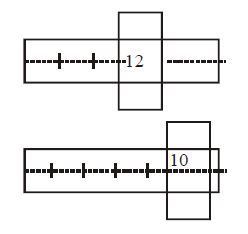
- A
$-0.16 $
- B
$+0.16$
- ✓
$+0.14$
- D
$-0.14$
AnswerCorrect option: C. $+0.14$
c
$\ell+x=2.12$
$2 \ell+x=4.10$
$x=0.14$
View full question & answer→MCQ 2521 Mark
Which of the following is the most precise device for measuring length
- A
a vernier callipers with $20$ divisions on the sliding scale
- B
a screw gauge of pitch $1\,\, mm$ and $100$ divisions on the circular scale
- ✓
an optical instrument that can measure length to within a wavelength of light
- D
Precison can not be changed by changing the instrument.
AnswerCorrect option: C. an optical instrument that can measure length to within a wavelength of light
View full question & answer→MCQ 2531 Mark
In a screw gauge, $5$ complete rotations of circular scale give $1.5\, mm$ reading on linear scale. Circular scale has $50$ divisions. Least count of the screw gauge is
- ✓
$0.006 \,mm$
- B
$0.003\, mm$
- C
$0.015\, mm$
- D
$0.03\, mm$
AnswerCorrect option: A. $0.006 \,mm$
a
Pitch $=\frac{1.5}{5}=0.3 \mathrm{mm}$
Least count $=\frac{0.3}{50}=0.006 \mathrm{mm}$
View full question & answer→MCQ 2541 Mark
Diagrams show readings of a screw gauge. figure $(i)$ shows the zero error reading when the screw gauge is closed, figure $(ii)$ the reading when the screw gauge is being used to measure the diameter of a ball-bearing. What is the diameter of the ball-bearing in $mm$? There are $50$ divisions on circular scale
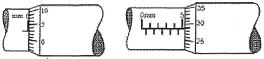
- A
$5 .29$
- ✓
$5 .26$
- C
$5 .32$
- D
$5 .28$
AnswerCorrect option: B. $5 .26$
b
Zero error is $3$ division
$\mathrm{LC}=\frac{0.5}{50}=0.01 \mathrm{mm}$
zero error $=0.03 \mathrm{mm}$
Reading $=5.0+29 \times 0.01$
$d=5.29-0.03=5.26 \mathrm{mm}$
View full question & answer→MCQ 2551 Mark
A screwgauage has pitch $1.5\; mm$ and there is no zero error. Linear scale has marking at $MSD = 1\; mm$ and there are $100$ equal division of circular scale. When diameter of a sphere is measured with instrument, main scale is having $2\; mm$ mark visible on linear scale, but $3\; mm$ mark is not visible, $76^{th}$ division of circuler scale is in line with linear scale. .......... $mm$ is the diameter of sphere.
- ✓
$3.14$
- B
$2.64$
- C
$1.14$
- D
$2.76$
AnswerCorrect option: A. $3.14$
a
$diameter = 2 + L.C\times C.S.R$ $= 1.5 mm +\frac{1.5\ mm}{100} \times 76 = 3.14\;mm$
View full question & answer→MCQ 2561 Mark
Two full turns of the circular scale of screw gauge cover a distance of $1\,mm$ on scale. The total number of divisions on circular scale is $50$. Further, it is found that screw gauge has a zero error of $+0.03\,mm$. While measuring the diameter of a thin wire a student notes the main scale reading of $3\,mm$ and the number of circular scale division in line, with the main scale is $35$. The diameter of the wire is .......... $mm$
- ✓
$3.32$
- B
$3.73$
- C
$3.67$
- D
$3.38$
AnswerCorrect option: A. $3.32$
a
pitch $=\frac{1 \mathrm{mm}}{2}=0.5 \mathrm{mm}$
$\mathrm{LC}=\frac{0.5 \mathrm{mm}}{50}=0.01 \mathrm{mm}$
observed diameter
${=3 \mathrm{mm}+(35 \times 0.01 \mathrm{mm})}$
${=3.35 \mathrm{mm}}$
Actual diameter
$= observed - error$
$=3.35 \mathrm{mm}-(+0.03 \mathrm{mm})$
$=3.32 \mathrm{\,mm}$
View full question & answer→MCQ 2571 Mark
In a vernier callipers, $10$ divisions of vernier scale coincides with $9$ divisions of main scale, the least count of which is $0.1\,cm$. If in the measurement of inner diameter of cylinder zero of vernier scale lies between $1.3\,cm$ and $1.4\, cm$ of main scale and $2^{nd}$ division of vernier scale coincides with main scale division then diameter will be .......... $cm$
- A
$1.30$
- B
$1.34$
- ✓
$1.32$
- D
$1.36$
AnswerCorrect option: C. $1.32$
c
$\mathrm{L} \mathrm{C} =1 \mathrm{MSD}-1 \mathrm{VSD}$
$=1 \mathrm{MSD}-\frac{9}{10} \mathrm{MSD}$
$=\left(1-\frac{9}{10}\right) \times 1 \mathrm{MSD}$ $\left[\begin{array}{l}{\text { Also }} \\ {10 \mathrm{VSD}=9 \mathrm{MSD}} \\ {1 \mathrm{VSD}=\frac{9}{10} \mathrm{MSD}}\end{array}\right]$
$=0.1 \times 0.1 \mathrm{cm}$
$=0.01\,cm$
$Diameter=MSR+LC \times VSR$
$=1.3+0.01 \times 2$
$=1.3+0.02=1.32 \mathrm{cm}$
View full question & answer→MCQ 2581 Mark
The circular scale of a micrometer has $200$ divisions and pitch of $2\,mm$ . Find the measured value of thickness of a thin sheet .......... $mm$

- A
$3.41$
- ✓
$6.41$
- C
$3.46$
- D
$3.51$
AnswerCorrect option: B. $6.41$
b
Least count $=\frac{\text { pitch }}{\text { No. of divisions }}$
$=\frac{2}{200}=0.01 \mathrm{mm}$
Reading $=3 \times 2+(46-5)(0.01)=6.41 \mathrm{mm}$
View full question & answer→MCQ 2591 Mark
If in a Vernier callipers $10 \,VSD$ coincides with $8 \,MSD$, then the least count of Vernier calliper is ............ $m$ [given $1 \,MSD =1 \,mm ]$
- ✓
$1 \times 10^{-4}$
- B
$2 \times 10^{-4}$
- C
$1 \times 10^{-3}$
- D
$8 \times 10^{-4}$
AnswerCorrect option: A. $1 \times 10^{-4}$
View full question & answer→MCQ 2601 Mark
The International Avogadro Coordination project created the world's most perfect sphere using Silicon in its crystalline form. The diameter of the sphere is $9.4 \,cm$ with an uncertainty of $0.2 \,nm$. The atoms in the crystals are packed in cubes of side $a$. The side is measured with a relative error of $2 \times 10^{-9}$, and each cube has $8$ atoms in it. Then, the relative error in the mass of the sphere is closest to (assume molar mass of Silicon and Avogadro's number to be known precisely)
- A
$6.4 \times 10^{-9}$
- B
$4.0 \times 10^{-10}$
- ✓
$1.2 \times 10^{-8}$
- D
$5.0 \times 10^{-8}$
AnswerCorrect option: C. $1.2 \times 10^{-8}$
c
(C)
$\text { Mass } \Rightarrow \frac{\frac{4}{3} \pi\left(\frac{ d }{2}\right)^3}{ a ^3} \times 8 \times\left(\frac{\text { Molar Mass }}{N_{ A }}\right)$
Take $\log$ and differentiate we get
$\frac{\Delta m }{ m }=3 \frac{\Delta d }{ d }+3 \frac{\Delta a }{ a }$
$\frac{\Delta m }{ m }=3 \times\left(\frac{0.2 \times 10^{-9}}{9.4 \times 10^{-2}}\right)+3\left(2 \times 10^{-9}\right)$
$\frac{\Delta m }{ m }= 6.3 \times 10^{-9}+6 \times 10^{-9} \Rightarrow 12.3 \times 10^{-9}$
$\frac{\Delta m }{ m }=1.2 \times 10^{-8}$
View full question & answer→MCQ 2611 Mark
The period of a body under SHM i.e. presented by $T = {P^a}{D^b}{S^c}$; where $P$ is pressure, $D$ is density and $S$ is surface tension. The value of $a,\,b$ and $c$ are
- ✓
$ - \frac{3}{2},\,\frac{1}{2},\,1$
- B
$ - 1,\, - 2,\,3$
- C
$\frac{1}{2},\, - \frac{3}{2},\, - \frac{1}{2}$
- D
$1,\,2,\,\frac{1}{3}$
AnswerCorrect option: A. $ - \frac{3}{2},\,\frac{1}{2},\,1$
a
(a) By substituting the dimension of each quantity we get
$T = {[M{L^{ - 1}}{T^{ - 2}}]^a}{[{L^{ - 3}}M]^b}{[M{T^{ - 2}}]^c}$
By solving we get $a = -3/2, b = 1/2$and $c = 1$
View full question & answer→MCQ 2621 Mark
Students $A, B$ and $C$ measure the length of a room using $25 \,m$ long measuring tape of least count $0.5 \,cm$, meter-scale of least count $0.1 \,cm$ and a foot-scale of least count $0.05 \,cm$, respectively. If the specified length of the room is $9.5 \,m$, then which of the following students will report the lowest relative error in the measured length?
- ✓
Student $A$
- B
Student $B$
- C
Student $C$
- D
Both $B$ and $C$
AnswerCorrect option: A. Student $A$
a
$(a)$
As, relative error $=\frac{\text { deviation in measurement }}{\text { true measurement }}$
For student $A$,
$RE =\frac{0.5 \times 10^{-2}}{9.5}=0.0005$
For student $B$ the meter-scale should be used $10$ times, $\therefore RE =\frac{0.1 \times 10^{-2}}{1} \times 10=0.01$
For student $C$,
$1$ foot $=30.48 \,cm$
So, the scale should be used $31$ times.
$\therefore RE =\frac{0.05}{30.48} \times 31=0.05$
Hence, the lowest relative error $(RE)$ in measured value is for student $A$.
View full question & answer→MCQ 2631 Mark
A specially designed Vernier calliper has the main scale least count of $1 \,mm$. On the Vernier scale, there are $10$ equal divisions and they match with $11$ main scale divisions. Then, the least count of the Vernier calliper is ........... $mm$
- ✓
$0.1$
- B
$0.909$
- C
$1.1$
- D
$0.09$
Answera
(a)
Here, $10$ divisions of vernier scall $=11$ main scale divisions
So, $1$ vernier scale division $=\frac{11}{10}$ main
scale divisions
Now, we use formula for least count,
Least count $=1$ main scale division $-1$
vernier scale division.
$\Rightarrow \quad LC=1 MSD -1 VSD$
$=\left(1-\frac{11}{10}\right) MSD$
$=-\frac{1}{10} MSD$
$=-\frac{1}{10} \times 1 \,mm$
$=-0.1 \,mm$
So, magnitude of least count is $0.1 \,mm$.
View full question & answer→MCQ 2641 Mark
In an experiment on simple pendulum to determine the acceleration due to gravity, a student measures the length of the thread as $63.2 \,cm$ and diameter of the pendulum bob as $2.256 \,cm$. The student should take the length of the pendulum to be ........... $cm$
- A
$64.328$
- ✓
$64.3$
- C
$65.456$
- D
$65.5$
AnswerCorrect option: B. $64.3$
b
(b)
Length of pendulum = Length of thread + Radius of bob
$=63.2+\frac{2.256}{2}=63.2+1128$
$=64.328 \,cm$
But now the student must apply rule for taking significant digits in a measurement.
In addition or subtraction,
Number of digits after decimal in result
= Least number of digits after decimal in quantities added
So, length of pendulum $=64.3 \,cm$.
View full question & answer→MCQ 2651 Mark
The figure of a centimetre scale below shows a particular position of the Vernier calipers. In this position, the value of $x$ shown in the figure is .......... $cm$ (figure is not to scale)
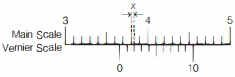
- A
$0.02$
- B
$3.65$
- C
$4.15$
- ✓
$0.03$
AnswerCorrect option: D. $0.03$
d
(D)
At the $4$ th reading of vernier's scale, the length between the two scales is min. and will be the least count $=0.01 \,cm$
So difference at $3$ rd reading of vernier scale is $2 \times 0.01 \,cm$
$\Rightarrow$ difference at and reading of vernier scale will be $3 \times 0.01 \,cm =0.03 \,cm$
View full question & answer→MCQ 2661 Mark
A massive black hole of mass $m$ and radius $R$ is spinning with angular velocity $\omega$. The power $P$ radiated by it as gravitational waves is given by $P=G c^{-5} m^{x} R^{y} \omega^{z}$, where $c$ and $G$ are speed of light in free space and the universal gravitational constant, respectively. Then,
- A
$x=-1, y=2, z=4$
- B
$x=1, y=1, z=4$
- C
$x=-1, y=4, z=4$
- ✓
$x=2, y=4, z=6$
AnswerCorrect option: D. $x=2, y=4, z=6$
d
$(d)$ Given, $P=G c^{-5} m^{x} R^{y} \omega^{z} \quad \ldots (i)$
Here, dimensions of various physical quantities are
Angular speed, $\omega=\left[ T ^{-1}\right]$
Power, $P=\left[ ML ^{2} T ^{-3}\right]$
Mass, $m=[ M ]$
Radius, $R=[ L ]$
Speed, $c=\left[ LT ^{-1}\right]$
Universal gravitational constant,
$G=\left[ M ^{-1} L ^{3} T ^{-2}\right]$
Substituting dimensions in Eq. $(i)$, we have
${\left[ ML ^{2} T ^{-3}\right]=} {\left[ M ^{-1} L ^{3} T ^{-2}\right]\left[ L ^{-5} T ^{5}\right][ M ]^{x} }$
${\left[ L ^{y}\left[ T ^{-z}\right]\right.}$
Equating dimensions of same quantity, we get
$1=-1+x \Rightarrow x=2$
$2=3-5+y \Rightarrow y=4$
$-3=-2+5-z \Rightarrow z=6$
View full question & answer→MCQ 2671 Mark
A neutron star with magnetic moment of magnitude $m$ is spinning with angular velocity $\omega$ about its magnetic axis. The electromagnetic power $P$ radiated by it is given by $\mu_{0}^{x} m^{y} \omega^{z} c^{u}$, where $\mu_{0}$ and $c$ are the permeability and speed of light in free space, respectively. Then,
- ✓
$x=1, y=2, z=4$ and $u=-3$
- B
$x=1, y=2, z=4$ and $u=3$
- C
$x=-1, y=2, z=4$ and $u=-3$
- D
$x=-1, y=2, z=4$ and $u=3$
AnswerCorrect option: A. $x=1, y=2, z=4$ and $u=-3$
a
$(a)$ Given, power radiated $P$ is
$P=\mu_{ 0 }^{x} m^{y} \omega^{z} c^{u}$
Substituting dimensions of different physical quantities involved, we have $\left[ ML ^{2} T ^{-3}\right]=\left[ MLT ^{-2} A ^{-2}\right]^{x}\left[ L ^{2} A \right]^{y}\left[ T ^{-1}\right]^{z} \left[ LT ^{-1}\right]^{u}$
Equating powers of fundamental quantities, we have
$x=1 \ldots \text { (i) }$
$x+2 y+u =2 \ldots(ii)$
$-2 x-z-u =-3 \ldots(iii)$
$-2 x+y =0 \ldots(iv)$
From Eq. $(i)$, putting the value of $x$ in Eq. $(iv)$, we get
$\Rightarrow \quad-2 \times 1+y=0 \Rightarrow y=2 \quad \ldots(v)$
Now, from E.q. $(i)$ and $(v)$, putting the values of $x$ and $y$ in Eq. $(ii)$, we get
$\Rightarrow \quad 1+2 \times 2+u=2 \Rightarrow u=-3 \quad \ldots(vi)$
Now, again from Eqs. $(i)$ and $(vi)$, putting the values of $x$ and $u$ in Eq. $(iii)$, we get
$\Rightarrow-2 \times 1-z+3=-3 \Rightarrow z=4$
So, $x=1, y=2, z=4, u=-3$
View full question & answer→MCQ 2681 Mark
Stokes' law states that the viscous drag force $F$ experienced by a sphere of radius $a$, moving with a speed $v$ through a fluid with coefficient of viscosity $\eta$, is given by $F=6 \pi \eta a v$. If this fluid is flowing through a cylindrical pipe of radius $r$, length $l$ and pressure difference of $p$ across its two ends, then the volume of water $V$ which flows through the pipe in time $t$ can be written as $\frac{V}{t}=k\left(\frac{p}{l}\right)^a \eta^b r^c$, where $k$ is a dimensionless constant. Correct values of $a, b$ and $c$ are
- ✓
$a=1, b=-1, c=4$
- B
$a=-1, b=1, c=4$
- C
$a=2, b=-1, c=3$
- D
$a=1, b=-2, c=-4$
AnswerCorrect option: A. $a=1, b=-1, c=4$
a
(a)
From $\frac{V}{t}=k\left(\frac{p}{l}\right)^a \eta^b r^c$,
we have
$\left[ L ^3 T ^{-1}\right]=\left[\frac{ ML ^{-1} T ^{-2}}{ L }\right]^a\left[ ML ^{-1} T ^{-1}\right]^b[ L ]^c$
Equating powers of $M , L$ and $T$, we get
$a+b=0 \Rightarrow-2 a-b+c=3$
$-2 a-b=-1$
Solving, we get $a=1, b=-1$ and $c=4$
View full question & answer→MCQ 2691 Mark
The distance $s$ travelled by a particle in time $t$ is $s=u t-\frac{1}{2} \,g t^{2}$. The initial velocity of the particle was measured to be $u=1.11 \pm 0.01 \,m / s$ and the time interval of the experiment was $t=1.01 \pm 0.1 \,s$. The acceleration was taken to be $g=9.8 \pm 0.1 \,m / s ^{2}$. With these measurements, the student estimates the total distance travelled. How should the student report the result?
- A
$1121 \pm 0.1 \,m$
- ✓
$11 \pm 0.1 \,m$
- C
$112 \pm 0.07 \,m$
- D
$11 \pm 0.07 \,m$
AnswerCorrect option: B. $11 \pm 0.1 \,m$
b
$(b)$ ln multiplication and division number of significant figure in result = smallest number of significant figures (as that of numbers involved in product or division).
In addition and subtraction number of significant figures $=$ smallest number of significant decimal places (as that of numbers used in sum and difference) So, from given data
So, result contains only one digit after decimal.
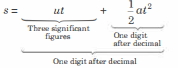
View full question & answer→MCQ 2701 Mark
Using dimensional analysis, the resistivity in terms of fundamental constants $h, m_{e}, c, e, \varepsilon_{0}$ can be expressed as
- A
$\frac{h}{\varepsilon_{0} m_{e} c e^{2}}$
- B
$\frac{\varepsilon_{0} m_{e} c e^{2}}{h}$
- ✓
$\frac{h^{2}}{m_{e} c e^{2}}$
- D
$\frac{m_{e} \varepsilon_{0}}{c e^{2}}$
AnswerCorrect option: C. $\frac{h^{2}}{m_{e} c e^{2}}$
c
$(c)$ Let resistivity depends on given fundamental constants.
$\rho=h^{} m_{e}^{b} c^{c} e^{d} \varepsilon_{0}^{f}$
where, $k=$ a numeric constant.
Now, substituting dimensions of different physical constants, we have
$\left[ ML ^{3} T ^{-3} A ^{-2}\right]=k\left[[ \mathrm { ML } ^ { 2 } \mathrm { T } ^ { - 1 } ] ^ { k } \left[ M ^{b}\left[ LT ^{-1}\right]^{c}\right.\right.$
$\left.[ AT ]^{d}\left[ M ^{-1} L ^{-3} T ^{4} A ^{2}\right]^{f}\right]$
Equating dimensions, we have
$1=a+b-f$
$3=2 a+c-3 f$
$-3=-a-c+d+4 f$
$-2=d+2 f$
Solving these, we get
$a=2$
$b=-1$
$c=-1$
$d=-2$
$f=0$
So, resistivity can be expressed as
$\rho=k\left(\frac{h^{2}}{m_{e} c e^{2}}\right)$
View full question & answer→MCQ 2711 Mark
The length and width of a rectangular room are measured to be $3.95 \pm 0.05 \,m$ and $3.05 \pm 0.05 \,m$, respectively. The area of the floor is .................... $m^2$
- A
$1205 \pm 0.01$
- B
$1205 \pm 0.005$
- ✓
$1205 \pm 0.34$
- D
$1205 \pm 0.40$
AnswerCorrect option: C. $1205 \pm 0.34$
c
(c)
Area, $A=l \times b$
$=3.95 \times 3.05=12.05\, m ^2$
Now, $A=l \times b$
$\Rightarrow \frac{d A}{A}=\frac{d l}{l}+\frac{d b}{b}$
$\Rightarrow \Delta A=\left(\frac{\Delta l}{l}+\frac{\Delta b}{b}\right) \times A$
$=\left(\frac{0.05}{3.95}+\frac{0.05}{3.05}\right) \times 12.05$
$\approx 0.34$
So, area of floor is $A=12.05 \pm 0.34 \,m ^2$.
View full question & answer→MCQ 2721 Mark
In an experiment, mass of an object is measured by applying a known force on it, and then measuring its acceleration. If in the experiment, the measured values of applied force and the measured acceleration are $F=10.0 \pm 0.2 \,N$ and $a=1.00 \pm 0.01 \,m / s ^2$, respectively. Then, the mass of the object is ............... $kg$
- A
$10.0$
- B
$10.0 \pm 0.1$
- ✓
$10.0 \pm 0.3$
- D
$10.0 \pm 0.4$
AnswerCorrect option: C. $10.0 \pm 0.3$
c
(c)
As, force $F=m a$
$\Rightarrow \frac{\Delta F}{F}=\frac{\Delta m}{m}+\frac{\Delta a}{a} \Rightarrow \frac{\Delta m}{m}=\frac{\Delta F}{F}-\frac{\Delta a}{a}$
$\Rightarrow \frac{\Delta m}{m}=\left(\frac{\pm 0.2}{10}\right)-\left(\frac{\pm 0.01}{1}\right)$
So, $\left(\frac{\Delta m}{m}\right)_{\max }=\frac{0.2}{10}+\frac{0.01}{1}=0.03$
Maximum error in mass occurs when error in force and acceleration are of different signs.
So, $\Delta m=0.03 \times m=0.03 \times 10 \Rightarrow \Delta m=0.3\, kg$
Hence, mass of object is $m=10 \pm 0.3 \,kg$.
View full question & answer→MCQ 2731 Mark
The dimensions of the area $A$ of a black hole can be written in terms of the universal gravitational constant $G$, its mass $M$ and the speed of light $c$ as $A=G^\alpha M^\beta c^\gamma$. Here,
- A
$\alpha=-2, \beta=-2$ and $\gamma=4$
- ✓
$\alpha=2, \beta=2$ and $\gamma=-4$
- C
$\alpha=3, \beta=3$ and $\gamma=-2$
- D
$\alpha=-3, \beta=-3$ and $\gamma=2$
AnswerCorrect option: B. $\alpha=2, \beta=2$ and $\gamma=-4$
b
(b)
Given, $A=G^\alpha M^\beta c^\gamma$
Substituting dimensions of $A, M$ and $c$, we have
$[ L ]^2=\left[\frac{ MLT ^{-2} L ^2}{ M ^2}\right]^\alpha[ M ]^\beta\left[\frac{ L }{ T }\right]^\gamma$
$\Rightarrow \quad[ L ]^2=\left[ M ^{-1} L ^3 T ^{-2}\right]^\alpha[ M ]^\beta\left[ LT ^{-1}\right]^\gamma$
$\Rightarrow \quad[ L ]^2= M ^{-\alpha+\beta} L ^{3 \alpha+\gamma} T ^{-2 \alpha-\gamma}$
Equating dimensions on both sides, we
$\text { have } \quad-\alpha+\beta=0 \quad \dots(i)$
$3 \alpha+\gamma =2 \quad \ldots(ii)$
$-2 \alpha-\gamma=0 \quad \dots(iii)$
Adding Eqs. $(ii)$ and $(iii)$, we get
$\Rightarrow \quad 3 \alpha+\gamma-2 \alpha-\gamma=2+0 \Rightarrow \alpha=2 \quad \ldots$ $(iv)$
Now, putting the value of $\alpha$ in Eq. $(i)$, we get
$\Rightarrow \quad-2+\beta=0 \Rightarrow \beta=2$
Again, putting the value of $\alpha$ in Eq. $(iii)$, we get
$\Rightarrow -2 \times 2-\gamma=0 \Rightarrow \gamma=-4$
$\text { So, } \alpha=2, \beta=2 \text { and } \gamma=-4$
View full question & answer→MCQ 2741 Mark
Stokes' law states that the viscous drag force $F$ experienced by a sphere of radius $a$, moving with a speed $v$ through a fluid with coefficient of viscosity $\eta$, is given by $F=6 \pi \eta a v$.If this fluid is flowing through a cylindrical pipe of radius $r$, length $l$ and a pressure difference of $p$ across its two ends, then the volume of water $V$ which flows through the pipe in time $t$ can be written as
$\frac{v}{t}=k\left(\frac{p}{l}\right)^a \eta^b r^c$
where, $k$ is a dimensionless constant. Correct value of $a, b$ and $c$ are
- ✓
$a=1, b=-1, c=4$
- B
$a=-1, b=1, c=4$
- C
$a=2, b=-1, c=3$
- D
$a=1, b=-2, c=-4$
AnswerCorrect option: A. $a=1, b=-1, c=4$
a
(a) By Stokes' law,
$F=6 \pi \eta a v$
We have, $\quad \eta=\frac{F}{6 \pi a v}$
Dimensions of viscosity index $\eta$ are
$\Rightarrow \quad[\eta]=\left[\frac{ MLT ^{-2}}{ L \cdot LT ^{-1}}\right]=\left[ ML ^{-1} T ^{-1}\right]$
Now, given relation of volume flow rate is
$\frac{V}{t}=k\left(\frac{p}{l}\right)^a \cdot \eta^b \cdot r^c$
Substituting dimensions of physical quantities and equating dimensions on both sides of equation, we have
$\frac{\left[ L ^3\right]}{[ T ]} =\left[ ML ^{-2} T ^{-2}\right]^a \cdot\left[ ML ^{-1} T ^{-1}\right]^b \cdot[ L ]^c$
$\Rightarrow\left[ M ^0 L ^3 T ^{-1}\right] =\left[ M ^{a+b} L ^{-2 a-b+c} T ^{-2 a-b}\right]$
$a+b=0 \quad \dots(i)$
$-2 a-b+c=3 \quad \dots(ii)$
$-2 a-b=-1 \quad \dots(iii)$
From Eqs. $(ii)$ and $(iii)$, we have
$c=4$
From Eqs. $(i)$ and $(iii)$, we have
$b=-1$
Substituting bin Eq. $(i)$, we have
$a=1$
So, $a=1, b=-1$ and $c=4$
View full question & answer→MCQ 2751 Mark
The dimensions of Stefan-Boltzmann's constant $\sigma$ can be written in terms of Planck's constant $h$, Boltzmann's constant $k_B$ and the speed of light $c$ as $\sigma=h^\alpha k_B^\beta c^\gamma$. Here,
- A
$\alpha=3, \beta=4$ and $\gamma=-3$
- B
$\alpha=3, \beta=-4$ and $\gamma=2$
- ✓
$\alpha=-3, \beta=4$ and $\gamma=-2$
- D
$\alpha=2, \beta=-3$ and $\gamma=-1$
AnswerCorrect option: C. $\alpha=-3, \beta=4$ and $\gamma=-2$
c
(c)
Let $\sigma=h^\alpha k^\beta c^\gamma$, then equating dimensions of both sides, we have
$\left[ MT ^{-3} K ^{-4}\right]=\left[ ML ^2 T ^{-1}\right]^\alpha\left[ ML ^2 T ^{-2} K ^{-1}\right]^\beta\left[ LT ^{-1}\right]^\gamma$
$\alpha+\beta=1 \quad...(i)$
$2 \alpha+2 \beta+\gamma=0 \quad \ldots (ii)$
$-\alpha-2 \beta-\gamma=-3 \quad \ldots (iii)$
In Eq. $(i)$, we multiplying with $2$, we get
$2 \alpha+2 \beta=2 \ldots(iv)$
Now, subtracting Eq. $(ii)$ from Eq. $(iv)$,
we get
$2 \alpha-2 \alpha+2 \beta-2 \beta+\gamma=0-2$
$\gamma=-2$
Now, putting the value of $\gamma$ in Eq. $(iii)$, we get
$\alpha+2 \beta=5 \ldots( v )$
And solve the Eq. $(i)$ and $(v)$, we get $\alpha=-3, \beta=4$
So, $\alpha=-3, \beta=4$ and $\gamma=-2$
View full question & answer→MCQ 2761 Mark
Young-Laplace law states that the excess pressure inside a soap bubble of radius $R$ is given by $\Delta P=4 \sigma / R$, where $\sigma$ is the coefficient of surface tension of the soap. The EOTVOS number $E_0$ is a dimensionless number that is used to describe the shape of bubbles rising through a surrounding fluid. It is a combination of $g$, the acceleration due to gravity $\rho$ the density of the surrounding fluid $\sigma$ and a characteristic length scale $L$ which could be the radius of the bubble. A possible expression for $E_0$ is
- A
$\frac{\rho g}{\sigma L^3}$
- B
$\frac{\rho L^2}{\sigma g}$
- ✓
$\frac{\rho g L^2}{\sigma}$
- D
$\frac{g L^2}{\sigma \rho}$
AnswerCorrect option: C. $\frac{\rho g L^2}{\sigma}$
c
(c)
As EOTVOS number $E_{\text {s }}$ is dimensionless, we check dimensions of options given to the choose correct answer.
Now, $\left[\frac{\rho g I^2}{\sigma}\right]=\frac{[\rho] \cdot[g] \cdot[L]^2}{[\sigma]}$
$=\frac{\left[ ML ^{-3}\right] \cdot\left[ LT ^{-2}\right] \cdot\left[ I ^2\right]}{\left[ MT ^{-2}\right]}$
$=\left[ M ^{0} L ^{0} T ^0\right]=\text { Dimensionless }$
View full question & answer→MCQ 2771 Mark
The potential energy of a point particle is given by the expression $V(x)=-\alpha x+\beta \sin (x / \gamma)$. A dimensionless combination of the constants $\alpha, \beta$ and $\gamma$ is
- A
$\frac{\alpha}{\beta \gamma}$
- B
$\frac{\alpha^2}{\beta \gamma}$
- C
$\frac{\gamma}{\alpha \beta}$
- ✓
$\frac{\alpha \gamma}{\beta}$
AnswerCorrect option: D. $\frac{\alpha \gamma}{\beta}$
d
(d)
Potential energy of the particle is
$V(x)=-\alpha x+\beta \sin \left(\frac{x}{\gamma}\right)$
Clearly, dimensions of $\alpha, \beta$ and $\gamma$ are
$[\alpha]=\frac{[ V ]}{[ x ]}=\frac{\left[ ML ^2 T ^{-2}\right]}{[ L ]}=\left[ MLT ^{-2}\right]$
$\mid \beta]=[ V ]=\left[ ML ^2 T ^{-2}\right]$
and $[\gamma]=[ x ]=[ L ]$
$=\left[ M ^0 L ^0 T ^0\right]$
View full question & answer→MCQ 2781 Mark
A liquid drop placed on a horizontal plane has a near spherical shape (slightly flattened due to gravity). Let $R$ be the radius of its largest horizontal section. A small disturbance causes the drop to vibrate with frequency $v$ about its equilibrium shape. By dimensional analysis, the ratio $\frac{v}{\sqrt{\sigma / \rho R^3}}$ can be (Here, $\sigma$ is surface tension, $\rho$ is density, $g$ is acceleration due to gravity and $k$ is an arbitrary dimensionless constant)
- ✓
$k \rho g R^2 / \sigma$
- B
$k \rho R^3 / g_\sigma$
- C
$k \rho R^2 / g \sigma$
- D
$k \rho / g \sigma$
AnswerCorrect option: A. $k \rho g R^2 / \sigma$
a
(a)
Dimensions of
$\frac{v}{\sqrt{\sigma}}=\frac{[v]}{\sqrt{\rho \cdot h^3}}=\frac{\left[ T ^{-1}\right]}{\sqrt{\left[\rho R ^3\right]}}=\frac{\left[ MT ^{-2}\right]}{\sqrt{\left[\frac{ M }{ L ^3} \cdot L ^3\right]}}$
$=\left[ M ^0 L ^0 T ^0\right]$
Now, from option $(a)$,
Dimensions of $\frac{k \rho g R^2}{\sigma}=\frac{\left[k \rho g R^2\right]}{[\sigma]}$
$=\frac{\left[\frac{ M }{ L ^3}\right] \cdot\left[ LT ^{-2}\right] \cdot\left[ L ^2\right]}{\left[ MT ^{-2}\right]}$
$=\left[ M ^0 L ^0 T ^0\right]$
So, by dimensional analysis, option $(a)$ is correct.
View full question & answer→MCQ 2791 Mark
The quantum hall resistance $R_H$ is a fundamental constant with dimensions of resistance. If $h$ is Planck's constant and $e$ is the electron charge, then the dimension of $R_H$ is the same as
- A
$\frac{e^2}{h}$
- ✓
$\frac{h}{e^2}$
- C
$\frac{h^2}{e}$
- D
$\frac{e}{h^2}$
AnswerCorrect option: B. $\frac{h}{e^2}$
b
(b)
Let $R_H=k h^a e^b \quad \dots(i)$
As, $R=\frac{V}{I}$
$\therefore {\left[R_H\right] } =\left[ ML ^2 T ^{-3} A ^{-2}\right]$
$\Rightarrow h =E \cdot t$
$\Rightarrow {[h] }=\left[ ML ^2 T ^{-1}\right]$
$e=I \cdot t \Rightarrow[e]=[ A \cdot T ]$
Substituting above values in Eq. $(i)$, we have
${\left[ ML ^2 T ^{-3} A ^{-2}\right] }=k\left[ ML ^2 T ^{-1}\right]^e[ AT ]^b$
$=k\left[ M ^a L ^{2 a} T ^{-a+b} A ^b\right]$
Equating dimensions, we get
$a=1 \text { and } b=-2$
Hence, $\quad R_H=k\left(\frac{h}{e^2}\right)$
So, dimensions of hall resistance are same as that of $\frac{h}{e^2}$.
View full question & answer→MCQ 2801 Mark
Four students measure the height of a tower. Each student uses a different method and each measures the height many different times. The data for each are plotted below. The measurement with highest precision is
Answera
(a)
Precision refers to the limit of resolution. Precision is determined by the least count of measuring instrument.
A smaller least count means greater precision.
So, more precise readings have least spread of readings as in case $I$.
View full question & answer→MCQ 2811 Mark
The temperature of a metal coin is increased by $100^{\circ} C$ and its diameter increases by $0.15 \%$. Its area increases by nearly
- A
$0.15 \%$
- ✓
$0.30 \%$
- C
$0.60 \%$
- D
$0.0225 \%$
AnswerCorrect option: B. $0.30 \%$
b
(b)
Percentage increase in area
$=\frac {Final \,area - Initial \,area}{Initial \,area} \times 100$
$=\frac{\pi\left(r_2^2-r_1^2\right)}{\pi r_1^2} \times 100$
$=\frac{\left(r_1+\Delta r\right)^2-r_1^2}{r_1^2} \times 100$
where, $\Delta r=$ increase in radius.
$=\left(\frac{r_1^2+2 r_1 \Delta r+\Delta r^2-r_1^2}{r_1^2}\right) \times 100$
$=\frac{2 r_1 \Delta r+\Delta r^2}{r_1^2} \times 100$
As $\Delta r$ is small, we can neglect $\Delta r^2$.
$\approx \frac{2 r_1 \Delta r}{r_1^2}=100$
$=2(\frac{\Delta r}{r_1} \times 100)$
$=2 \times 0.15 \%=0.30 \%$
View full question & answer→MCQ 2821 Mark
If $\varepsilon_0$ is the permittivity of free space and $E$ is the electric field, then $\varepsilon_0 E^2$ has the dimensions
- A
$\left[\mathrm{M}^0 \mathrm{~L}^{-2} \mathrm{TA}\right]$
- ✓
$\left[\mathrm{ML}^{-1} \mathrm{~T}^{-2}\right]$
- C
$\left[\mathrm{M}^{-1} \mathrm{~L}^{-3} \mathrm{~T}^4 \mathrm{~A}^2\right]$
- D
$\left[\mathrm{M} \mathrm{L}^2 \mathrm{~T}^{-2}\right]$
AnswerCorrect option: B. $\left[\mathrm{ML}^{-1} \mathrm{~T}^{-2}\right]$
b
$\mathrm{E}=\frac{\mathrm{K}}{\mathrm{R}^2}$
$\mathrm{E}=\frac{\mathrm{Q}}{4 \pi \varepsilon_0 \mathrm{R}^2}$
$\varepsilon_0=\frac{\mathrm{Q}}{4 \pi \mathrm{R}^2 \mathrm{E}}$
$\text { Now, } \varepsilon_0 \mathrm{E}^2=\frac{\mathrm{Q}}{4 \pi \mathrm{R}^2\mathrm{E}} \cdot \mathrm{E}^2=\frac{\mathrm{Q}}{4 \pi \mathrm{R}^2} \cdot \mathrm{E}$
${\left[\varepsilon_0 \mathrm{E}^2\right]=\left[\frac{\mathrm{QE}}{\mathrm{R}^2}\right]=\frac{[\mathrm{Q}][\mathrm{E}]}{\left[\mathrm{R}^2\right]}=\frac{[\mathrm{Q}]}{\left[\mathrm{R}{ }^2\right][\mathrm{Q}][\mathrm{R}]}}$
$=\frac{[\mathrm{W}]}{\left[\mathrm{R}^3\right]}=\frac{\mathrm{ML}^2 \mathrm{~T}^{-2}}{\mathrm{~L}^3}=\mathrm{ML}^{-1} \mathrm{~T}^{-2}$
View full question & answer→MCQ 2831 Mark
Match List $-I$ with List $-II$
| |
List $-I$ |
|
List $-II$ |
| $A$. |
Coefficient of Viscosity |
$I$. |
$[M L^2T^{–2}]$ |
| $B$. |
Surface Tension |
$II$. |
$[M L^2T^{–1}]$ |
| $C$. |
Angular momentum |
$III$. |
$[M L^{-1}T^{–1}]$ |
| $D$. |
Rotational Kimeatic energy |
$IV$. |
$[M L^0T^{–2}]$ |
- A
$ A-II, B-I, C-IV, D-III$
- B
$ A-I, B-II, C-III, D-IV$
- ✓
$ A-III, B-IV, C-II, D-I$
- D
$A-IV, B-III, C-II, D-I$
AnswerCorrect option: C. $ A-III, B-IV, C-II, D-I$
c
$ F=\eta A \frac{d v}{d y} $
$ {\left[M L T^{-2}\right]=\eta\left[L^2\right]\left[T^{-1}\right]} $
$ \eta=\left[M L^{-1} T^{-1}\right] $
$ S . T=\frac{F}{\ell}=\frac{\left[M L T^{-2}\right]}{[L]}=\left[M L^0 T^{-2}\right] $
$ L=m v r=\left[M L^2 T^{-1}\right] $
$ K . E=\frac{1}{2} I \omega^2=\left[M L^2 T^{-2}\right]$
View full question & answer→MCQ 2841 Mark
A force is represented by $\mathrm{F}=a \mathrm{x}^2+\mathrm{bt}^{1 / 2}$. Where $\mathrm{x}=$ distance and $\mathrm{t}=$ time. The dimensions of $\mathrm{b}^2 / \mathrm{a}$ are :
- ✓
$\left[\mathrm{ML}^3 \mathrm{~T}^{-3}\right]$
- B
$\left[\mathrm{MLT}^{-2}\right]$
- C
$\left[\mathrm{ML}^{-1} \mathrm{~T}^{-1}\right]$
- D
$\left[\mathrm{ML}^2 \mathrm{~T}^{-3}\right]$
AnswerCorrect option: A. $\left[\mathrm{ML}^3 \mathrm{~T}^{-3}\right]$
a
$\mathrm{F}=\mathrm{ax}^2+\mathrm{bt}^{1 / 2}$
${[\mathrm{a}]=\frac{[\mathrm{F}]}{\left[\mathrm{x}^2\right]}=\left[\mathrm{M}^1 \mathrm{~L}^{-1} \mathrm{~T}^{-2}\right]}$
${[\mathrm{b}]=\frac{[\mathrm{F}]}{\left[\mathrm{t}^{1 / 2}\right]}=\left[\mathrm{M}^1 \mathrm{~L}^1 \mathrm{~T}^{-5 / 2}\right]}$
${\left[\frac{\mathrm{b}^2}{\mathrm{a}}\right]=\frac{\left[\mathrm{M}^2 \mathrm{~L}^2 \mathrm{~T}^{-5}\right]}{\left[\mathrm{M}^1 \mathrm{~L}^{-1} \mathrm{~T}^{-2}\right]}=\left[\mathrm{M}^1 \mathrm{~L}^3 \mathrm{~T}^{-3}\right]}$
View full question & answer→MCQ 2851 Mark
Applying the principle of homogeneity of dimensions, determine which one is correct. where $\mathrm{T}$ is time period, $\mathrm{G}$ is gravitational constant, $M$ is mass, $r$ is radius of orbit.
- A
$\mathrm{T}^2=\frac{4 \pi^2 \mathrm{r}}{\mathrm{GM}^2}$
- B
$\mathrm{T}^2=4 \pi^2 \mathrm{r}^3$
- ✓
$\mathrm{T}^2=\frac{4 \pi^2 \mathrm{r}^3}{G M}$
- D
$\mathrm{T}^2=\frac{4 \pi^2 \mathrm{r}^2}{G M}$
AnswerCorrect option: C. $\mathrm{T}^2=\frac{4 \pi^2 \mathrm{r}^3}{G M}$
c
According to principle of homogeneity dimension of $LHS$ should be equal to dimensions of RHS so option $(3)$ is correct.
$\mathrm{T}^2=\frac{4 \pi^2 \mathrm{r}^3}{\mathrm{GM}}$
${\left[\mathrm{T}^2\right]=\frac{\left[\mathrm{L}^3\right]}{\left[\mathrm{M}^{-1} \mathrm{~L}^3 \mathrm{~T}^{-2}\right][\mathrm{M}]}}$
(Dimension of G is $\left[\mathrm{M}^{-1} \mathrm{~L}^3 \mathrm{~T}^{-2}\right]$ )
$\left[\mathrm{T}^2\right]=\frac{\left[\mathrm{L}^3\right]}{\left[\mathrm{L}^3 \mathrm{~T}^{-2}\right]}=\left[\mathrm{T}^2\right]$
View full question & answer→MCQ 2861 Mark
Consider two physical quantities A and B related to each other as $E=\frac{B-x^2}{A t}$ where $E, x$ and $t$ have dimensions of energy, length and time respectively. The dimension of $A B$ is
- A
$\mathrm{L}^{-2} \mathrm{M}^1 \mathrm{~T}^0$
- ✓
$\mathrm{L}^2 \mathrm{M}^{-1} \mathrm{~T}^1$
- C
$\mathrm{L}^{-2} \mathrm{M}^{-1} \mathrm{~T}^1$
- D
$\mathrm{L}^0 \mathrm{M}^{-1} \mathrm{~T}^1$
AnswerCorrect option: B. $\mathrm{L}^2 \mathrm{M}^{-1} \mathrm{~T}^1$
b
${[B]=L^2}$
$A=\frac{x^2}{t E}=\frac{L^2}{T^2 T^{-2}}=\frac{1}{M^{-1}}$
${[A]=M^{-1} T}$
${[A B]=\left[L^2 M^{-1} T^1\right]}$
View full question & answer→MCQ 2871 Mark
Given below are two statements :
$Statement$ $(I)$ : Planck's constant and angular momentum have same dimensions.
$Statement$ $(II)$ : Linear momentum and moment of force have same dimensions.
In the light of the above statements, choose the correct answer from the options given below :
- ✓
Statement $I$ is true but Statement $II$ is false
- B
Both Statement $I$ and Statement $II$ are false
- C
Both Statement $I$ and Statement $II$ are true
- D
Statement $I$ is false but Statement $II$ is true
AnswerCorrect option: A. Statement $I$ is true but Statement $II$ is false
a
$ {[\mathrm{h}]=\mathrm{ML}^2 \mathrm{~T}^{-1}} $
$ {[\mathrm{~L}]=\mathrm{ML}^2 \mathrm{~T}^{-1}} $
$ {[\mathrm{P}]=\mathrm{MLT}^{-1}} $
$ {[\tau]=\mathrm{ML}^2 \mathrm{~T}^{-2}}$
(Here $\mathrm{h}$ is Planck's constant, $\mathrm{L}$ is angular momentum, $\mathrm{P}$ is linear momentum and $\tau$ is moment of force)
View full question & answer→MCQ 2881 Mark
Given below are two statements :
Statement $(I)$ : Dimensions of specific heat is $\left[\mathrm{L}^2 \mathrm{~T}^{-2} \mathrm{~K}^{-1}\right]$
Statement $(II)$ : Dimensions of gas constant is $\left[\mathrm{ML}^2 \mathrm{~T}^{-1} \mathrm{~K}^{-1}\right]$
- A
Statement $(I)$ is incorrect but statement $(II)$ is correct
- B
Both statement $(I)$ and statement $(II)$ are incorrect
- ✓
Statement $(I)$ is correct but statement $(II)$ is incorrect
- D
Both statement $(I)$ and statement $(II)$ are correct
AnswerCorrect option: C. Statement $(I)$ is correct but statement $(II)$ is incorrect
c
$\Delta \mathrm{Q}=\mathrm{mS} \Delta \mathrm{T}$
$\mathrm{s}=\frac{\Delta \mathrm{Q}}{\mathrm{m} \Delta \mathrm{T}}$
${[\mathrm{s}]=\left[\frac{\mathrm{ML}^2 \mathrm{~T}^{-2}}{\mathrm{MK}}\right]}$
${[\mathrm{s}]=\left[\mathrm{L}^2 \mathrm{~T}^{-2} \mathrm{~K}^{-1}\right]}$
Statement-$(I)$ is correct
$\mathrm{PV}=\mathrm{nRT} \Rightarrow \mathrm{R}=\frac{\mathrm{PV}}{\mathrm{nT}}$
${[\mathrm{R}]=\frac{\left[\mathrm{ML}^{-1} \mathrm{~T}^{-2}\right]\left[\mathrm{L}^3\right]}{[\mathrm{mol}][\mathrm{K}]}}$
${[\mathrm{R}]=\left[\mathrm{ML}^{-2} \mathrm{~T}^{-2} \mathrm{~mol}^{-1} \mathrm{~K}^{-1}\right]}$
Statement$-II$ is incorrect
View full question & answer→MCQ 2891 Mark
If $\mathrm{G}$ be the gravitational constant and $\mathrm{u}$ be the energy density then which of the following quantity have the dimension as that the $\sqrt{\mathrm{uG}}$ :
- A
Pressure gradient per unit mass
- ✓
- C
- D
Answerb
${[\mathrm{uG}]=\left[\left(\mathrm{M}^1 \mathrm{~L}^{-1} \mathrm{~T}^{-2}\right)\left(\mathrm{M}^{-1} \mathrm{~L}^3 \mathrm{~T}^{-2}\right)\right]}$
${[\mathrm{uG}]=\left[\mathrm{M}^0 \mathrm{~L}^2 \mathrm{~T}^{-4}\right]}$
${[\sqrt{\mathrm{uG}}]=\left[\mathrm{L}^1 \mathrm{~T}^{-2}\right]}$
Option $(2)$ is correct
View full question & answer→MCQ 2901 Mark
If mass is written as $\mathrm{m}=\mathrm{kc}^{\mathrm{p}} \mathrm{G}^{-1 / 2} \mathrm{~h}^{1 / 2}$ then the value of $P$ will be : (Constants have their usual meaning with $\mathrm{k}$ a dimensionless constant)
- ✓
$1 / 2$
- B
$1 / 3$
- C
$2$
- D
$-1 / 3$
AnswerCorrect option: A. $1 / 2$
a
$\mathrm{m}=\mathrm{kc}^{\mathrm{P}} \mathrm{G}^{-1 / 2} \mathrm{~h}^{1 / 2}$
$\mathrm{M}^1 \mathrm{~L}^0 \mathrm{~T}^0=\left[\mathrm{LT}^{-1}\right]^{\mathrm{P}}\left[\mathrm{M}^{-1} \mathrm{~L}^3 \mathrm{~T}^{-2}\right]^{-1 / 2}\left[\mathrm{ML}^2 \mathrm{~T}^{-1}\right]^{1 / 2}$
$\text { By comparing } P=1 / 2$
View full question & answer→MCQ 2911 Mark
Match List $I$ with List $II$
| List $I$ |
List $II$ |
| $A$ Torque |
$I$ ${\left[\mathrm{M}^1 \mathrm{~L}^1 \mathrm{~T}^{-2} \mathrm{~A}^{-2}\right]}$ |
| $B$ Magnetic fileld |
$II$ $\left[\mathrm{L}^2 \mathrm{~A}^1\right]$ |
| $C$ Magneti moment |
$III$ ${\left[\mathrm{M}^1 \mathrm{~T}^{-2} \mathrm{~A}^{-1}\right]}$ |
| $D$ permeability of free space |
$IV$ $\left[\mathrm{M}^1 \mathrm{~L}^2 \mathrm{~T}^{-2}\right]$ |
Choose the correct answer from the options given below :
- A
$A-I, B-III, C-II, D-IV$
- ✓
$A-IV, B-III, C-II, D-I$
- C
$A-III, B-I, C-II, D-IV$
- D
$A-IV, B-II, C-III, D-I$
AnswerCorrect option: B. $A-IV, B-III, C-II, D-I$
b
${[\tilde{\tau}]=[\overrightarrow{\mathrm{r}} \times \overrightarrow{\mathrm{F}}]=\left[\mathrm{ML}^2 \mathrm{~T}^{-2}\right]}$
${[\mathrm{F}]=[\mathrm{qVB}]}$
$\Rightarrow \mathrm{B}=\left(\frac{\mathrm{F}}{\mathrm{qV}}\right)=\left[\frac{\mathrm{MLT}^{-2}}{\mathrm{ATLT}^{-1}}\right]=\left[\mathrm{MA}^{-1} \mathrm{~T}^{-2}\right]$
${[\mathrm{M}]=[\mathrm{I} \times \mathrm{A}]=\left[\mathrm{AL}^2\right]}$
$\mathrm{B}=\frac{\mu_0}{4 \pi} \frac{\mathrm{Idl} \sin \theta}{\mathrm{r}^2}$
$\Rightarrow[\mu]=\left[\frac{\mathrm{Br}^2}{\mathrm{Idl}}\right]=\left[\frac{\mathrm{MT}^{-2} \mathrm{~A}^{-1} \times \mathrm{L}^2}{\mathrm{AL}}\right]$
$=\left[\mathrm{MLT}^{-2} \mathrm{~A}^{-2}\right]$
View full question & answer→MCQ 2921 Mark
The de-Broglie wavelength associated with a particle of mass $m$ and energy $E$ is $\mathrm{h} / \sqrt{2 m E}$ The dimensional formula for Planck's constant is:
- A
$\left[\mathrm{ML}^{-1} \mathrm{~T}^{-2}\right]$
- ✓
$\left[\mathrm{ML}^2 \mathrm{~T}^{-1}\right]$
- C
$\left[\mathrm{MLT}^{-2}\right]$
- D
$\left[\mathrm{M}^2 \mathrm{~L}^2 \mathrm{~T}^{-2}\right]$
AnswerCorrect option: B. $\left[\mathrm{ML}^2 \mathrm{~T}^{-1}\right]$
b
$\lambda=\frac{\mathrm{h}}{\sqrt{2 \mathrm{mE}}} \text { or } \mathrm{E}=\mathrm{h} \nu$
${\left[\mathrm{ML}^2 \mathrm{~T}^{-2}\right]=\mathrm{h}\left[\mathrm{T}^{-1}\right]}$
$\mathrm{h}=\left[\mathrm{ML}^2 \mathrm{~T}^{-1}\right]$
View full question & answer→MCQ 2931 Mark
The dimensional formula of angular impulse is:
- A
$\left[\mathrm{M} \mathrm{L}^2 \mathrm{~T}^1\right]$
- B
$\left[\mathrm{M} \mathrm{L}^2 \mathrm{~T}^2\right]$
- C
$\left[\mathrm{ML} \mathrm{T}{ }^{-1}\right]$
- ✓
$\left[\mathrm{M} \mathrm{L}^2 \mathrm{~T}^{-1}\right]$
AnswerCorrect option: D. $\left[\mathrm{M} \mathrm{L}^2 \mathrm{~T}^{-1}\right]$
d
Angular impulse $=$ change in angular momentum.
[Angular impulse $]=[$ Angular momentum $]=[\mathrm{mvr}]$
$=\left[\mathrm{ML}^2 \mathrm{~T}^{-1}\right]$
View full question & answer→MCQ 2941 Mark
The dimensional formula of latent heat is:
- A
$\left[\mathrm{M}^0 \mathrm{LT}^{-2}\right]$
- B
$\left[\mathrm{MLT}^{-2}\right]$
- ✓
$\left[M^0 L^2 T^{-2}\right]$
- D
$\left[\mathrm{ML}^2 \mathrm{~T}^{-2}\right]$
AnswerCorrect option: C. $\left[M^0 L^2 T^{-2}\right]$
c
Latent heat is specific heat
$\Rightarrow \frac{\mathrm{ML}^2 \mathrm{~T}^{-2}}{\mathrm{M}}=\mathrm{M}^0 \mathrm{~L}^2 \mathrm{~T}^{-2}$
View full question & answer→MCQ 2951 Mark
The equation of state of a real gas is given by $\left(\mathrm{P}+\frac{\mathrm{a}}{\mathrm{V}^2}\right)(\mathrm{V}-\mathrm{b})=\mathrm{RT}$, where $\mathrm{P}, \mathrm{V}$ and $\mathrm{T}$ are pressure. volume and temperature respectively and $R$ is the universal gas constant. The dimensions of $\frac{a}{b^2}$ is similar to that of :
- A
$PV$
- ✓
$\mathrm{P}$
- C
$RT$
- D
$\mathrm{R}$
AnswerCorrect option: B. $\mathrm{P}$
b
$ {[\mathrm{P}]=\left[\frac{\mathrm{a}}{\mathrm{V}^2}\right] \Rightarrow[\mathrm{a}]=\left[\mathrm{PV}^2\right]} $
$ \text { And }[\mathrm{V}]=[\mathrm{b}] $
$ \frac{[\mathrm{a}]}{\left[\mathrm{b}^2\right]}=\frac{\left[\mathrm{PV}^2\right]}{\left[\mathrm{V}^2\right]}=[\mathrm{P}]$
View full question & answer→MCQ 2961 Mark
The equation of stationary wave is
$\mathrm{y}=2 \mathrm{a} \sin \left(\frac{2 \pi \mathrm{nt}}{\lambda}\right) \cos \left(\frac{2 \pi \mathrm{x}}{\lambda}\right)$
Which of the following is NOT correct
- A
The dimensions of nt is $[L]$
- B
The dimensions of $n$ is $\left[\mathrm{LT}^{-1}\right]$
- ✓
The dimensions of $n / \lambda$ is $[T]$
- D
The dimensions of $x$ is $[L]$
AnswerCorrect option: C. The dimensions of $n / \lambda$ is $[T]$
c
Comparing the given equation with standard equation of standing $\frac{2 \pi \mathrm{n}}{\lambda}=\omega \& \frac{2 \pi}{\lambda}=\mathrm{k}$
${\left[\frac{\mathrm{n}}{\lambda}\right]=[\omega]=\mathrm{T}^{-1}}$
${[\mathrm{nt}]=[\lambda]=\mathrm{L}}$
${[\mathrm{n}]=[\lambda \omega]=\mathrm{LT}^{-1}}$
${[\mathrm{x}]=[\lambda]=\mathrm{L}}$
Hence option $(3)$
View full question & answer→MCQ 2971 Mark
What is the dimensional formula of $a b^{-1}$ in the equation $\left(\mathrm{P}+\frac{\mathrm{a}}{\mathrm{V}^2}\right)(\mathrm{V}-\mathrm{b})=\mathrm{RT}$, where letters have their usual meaning.
- A
$\left[\mathrm{M}^6 \mathrm{~L}^3 \mathrm{~T}^{-2}\right]$
- ✓
$\left[\mathrm{ML}^2 \mathrm{~T}^{-2}\right]$
- C
$\left[M^{-1} L^j T^3\right]$
- D
$\left[M^6 L^7 T^4\right]$
AnswerCorrect option: B. $\left[\mathrm{ML}^2 \mathrm{~T}^{-2}\right]$
b
$\because[\mathrm{V}]=[\mathrm{b}]$
$\therefore \text { Dimension of } \mathrm{b}=\left[\mathrm{L}^3\right]$
$\&[\mathrm{P}]=\left[\frac{\mathrm{a}}{\mathrm{V}^2}\right]$
${[\mathrm{a}]=\left[\mathrm{PV}^2\right]=\left[\mathrm{ML}^{-1} \mathrm{~T}^{-2}\right]\left[\mathrm{L}^6\right]}$
$\text { Dimension of } \mathrm{a}=\left[\mathrm{ML}^5 \mathrm{~T}^{-2}\right]$
$\therefore \mathrm{ab}^{-1}=\frac{\left[\mathrm{ML}^5 \mathrm{~T}^{-2}\right]}{\left[\mathrm{L}^3\right]}=\left[\mathrm{ML}^2 \mathrm{~T}^{-2}\right]$
View full question & answer→MCQ 2981 Mark
The resistance $\mathrm{R}=\frac{\mathrm{V}}{\mathrm{I}}$ where $\mathrm{V}=(200 \pm 5) \mathrm{V}$ and $I=(20 \pm 0.2) A$, the percentage error in the measurement of $R$ is :
- ✓
$3.5 \%$
- B
$7 \%$
- C
$3 \%$
- D
$5.5 \%$
AnswerCorrect option: A. $3.5 \%$
a
$\mathrm{R}=\frac{\mathrm{V}}{1}$
According to error analysis
$ \frac{\mathrm{dR}}{\mathrm{R}}=\frac{\mathrm{dV}}{\mathrm{V}}+\frac{\mathrm{dI}}{\mathrm{I}} $
$ \frac{\mathrm{dR}}{\mathrm{R}}=\frac{5}{200}+\frac{0.2}{20} $
$ \frac{\mathrm{dR}}{\mathrm{R}}=\frac{7}{200} $
$ \% \text { error } \frac{\mathrm{dR}}{\mathrm{R}} \times 100=\frac{7}{200} \times 100=3.5 \%$
View full question & answer→MCQ 2991 Mark
A physical quantity $Q$ is found to depend on quantities $a, b, c$ by the relation $Q=\frac{a^4 b^3}{c^2}$. The percentage error in $a$, $b$ and $c$ are $3 \%, 4 \%$ and $5 \%$ respectively. Then, the percentage error in $\mathrm{Q}$ is :
- A
$66 \%$
- B
$43 \%$
- ✓
$34 \%$
- D
$14 \%$
AnswerCorrect option: C. $34 \%$
c
$ \mathrm{Q}=\frac{\mathrm{a}^4 \mathrm{~b}^3}{\mathrm{c}^2} $
$ \frac{\Delta \mathrm{Q}}{\mathrm{Q}}=4 \frac{\Delta \mathrm{a}}{\mathrm{a}}+3 \frac{\Delta \mathrm{b}}{\mathrm{b}}+2 \frac{\Delta \mathrm{c}}{\mathrm{c}} $
$ \frac{\Delta \mathrm{Q}}{\mathrm{Q}} \times 100=4\left(\frac{\Delta \mathrm{a}}{\mathrm{a}} \times 100\right)+3\left(\frac{\Delta \mathrm{b}}{\mathrm{b}} \times 100\right)+2\left(\frac{\Delta \mathrm{c}}{\mathrm{c}} \times 100\right) $
$ \% \text { error in } \mathrm{Q}=4 \times 3 \%+3 \times 4 \%+2 \times 5 \% $
$=12 \%+12 \%+10 \% $
$=34 \%$
View full question & answer→MCQ 3001 Mark
If the percentage errors in measuring the length and the diameter of a wire are $0.1 \%$ each. The percentage error in measuring its resistance will be:
- A
$0.2 \%$
- ✓
$0.3 \%$
- C
$0.1 \%$
- D
$0.144 \%$
AnswerCorrect option: B. $0.3 \%$
b
$\mathrm{R}=\frac{\rho \mathrm{L}}{\pi \frac{\mathrm{d}^2}{4}}$
$\frac{\Delta \mathrm{R}}{\mathrm{R}}=\frac{\Delta \mathrm{L}}{\mathrm{L}}+\frac{2 \Delta \mathrm{d}}{\mathrm{d}}$
$\frac{\Delta \mathrm{L}}{\mathrm{L}}=0.1 \% \text { and } \frac{\Delta \mathrm{d}}{\mathrm{d}}=0.1 \%$
$\frac{\Delta \mathrm{R}}{\mathrm{R}}=0.3 \%$
View full question & answer→MCQ 3011 Mark
The measured value of the length of a simple pendulum is $20 \mathrm{~cm}$ with $2 \mathrm{~mm}$ accuracy. The time for $50$ oscillations was measured to be $40$ seconds with $1$ second resolution. From these measurements, the accuracy in the measurement of acceleration due to gravity is $\mathrm{N} \%$. The value of $\mathrm{N}$ is:
Answerc
$\mathrm{T}=2 \pi \sqrt{\frac{\ell}{\mathrm{g}}}$
$\mathrm{g}=\frac{4 \pi^2 \ell}{\mathrm{T}^2}$
$\frac{\Delta \mathrm{g}}{\mathrm{g}}=\frac{\Delta \ell}{\ell}+\frac{2 \Delta \mathrm{T}}{\mathrm{T}}$
$\quad=\frac{0.2}{20}+2\left(\frac{1}{40}\right)$
$=\frac{0.3}{20}$
$\text { Percentage change }=\frac{0.3}{20} \times 100=6 \%$
View full question & answer→MCQ 3021 Mark
The radius ( $\mathrm{r})$, length $(l)$ and resistance $(\mathrm{R})$ of a metal wire was measured in the laboratory as
$\mathrm{r}=(0.35 \pm 0.05) \mathrm{cm}$
$\mathrm{R}=(100 \pm 10) \mathrm{ohm}$
$l=(15 \pm 0.2) \mathrm{cm}$
The percentage error in resistivity of the material of the wire is :
- A
$25.6 \%$
- ✓
$39.9 \%$
- C
$37.3 \%$
- D
$35.6 \%$
AnswerCorrect option: B. $39.9 \%$
b
$\rho={R} \frac{\rho}{\ell}$
$\frac{\Delta \rho}{\rho}=\frac{\Delta \mathrm{R}}{\mathrm{R}}+2 \frac{\Delta \mathrm{r}}{\mathrm{r}}+\frac{\Delta \ell}{\ell}$
$=\frac{10}{100}+2 \times \frac{0.05}{0.35}+\frac{0.2}{15}$
$=\frac{1}{10}+\frac{2}{7}+\frac{1}{75}$
$\frac{\Delta \rho}{\rho}=39.9 \%$
View full question & answer→MCQ 3031 Mark
Match List - $I$ with List - $II$.
| List - $I$ $(Number)$ |
$List - II$ $(Significant figure)$ |
| $(A)$ $1001$ |
$(I)$ $3$ |
| $(B)$ $010.1$ |
$(II)$ $4$ |
| $(C)$ $100.100$ |
$(III)$ $5$ |
| $(D)$ $0.0010010$ |
$(IV)$ $6$ |
Choose the correct answer from the options given below :
- A
$(A)-(III), (B)-(IV), (C)-(II), (D)-(I)$
- B
$(A)-(IV), (B)-(III), (C)-(I), (D)-(II)$
- ✓
$(A)-(II), (B)-(I), (C)-(IV), (D)-(III)$
- D
$(A)-(I), (B)-(II), (C)-(III), (D)-(IV)$
AnswerCorrect option: C. $(A)-(II), (B)-(I), (C)-(IV), (D)-(III)$
View full question & answer→MCQ 3041 Mark
Time periods of oscillation of the same simple pendulum measured using four different measuring clocks were recorded as $4.62 \mathrm{~s}, 4.632 \mathrm{~s}, 4.6 \mathrm{~s}$ and $4.64 \mathrm{~s}$. The arithmetic mean of these reading in correct significant figure is.
- A
$4.623 \mathrm{~s}$
- B
$4.62 \mathrm{~s}$
- ✓
$4.6 \mathrm{~s}$
- D
$5 \mathrm{~s}$
AnswerCorrect option: C. $4.6 \mathrm{~s}$
c
Sum of number by considering significant digit sum $=4.6+4.6+4.6+4.6=18.4$
$\text { Arithmetic Mean }=\frac{\text { sum }}{4}=\frac{18.4}{4}=4.6$
View full question & answer→MCQ 3051 Mark
If $50$ Vernier divisions are equal to $49$ main scale divisions of a travelling microscope and one smallest reading of main scale is $0.5 \mathrm{~mm}$, the Vernier constant of travelling microscope is:
- A
$0.1 \mathrm{~mm}$
- B
$0.1 \mathrm{~cm}$
- C
$0.01 \mathrm{~cm}$
- ✓
$0.01 \mathrm{~mm}$
AnswerCorrect option: D. $0.01 \mathrm{~mm}$
d
$50 \mathrm{~V}+\mathrm{S}=49 \mathrm{~S}+\mathrm{S}$
$\mathrm{S}=50(\mathrm{~S}-\mathrm{V})$
$5=50(\mathrm{~S}-\mathrm{V})$
$\mathrm{S}-\mathrm{V}=\frac{0.5}{50}=\frac{1}{100}=0.01 \mathrm{~mm}$
View full question & answer→MCQ 3061 Mark
$10$ divisions on the main scale of a Vernier calliper coincide with $11$ divisions on the Vernier scale. If each division on the main scale is of $5$ units, the least count of the instrument is :
- A
$\frac{1}{2}$
- B
$\frac{10}{11}$
- C
$\frac{50}{11}$
- ✓
$\frac{5}{11}$
AnswerCorrect option: D. $\frac{5}{11}$
d
$10 \mathrm{MSD}=11 \mathrm{VSD}$
$1 \mathrm{VSD}=\frac{10}{11} \mathrm{MSD}$
$\mathrm{LC}=1 \mathrm{MSD}-1 \mathrm{VSD}$
$=1 \mathrm{MSD}-\frac{10}{11} \mathrm{MSD}$
$=\frac{1 \mathrm{MSD}}{11}$
$-\frac{5}{11} \text { units }$
View full question & answer→MCQ 3071 Mark
A vernier callipers has $20$ divisions on the vernier scale, which coincides with $19^{\text {th }}$ division on the main scale. The least count of the instrument is $0.1 \mathrm{~mm}$. One main scale division is equal to $. . . . . ..$ $\mathrm{mm}$
Answerc
$20 \mathrm{VSD}=19 \mathrm{MSD}$
$1 \mathrm{VSD}=\frac{19}{20} \mathrm{MSD}$
$\text { L.C. }=1 \mathrm{MSD}-1 \mathrm{VSD}$
$0.1 \mathrm{~mm}=1 \mathrm{MSD}-\frac{19}{20} \mathrm{MSD}$
$0.1=\frac{1}{20} \mathrm{MSD}$
$1 \mathrm{MSD}=2 \mathrm{~mm}$
View full question & answer→MCQ 3081 Mark
While measuring diameter of wire using screw gauge the following readings were noted. Main scale reading is $1 \mathrm{~mm}$ and circular scale reading is equal to $42$ divisions. Pitch of screw gauge is $1 \mathrm{~mm}$ and it has $100$ divisions on circular scale. The diameter of the wire is $\frac{x}{50} \mathrm{~mm}$. The value of $x$ is :
Answerb
$\mathrm{MSR}=1 \mathrm{~mm}, \mathrm{CSR}=42, \text { pitch }=1 \mathrm{~mm}$
$\mathrm{LC}=\frac{\text { pitch }}{\text { No. of } \mathrm{CSD}}=\left(\frac{1}{100}\right)=0.01 \mathrm{~mm}$
$\text { Diameter }=\mathrm{MSR}+\mathrm{LC} \times \mathrm{CSD}$
$\text { Diameter }=1+(0.01) \times 42 \mathrm{~mm}$
$\text { Diameter }=1.42 \mathrm{~mm}=\frac{\mathrm{x}}{50}$
$\therefore \mathrm{x}=71$
View full question & answer→MCQ 3091 Mark
In finding out refractive index of glass slab the following observations were made through travelling microscope $50$ vernier scale division $=$ $49 \mathrm{MSD} ; 20$ divisions on main scale in each $\mathrm{cm}$ For mark on paper
$\mathrm{MSR}=8.45 \mathrm{~cm}, \mathrm{VC}=26$
For mark on paper seen through slab
$\mathrm{MSR}=7.12 \mathrm{~cm}, \mathrm{VC}=41$
For powder particle on the top surface of the glass slab
$\mathrm{MSR}=4.05 \mathrm{~cm}, \mathrm{VC}=1$
$(\mathrm{MSR}=$ Main Scale Reading, $\mathrm{VC}=$ Vernier Coincidence)
Refractive index of the glass slab is:
- ✓
$1.42$
- B
$1.52$
- C
$1.24$
- D
$1.35$
AnswerCorrect option: A. $1.42$
a
$1 \mathrm{MSD}=\frac{1 \mathrm{~cm}}{20}=0.05 \mathrm{~cm}$
$1 \mathrm{VSD}=\frac{49}{50} \mathrm{MSD}=\frac{49}{50} \times 0.05 \mathrm{~cm}=0.049 \mathrm{~cm}$
$\mathrm{LC}=1 \mathrm{MSD}-1 \mathrm{VSD}=0.001 \mathrm{~cm}$
$\text { For mark on paper, } \mathrm{L}_1=8.45 \mathrm{~cm}+26 \times 0.001 \mathrm{~cm} $
$=84.76 \mathrm{~mm}$
$\text { For mark on paper through slab, } \mathrm{L} 2=7.12 \mathrm{~cm}+$
$41 \times 0.001 \mathrm{~cm}=71.61 \mathrm{~mm}$
$\text { For powder particle on top surface, } \mathrm{ZE}=4.05 \mathrm{~cm}$
$+1 \times 0.001 \mathrm{~cm}=40.51 \mathrm{~mm}$
$\therefore \text { actual } \mathrm{L}_1=84.76-40.51=44.25 \mathrm{~mm}$
$\quad \text { actual } \mathrm{L} 2=71.61-40.51=31.10 \mathrm{~mm}$
$\quad \mathrm{~L}_2=\frac{\mathrm{L}_1}{\mu}$
$\Rightarrow \mu=\frac{\mathrm{L}_1}{\mathrm{~L}_2}=\frac{44.25}{31.10}=1.42$
View full question & answer→MCQ 3101 Mark
In a vernier calliper, when both jaws touch each other, zero of the vernier scale shifts towards left and its $4^{\text {th }}$ division coincides exactly with a certain division on main scale. If $50$ vernier scale divisions equal to $49$ main scale divisions and zero error in the instrument is $0.04 \mathrm{~mm}$ then how many main scale divisions are there in $1 \mathrm{~cm}$ ?
Answerc
$4^{\text {th }}$ division coincides with $3^{\text {rd }}$ division then
$ 0.004 \mathrm{~cm}=4 \mathrm{VSD}-3 \mathrm{MSD}$
$49 \mathrm{MSD}=50 \mathrm{VSD}$
$1 \mathrm{MSD}=\frac{1}{\mathrm{~N}} \mathrm{~cm}$
$0.004=4\left\{\frac{49}{50} \mathrm{MSD}\right\}-3 \mathrm{MSD}$
$0.004=\left(\frac{196}{50}-3\right)\left(\frac{1}{\mathrm{~N}}\right)$
$\mathrm{N}=\frac{46}{50} \times \frac{1000}{4}=\frac{46 \times 1000}{200}=230$
View full question & answer→MCQ 3111 Mark
The diameter of a sphere is measured using a vernier caliper whose $9$ divisions of main scale are equal to $10$ divisions of vernier scale. The shortest division on the main scale is equal to $1 \mathrm{~mm}$. The main scale reading is $2 \mathrm{~cm}$ and second division of vernier scale coincides with a division on main scale. If mass of the sphere is $8.635 \mathrm{~g}$, thedensity of the sphere $1 \mathrm{~s}$ :
- A
$2.5 \mathrm{~g} / \mathrm{cm}^3$
- B
$1.7 \mathrm{~g} / \mathrm{cm}^3$
- C
$2.2 \mathrm{~g} / \mathrm{cm}^3$
- ✓
$2.0 \mathrm{~g} / \mathrm{cm}^3$
AnswerCorrect option: D. $2.0 \mathrm{~g} / \mathrm{cm}^3$
d
$\text { Given } 9 \mathrm{MSD}=10 \mathrm{VSD}$
$\text { mass }=8.635 \mathrm{~g}$
$\mathrm{LC}=1 \mathrm{MSD}-1 \mathrm{VSD}$
$\mathrm{LC}=1 \mathrm{MSD}-\frac{9}{10} \mathrm{MSD}$
$\mathrm{LC}=\frac{1}{10} \mathrm{MSD}$
$\mathrm{LC}=0.01 \mathrm{~cm}$
$\text { Reading of diameter }=\mathrm{MSR}+\mathrm{LC} \times \mathrm{VSR}$
$=2 \mathrm{~cm}+(0.01) \times(2)$
$=2.02 \mathrm{~cm}$
$\text { Volume of sphere }=\frac{4}{3} \pi\left(\frac{d}{2}\right)^3=\frac{4}{3} \pi\left(\frac{2.02}{2}\right)^3$
$=4.32 \mathrm{~cm}^3$
$\text { Density }=\frac{\text { mass }}{\text { volume }}=\frac{8.635}{4.32}=1.998 \sim 2.00 \mathrm{~g}$
View full question & answer→MCQ 3121 Mark
There are $100$ divisions on the circular scale of a screw gauge of pitch $1 \mathrm{~mm}$. With no measuring quantity in between the jaws, the zero of the circular scale lies $5$ divisions below the reference line. The diameter of a wire is then measured using this screw gauge. It is found the $4$ linear scale divisions are clearly visible while $60$ divisions on circular scale coincide with the reference line. The diameter of the wire is :
- A
$4.65 \mathrm{~mm}$
- ✓
$4.55 \mathrm{~mm}$
- C
$4.60 \mathrm{~mm}$
- D
$3.35 \mathrm{~mm}$
AnswerCorrect option: B. $4.55 \mathrm{~mm}$
b
$\text { Least count }=\frac{1}{100} \mathrm{~mm}=0.01 \mathrm{~mm}$
$\text { zero error }=+0.05 \mathrm{~mm}$
$\text { Reading }=4 \times 1 \mathrm{~mm}+60 \times 0.01 \mathrm{~mm}-0.05 \mathrm{~mm}$
$=4.55 \mathrm{~mm}$
View full question & answer→MCQ 3131 Mark
Least count of a vernier caliper is $\frac{1}{20 \mathrm{~N}} \mathrm{~cm}$. The value of one division on the main scale is $1 \mathrm{~mm}$. Then the number of divisions of main scale that coincide with $\mathrm{N}$ divisions of vernier scale is :
- A
$\left(\frac{2 \mathrm{~N}-1}{20 \mathrm{~N}}\right)$
- ✓
$\left(\frac{2 \mathrm{~N}-1}{2}\right)$
- C
$(2 \mathrm{~N}-1)$
- D
$\left(\frac{2 \mathrm{~N}-1}{2 \mathrm{~N}}\right)$
AnswerCorrect option: B. $\left(\frac{2 \mathrm{~N}-1}{2}\right)$
b
Least count of vernier calipers $=\frac{1}{20 \mathrm{~N}} \mathrm{~cm}$
$\because$ Least count$=1 \mathrm{MSD}-1 \mathrm{VSD}$
let $\mathrm{x}$ no. of divisions of main scale coincides with $\mathrm{N}$ division of vernier scale, then
$1 \mathrm{VSD}=\frac{\mathrm{x} \times 1 \mathrm{~mm}}{\mathrm{~N}}$
$\therefore \frac{1}{20 \mathrm{~N}} \mathrm{~cm}=1 \mathrm{~mm}-\frac{\mathrm{x} \times 1 \mathrm{~mm}}{\mathrm{~N}}$
$\frac{1}{2 \mathrm{~N}} \mathrm{~mm}=1 \mathrm{~mm}-\frac{\mathrm{x}}{\mathrm{N}} \mathrm{mm}$
$\mathrm{x}=\left(1-\frac{1}{2 \mathrm{~N}}\right) \mathrm{N}$
$\mathrm{x}=\frac{2 \mathrm{~N}-1}{2}$
View full question & answer→MCQ 3141 Mark
One main scale division of a vernier caliper is equal to $m$ units. If $n^{\text {th }}$ division of main scale coincides with $(n+1)^{\mathrm{ht}}$ division of vernier scale, the least count of the vernier caliper is:
- A
$\frac{\mathrm{n}}{(\mathrm{n}+1)}$
- ✓
$\frac{\mathrm{m}}{(\mathrm{n}+1)}$
- C
$\frac{1}{(n+1)}$
- D
$\frac{\mathrm{m}}{\mathrm{n}(\mathrm{n}+1)}$
AnswerCorrect option: B. $\frac{\mathrm{m}}{(\mathrm{n}+1)}$
b
$n M S D=(n+1) V S D$
$\Rightarrow 1 V S D=\frac{n}{n+1} M S D$
$L \cdot C=1 M S D-1 V S D$
$L \cdot C=m-m\left(\frac{n}{n+1}\right)$
$L \cdot C=m\left(\frac{n+1-n}{n+1}\right)$
$\Rightarrow L \cdot C=\left(\frac{m}{n+1}\right)$
View full question & answer→MCQ 3151 Mark
Match List $I$ with List $II$
| LIST$-I$ |
LIST$-II$ |
| $(A)$ Surface tension |
$(I)$ $Kg m ^{-1} s ^{-1}$ |
| $(B)$ Pressure |
$(II)$ $Kg ms^{-1 }$ |
| $(C)$ Viscosity |
$(III)$ $Kg m ^{-1} s ^{-2}$ |
| $(D)$ Impulse |
$(IV)$ $Kg s ^{-2}$ |
Choose the correct answer from the options given below :
- A
$(A)-(IV), (B)-(III), (C)-( II), (D)-(I)$
- ✓
$(A)-(IV), (B)-(III), (C)-(I), (D)-(II)$
- C
$(A)-(III), (B)-(IV), (C)-(I), (D)-(II)$
- D
$(A)-(II), (B)-(I), (C)-(III), (D)-(IV)$
AnswerCorrect option: B. $(A)-(IV), (B)-(III), (C)-(I), (D)-(II)$
b
$(A)$ Surface Tension $=\frac{ F }{\ell}=\frac{ MLT ^{-2}}{ L }= ML ^{-1} T ^{-2}$
$= Kgs ^{-2}( IV )$
$(B)$ Pressure $=\frac{ F }{ A }=\frac{ MLT ^{-2}}{ L ^2}$
$= kg m ^{-1} s ^{-2}$ (III)
$(C)$ Viscosity $==\frac{ F }{ A \left(\frac{ dV }{ dz }\right)}=\frac{ MLT ^{-2}}{ L ^2\left(\frac{ LT ^{-1}}{ L }\right)}$
$= ML ^{-1} T ^{-1}= kg m ^{-1} s ^{-1}$ (I)
$(D)$ Impulse $=\int Fdt = MLT ^{-2} \times T$
$= MLT ^{-1}= Kgms ^{-1}( II )$
View full question & answer→MCQ 3161 Mark
Electric field in a certain region is given by $\overrightarrow{ E }=\left(\frac{ A }{ x ^2} \hat{ i }+\frac{ B }{ y ^3} \hat{ j }\right)$. The $SI$ unit of $A$ and $B$ are
- A
$Nm ^3\,C ^{-1} ; Nm ^2 \,C ^{-1}$
- ✓
$Nm ^2\, C ^{-1} ; Nm ^3 \,C ^{-1}$
- C
$Nm ^3 \,C ; Nm ^2 \,C$
- D
$Nm ^2 \,C ; Nm ^3\, C$
AnswerCorrect option: B. $Nm ^2\, C ^{-1} ; Nm ^3 \,C ^{-1}$
b
$\overrightarrow{ E }=\frac{ A }{ x ^2} \hat{ i }+\frac{ B }{ y ^3} \hat{ j }$
${\left[\frac{ A }{ x ^2}\right]= NC ^{-1} \Rightarrow[ A ]= Nm ^2 C ^{-1}}$
${\left[\frac{ B }{ y ^3}\right]= NC ^{-1} \Rightarrow[ B ]= Nm ^3 C ^{-1}}$
View full question & answer→MCQ 3171 Mark
Match List $I$ with List $II$.
| LIST $-I$ |
LIST $-II$ |
| $(A)$ Torque |
$(I)$ $kg\,m ^{-1}\,s ^{-2}$ |
| $(B)$ Energy density |
$(II)$ $kg\,m\,s^{-1}$ |
| $(C)$ Pressure gradient |
$(III)$ $kg\,m ^{-2}\,s ^{-2}$ |
| $(D)$ Impulse |
$(IV)$ $kg\,m ^2\,s ^{-2}$ |
Choose the correct answer from the options given below
- A
$(A)-(IV), (B)-(III), (C)-(I), (D)-(II)$
- B
$(A)-(I), (B)-(IV), (C)-(III), (D)-(II)$
- C
$(A)-(IV), (B)-(I), (C)-(II), (D)-(III)$
- ✓
$(A)-(IV), (B)-(I), (C)-(III), (D)-(II)$
AnswerCorrect option: D. $(A)-(IV), (B)-(I), (C)-(III), (D)-(II)$
View full question & answer→MCQ 3181 Mark
Dimension of $\frac{1}{\mu_0 \varepsilon_0}$ should be equal to
- A
$T ^2 / L ^2$
- B
$L / T$
- ✓
$L ^2 / T ^2$
- D
$T / L$
AnswerCorrect option: C. $L ^2 / T ^2$
c
$\frac{1}{\mu_0 \in_0}=c^2 \Rightarrow\left[\frac{1}{\mu_0 \in_0}\right]=\left[ c ^2\right]=\left[ L ^2 T ^{-2}\right]$
View full question & answer→MCQ 3191 Mark
Match List $I$ with List $II$ :
| List $I$ (Physical Quantity) |
List $II$ (Dimensional Formula) |
| $(A)$ Pressure gradient |
$(I)$ $\left[ M ^0 L ^2 T ^{-2}\right]$ |
| $(B)$ Energy density |
$(II)$ $\left[ M ^1 L ^{-1} T ^{-2}\right]$ |
| $(C)$ Electric Field |
$(III)$ $\left[ M ^1 L ^{-2} T ^{-2}\right]$ |
| $(D)$ Latent heat |
$(IV)$ $\left[ M ^1 L ^1 T ^{-3} A ^{-1}\right]$ |
Choose the correct answer from the options given below:
- A
$(A)-(III), (B)-(II), (C)-(I), (D)-(IV)$
- B
$(A)-(II), (B)-(III), (C)-(IV), (D)-(I)$
- ✓
$(A)-(III), (B)-(II), (C)-(IV), (D)-(I)$
- D
$(A)-(II), (B)-(III), (C)-(I), (D)-(IV)$
AnswerCorrect option: C. $(A)-(III), (B)-(II), (C)-(IV), (D)-(I)$
c
Pressure gradient$=\frac{ dp }{ dx }=\frac{\left[ ML ^{-1} T ^{-2}\right]}{[ L ]}$
$=\left[ M ^1 L ^{-2} T ^{-2}\right]$
Energy density $=\frac{\text { energy }}{\text { volume }}=\frac{\left[ ML ^2 T ^{-2}\right]}{\left[ L ^3\right]}$
$=\left[ M ^1 L ^{-1} T ^{-2}\right]$
$\text { Electric field }=\frac{\text { Force }}{\text { ch arge }}=\frac{\left\lfloor MLT ^{-2}\right\rfloor}{[ A . T ]}$
$=\left[ M ^1 L ^1 T ^{-3} A ^{-1}\right]$
$\text { Latent heat }=\frac{\text { heat }}{\text { mass }}=\frac{\left[ ML ^2 T ^{-2}\right]}{[ M ]}$
$=\left[ M ^0 L ^2 T ^{-2}\right]$
View full question & answer→MCQ 3201 Mark
Match List $I$ with List $II$
| List $I$ |
List $II$ |
| $A$ Spring constant |
$I$ $(T ^{-1})$ |
| $B$ Angular speed |
$II$ $(MT ^{-2})$ |
| $C$ Angular momentum |
$III$ $(ML ^2)$ |
| $D$ Moment of Inertia |
$IV$ $(ML ^2 T ^{-1})$ |
Choose the correct answer from the options given below
- ✓
$(A)-(II), (B)-(I), (C)-(IV), (D)-(III)$
- B
$(A)-(IV), (B)-(I), (C)-(III), (D)-(II)$
- C
$(A)-(II), (B)-(III), (C)-(I), (D)-(IV)$
- D
$(A)-(I), (B)-(III), (C)-(II), (D)-(IV)$
AnswerCorrect option: A. $(A)-(II), (B)-(I), (C)-(IV), (D)-(III)$
a
Spring Constant
${[ K ]=\frac{[ F ]}{[ x ]}=\frac{ MLT ^{-2}}{ L }= MT ^{-2}}$
${[\omega]=\frac{[\theta]}{[ t ]}=\frac{1}{ T }= T ^{-1}}$
View full question & answer→MCQ 3211 Mark
Match List $I$ with List $II$
| LIST$-I$ |
LIST$-II$ |
| $(A)$ Torque |
$(I)$ $ML ^{-2} T ^{-2}$ |
| $(B)$ Stress |
$(II)$ $ML ^2 T ^{-2}$ |
| $(C)$ Pressure of gradient |
$(III)$ $ML ^{-1} T ^{-1}$ |
| $(D)$ Coefficient of viscosity |
$(IV)$ $ML ^{-1} T ^{-2}$ |
Choose the correct answer from the options given below
- A
$(A)-(III), (B)-(IV), (C)-(I), (D)-(II)$
- B
$(A)-(IV), (B)-(II), (C)-(III), (D)-(I)$
- ✓
$(A)-(II), (B)-(IV), (C)-(I), (D)-(III)$
- D
$(A)-(II), (B)-(I), (C)-(IV), (D)-(III)$
AnswerCorrect option: C. $(A)-(II), (B)-(IV), (C)-(I), (D)-(III)$
c
A. Torque $\Rightarrow \vec{\tau}=\overrightarrow{ r } \times \overrightarrow{ F }$
${[\tau]=[ L ]\left[ MLT ^{-2}\right] }$
$\Rightarrow ML ^2 T ^{-2}$
B. Stress $=\frac{F}{A} \Rightarrow \frac{M L T^{-2}}{ L ^2}$
$[\text { stress }]= ML ^{-1} T ^{-2}$
C.$\text { Pressure gradient }=\frac{\Delta P }{\Delta X }$
$\Rightarrow \frac{[ F / A ]}{[ L ]} \Rightarrow \frac{ ML T ^{-2}}{ L ^3}$
$\Rightarrow ML ^{-2} T ^{-2}$
D. Coefficient of viscosity $\Rightarrow F=6 \pi \eta rV$
$MLT ^{-2}=[\eta] L ^2 T ^{-1}$
${[\eta]= ML ^{-1} T ^{-1}}$
View full question & answer→MCQ 3221 Mark
Match List $I$ with List $II$
| List $I$ |
List $II$ |
| $(A)$ Young's Modulus $(Y)$ |
$(I)$ $\left[ M L ^{-1} T ^{-1}\right]$ |
| $(B)$ Co-efficient of Viscosity $(\eta)$ |
$(II)$ $\left[ M L ^2 T ^{-1}\right]$ |
| $(C)$ Planck's Constant $(h)$ |
$(III)$ $\left[ M L ^{-1} T ^{-2}\right]$ |
| $(D)$ Work Function $(\phi)$ |
$(IV)$ $\left[ M L ^2 T ^{-2}\right]$ |
Choose the correct answer from the options given below:
- A
$(A)-(II), (B)-(III), (C)-(IV), (D)-(I)$
- ✓
$(A)-(III), (B)-(I), (C)-(II), (D)-(IV)$
- C
$(A)-(I), (B)-(III), (C)-(IV), (D)-(II)$
- D
$(A)-(I), (B)-(II), (C)-(III), (D)-(IV)$
AnswerCorrect option: B. $(A)-(III), (B)-(I), (C)-(II), (D)-(IV)$
b
$Y =\frac{\text { Stress }}{\text { Strain }}=\frac{ F / A }{\Delta \ell / \ell}=\frac{\left[ MLT ^{-2}\right]}{\left[ L ^2\right]}=\left[ ML ^{-1} T ^{-2}\right]$
$F =6 \pi \eta rv \Rightarrow \eta=\frac{ F }{6 \pi rv }$
${[\eta]=\frac{\left[ MLT ^{-2}\right]}{[ L ]\left[ LT ^{-1}\right]}=\left[ ML ^{-1} T ^{-1}\right]}$
$E = h v \Rightarrow h =\frac{ E }{v}=\frac{\left[ ML ^2 T ^{-2}\right]}{\left[ T ^{-1}\right]}=\left[ ML ^2 T ^{-1}\right]$
Work function has same dimension as that of energy, so $[\phi]=\left[ ML ^2 T ^{-2}\right]$
View full question & answer→MCQ 3231 Mark
Match List$-I$ with List$-II$.
| List$-I$ |
List$-II$ |
| $(A)$ Angular momentum |
$(I)$ $\left[ ML ^2 T ^{-2}\right]$ |
| $(B)$ Torque |
$(II)$ $\left[ ML ^{-2} T ^{-2}\right]$ |
| $(C)$ Stress |
$(III)$ $\left[ ML ^2 T ^{-1}\right]$ |
| $(D)$ Pressure gradient |
$(IV)$ $\left[ ML ^{-1} T ^{-2}\right]$ |
Choose the correct answer from the options given below:
- A
$(A)-(I), (B)-(IV), (C)-(III), (D)-(II)$
- ✓
$(A)-(III), (B)-(I), (C)-(IV), (D)-(II)$
- C
$(A)-(II), (B)-(III), (C)-(IV), (D)-(I)$
- D
$(A)-(IV), (B)-(II), (C)-(I), (D)-(III)$
AnswerCorrect option: B. $(A)-(III), (B)-(I), (C)-(IV), (D)-(II)$
View full question & answer→MCQ 3241 Mark
The equation of a circle is given by $x^2+y^2=a^2$, where $a$ is the radius. If the equation is modified to change the origin other than $(0,0)$, then find out the correct dimensions of $A$ and $B$ in a new equation: $(x-A t)^2+\left(y-\frac{t}{B}\right)^2=a^2$.The dimensions of $t$ is given as $\left[ T ^{-1}\right]$.
- A
$A =\left[ L ^{-1} T \right], B =\left[ LT ^{-1}\right]$
- ✓
$A =[ LT ], B =\left[ L ^{-1} T ^{-1}\right]$
- C
$A =\left[ L ^{-1} T ^{-1}\right], B =\left[ LT ^{-1}\right]$
- D
$A =\left[ L ^{-1} T ^{-1}\right], B =[ LT ]$
AnswerCorrect option: B. $A =[ LT ], B =\left[ L ^{-1} T ^{-1}\right]$
b
$( x - At )^2+\left( y -\frac{ t }{ B }\right)^2= a ^2$
${[ At ]= A \times \frac{1}{ T }= L }$
$\therefore \quad[ A ]= T ^1 L ^1$
$\quad \frac{ t }{ B } \text { is in meters }$
$\therefore \quad \frac{1}{ T [ B ]}= L$
$\therefore \quad[ B ]= T ^{-1} L ^{-1}$
View full question & answer→MCQ 3251 Mark
The frequency $(v)$ of an oscillating liquid drop may depend upon radius $(r)$ of the drop, density $(\rho)$ of liquid and the surface tension $(s)$ of the liquid as : $v=r^{ a } \rho^{ b } s ^{ c }$. The values of $a , b$ and $c$ respectively are
- ✓
$\left(-\frac{3}{2},-\frac{1}{2}, \frac{1}{2}\right)$
- B
$\left(\frac{3}{2},-\frac{1}{2}, \frac{1}{2}\right)$
- C
$\left(\frac{3}{2}, \frac{1}{2},-\frac{1}{2}\right)$
- D
$\left(-\frac{3}{2}, \frac{1}{2}, \frac{1}{2}\right)$
AnswerCorrect option: A. $\left(-\frac{3}{2},-\frac{1}{2}, \frac{1}{2}\right)$
a
${\left[ T ^{-1}\right]=\left[ L ^1\right]^{ a }\left[ M ^{ 1 } L ^{-3}\right]^{ b }\left[\frac{ MLT ^{-2}}{ L }\right]^{ c }}$
$\Rightarrow T ^{-1}= M ^{ b + c } \cdot L ^{ a -3 b } \cdot T ^{-2 c}$
$c =\frac{1}{2}, b =-\frac{1}{2}, \quad a -3 b =0$
$a +\frac{3}{2}=0 \Rightarrow a =-\frac{3}{2}$
View full question & answer→MCQ 3261 Mark
The speed of a wave produced in water is given by $v=\lambda^a g^b \rho^c$. Where $\lambda$, g and $\rho$ are wavelength of wave, acceleration due to gravity and density of water respectively. The values of $a , b$ and $c$ respectively, are
- ✓
$\frac{1}{2}, \frac{1}{2}, 0$
- B
$1,1,0$
- C
$1,-1,0$
- D
$\frac{1}{2}, 0, \frac{1}{2}$
AnswerCorrect option: A. $\frac{1}{2}, \frac{1}{2}, 0$
a
$v=\lambda^a g^b \rho^c$
using dimension formula
$\Rightarrow\left[ M ^0 L ^1 T ^{-1}\right]=\left[ L ^1\right]^{ a }\left[ L ^1 T ^{-2}\right]^{ b }\left[ M ^1 L ^{-3}\right]^{ c }$
$\Rightarrow\left[ M ^0 L ^1 T ^{-1}\right]=\left[ M ^{ c } L ^{ a + b -3 c } T ^{-2 b}\right]$
$\therefore c =0, a + b -3 c =1,-2 b =-1 \Rightarrow b =\frac{1}{2}$
Now $a+b-3 c=1$
$\Rightarrow a+\frac{1}{2}-0=1$
$\Rightarrow a=\frac{1}{2}$
$\therefore a=\frac{1}{2}, b=\frac{1}{2}, c=0$
View full question & answer→MCQ 3271 Mark
Given below are two statements :
Statements $I$ : Astronomical unit $(Au)$. Parsec $(Pc)$ and Light year $(ly)$ are units for measuring astronomical distances.
Statements $II:$ $Au < Parsec ( Pc ) < ly$
In the light of the above statements. choose the most appropriate answer from the options given below:
- A
Both Statements $I$ and Statements $II$ are correct.
- ✓
Statements $I$ is correct but Statements $II$ is incorrect.
- C
Both Statements $I$ and Statements $II$ are incorrect.
- D
Statements $I$ is incorrect but statements $II$ is correct.
AnswerCorrect option: B. Statements $I$ is correct but Statements $II$ is incorrect.
b
$1 AU =1.496 \times 10^{11}\,m$
$1 \text { par sec }=3.08 \times 10^{16}\,m$
$1 \text { light year }=9.46 \times 10^{15}\,m$
So, $Au < ly < Per\,sec$
View full question & answer→MCQ 3281 Mark
A cylindrical wire of mass $(0.4 \pm 0.01)\,g$ has length $(8 \pm 0.04)\,cm$ and radius $(6 \pm 0.03)\,mm$.The maximum error in its density will be $......\,\%$
Answerc
$\rho=\frac{ m }{\pi r ^2 l} \Rightarrow\left|\frac{ d \rho}{\rho}\right|_{\max }=\left|\frac{ dm }{ m }\right|+2\left|\frac{ dr }{ r }\right|+\left|\frac{ d l}{l}\right|$
$=\frac{0.01}{0.4}+\frac{2(0.03)}{6}+\frac{0.04}{8}$
$\Rightarrow \% \text { error in density }=\left(\frac{ d \rho}{\rho}\right) \times 100 \%$
$=(2.5+1+0.5) \%=4 \%$
View full question & answer→MCQ 3291 Mark
A body of mass $(5 \pm 0.5) kg$ is moving with a velocity of $(20 \pm 0.4) m / s$. Its kinetic energy will be
- ✓
$(1000 \pm 140)\,J$
- B
$(1000 \pm 0.14)\,J$
- C
$(500 \pm 0.14)\,J$
- D
$(500 \pm 140)\,J$
AnswerCorrect option: A. $(1000 \pm 140)\,J$
a
$k =\frac{1}{2} mv ^2$
$k =\frac{1}{2} \times 5 \times 400=5 \times 200=1000\,J$
$\frac{\Delta k }{2 k }=\frac{\Delta m }{ m }+\frac{2 \Delta v }{ v }=\frac{0.5}{5}+\frac{2 \times 0.4}{20}$
$\Delta k =1000\left(\frac{1}{10}+\frac{4}{100}\right)=1000\left(\frac{10+4}{100}\right)=140\,J$
View full question & answer→MCQ 3301 Mark
Given below are two statements: one is labelled as Assertion $A$ and the other is labelled as Reason $R$
Assertion $A$ : A spherical body of radius $(5 \pm 0.1)$ $mm$ having a particular density is falling through a liquid of constant density. The percentage error in the calculation of its terminal velocity is $4\,\%$.
Reason $R$ : The terminal velocity of the spherical body falling through the liquid is inversely proportional to its radius.
In the light of the above statements, choose the correct answer from the options given below on :
- A
Both $A$ and $R$ are true but $R$ is NOT the correct explanation of $A$
- B
Both $A$ and $R$ are true and $R$ is the correct explanation of $A$
- C
$A$ is false but $R$ is true
- ✓
$A$ is true but $R$ is false
AnswerCorrect option: D. $A$ is true but $R$ is false
d
Terminal velocity of a spherical body in liquid
$\Rightarrow V _{ t } \propto r ^2$
$\Rightarrow \frac{\Delta V _{ t }}{ V _{ t }}=2 \cdot \frac{\Delta r }{ r }$
$\Rightarrow \frac{\Delta V _{ t }}{ V _{ t }} \times 100 \%=2 \frac{(0.1)}{5} \times 100=4\,\%$
Also $V_t \propto r^2$
Reason $R$ is false
View full question & answer→MCQ 3311 Mark
In an experiment with Vernier callipers of least count $0.1\,mm$, when two jaws are joined together the zero of Vernier scale lies right to the zero of the main scale and $6^{\text {th }}$ division of Vernier scale coincides with the main scale division. While measuring the diameter of a spherical bob, the zero of vernier scale lies in between $3.2\,cm$ and $3.3\,cm$ marks, and $4^{\text {th }}$ division of vernier scale coincides with the main scale division. The diameter of bob is measured as $.......\,cm$
- ✓
$3.18$
- B
$3.25$
- C
$3.26$
- D
$3.22$
AnswerCorrect option: A. $3.18$
a
$LC =0.1\,mm$
$\text { Zero Error }=6 \times LC =0.6\,mm$
$\text { Reading }= MSR + VSR \times LC -\text { Zero Error }$
$=[32\,mm +(0.1) 4\,mm ]-0.6\,mm$
$=31.8\,mm$
$=3.18\,cm$
View full question & answer→MCQ 3321 Mark
If $R , X _{ L }$. and $X _{ C }$ represent resistance, inductive reactance and capacitive reactance. Then which of the following is dimensionless:
AnswerCorrect option: B. $\frac{ R }{\sqrt{ X _{ L } X _{ C }}}$
b
All three have same dimension therefore $\frac{ R }{\sqrt{X_L X_C}}$ is dimensionless.
View full question & answer→MCQ 3331 Mark
A physical quantity $P$ is given as $P=\frac{a^2 b^3}{c \sqrt{d}}$ The percentage error in the measurement of $a, b, c$ and $d$ are $1 \%, 2 \%, 3 \%$ and $4 \%$ respectively. The percentage error in the measurement of quantity $P$ will be $.......\%$
Answera
$\frac{\Delta P }{ P } \times 100 \%=\left(2 \frac{\Delta a }{ a }+3 \frac{\Delta b }{ b }+\frac{\Delta c }{ c }+\frac{1}{2} \frac{\Delta d }{ d }\right) \times 100 \%$
$=2(1 \%)+3(2 \%)+3 \%+\frac{1}{2} \times 4 \%=13 \%$
View full question & answer→MCQ 3341 Mark
$\left(P+\frac{a}{V^2}\right)(V-b)=R T$ represents the equation of state of some gases. Where $P$ is the pressure, $V$ is the volume, $T$ is the temperature and $a, b, R$ are the constants. The physical quantity, which has dimensional formula as that of $\frac{b^2}{a}$, will be
Answerc
${[b]=[V]}$
$\left[\frac{a}{b^2}\right]=[P] \quad \therefore \quad\left[\frac{b^2}{a}\right]=\frac{1}{[P]}=\frac{1}{[B]}=[K]$
View full question & answer→MCQ 3351 Mark
If the velocity of light $c$, universal gravitational constant $G$ and planck's constant $h$ are chosen as fundamental quantities. The dimensions of mass in the new system is
- A
$\left[h^{\frac{1}{2}} c^{-\frac{1}{2}} G^1\right]$
- B
$\left[ h ^1 c ^1 G ^{-1}\right]$
- C
$\left[ h ^{-\frac{1}{2}} c ^{\frac{1}{2}} G ^{\frac{1}{2}}\right]$
- ✓
$\left[h^{\frac{1}{2}} c^{\frac{1}{2}} G ^{-\frac{1}{2}}\right]$
AnswerCorrect option: D. $\left[h^{\frac{1}{2}} c^{\frac{1}{2}} G ^{-\frac{1}{2}}\right]$
d
Say dimensional formale of mass is $H ^{ x } C ^{ y } G ^z$
$M ^1=\left( ML ^2 T ^{-1}\right)^{ x }\left( LT ^{-1}\right)\left( M ^{-1} L ^3 T ^{-2}\right)^Z$
$M ^1 L ^0 T ^0= M ^{ x - z } L ^{2 x + y +3 z} T ^{- x - y -2 z}$
on comparing both side
$x-z=1$
$2 x+y+3 z=0$
$-x-y-2 z=0$
On solving above equations we get
$x=\frac{1}{2} \quad y=\frac{1}{2} \quad z=\frac{-1}{2}$
View full question & answer→MCQ 3361 Mark
In the equation $\left[X+\frac{a}{Y^2}\right][Y-b]= R T, X$ is pressure, $Y$ is volume, $R$ is universal gas constant and $T$ is temperature. The physical quantity equivalent to the ratio $\frac{a}{b}$ is
Answera
$X$ and $\frac{a}{Y^2}$ have same dimensions
$Y$ and $b$ have same dimensions
$\therefore[a] =\left[ ML ^5 T ^{-2}\right]$
${[b] } =\left[ L ^3\right]$
$\frac{[a]}{[b]} =\left[ ML ^2 T ^{-2}\right] \text { has dimensions of energy }$
View full question & answer→MCQ 3371 Mark
Two resistances are given as $R _1=(10 \pm 0.5)\,\Omega$ and $R_2=(15 \pm 0.5)\, \Omega$. The percentage error in the measurement of equivalent resistance when they are connected in parallel is
- A
$6.33$
- B
$2.33$
- ✓
$4.33$
- D
$5.33$
AnswerCorrect option: C. $4.33$
c
$\frac{1}{ R }=\frac{1}{ R _1}+\frac{1}{ R _2}$
Differentiating both sides, we get
$\frac{\Delta R }{ R ^2}=\frac{\Delta R _1}{ R _1^2}+\frac{\Delta R _2}{ R _2^2}\left[ R =\frac{ R _1 R _2}{ R _1+ R _2}=\frac{10 \times 15}{10+15}=6\right]$
$\Rightarrow \frac{\Delta R }{ R }=\left(\frac{\Delta R _1}{ R _1^2}+\frac{\Delta R _2}{ R _2^2}\right) R$
$=\left(\frac{0.5}{100}+\frac{0.5}{225}\right) 6$
$=\left(\frac{6 \times 0.5}{25}\right)\left(\frac{1}{4}+\frac{1}{9}\right)=\frac{13}{300}$
$\frac{\Delta R }{ R } \times 100=\frac{13}{3}=4.33 \%$
View full question & answer→MCQ 3381 Mark
In a screw gauge, there are $100$ divisions on the circular scale and the main scale moves by $0.5\,mm$ on a complete rotation of the circular scale. The zero of circular scale lies $6$ divisions below the line of graduation when two studs are brought in contact with each other. When a wire is placed between the studs, $4$ linear scale divisions are clearly visible while $46^{\text {th }}$ division the circular scale coincide with the reference line. The diameter of the wire is $...........\times 10^{-2}\,mm$
Answerd
$\text { Least count }=\frac{\text { Pitch }}{\text { No. of circular divisions }}$
$=\frac{0.5\,mm }{100}$
$\text { Least count }=5 \times 10^{-3}\,mm$
$\text { Positive Error }= MSR + CSR ( LC )$
$=0\,mm +6\left(5 \times 10^{-3}\,mm \right)$
$\text { Reading of Diameter }= MSR + CSR ( LC )-$
$\text { Positive zero error }$
$=4 \times 0.5\,mm +\left(46\left(5 \times 10^{-3}\right)\right)-6\left(5 \times 10^{-3}\right)\,mm$
$=2\,mm +40 \times 5 \times 10^{-3}\,mm =2.2\,mm$
View full question & answer→MCQ 3391 Mark
Match List $I$ with List $II$.
| List $I$ |
List $II$ |
| $(A)$ Torque |
$(I)$ $Nms^{-1}$ |
| $(B)$ Stress |
$(II)$ $J\,kg^{-1}$ |
| $(C)$ Latent Heat |
$(III)$ $Nm$ |
| $(D)$ Power |
$(IV)$ $Nm^{-2}$ |
Choose the correct answer from the options below.
- A
$(A)-(III), (B)-(II), (C)-(I), (D)-(IV)$
- ✓
$(A)-(III), (B)-(IV), (C)-(II), (D)-(I)$
- C
$(A)-(IV), (B)-(I), (C)-(III), (D)-(II)$
- D
$(A)-(II), (B)-(III), (C)-(I), (D)-(IV)$
AnswerCorrect option: B. $(A)-(III), (B)-(IV), (C)-(II), (D)-(I)$
b
Torque $= F \times r _{\perp} \quad Nm$
Stress $=\frac{\text { Force }}{\text { Area }} \quad N / m ^{2}$
Latent heat $=\frac{\text { Energy }}{\text { Mass }} \quad J Kg ^{-1}$
Power $=\frac{\text { Work }}{\text { Time }} \quad N ms ^{-1}$
View full question & answer→MCQ 3401 Mark
An expression for a dimensionless quantity $P$ is given by $P=\frac{\alpha}{\beta} \log _{e}\left(\frac{ kt }{\beta x }\right)$; where $\alpha$ and $\beta$ are constants, $x$ is distance ; $k$ is Boltzmann constant and $t$ is the temperature. Then the dimensions of $\alpha$ will be
AnswerCorrect option: C. $[ MLT ^{-2}]$
c
$P=\frac{\alpha}{\beta} \log _{ e }\left(\frac{ kt }{\beta x }\right)$
$\frac{ kt }{\beta x }=1 \Rightarrow \beta=\frac{ kt }{ x }=\frac{ ML ^{2} T ^{-2}}{ L }$
$\left(\because E =\frac{1}{2} kt \right)$
$As \; P$ is dimensionless
$\Rightarrow[\alpha]=[\beta]=\left[ MLT ^{-2}\right]$
View full question & answer→MCQ 3411 Mark
Given below are two statements: One is labelled as Assertion $(A)$ and other is labelled as Reason $(R)$.
Assertion $(A)$ : Time period of oscillation of a liquid drop depends on surface tension $(S)$, if density of the liquid is $p$ and radius of the drop is $r$, then $T = k \sqrt{ pr ^{3} / s ^{3 / 2}}$ is dimensionally correct, where $K$ is dimensionless.
Reason $(R)$: Using dimensional analysis we get $R.H.S.$ having different dimension than that of time period.
In the light of above statements, choose the correct answer from the options given below.
- A
Both $(A)$ and $(R)$ are true and $(R)$ is the correct explanation of $(A)$
- B
Both $(A)$ and $(R)$ are true but $(R)$ is not the correct explanation of $(A)$
- C
$(A)$ is true but $(R)$ is false
- ✓
$(A)$ is false but $(R)$ is true
AnswerCorrect option: D. $(A)$ is false but $(R)$ is true
d
$T=k \sqrt{\frac{\rho r^{3}}{s^{3 / 2}}}$
Dimensions of $RHS =\frac{\left[ M ^{1 / 2} L ^{-3 / 2}\right]\left[ L ^{3 / 2}\right]}{\left[ MT ^{-2}\right]^{3 / 4}}= M ^{1 / 3} L ^{0} T ^{3 / 2}$
Dimensions of L.H.S $\neq$ Dimensions of R.H.S
$\therefore$ option (D)
View full question & answer→MCQ 3421 Mark
Given below are two statements: One is labelled as Assertion $A$ and the other is labelled as Reason $R$.
Assertion $A$ : Product of Pressure $(P)$ and time $(t)$ has the same dimension as that of coefficient of viscosity.
Reason $R$ : Coefficient of viscosity $=\frac{\text { Force }}{\text { Velocity gradient }}$
Question : Choose the correct answer from the options given below
- A
Both $A$ and $R$ true, and $R$ is correct explanation of $A$
- B
Both $A$ and $R$ are true but $R$ is $NOT$ the correct explanation of $A$.
- ✓
$A$ is true but $R$ is false.
- D
$A$ is false but $R$ is true.
AnswerCorrect option: C. $A$ is true but $R$ is false.
c
Pressure and time
$P : \frac{ N }{ m ^{2}}, \text { Time : Sec }$
$Pt =\frac{ Nsec }{ m ^{2}}$
$\eta=\frac{ F }{6 \pi r v}: \frac{ N }{ m \cdot m / sec }: \frac{ Nsec }{ m ^{2}}$
View full question & answer→MCQ 3431 Mark
Identify the pair of physical quantities that have same dimensions
- ✓
velocity gradient and decay constant
- B
wien's constant and Stefan constant
- C
angular frequency and angular momentum
- D
wave number and Avogadro number
AnswerCorrect option: A. velocity gradient and decay constant
a
Velocity gradient $=\frac{ dV }{ dx }=\frac{1}{ S }$
$\lambda=\frac{1}{S}$
View full question & answer→MCQ 3441 Mark
Identify the pair of physical quantities which have different dimensions
- A
Wave number and Rydberg's constant
- B
Stress and Coefficient of elasticity
- C
Coercivity and Magnetisation
- ✓
Specific heat capacity and Latent heat
AnswerCorrect option: D. Specific heat capacity and Latent heat
d
$S =\frac{ Q }{ m \Delta T }=\frac{ J }{ Kg ^{\circ} C }$
$L =\frac{ Q }{ m }=\frac{ J }{ Kg }$
View full question & answer→MCQ 3451 Mark
If $L , C$ and $R$ are the self inductance, capacitance and resistance respectively, which of the following does not have the dimension of time?
- A
$RC$
- B
$\frac{L}{R}$
- C
$\sqrt{ LC }$
- ✓
$\frac{L}{C}$
AnswerCorrect option: D. $\frac{L}{C}$
d
$\left(\frac{L}{C}\right)$ does not have dimension of time.
$RC , \frac{ L }{ R }$ are time constant while $\sqrt{ LC }$ is reciprocal of angular frequency or having dimension of time.
View full question & answer→MCQ 3461 Mark
If momentum $[ P ]$, area $[ A ]$ and time $[ T ]$ are taken as fundamental quantities, then the dimensional formula for coefficient of viscosity is :
- ✓
$\left[ PA ^{-1} T ^{0}\right]$
- B
$\left[ PA T ^{-1}\right]$
- C
$\left[ PA ^{-1} T \right]$
- D
$\left[ PA ^{-1} T ^{-1}\right]$
AnswerCorrect option: A. $\left[ PA ^{-1} T ^{0}\right]$
a
Viscosity $=$ pascal.second
$P ^{ x } A ^{ y } T ^{z}=\left[ M ^{1} L ^{-1} T ^{-1}\right]$
$\left[ M ^{1} L ^{+1} T ^{-1}\right]^{ x }\left[ L ^{2}\right]^{y}\left[ T ^{1}\right]^{z}= M ^{1} L ^{-1} T ^{-1}$
$M ^{ x } L ^{+ x +2 y } T ^{- x + z }= M ^{1} L ^{-1} T ^{-1}$
$x=1 \quad x+2 y=-1 \quad-x+z=-1$
$y=-1$
$z=0$
Viscosity $= P ^{1} A ^{-1} T ^{0}$
View full question & answer→MCQ 3471 Mark
In Vander Waals equation $\left[ P +\frac{ a }{ V ^{2}}\right][ V - b ]= RT$; $P$ is pressure, $V$ is volume, $R$ is universal gas constant and $T$ is temperature. The ratio of constants $\frac{a}{b}$ is dimensionally equal to .................
- A
$\frac{P}{V}$
- B
$\frac{ V }{ P }$
- ✓
$PV$
- D
$PV ^{3}$
Answerc
By principle of homogenity
${[ P ]=\left[\frac{ a }{ v ^{2}}\right] \text { and }[ b ]=[ v ]}$
$\Rightarrow\left[\frac{ a }{ b }\right]=[ PV ]$
View full question & answer→MCQ 3481 Mark
The $SI$ unit of a physical quantity is pascal-second. The dimensional formula of this quantity will be ..............
- ✓
$\left[ ML ^{-1} T ^{-1}\right]$
- B
$\left[ ML ^{-1} T ^{-2}\right]$
- C
$\left[ ML ^{2} T ^{-1}\right]$
- D
$\left[ M ^{-1} L ^{3} T ^{0}\right]$
AnswerCorrect option: A. $\left[ ML ^{-1} T ^{-1}\right]$
a
Pascal second
$\frac{F}{A} t=\frac{M L T^{-2}}{L^{2}} T=M L^{-1} T^{-1}$
View full question & answer→MCQ 3491 Mark
The dimension of mutual inductance is ............
- A
$\left[ ML ^{2} T ^{-2} A ^{-1}\right]$
- B
$\left[ ML ^{2} T ^{-3} A ^{-1}\right]$
- ✓
$\left[ ML ^{2} T ^{-2} A ^{-2}\right]$
- D
$\left[ ML ^{2} T ^{-3} A ^{-2}\right]$
AnswerCorrect option: C. $\left[ ML ^{2} T ^{-2} A ^{-2}\right]$
c
$e _{2}$ : induced emf in secondary coil
$i _{1}:$ Current in primary coil
$M$ : Mutual inductance
$e _{2}=- M \frac{ di _{1}}{ dt }$
$M =-\frac{ e _{2}}{\frac{ di }{ dt }}$
${[ M ]=\frac{\left[ e _{2}\right]}{\left[\frac{ di _{1}}{ dt }\right]}=\frac{\left[\frac{ W }{ q }\right]}{\left[\frac{ di _{1} }{ dt }\right]}=\frac{\left[ ML ^{2} T ^{-2}\right]}{\left[ \frac {AT}{AT^{-1}}\right]}}$
$=\left[ ML ^{2} T ^{-2} A ^{-2}\right]$
View full question & answer→MCQ 3501 Mark
The dimensions of $\left(\frac{ B ^{2}}{\mu_{0}}\right)$ will be.
(if $\mu_{0}$ : permeability of free space and $B$ : magnetic field)
- A
$\left[ ML ^{2} T ^{-2}\right]$
- B
$\left[ ML T ^{-2}\right]$
- ✓
$\left[ ML ^{-1} T ^{-2}\right]$
- D
$\left[ ML ^{2} T ^{-2} A ^{-1}\right]$
AnswerCorrect option: C. $\left[ ML ^{-1} T ^{-2}\right]$
c
$u =\frac{ B ^{2}}{2 \mu_{0}}$
$u \rightarrow$ Energy per unit volume
$\left[\frac{ B ^{2}}{\mu_{0}}\right]=[ u ]=\frac{\left[ ML ^{2} T ^{-2}\right]}{\left[ L ^{3}\right]}=\left[ ML ^{-1} T ^{-2}\right]$
View full question & answer→MCQ 3511 Mark
The distance of the Sun from earth is $1.5 \times 10^{11} \,m$ and its angular diameter is $(2000) \,s$ when observed from the earth. The diameter of the Sun will be ...........
- A
$2.45 \times 10^{10} \,m$
- B
$1.45 \times 10^{10} \,m$
- ✓
$1.45 \times 10^{9} \,m$
- D
$0.14 \times 10^{9} \,m$
AnswerCorrect option: C. $1.45 \times 10^{9} \,m$
c
$\theta=\frac{ d }{ r }$
$\frac{2000}{60 \times 60} \times \frac{\pi}{180}=\frac{ d }{1.5 \times 10^{\prime \prime}}$
$\Rightarrow d =\frac{2000}{60 \times 60} \times \frac{\pi}{180} \times 1.5 \times 10^{\prime \prime}$
$=\frac{\pi \times 1.5}{3 \times 6 \times 18} \times 10^{\prime \prime}=1.45 \times 10^{9}$
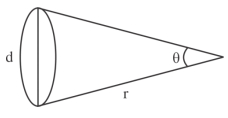
View full question & answer→MCQ 3521 Mark
A sliver wire has mass $(0.6 \pm 0.006) \; g$, radius $(0.5 \pm 0.005) \; mm$ and length $(4 \pm 0.04) \; cm$. The maximum percentage error in the measurement of its density will be $......\,\%$
Answera
$M=(0.6 \pm 0.006) \; g$
$r=(0.5 \pm 0.005) \; mm$
$l=(4 \pm 0.04) \; cm$
$\rho=\frac{m}{V}$
$\Rightarrow \frac{\Delta \rho}{\rho}=\frac{\Delta m}{m}+\frac{2 \Delta r}{r}+\frac{\Delta l}{l}$
(Volume of cylinder $=\pi r^{2} l$ )
$=\frac{0.006}{0.6}+\frac{2 \times 0.005}{0.5}+\frac{0.04}{4}$
$100 \times \frac{\Delta \rho}{\rho}=4 \times 10^{-2} \times 100$
$\frac{\Delta \rho}{\rho} \times 100=4 \%$
View full question & answer→MCQ 3531 Mark
A student in the laboratory measures thickness of a wire using screw gauge. The readings are $1.22\,mm , 1.23\,mm , 1.19\,mm$ and $1.20\,mm$. The percentage error is $\frac{ x }{121} \%$. The value of $x$ is ..............
Answerb
$X =\frac{1.22 mm +1.23 mm +1.19 mm +1.20 mm }{4}$
$X =1.21 mm$
$\Delta x =\frac{0.01+0.02+0.02+0.01}{4}=\frac{0.06}{4}=0.015$
Percentage error $=\frac{0.015}{1.21} \times 100$
$X =150$
View full question & answer→MCQ 3541 Mark
A torque meter is calibrated to reference standards of mass, length and time each with $5 \%$ accuracy. After calibration, the measured torque with this torque meter will have net accuracy of$............\%$
Answerb
Dimensional formula for Torque
$[\tau]=\left[ ML ^{2} T ^{-2}\right]$
Now
Percentage error in torque $=\% \tau=\% M +2 \% L+2 \% T$
$\% \tau=25 \%$
View full question & answer→MCQ 3551 Mark
In an experiment to find acceleration due to gravity $(g)$ using simple pendulum, time period of $0.5\,s$ is measured from time of $100$ oscillation with a watch of $1\;s$ resolution. If measured value of length is $10\; cm$ known to $1\; mm$ accuracy. The accuracy in the determination of $g$ is found to be $x \%$. The value of $x$ is
Answerb
$T=2 \pi \sqrt{\frac{\ell}{g}}$
$g=\frac{1}{4 \pi^{2}} \frac{T^{2}}{\ell}$
$\frac{\Delta g}{g}=\frac{2 \Delta T }{ T }+\frac{\Delta \ell}{\ell}$
$\frac{\Delta g}{g}=2 \cdot \frac{1}{100 \times 0.5}+\frac{1\,mm }{10\,cm }$
$\frac{\Delta g}{g}=\frac{5}{100}$
View full question & answer→MCQ 3561 Mark
A travelling microscope is used to determine the refractive index of a glass slab. If $40$ divisions are there in $1 \; cm$ on main scale and $50$ Vernier scale divisions are equal to $49$ main scale divisions, then least count of the travelling microscope is $\dots \; \times 10^{-6} \; m$
Answerd
$50 \; VSD =49 \; MSD$
$1 \; VSD =\frac{49}{50} \; MSD$
Least count $=1 MSD -1 VSD$
$=\left(1-\frac{49}{50}\right) MSD =\frac{1}{50} \; MSD$
$1 \; MSD =\frac{1}{40} \; cm$
Least count $=\frac{1}{50 \times 40} \; cm$
$=\frac{1}{2000} cm =\frac{1}{2} \times 10^{-5} \; m$
$=0.5 \times 10^{-5} \; m$
$=5 \times 10^{-6} \; m$
View full question & answer→MCQ 3571 Mark
In a vernier callipers, each $cm$ on the main scale is divided into $20$ equal parts. If tenth vernier scale division coincides with nineth main scale division. Then the value of vernier constant will be $\dots \; \times 10^{-2} \;mm$
Answerb
$20 \; MSD =1 \; cm$
$1 \; MSD =\frac{1}{20} \; cm$
$10 \; VSD =9 \; MSD$
$1 \; VSD =\frac{9}{10} \; MSD$
$=\frac{9}{10} \times \frac{1}{20} \; cm$
$1 VSD =\frac{9}{200} \; cm$
VC $=1 MSD -1 \; VSD$
$=\frac{1}{20} \; cm -\frac{9}{200} \; cm$
$=\frac{1}{200} \times 10 \; mm$
VC $=5 \times 10^{-2} \; mm$
Ans. $5$
View full question & answer→MCQ 3581 Mark
The vernier constant of Vernier callipers is $0.1 \,mm$ and it has zero error of $(-0.05) \,cm$. While measuring diameter of a sphere, the main scale reading is $1.7 \,cm$ and coinciding vernier division is $5$. The corrected diameter will be ........... $\times 10^{-2} \,cm$
Answerd
Measured diameter $= MSR + VSR \times VC$
$=1.7+0.01 \times 5$
$=1.75$
Corrected $=$ Measured - Error
$=1.75-(-0.05)$
$=1.80 \,cm$
$=180 \times 10^{-2} \,cm$
$180$
View full question & answer→MCQ 3591 Mark
A travelling microscope has $20$ divisions per $cm$ on the main scale while its Vernier scale has total $50$ divisions and $25$ Vernier scale divisions are equal to $24$ main scale divisions, what is the least count of the travelling microscope $..........\,cm$
- A
$0.001$
- B
$0.0002$
- ✓
$0.002$
- D
$0.005$
AnswerCorrect option: C. $0.002$
c
$1\,MSD =\frac{1}{20}\,cm$
$1\,VSD =\frac{24}{25}\,MSD =\frac{24}{25} \times \frac{1}{20}\,cm$
$\therefore$ Least count $=\frac{1}{20}\left(1-\frac{24}{25}\right)\,cm$
$=\frac{1}{20} \times \frac{1}{25}=\frac{1}{500}\,cm$
$=0.002\,cm$
View full question & answer→MCQ 3601 Mark
In an experiment to find out the diameter of wire using screw gauge, the following observation were noted.
$(a)$ Screw moves $0.5\,mm$ on main scale in one complete rotation
$(b)$ Total divisions on circular scale $=50$
$(c)$ Main scale reading is $2.5\,mm$
$(d)$ $45^{\text {th }}$ division of circular scale is in the pitch line
$(e)$ Instrument has $0.03 \;mm$ negative error
Then the diameter of wire is $...........\,mm$
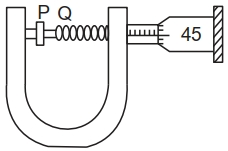
- A
$2.92$
- B
$2.54$
- ✓
$2.98$
- D
$3.45$
AnswerCorrect option: C. $2.98$
c
$MSR =2.5\,mm$
$CSR =45 \times \frac{0.5}{50}\,mm$
$=0.45\,mm$
Diameter reading $= MSR + CSR -$ zero error
$=2.5+0.45-(-0.03)$
$=2.98\,mm$
View full question & answer→MCQ 3611 Mark
For $z=a^{2} x^{3} y^{\frac{1}{2}}$, where $a$ is a constant. If percentage error in measurement of $x$ and $y$ are $4 \%$ and $12 \%$, respectively, then the percentage error for $z$ will be $%$
Answera
$z = a ^{2} x ^{3} y ^{1 / 2}$
$\frac{\Delta z }{ z }=\frac{2 \Delta a }{ a }+\frac{3 \Delta x }{ x }+\frac{1}{2}\frac{\Delta y }{ y }$
$a$ is constant
$\frac{\Delta z}{z} \times 100=3(4 \%)+\frac{1}{2}(12 \%)=18%$
View full question & answer→MCQ 3621 Mark
If $Z=\frac{A^{2} B^{3}}{C^{4}}$, then the relative error in $Z$ will be
- A
$\frac{\Delta A }{ A }+\frac{\Delta B }{ B }+\frac{\Delta C }{ C }$
- B
$\frac{2 \Delta A }{ A }+\frac{3 \Delta B }{ B }-\frac{4 \Delta C }{ C }$
- ✓
$\frac{2 \Delta A }{ A }+\frac{3 \Delta B }{ B }+\frac{4 \Delta C }{ C }$
- D
$\frac{\Delta A }{ A }+\frac{\Delta B }{ B }-\frac{\Delta C }{ C }$
AnswerCorrect option: C. $\frac{2 \Delta A }{ A }+\frac{3 \Delta B }{ B }+\frac{4 \Delta C }{ C }$
c
$Z=\frac{A^{2} B^{3}}{C^{4}}$
In case of error
$\frac{ dZ }{ Z }=\frac{2 d A}{ A }+\frac{3 dB }{ B }+\frac{4 dC }{ C }$
$\frac{\Delta Z }{ Z }=\frac{2 \Delta A }{ A }+\frac{3 \Delta B }{ B }+\frac{4 \Delta C }{ C }$
View full question & answer→MCQ 3631 Mark
The maximum error in the measurement of resistance, current and time for which current flows in an electrical circuit are $1 \%, 2 \%$ and $3 \%$ respectively. The maximum percentage error in the detection of the dissipated heat will be
Answerd
$E _{ H }= I ^{2} R \times t$
$\frac{\Delta E }{ E } \times 100=\frac{2 \Delta I }{ I } \times 100+\frac{\Delta R }{ R } \times 100+\frac{\Delta T }{ T } \times 100$
$=2 \times 2+1+3=8$
View full question & answer→MCQ 3641 Mark
An expression of energy density is given by $u=\frac{\alpha}{\beta} \sin \left(\frac{\alpha x}{k t}\right)$, where $\alpha, \beta$ are constants, $x$ is displacement, $k$ is Boltzmann constant and $t$ is the temperature. The dimensions of $\beta$ will be.
- A
$\left[ ML ^{2} T ^{-2} \theta^{-1}\right]$
- B
$\left[ M ^{0} L ^{2} T ^{-2}\right]$
- C
$\left[ M ^{0} L ^{0} T ^{0}\right]$
- ✓
$\left[ M ^{0} L ^{2} T ^{0}\right]$
AnswerCorrect option: D. $\left[ M ^{0} L ^{2} T ^{0}\right]$
d
$\frac{\alpha[ L ]}{\left[ ML ^{2} T ^{-2}\right]}=\left[ M ^{0} L ^{0} T ^{0}\right]$
$\alpha=\left[ ML ^{1} T ^{-2}\right]$
$\frac{\alpha}{\beta}=\frac{\left[ ML ^{2} T ^{-2}\right]}{\left[ L ^{3}\right]} \Rightarrow \beta=\frac{\left[ ML ^{1} T ^{-2}\right]\left[ L ^{3}\right]}{ ML ^{2} T ^{-2}}$
View full question & answer→MCQ 3651 Mark
Velocity $(v)$ and acceleration $(a)$ in two systems of units $1$ and $2$ are related as $V _{2}=\frac{ n }{ m ^{2}} v _{1}$ and $a_{2}=\frac{a_{1}}{m n}$ respectively. Here $m$ and $n$ are constants. The relations for distance and time in two systems respectively are
- ✓
$\frac{ n ^{3}}{ m ^{3}} L _{1}= L _{2}$ and $\frac{ n ^{2}}{ m } T _{1}= T _{2}$
- B
$L_{1}=\frac{n^{4}}{m^{2}} L_{2}$ and $T_{1}=\frac{n^{2}}{m} T_{2}$
- C
$L _{1}=\frac{ n ^{2}}{ m } L _{2}$ and $T _{1}=\frac{ n ^{4}}{ m ^{2}} T _{2}$
- D
$\frac{ n ^{2}}{ m } L _{1}= L _{2}$ and $\frac{ n ^{4}}{ m ^{2}} T _{1}= T _{2}$
AnswerCorrect option: A. $\frac{ n ^{3}}{ m ^{3}} L _{1}= L _{2}$ and $\frac{ n ^{2}}{ m } T _{1}= T _{2}$
a
$\frac{ L _{2}}{ T _{2}}=\frac{ n }{ m ^{2}} \frac{ L _{2}}{ T _{1}}$
$\frac{ L _{2}}{ T _{2}^{2}}=\frac{ L _{1}}{ T _{1}^{2} \times mn }$
$\frac{ n }{ m ^{2}} \times \frac{ T _{2}}{ T _{1}}=\frac{ T _{2}^{2}}{ T _{1}^{2} \times mn }$
$\frac{ n ^{2}}{ m }=\frac{ T _{2}}{ T _{1}}$
$\frac{ L _{2}}{ L _{1}}=\frac{ n ^{4}}{ m ^{2}} \times \frac{1}{ mn }$
$\frac{ L _{2}}{ L _{1}}=\frac{ n ^{5}}{ m ^{3}}$
View full question & answer→MCQ 3661 Mark
Which of the following physical quantities have the same dimensions?
AnswerCorrect option: A. Electric displacement $(\overrightarrow{ D })$ and surface charge density
a
Electric displacement
$\overrightarrow{ D }=\in_{0} \overrightarrow{ E }$
$[ D ]=\left[\in_{0} E \right]=\left[\in_{0} \frac{\sigma}{\in_{0}}\right]$
$[ D ]=[\sigma]$
$\rightarrow$ Surface change density $=\sigma$.
View full question & answer→MCQ 3671 Mark
In an experiment of determine the Young's modulus of wire of a length exactly $1\; m$, the extension in the length of the wire is measured as $0.4\,mm$ with an uncertainty of $\pm 0.02\,mm$ when a load of $1\,kg$ is applied. The diameter of the wire is measured as $0.4\,mm$ with an uncertainty of $\pm 0.01\,mm$. The error in the measurement of Young's modulus $(\Delta Y)$ is found to be $x \times 10^{10}\,Nm ^{-2}$. The value of $x$ is
$\left[\right.$ Take $\left.g =10\,m / s ^{2}\right]$
Answerc
$L =1\,m$
$\Delta L =0.4 \times 10^{-3} m$
$m =1\,kg$
$d =0.4 \times 10^{-3}\,m$
$\frac{ F }{ A }= Y \frac{\Delta L }{ L }$
$Y =\frac{ FL }{ A \Delta L }=\frac{( mg ) \cdot(1)}{\left(\frac{\pi d ^{2}}{4}\right) 0.4 \times 10^{-3}}$
$\Rightarrow \frac{10 \times 4}{\pi\left(0.4 \times 10^{-3}\right)^{2} \times 0.4 \times 10^{-3}}$
$Y =\frac{40}{\pi\left(0.4 \times 10^{-3}\right)^{3}}$
$Y =\frac{40 \times 7}{22 \times 64 \times 10^{-3} \times 10^{-9}}$
$Y =0.199 \times 10^{-12} N / m ^{2}$
$\frac{\Delta Y }{ Y }=\frac{\Delta F }{ F }+\frac{\Delta L }{ L }+\frac{\Delta A }{ A }+\frac{\Delta(\Delta L )}{(\Delta L )}$
$=\frac{0.02}{0.4}+2 \frac{\Delta d }{ d }=\frac{0.2}{4}+2 \times \frac{0.01}{0.4}$
$=\frac{0.1}{2}+\frac{0.1}{2}=0.1$
$\Rightarrow \Delta Y =0.1 \times Y$
$=0.199 \times 10^{11}=1.99 \times 10^{10}$
View full question & answer→MCQ 3681 Mark
In a Vernier Calipers. $10$ divisions of Vernier scale is equal to the $9$ divisions of main scale. When both jaws of Vernier calipers touch each other, the zero of the Vernier scale is shifted to the left of $zero$ of the main scale and $4^{\text {th }}$ Vernier scale division exactly coincides with the main scale reading. One main scale division is equal to $1\,mm$. While measuring diameter of a spherical body, the body is held between two jaws. It is now observed that zero of the Vernier scale lies between $30$ and $31$ divisions of main scale reading and $6^{\text {th }}$ Vernier scale division exactly. coincides with the main scale reading. The diameter of the spherical body will be $.......cm$
- A
$3.02$
- B
$3.06$
- ✓
$3.10$
- D
$3.20$
AnswerCorrect option: C. $3.10$
c
$1 \text { M.S.D }=1\,mm$
$9 \text { M.S.D }=10 \text { V.S.D }$
$\text { 1 V.S.D }=0.9 \text { M.S.D }=0.9\,mm$
$\text { L.C of vernier caliper }=1-0.9=0.1\,mm =0.01\,cm$
$\text { zero error }=-(10-4) \times 0.1\,mm =-0.6\,mm$
$\text { Reading }=\text { M.S.R }+\text { V.S.R }-\text { Zero error }$
$=3\,cm +6 \times 0.01-[-0.06]$
$=3+0.06+0.06$
$=3.12\,cm$
Nearest given answer in the options is $3.10$
View full question & answer→MCQ 3691 Mark
A screw gauge of pitch $0.5\,mm$ is used to measure the diameter of uniform wire of length $6.8\,cm$, the main scale reading is $1.5\,mm$ and circular scale reading is $7$. The calculated curved surface area of wire to appropriate significant figures is $......cm^2$ . [Screw gauge has $50$ divisions on the circular scale]
Answerb
$ L.C.=\frac{P}{N}=\frac{0.5\,mm}{50}=0.01\,mm$
Length of wire $=6.8 cm$
Diameter of wire $=1.5\,mm +7 \times L.C$
$=1.5\, mm +7 \times .01=1.57\,mm$
Curved surface area $=\pi Dl$
$=3.14 \times 6.8 \times 1.57 \times 10^{-1} cm^{2}$
$=3.352\,cm ^{2}=3.4\,cm ^{2}$
View full question & answer→MCQ 3701 Mark
The one division of main scale of vernier callipers reads $1\,mm$ and $10$ divisions of Vernier scale is equal to the $9$ divisions on main scale. When the two jaws of the instrument touch each other the $zero$ of the Vernier lies to the right of $zero$ of the main scale and its fourth division coincides with a main scale division. When a spherical bob is tightly placed between the two jaws, the $zero$ of the Vernier scale lies in between $4.1\,cm$ and $4.2\,cm$ and $6^{\text {th }}$ Vernier division coincides with a main scale division. The diameter of the bob will be $.............10^{-2}\,cm$
Answerd
$10\,VSD =9\,MSD$
$1\,VST =.9\,MSD$
$L.C.$ $=1\,mm =.01\,cm$
$+ve$ zero error $=4\,mm$
$=0.04\,cm$
Negative zero error $=4.1\,cm +6 \times .01$
$=4.12\,cm$
$=412 \times 10^{-2}\,cm$
View full question & answer→MCQ 3711 Mark
If ${E}, {L}, {m}$ and ${G}$ denote the quantities as energy, angular momentum, mass and constant of gravitation respectively, then the dimensions of ${P}$ in the formula ${P}={EL}^{2} {m}^{-5} {G}^{-2}$ are
- A
$\left[{M}^{0} {L}^{1} {T}^{0}\right]$
- B
$\left[{M}^{-1} {L}^{-1} {T}^{2}\right]$
- C
$\left[{M}^{1} {L}^{1} {T}^{-2}\right]$
- ✓
$\left[{M}^{0} {L}^{0} {T}^{0}\right]$
AnswerCorrect option: D. $\left[{M}^{0} {L}^{0} {T}^{0}\right]$
d
${E}={ML}^{2} {T}^{-2}$
${L}={ML}^{2} {T}^{-1}$
${m}={M}$
${G}={M}^{-1} {L}^{+3} {T}^{-2}$
${P}=\frac{{EL}^{2}}{{M}^{5} {G}^{2}}$
${[{P}]=\frac{\left({ML}^{2} {T}^{-2}\right)\left({M}^{2} {L}^{4} {T}^{-2}\right)}{{M}^{5}\left({M}^{-2} {L}^{6} {T}^{-4}\right)}={M}^{0} {L}^{0} {T}^{0}}$
View full question & answer→MCQ 3721 Mark
If time $(t)$, velocity $(u)$, and angular momentum $(I)$ are taken as the fundamental units. Then the dimension of mass $({m})$ in terms of ${t}, {u}$ and ${I}$ is
- ✓
$[t^{-1} u^{-2}\,I^{1}]$
- B
$[t^{1} u^{2}\,I^{-1}]$
- C
$[t^{-2} u^{-1}\,I^{1}]$
- D
$[t^{-1} u^{1}\,I^{-2}]$
AnswerCorrect option: A. $[t^{-1} u^{-2}\,I^{1}]$
a
$m \propto t^{a} v^{b} \ell^{c}$
$m \propto[T]^{a}\left[L T^{-1}\right]^{b}\left[M L^{2} T^{-1}\right]^{c}$
$M^{1} L^{0} T^{0}=M^{c} L^{b+2 c} T^{a-b-c}$
comparing powers
$v=1, b=-2, a=-1$
$m \propto t^{-1} v^{-2} \ell^{1}$
View full question & answer→MCQ 3731 Mark
If velocity $[V],$ time $[T]$ and force $[F]$ are chosen as the base quantities, the dimensions of the mass will be
- A
$\left[{FT}^{-1} {V}^{-1}\right]$
- ✓
$[FTV$ $\left.^{-1}\right]$
- C
$\left[{FT}^{2} {V}\right]$
- D
$\left[{FVT}^{-1}\right]$
AnswerCorrect option: B. $[FTV$ $\left.^{-1}\right]$
b
${[{M}]={K}[{F}]^{{a}}[{T}]^{{b}}[{V}]^{c}}$
${\left[{M}^{1}\right]=\left[{M}^{1} {L}^{1} {T}^{-2}\right]^{{a}}\left[{T}^{{l}}\right]^{{b}}\left[{L}^{1} {T}^{-1}\right]^{c}}$
${a}=1, {b}=1, {c}=-1$
$\therefore[{M}]=\left[{FTV}^{-1}\right]$
View full question & answer→MCQ 3741 Mark
Match List$-I$ with List$-II.$
| List$-I$ |
List$-II$ |
| $(a)$ Capacitance, $C$ |
$(i)$ ${M}^{1} {L}^{1} {T}^{-3} {A}^{-1}$ |
| $(b)$ Permittivity of free space, $\varepsilon_{0}$ |
$(ii)$ ${M}^{-1} {L}^{-3} {T}^{4} {A}^{2}$ |
| $(c)$ Permeability of free space, $\mu_{0}$ |
$(iii)$ ${M}^{-1} L^{-2} T^{4} A^{2}$ |
| $(d)$ Electric field, $E$ |
$(iv)$ ${M}^{1} {L}^{1} {T}^{-2} {A}^{-2}$ |
Choose the correct answer from the options given below
- ✓
$(a) \rightarrow(i i i),(b) \rightarrow(i i),(c) \rightarrow(i v),(d) \rightarrow(i)$
- B
$(a) \rightarrow(i i i),(b) \rightarrow(i v),(c) \rightarrow(i i),(d) \rightarrow(i)$
- C
$(a) \rightarrow(iv),(b) \rightarrow(i i),(c) \rightarrow(iii),(d) \rightarrow(i)$
- D
$(a) \rightarrow(iv),(b) \rightarrow(iii),(c) \rightarrow(ii),(d) \rightarrow(i)$
AnswerCorrect option: A. $(a) \rightarrow(i i i),(b) \rightarrow(i i),(c) \rightarrow(i v),(d) \rightarrow(i)$
a
As we know
$q=C V$
${[C]=\left[\frac{q}{V}\right]=\frac{(A \times T)^{2}}{M L^{2} T^{-2}}}$
$=M^{-1} L^{-2} T^{4} A^{2}$
${[E]=\left[\frac{F}{q}\right]=\frac{M L T^{-2}}{A T}}$
$=M L T_{q}^{-3} A^{-1}$
$F=\frac{q_{1} q_{2}}{4 \pi \in_{0} r^{2}}$
${\left[\in_{0}\right]=M^{-1} L^{-3} T^{4} A^{2}}$
$\text { Speed of light } c=\frac{1}{\sqrt{\mu_{0} \in_{0}}}$
$\mu_{0}=\frac{1}{\in_{0} c^{2}}$
${\left[\mu_{0}\right]=\frac{1}{\left[M^{-1} L^{-3} T^{4} A^{2}\right]\left[L T^{-1}\right]^{2}}}$
$=\left[M^{1} L^{1} T^{-2} A^{-2}\right]$
View full question & answer→MCQ 3751 Mark
Match List$-I$ with List$-II.$
| List$-I$ |
List$-II$ |
| $(a)$ Magnetic Induction |
$(i)$ ${ML}^{2} {T}^{-2} {A}^{-1}$ |
| $(b)$ Magnetic Flux |
$(ii)$ ${M}^{0} {L}^{-1} {A}$ |
| $(c)$ Magnetic Permeability |
$(iii)$ ${MT}^{-2} {A}^{-1}$ |
| $(d)$ Magnetization |
$(iv)$ ${MLT}^{-2} {A}^{-2}$ |
Choose the most appropriate answer from the options given below:
- A
$(a)-(ii), (b)-(iv), (c)-(i), (d)-(iii)$
- B
$(a)-(ii), (b)-(i), (c)-(iv), (d)-(iii)$
- C
$(a)-(iii), (b)-(ii), (c)-(iv), (d)-(i)$
- ✓
$(a)-(iii), (b)-(i), (c)-(iv), (d)-(ii)$
AnswerCorrect option: D. $(a)-(iii), (b)-(i), (c)-(iv), (d)-(ii)$
d
$(a)$ Magnetic Induction $={MT}^{-2} {A}^{-1}$
$(b)$ Magnetic Flux $={ML}^{2} {T}^{2} {A}^{-1}$
$(c)$ Magnetic Permeability $={MLT}^{-2} {A}^{-2}$
$(d)$ Magnetization $={M}^{0} {L}^{-1} {A}$
View full question & answer→MCQ 3761 Mark
Match List$-I$ with List$-II.$
| List$-I$ |
List$-II$ |
| $(a)$ Torque |
$(i)$ ${MLT}^{-1}$ |
| $(b)$ Impulse |
$(ii)$ ${MT}^{-2}$ |
| $(c)$ Tension |
$(iii)$ ${ML}^{2} {T}^{-2}$ |
| $(d)$ Surface Tension |
$(iv)$ ${MI} {T}^{-2}$ |
Choose the most appropriate answer from the option given below :
- ✓
$(a)-(iii), (b) -(i), (c)-(iv), (d)-(ii)$
- B
$(a)-(ii), (b)-(i), (c)-(iv), (d)-(iii)$
- C
$(a)-(i), (b)-(iii), (c)-(iv), (d)-(ii)$
- D
$(a)-(iii), (b)-(iv), (c)-(i), (d)-(ii)$
AnswerCorrect option: A. $(a)-(iii), (b) -(i), (c)-(iv), (d)-(ii)$
a
torque $\tau \rightarrow {ML}^{2} {T}^{-2}$ $(III)$
Impulse $I$ $\Rightarrow {MLT}^{-1}$ $(I)$
Tension force $\Rightarrow {MLT}^{-2}$ $(IV)$
Surface tension $\Rightarrow {MT}^{-2}$ $(II)$
View full question & answer→MCQ 3771 Mark
Match List$-I$ with List$-II$
| List$-I$ |
List$-II$ |
| $(a)$ $h$ (Planck's constant) |
$(i)$ $\left[ M L T ^{-1}\right]$ |
| $(b)$ $E$ (kinetic energy) |
$(ii)$ $\left[ M L ^{2} T ^{-1}\right]$ |
| $(c)$ $V$ (electric potential) |
$(iii)$ $\left[ M L ^{2} T ^{-2}\right]$ |
| $(d)$ $P$ (linear momentum) |
$( iv )\left[ M L ^{2} I ^{-1} T ^{-3}\right]$ |
Choose the correct answer from the options given below
- A
$( a ) \rightarrow( iii ),( b ) \rightarrow( iv ),( c ) \rightarrow( ii ),( d ) \rightarrow( i )$
- ✓
$(a) \rightarrow( ii ),( b ) \rightarrow( iii ),( c ) \rightarrow( iv ),( d ) \rightarrow( i )$
- C
$(a)\rightarrow( i ),( b ) \rightarrow( ii ),( c ) \rightarrow( iv ),( d ) \rightarrow( iii )$
- D
$(a)\rightarrow( iii ),( b ) \rightarrow( ii ),( c ) \rightarrow( iv ),( d ) \rightarrow( i )$
AnswerCorrect option: B. $(a) \rightarrow( ii ),( b ) \rightarrow( iii ),( c ) \rightarrow( iv ),( d ) \rightarrow( i )$
b
By dimensional analysis.
View full question & answer→MCQ 3781 Mark
The force is given in terms of time $t$ and displacement $x$ by the equation
${F}={A} \cos {Bx}+{C} \sin {Dt}$
The dimensional formula of $\frac{{AD}}{{B}}$ is -
- ✓
$\left[{ML}^{2} {T}^{-3}\right]$
- B
$\left[{M}^{2} L^{2} {T}^{-3}\right]$
- C
$\left[{M}^{1} {L}^{1} {T}^{-2}\right]$
- D
$\left[{M}^{0} {LT}^{-1}\right]$
AnswerCorrect option: A. $\left[{ML}^{2} {T}^{-3}\right]$
a
$\theta$ of cos or sin should be dimensionless.
${[ A ]=\left[ MLT ^{-2}\right] }$
${[ B ]=\left[ L ^{-1}\right] }$
${[ D ]=\left[ T ^{-1}\right] }$
${\left[\frac{ AD }{ B }\right]=\frac{\left[ MLT ^{-2}\right]\left[ T ^{-1}\right]}{\left[ L ^{-1}\right]} }$
${\left[\frac{ AD }{ B }\right]=\left[ ML ^{2} T ^{-3}\right] }$
View full question & answer→MCQ 3791 Mark
The resistance $R =\frac{ V }{ I },$ where $V =(50 \pm 2) \;V$ and $I=(20 \pm 0.2)\;A.$ The percentage error in $R$ is $x\%$. The value of $x$ to the nearest integer is .........
Answerd
$\frac{\Delta R }{ R } \times 100=\frac{\Delta V }{ V } \times 100+\frac{\Delta I }{ I } \times 100$
$\%$ error in $R =\frac{2}{50} \times 100+\frac{0.2}{20} \times 100$
$\%$ error in $R =4+1$
$\%$ error in $R =5 \%$
View full question & answer→MCQ 3801 Mark
The radius of a sphere is measured to be $(7.50 \pm 0.85) \,cm .$ Suppose the percentage error in its volume is $x$. The value of $x$, to the nearest integer is .....$\%$
Answerb
$\because V =\frac{4}{3} \pi r ^{3}$
taking log and then differentiate
$\frac{ dV }{ V }=3 \frac{ dr }{ r }$
$=\frac{3 \times 0.85}{7.5} \times 100\, \%=34\, \%$
View full question & answer→MCQ 3811 Mark
The period of oscillation of a simple pendulum is $T =2 \pi \sqrt{\frac{ L }{ g }} .$ Measured value of $ L $ is $1.0\, m$ from meter scale having a minimum division of $1 \,mm$ and time of one complete oscillation is $1.95\, s$ measured from stopwatch of $0.01 \,s$ resolution. The percentage error in the determination of $g$ will be ..... $\%.$
- ✓
$1.13$
- B
$1.03$
- C
$1.33$
- D
$1.30$
AnswerCorrect option: A. $1.13$
a
$T =2 \pi \sqrt{\frac{\ell}{ g }}$
$g =\frac{4 \pi^{2} \ell}{ T ^{2}}$
$\frac{\Delta g }{ g }=\frac{\Delta \ell}{\ell}+\frac{2 \Delta T }{ T }$
$\frac{\Delta g }{ g }=\frac{1 \times 10^{-3}}{1}+2 \times \frac{0.01}{1.95}$
$\frac{\Delta g }{ g }=0.0113$ or $1.13\, \%$
View full question & answer→MCQ 3821 Mark
A physical quantity $y$ is represented by the formula $y=m^{2}\, r^{-4}\, g^{x}\,l^{-\frac{3}{2}}$. If the percentage error found in $y, m, r, l$ and $g$ are $18,1,0.5,4$ and $p$ respectively, then find the value of $x$ and $p$.
AnswerCorrect option: D. $\frac{16}{3}$ and $\pm \frac{3}{2}$
d
$\frac{\Delta y}{y}=\frac{2 \Delta m}{m}+\frac{4 \Delta r}{r}+\frac{x \Delta g}{g}+\frac{3}{2} \frac{\Delta \ell}{\ell}$
$18=2(1)+4(0.5)+x p+\frac{3}{2}(4)$
$8=x p$
By checking from options.
$x=\frac{16}{3}, p=\pm \frac{3}{2}$
View full question & answer→MCQ 3831 Mark
One main scale division of a vernier callipers is $a$ $cm$ and $n ^{\text {th }}$ division of the vernier scale coincide with $( n -1)^{\text {th }}$ division of the main scale. The least count of the callipers in $mm$ is
AnswerCorrect option: D. $\frac{10 a }{ n }$
d
$(n-1) a=n\left(a^{\prime}\right)$
$a^{\prime}=\frac{(n-1) a}{n}$
$\therefore L \cdot C \cdot=1 M S D-1 VSD$
$=\left(a-a^{\prime}\right) c m$
$=a-\frac{(n-1) a}{n}$
$=\frac{n a-n a+a}{n}=\frac{a}{n} c m$
$=\left(\frac{10 a}{n}\right) m m$
View full question & answer→MCQ 3841 Mark
The vernier scale used for measurement has a positive zero error of $0.2\, mm$. If while taking a measurement it was noted that $'0'$ on the vernier scale lies between $8.5\, cm$ and $8.6\, cm$ vernier coincidence is $6,$ then the correct value of measurement is ............. $cm$. (least count $=0.01\, cm )$
- A
$8.36$
- ✓
$8.54$
- C
$8.58$
- D
$8.56$
AnswerCorrect option: B. $8.54$
b
Positive zero error $=0.2 mm$
Main scale reading $=8.5 cm$
Vernier scale reading $=6 \times 0.01=0.06 cm$
Final reading $=8.5+0.06-0.02=8.54 cm$
View full question & answer→MCQ 3851 Mark
Asseretion $A:$ If in five complete rotations of the circular scale, the distance travelled on main scale of the screw gauge is $5\, {mm}$ and there are $50$ total divisions on circular scale, then least count is $0.001\, {cm}$.
Reason $R:$ Least Count $=\frac{\text { Pitch }}{\text { Total divisions on circular scale }}$
In the light of the above statements, choose the most appropriate answer from the options given below:
- A
Both $A$ and $R$ are correct and $R$ is the correct explanation of $A$
- ✓
$A$ is not correct but $R$ is correct.
- C
Both $A$ and $R$ are correct and $R$ is NOT the correct explanation of $A$.
- D
${A}$ is correct but ${R}$ is not correct.
AnswerCorrect option: B. $A$ is not correct but $R$ is correct.
b
Least count $=\frac{\text { Pitch }}{\text { total division on circular scale }}$
In $5$ revolution, distance travel, $5 \,mm$
In $1$ revolution, it will travel $1 \,mm$.
So least count $=\frac{1}{50}=0.02$
View full question & answer→MCQ 3861 Mark
If ${E}$ and ${H}$ represents the intensity of electric field and magnetising field respectively, then the unit of $E/H$ will be :
- ✓
$ohm$
- B
$mho$
- C
$joule$
- D
$newton$
Answera
Unit of $\frac{E}{H}$ is $\frac{\text { volt / metre }}{\text { Ampere / metre }}=\frac{\text { volt }}{\text { Ampere }}=$ $ohm$
View full question & answer→MCQ 3871 Mark
Match List$-I$ with List$-II$.
| List$-I$ |
List$-II$ |
| $(a)$ ${R}_{{H}}$ (Rydberg constant) |
$(i)$ ${kg} {m}^{-1} {s}^{-1}$ |
| $(b)$ $h$ (Planck's constant) |
$(ii)$ ${kg} {m}^{2} {s}^{-1}$ |
| $(c)$ $\mu_{{B}}$ (Magnetic field energy density) |
$(iii)$ ${m}^{-1}$ |
| $(d)$ $\eta$ (coefficient of viscocity) |
$(iv)$ ${kg} {m}^{-1} {s}^{-2}$ |
Choose the most appropriate answer from the options given below:
- A
$(a)-(ii), (b)-(iii), (c)-(iv), (d)-(i)$
- ✓
$(a)-(iii), (b)-(ii), (c)-(iv), (d)-(i)$
- C
$(a)-(iv), (b)-(ii), (c)-(i), (d)-(iii)$
- D
$(a)-(iii), (b)-(ii), (c)-(i), (d)-(iv)$
AnswerCorrect option: B. $(a)-(iii), (b)-(ii), (c)-(iv), (d)-(i)$
b
$SI$ unit of Rydberg const. $={m}^{-1}$
$SI$ unit of Plank's const. $={kg} {m}^{2} {s}^{-1}$
$SI$ unit of Magnetic field energy density $={kg} {m}^{-1} {s}^{-2}$
$SI$ unit of coeff. of viscosity $={kg} {m}^{-1} {s}^{-1}$
View full question & answer→MCQ 3881 Mark
If $C$ and $V$ represent capacity and voltage respectively then what are the dimensions of $\lambda,$ where $\frac{ C }{ V }=\lambda ?$
- A
$\left[ M ^{-2} L ^{-3} I ^{2} T ^{6}\right]$
- B
$\left[ M ^{-3} L ^{-4} I ^{3} T ^{7}\right]$
- C
$\left[ M ^{-1} L ^{-3} I ^{-2} T ^{-7}\right]$
- ✓
$\left[ M ^{-2} L ^{-4} I ^{3} T ^{7}\right]$
AnswerCorrect option: D. $\left[ M ^{-2} L ^{-4} I ^{3} T ^{7}\right]$
d
$\lambda=\frac{ C }{ V }=\frac{ Q / V }{ V }=\frac{ Q }{ V ^{2}}$
$V =\frac{\text { work }}{ Q }$
$\lambda=\frac{ Q ^{3}}{(\text { work })^{2}}=\frac{( It )^{3}}{( F . s )^{2}}$
$=\frac{\left[ I ^{3} T ^{3}\right]}{\left[ ML ^{2} T ^{-2}\right]^{2}}=\left[ M ^{-2} L ^{-4} I ^{3} T ^{7}\right]$
View full question & answer→MCQ 3891 Mark
If e is the electronic charge, $c$ is the speed of light in free space and $h$ is Planck's constant, the quantity $\frac{1}{4 \pi \varepsilon_{0}} \frac{| e |^{2}}{h c}$ has dimensions of .......
- ✓
$\left[ M ^{0} L ^{0} T ^{0}\right]$
- B
$\left[ L C ^{-1}\right]$
- C
$\left[ M L T ^{-1}\right]$
- D
$\left[ M L T ^{0}\right]$
AnswerCorrect option: A. $\left[ M ^{0} L ^{0} T ^{0}\right]$
a
$F =\frac{1}{4 \pi \in_{0}} \frac{ e ^{2}}{ r ^{2}}$
$E =\frac{ hc }{\lambda}$
$\left[\frac{ e ^{2}}{4 \pi \varepsilon_{0}} \times \frac{1}{ hc }\right]=\frac{ Fr ^{2}}{ E \lambda}=\left( M ^{0} L ^{0} T ^{0}\right)$
View full question & answer→MCQ 3901 Mark
If force $({F})$, length $({L})$ and time $({T})$ are taken as the fundamental quantities. Then what will be the dimension of density
- ✓
$\left[{FL}^{-4} {T}^{2}\right]$
- B
$\left[{FL}^{-3} {T}^{2}\right]$
- C
$\left[{FL}^{-5} {T}^{2}\right]$
- D
$\left[{FL}^{-3} {T}^{3}\right]$
AnswerCorrect option: A. $\left[{FL}^{-4} {T}^{2}\right]$
a
$\text { Density }=\left[{F}^{{a}} {L}^{{b}} {T}^{{c}}\right]$
${\left[{ML}^{-3}\right]=\left[{M}^{{a}} {L}^{{a}} {T}^{-2 {a}} {L}^{{b}} {T}^{{c}}\right]}$
${\left[{M}^{1} {L}^{-3}\right]=\left[{M}^{{a}} {L}^{{a}+{b}} {T}^{-2 {a}+c}\right]}$
${a}=1 ; \quad {a}+{b}=-3 \quad ; \quad-2 {a}+{c}=0$
$\quad 1+{b}=-3 \quad {c}=2 {a}$
${b}=-4 \quad {c}=2$
So, density $=\left[{F}^{1} {L}^{-4} {T}^{2}\right]$
View full question & answer→MCQ 3911 Mark
In a typical combustion engine the work done by a gas molecule is given $W =\alpha^{2} \beta e ^{\frac{-\beta x ^{2}}{ KT }}$, where $x$ is the displacement, $k$ is the Boltzmann constant and $T$ is the temperature. If $\alpha$ and $\beta$ are constants, dimensions of $\alpha$ will be
- A
$\left[ MLT ^{-2}\right]$
- ✓
$\left[ M ^{0} LT ^{0}\right]$
- C
$\left[ M ^{2} LT ^{-2}\right]$
- D
$\left[ MLT ^{-1}\right]$
AnswerCorrect option: B. $\left[ M ^{0} LT ^{0}\right]$
b
$kT$ has dimension of energy
$\frac{\beta x ^{2}}{ kT }$ is dimensionless
$[\beta]\left[ L ^{2}\right]=\left[ ML ^{2} T ^{-2}\right]$
$[\beta]=\left[ MT ^{-2}\right]$
$\alpha^{2} \beta$ has dimensions of work
$\left[\alpha^{2}\right]\left[ MT ^{-2}\right]=\left[ ML ^{2} T ^{-2}\right]$
$[\alpha]=\left[ M ^{0} LT ^{0}\right]$
View full question & answer→MCQ 3921 Mark
The entropy of any system is given by
${S}=\alpha^{2} \beta \ln \left[\frac{\mu {kR}}{J \beta^{2}}+3\right]$
Where $\alpha$ and $\beta$ are the constants. $\mu, J, K$ and $R$ are no. of moles, mechanical equivalent of heat, Boltzmann constant and gas constant repectively. [Take ${S}=\frac{{dQ}}{{T}}$ ]
Choose the incorrect option from the following:
- A
${S}, \beta, {k}$ and $\mu {R}$ have the same dimensions.
- B
$\alpha$ and ${J}$ have the same dimensions.
- C
${S}$ and $\alpha$ have different dimensions.
- ✓
$\alpha$ and ${k}$ have the same dimensions.
AnswerCorrect option: D. $\alpha$ and ${k}$ have the same dimensions.
d
$S=\alpha^{2} \beta \ell {n}\left(\frac{\mu K R}{j \beta^{2}}+3\right)$
$S=\frac{Q}{T}=\text { Joule } / k$
$P V=n R T \quad\left[\frac{\mu K R}{J \beta^{2}}\right]=1$
${R=\frac{\text { Joule }}{K}}$
${\Rightarrow \beta=\left(\frac{\text { Joule }}{K}\right)}$
${\Rightarrow \alpha=\text { dimensionless }}$
View full question & answer→MCQ 3931 Mark
The workdone by a gas molecule in an isolated system is given by, $W =\alpha \beta^{2} e ^{-\frac{ x ^{2}}{\alpha kT }},$ where $x$ is the displacement, $k$ is the Boltzmann constant and $T$ is the temperature, $\alpha$ and $\beta$ are constants. Then the dimension of $\beta$ will be
- A
$\left[ M L ^{2} T ^{-2}\right]$
- ✓
$\left[ M L T ^{-2}\right]$
- C
$\left[ M ^{2} L T ^{2}\right]$
- D
$\left[ M ^{0} L T ^{0}\right]$
AnswerCorrect option: B. $\left[ M L T ^{-2}\right]$
b
$\frac{ x ^{2}}{\alpha kT } \rightarrow$ dimensionless
$\Rightarrow[\alpha]=\frac{\left[ x ^{2}\right]}{[ kT ]}=\frac{ L ^{2}}{ ML ^{2} T ^{-2}}= M ^{-1} T ^{2}$
Now $[ W ]=[\alpha][\beta]^{2}$
$[\beta]=\sqrt{\frac{ ML ^{2} T ^{-2}}{ M ^{-1} T ^{2}}}= M ^{1} L ^{1} T ^{-2}$
View full question & answer→MCQ 3941 Mark
Which of the following equations is dimensionally incorrect?
Where $t=$ time, $h=$ height, $s=$ surface tension, $\theta=$ angle, $\rho=$ density, $a, r=$ radius, $g=$ acceleration due to gravity, ${v}=$ volume, ${p}=$ pressure, ${W}=$ work done, $\Gamma=$ torque, $\varepsilon=$ permittivity, ${E}=$ electric field, ${J}=$ current density, ${L}=$ length.
- ✓
${v}=\frac{\pi {pa}^{4}}{8 \eta {L}}$
- B
${h}=\frac{2 {s} \cos \theta}{\rho {rg}}$
- C
${J}=\varepsilon \frac{\partial {E}}{\partial {t}}$
- D
${W}=\Gamma \theta$
AnswerCorrect option: A. ${v}=\frac{\pi {pa}^{4}}{8 \eta {L}}$
a
$(i)$ $\frac{\pi {pa}^{4}}{8 \eta {L}}=\frac{{d} {v}}{{dt}}=$ Volumetric flow rate
(poiseuille's law)
$(ii)$ ${h} \rho {g}=\frac{2 {s}}{{r}} \cos \theta$
$(iii)$ ${RHS} \Rightarrow \varepsilon \times \frac{1}{4 \pi \varepsilon_{0}} \frac{{a}}{{r}^{2}} \times \frac{1}{\varepsilon}=\frac{{q}}{{t}} \times \frac{1}{{r}^{2}}$ $=\frac{{I}}{{L}^{2}}={IL}^{-2}$
$LHS$
${T}=\frac{{I}}{{A}}={IL}^{-2}$
$(iv)$ ${W}=\tau \theta$
View full question & answer→MCQ 3951 Mark
Which of the following is not a dimensionless quantity?
AnswerCorrect option: C. Permeability of free space $\left(\mu_{0}\right)$
c
$\left[\mu_{{}}\right]=1 \text { as } \mu_{{r}}=\frac{\mu}{\mu_{{m}}}$
[power factor $(\cos \phi)]=1$
$\mu_T{0}=\frac{{B}_{0}}{{H}}\left(\right.$ unit $\left.={NA}^{-2}\right)$ : Not dimensionless
$\left[\mu_{0}\right]=\left[{MLT}^{-2} {A}^{-2}\right]$
quality factor (Q) $=\frac{\text { Energystored }}{\text { Energy dissipated per cycle }}$
So $Q$ is unitless $\&$ dimensionless.
View full question & answer→MCQ 3961 Mark
The time period of a simple pendulum is given by $T =2 \pi \sqrt{\frac{\ell}{ g }}$. The measured value of the length of pendulum is $10\, cm$ known to a $1\, mm$ accuracy. The time for $200$ oscillations of the pendulum is found to be $100$ second using a clock of $1s$ resolution. The percentage accuracy in the determination of $'g'$ using this pendulum is $'x'$. The value of $'x'$ to the nearest integer is ...........$\%$
Answerb
$g=\frac{4 \pi^{2} \ell}{T^{2}}$
$\frac{\Delta g}{g}=\frac{\Delta \ell}{\ell}+2 \frac{\Delta T}{T}=\frac{0.1}{10}+2\left(\frac{\frac{1}{200}}{0.5}\right)$
$\frac{\Delta g}{g}=\frac{1}{100}+\frac{1}{50}$
$\frac{\Delta g}{g} \times 100=3 \%$
View full question & answer→MCQ 3971 Mark
In order to determine the Young's Modulus of a wire of radius $0.2\, cm$ (measured using a scale of least count $=0.001\, cm )$ and length $1 \,m$ (measured using a scale of least count $=1\, mm$ ), a weight of mass $1\, kg$ (measured using a scale of least count $=1 \,g$ ) was hanged to get the elongation of $0.5\, cm$ (measured using a scale of least count $0.001\, cm$ ). What will be the fractional error in the value of Young's Modulus determined by this experiment? (in $\%$)
Answerd
$Y=\frac{\text { Stress }}{\text { Strain }}=\frac{ FL }{ Al }=\frac{ mg . L }{\pi R ^{2} \cdot \ell}$
$\frac{\Delta Y }{ Y }=\frac{\Delta m }{ m }+\frac{\Delta L }{ L }+2 \cdot \frac{\Delta R }{ R }+\frac{\Delta \ell}{\ell}$
$\frac{\Delta Y }{ Y } \times 100=100\left[\frac{1}{1000}+\frac{1}{1000}+2\left(\frac{0.001}{0.2}\right)+\frac{0.001}{0.5}\right]$
$=\frac{1}{10}+\frac{1}{10}+1+\frac{1}{5}=\frac{14}{10}=1.4\, \%$
View full question & answer→MCQ 3981 Mark
A student determined Young's Modulus of elasticity using the formula $Y=\frac{M g L^{3}}{4 b d^{3} \delta} .$ The value of $g$ is taken to be $9.8 \,{m} / {s}^{2}$, without any significant error, his observation are as following.
| Physical Quantity |
Least count of the Equipment used for measurement |
Observed value |
| Mass $({M})$ |
$1\; {g}$ |
$2\; {kg}$ |
| Length of bar $(L)$ |
$1\; {mm}$ |
$1 \;{m}$ |
| Breadth of bar $(b)$ |
$0.1\; {mm}$ |
$4\; {cm}$ |
| Thickness of bar $(d)$ |
$0.01\; {mm}$ |
$0.4 \;{cm}$ |
| Depression $(\delta)$ |
$0.01\; {mm}$ |
$5 \;{mm}$ |
Then the fractional error in the measurement of ${Y}$ is
- A
$0.0083$
- ✓
$0.0155$
- C
$0.155$
- D
$0.083$
AnswerCorrect option: B. $0.0155$
b
${y}=\frac{{MgL}^{3}}{4 {bd}^{3} \delta}$
$\frac{\Delta {y}}{{y}}=\frac{\Delta {M}}{{M}}+\frac{3 \Delta {L}}{{L}}+\frac{\Delta {b}}{{b}}+\frac{3 \Delta {d}}{{d}}+\frac{\Delta \delta}{\delta}$
$\frac{\Delta {y}}{{y}}=\frac{10^{-3}}{2}+\frac{3 \times 10^{-3}}{1}+\frac{10^{-2}}{4}+\frac{3 \times 10^{-2}}{4}+\frac{10^{-2}}{5}$
$=10^{-3}[0.5+3+2.5+7.5+2]=0.0155$
View full question & answer→MCQ 3991 Mark
Two resistors ${R}_{1}=(4 \pm 0.8) \Omega$ and ${R}_{2}=(4 \pm 0.4)$ $\Omega$ are connected in parallel. The equivalent resistance of their parallel combination will be
- A
$(4 \pm 0.4)\, \Omega$
- B
$(2 \pm 0.4)\, \Omega$
- ✓
$(2 \pm 0.3) \,\Omega$
- D
$(4 \pm 0.3) \,\Omega$
AnswerCorrect option: C. $(2 \pm 0.3) \,\Omega$
c
$\frac{1}{{R}_{{eq}}}=\frac{1}{{R}_{1}}+\frac{1}{{R}_{2}}$
$\frac{1}{{R}_{{eq}}}=\frac{1}{4}+\frac{1}{4} \Rightarrow {R}_{{eq}}=2\, \Omega$
Also $\frac{\Delta {R}_{{eq}}}{{R}_{{eq}}^{2}}=\frac{\Delta {R}_{1}}{{R}_{1}^{2}}+\frac{\Delta {R}_{2}}{{R}_{2}^{2}}$
$\frac{\Delta {R}_{{eq}}}{4}=\frac{.8}{16}+\frac{.4}{16}=\frac{1.2}{16}$
$\triangleq {R}_{{eq}}=0.3 \,\Omega$
${R}_{{eq}}=(2 \pm 0.3)\, \Omega$
View full question & answer→MCQ 4001 Mark
Three students $S_{1}, S_{2}$ and $S_{3}$ perform an experiment for determining the acceleration due to gravity $(g)$ using a simple pendulum. They use different lengths of pendulum and record time for different number of oscillations. The observations are as shown in the table.
| Student No. |
Length of pendulum $(cm)$ |
No. of oscillations $(n)$ |
Total time for oscillations |
Time period $(s)$ |
| $1.$ |
$64.0$ |
$8$ |
$128.0$ |
$16.0$ |
| $2.$ |
$64.0$ |
$4$ |
$64.0$ |
$16.0$ |
| $3.$ |
$20.0$ |
$4$ |
$36.0$ |
$9.0$ |
(Least count of length $=0.1 \,{m}$, least count for time $=0.1\, {s}$ )
If $E_{1}, E_{2}$ and $E_{3}$ are the percentage errors in $'g'$ for students $1,2$ and $3$ respectively, then the minimum percentage error is obtained by student no. ....... .
Answerc
$T=2 \pi \sqrt{\frac{\ell}{g}} \Rightarrow g=\frac{4 \pi^{2} \ell}{T^{2}}$
$\frac{\Delta g}{g}=\frac{\Delta \ell}{\ell}+\frac{2 \Delta T}{T}$
$\Delta T=\frac{\text { least count of time }\left(\Delta T_{0}\right)}{\text { number of oscillations(n) }}$
$\frac{\Delta g}{g}=\frac{\Delta \ell}{\ell}+\frac{2 \Delta T_{0}}{n T}$
As $\Delta \ell$ and $\Delta T_{0}$ same for all observations so $\frac{\Delta g}{g}$ is minimum for highest value of,$n$ and $T$
Minimum percentage error in $g$ is for student number$-1$
View full question & answer→MCQ 4011 Mark
The pitch of the screw gauge is $1\, mm$ and there are $100$ divisions on the circular scale. When nothing is put in between the jaws, the zero of the circular scale lies $8$ divisions below the reference line. When a wire is placed between the jaws, the first linear scale division is clearly visible while $72^{\text {nd }}$ division on circular scale coincides with the reference line. The radius of the wire is.........$mm$
- A
$1.64$
- ✓
$0.82$
- C
$1.80$
- D
$0.90$
AnswerCorrect option: B. $0.82$
b
Least count $=\frac{1 mm }{100}=0.01 mm$
zero error $=+8 \times LC =+0.08 mm$
True reading (Diameter)
$=(1 mm +72 \times LC )-($ Zero error $)$
$=(1 mm +72 \times 0.01 mm )-0.08 mm$
$=1.72 mm -0.08 mm$
$=1.64 mm$
therefore, radius $=\frac{1.64}{2}=0.82 mm$
View full question & answer→MCQ 4021 Mark
In a Screw Gauge, fifth division of the circular scale coincides with the reference line when the ratchet is closed. There are $50$ divisions on the circular scale, and the main scale moves by $0.5 \,{mm}$ on a complete rotation. For a particular observation the reading on the main scale is $5\, {mm}$ and the $20^{\text {th }}$ division of the circular scale coincides with reference line. Calculate the true reading. (in ${mm}$)
- A
$5.00$
- B
$5.25$
- ✓
$5.15$
- D
$5.20$
AnswerCorrect option: C. $5.15$
c
Least count $({L} \cdot {C})=\frac{0.5}{50}$
True reading $=5+\frac{0.5}{50} \times 20-\frac{0.5}{50} \times 5$
$=5+\frac{0.5}{50}(15)=5.15\, {mm}$
View full question & answer→MCQ 4031 Mark
The diameter of a spherical bob is measured using a vernier callipers. $9$ divisions of the main scale, in the vernier callipers, are equal to $10$ divisions of vernier scale. One main scale division is $1\, {mm}$. The main scale reading is $10\, {mm}$ and $8^{\text {th }}$ division of vernier scale was found to coincide exactly with one of the main scale division. If the given vernier callipers has positive zero error of $0.04\, {cm}$, then the radius of the bob is $...... \,\times 10^{-2} \,{cm}$
Answerd
$9 \,{MSD}=10 \,{VSD}$
$9 \times 1\, {mm}=10\, {VSD}$
$\therefore 1 \,{VSD}=0.9\, {mm}$
${LC}=1\, {MSD}-1\, {VSD}=0.1 \,{mm}$
Reading $={MSR}+{VSR} \times {LC}$
$10+8 \times 0.1=10.8\, {mm}$
Actual reading $=10.8-0.4=10.4\, {mm}$
radius $=\frac{{d}}{2}=\frac{10.4}{2}=5.2 \,{mm}$
$=52 \times 10^{-2}\, {cm}$
View full question & answer→MCQ 4041 Mark
Student $A$ and Student $B$ used two screw gauges of equal pitch and $100$ equal circular divisions to measure the radius of a given wire. The actual value of the radius of the wire is $0.322\, {cm}$. The absolute value of the difference between the final circular scale readings observed by the students $A$ and $B$ is .... .
[Figure shows position of reference $'O'$ when jaws of screw gauge are closed]
Given pitch $=0.1 \,{cm}$.
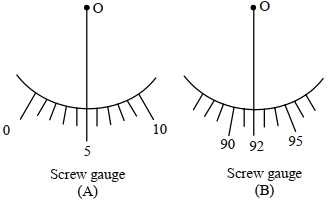
Answera
For $A$
Reading $=$ MSR $+$ CSR $+$ Error
$0.322=0.300+C S R+5 \times L C$
$0.322=0.300+C S R+0.005$
$C S R=0.017$
For $B$
Reading $=$ MSR $+$ CSR $+$ Error
$0.322=0.200+C S R+0.092$
$C S R=0.030$
Difference $=0.030-0.017=0.013 cm$
Division on circular scale $=\frac{0.013}{0.001}=13$
View full question & answer→MCQ 4051 Mark
A quantity $f$ is given by $f=\sqrt{\frac{{hc}^{5}}{{G}}}$ where $c$ is speed of light, $G$ universal gravitational constant and $h$ is the Planck's constant. Dimension of $f$ is that of
Answerc
$[\mathrm{h}]=\mathrm{M}^{1} \mathrm{L}^{2} \mathrm{T}^{-1}$
$[\mathrm{C}]=\mathrm{L}^{1} \mathrm{T}^{-1}$
$[\mathrm{G}]=\mathrm{M}^{-1} \mathrm{L}^{3} \mathrm{T}^{-2}$
$[\mathrm{f}]=\sqrt{\frac{\mathrm{M}^{1} \mathrm{L}^{2} \mathrm{T}^{-1} \times \mathrm{L}^{5} \mathrm{T}^{-5}}{\mathrm{M}^{-1} \mathrm{L}^{3} \mathrm{T}^{-2}}}=\mathrm{M}^{1} \mathrm{L}^{2} \mathrm{T}^{-2}$
View full question & answer→MCQ 4061 Mark
Amount of solar energy received on the earth's surface per unit area per unit time is defined a solar constant. Dimension of solar constant is
- A
$ML ^{2} T ^{-2}$
- B
$MLT ^{-2}$
- C
$M ^{2} L ^{0} T ^{-1}$
- ✓
$ML ^{0} T ^{-3}$
AnswerCorrect option: D. $ML ^{0} T ^{-3}$
d
$S=\frac{P}{A}=\frac{M L^{2} T^{-3}}{L^{2}}=M T^{-3}$
View full question & answer→MCQ 4071 Mark
If momentum $(P),$ area $(A)$ and time $(T)$ are taken to be the fundamental quantities then the dimensional formula for energy is :
- A
$\left[ PA ^{-1} T ^{-2}\right]$
- ✓
$\left[ PA ^{1 / 2} T ^{-1}\right]$
- C
$\left[ P ^{2} AT ^{-2}\right]$
- D
$\left[ P ^{1 / 2} AT ^{-1}\right]$
AnswerCorrect option: B. $\left[ PA ^{1 / 2} T ^{-1}\right]$
b
Let $[ E ]=[ P ]^{ x }[ A ]^{ y }[ T ]^{z}$
$ML ^{2} T ^{-2}=\left[ MLT ^{-1}\right]^{ x }\left[ L ^{2}\right] y [ T ]^{z}$
$ML ^{2} T ^{-2}= M ^{ x } L ^{ x +2 y } T ^{- x +z}$
$\rightarrow x =1$
$\rightarrow x +2 y =2$
$1+2 y =2$
$y =\frac{1}{2}$
$\rightarrow- x + z =-2$
$-1+ z =-2$
$z =-1$
$[ E ]=\left[ P A ^{1 / 2} T ^{-1}\right]$
View full question & answer→MCQ 4081 Mark
The dimension of $\frac{\mathrm{B}^{2}}{2 \mu_{0}}$, where $\mathrm{B}$ is magnetic field and $\mu_{0}$ is the magnetic permeability of vacuum, is
- ✓
$M L^{-1} T^{-2}$
- B
$\mathrm{ML}^{2} \mathrm{T}^{-1}$
- C
$\mathrm{ML} \mathrm{T}^{-2}$
- D
$\mathrm{ML}^{2} \mathrm{T}^{-2}$
AnswerCorrect option: A. $M L^{-1} T^{-2}$
a
Magnetic energy stored per unit volume is $\frac{\mathrm{B}^{2}}{2 \mu_{0}}$
Dimension is $ML ^{-1} \mathrm{T}^{-2}$
View full question & answer→MCQ 4091 Mark
A simple pendulum is being used to determine the value of gravitational acceleration $\mathrm{g}$ at a certain place. The length of the pendulum is $25.0\; \mathrm{cm}$ and a stop watch with $1\; \mathrm{s}$ resolution measures the time taken for $40$ oscillations to be $50\; s$. The accuracy in $g$ is ....... $\%$
- A
$3.40$
- B
$5.40 $
- ✓
$4.40 $
- D
$2.40 $
AnswerCorrect option: C. $4.40 $
c
$\mathrm{T}=2 \pi \sqrt{\frac{\ell}{\mathrm{g}}}$
$\mathrm{g}=\frac{4 \pi^{2} \ell}{\mathrm{T}^{2}}$
$\frac{\Delta g}{g}=\frac{\Delta \ell}{\ell}+\frac{2 \Delta T}{T}$
$=\frac{0.1}{25}+\frac{2 \times 1}{50}$
$\frac{\Delta g}{g}=4.4 \%$
View full question & answer→MCQ 4101 Mark
A physical quantity $z$ depends on four observables $a,$ $b,$ $c$ and $d ,$ as $z =\frac{ a ^{2} b ^{\frac{2}{3}}}{\sqrt{ c } d ^{3}} .$ The percentage of error in the measurement of $a, b, c$ and $d$ are $2 \%, 1.5 \%, 4 \%$ and $2.5 \%$ respectively. The percentage of error in $z$ is$......\%$
- A
$12.5$
- ✓
$14.5$
- C
$16.5$
- D
$13.5$
AnswerCorrect option: B. $14.5$
b
$\frac{\Delta Z}{Z}=\frac{2 \Delta a }{ a }+\frac{2}{3} \frac{\Delta b }{ b }+\frac{1}{2} \frac{\Delta c }{ c }+\frac{3 \Delta d }{ d }=14.5 \%$
View full question & answer→MCQ 4111 Mark
If the screw on a screw-gauge is given six rotations, it moves by $3\; \mathrm{mm}$ on the main scale. If there are $50$ divisions on the circular scale the least count of the screw gauge is
- A
$0.001\; mm$
- ✓
$0.001\; cm$
- C
$0.02\; mm$
- D
$0.01\; cm$
AnswerCorrect option: B. $0.001\; cm$
b
On six rotation, reading of main scale changes by $3 \mathrm{mm} .$
1 rotation corresponds to $\frac{1}{2} \mathrm{mm}$
Also no. of division on circular scale $=50 .$
Least count of the screw gauge will be
$\frac{0.5}{50} \mathrm{mm}=0.001 \mathrm{cm}$
View full question & answer→MCQ 4121 Mark
The least count of the main scale of a vernier callipers is $1\, mm$. Its vernier scale is divided into $10$ divisions and coincide with $9$ divisions of the main scale. When jaws are touching each other, the $7$ th division of vernier scale coincides with a division of main scale and the zero of vernier scale is lying right side of the zero of main scale. When this vernier is used to measure length of a cylinder the zero of the vernier scale between $3.1\, cm$ and $3.2\, cm$ and $4^{th}$ $VSD$ coincides with a main scale division.The length of the cylinder is $.....cm$
($VSD$ is vernier scale division)
- A
$3.21$
- B
$2.99$
- C
$3.2$
- ✓
$3.07$
AnswerCorrect option: D. $3.07$
d
Least count $=1 mm$ or $0.01 cm$
Zero error $=0+0.01 \times 7=0.07 cm$
Reading $=3.1+(0.01 \times 4)-0.07$
$=3.1+0.04-0.07$
$=3.1-0.03$
$=3.07 cm$
View full question & answer→MCQ 4131 Mark
Using screw gauge of pitch $0.1$ $cm$ and $50$ divisions on its circular scale, the thickness of an object is measured. It should correctly be recorded as
- A
$2.123\;cm$
- B
$2.125\;cm$
- C
$2.121\;cm$
- ✓
$2.124\;cm$
AnswerCorrect option: D. $2.124\;cm$
d
$LC =\frac{\text { pitch }}{ CSD }=\frac{0.1 cm }{50}=0.002 cm$
So any measurement will be integral
Multiple of $LC.$
will be $2.124 cm$
View full question & answer→MCQ 4141 Mark
A student measuring the diameter of a pencil of circular cross-section with the help of a vernier scale records the following four readings $5.50\, mm , 5.55\, mm ,$$ 5.45\, mm ; 5.65\, mm .$ The average of these four readings is $5.5375\, mm$ and the standard deviation of the data is $0.07395\, mm .$ The average diameter of the pencil should therefore be recorded as
- A
$(5.5375 \pm 0.0739)\, mm$
- B
$(5.538 \pm 0.074)\, mm$
- ✓
$(5.54 \pm 0.07)\, mm$
- D
$(5.5375 \pm 0.0740)\, mm$
AnswerCorrect option: C. $(5.54 \pm 0.07)\, mm$
c
Use significant figures. Answer must be upto three significant figures.
View full question & answer→MCQ 4151 Mark
A screw gauge has $50$ divisions on its circular scale. The circular scale is $4$ units ahead of the pitch scale marking, prior to use. Upon one complete rotation of the circular scale, a displacement of $0.5\, mm$ is noticed on the pitch scale. The nature of zero error involved, and the least count of the screw gauge, are respectively
- A
Negative, $2\, \mu m$
- ✓
Positive, $10\, \mu m$
- C
Positive, $0.1$ $\mu m$
- D
Positive, $0.1$ $mm$
AnswerCorrect option: B. Positive, $10\, \mu m$
b
Least count of screw gauge
$=\frac{\text { Pitch }}{\text { no. of division on circular scale }}$
$=\frac{0.5}{50} mm =1 \times 10^{-5} m$
$=10\, \mu m$
Zero error in positive
View full question & answer→MCQ 4161 Mark
A quantity $x$ is given by $\left( IF v^{2} / WL ^{4}\right)$ in terms of moment of inertia $I,$ force $F$, velocity $v$, work $W$ and Length $L$. The dimensional formula for $x$ is same as that of
Answerc
$x=\frac{I F V^{2}}{W L^{4}}$
$[ x ]=\frac{\left[ ML ^{2}\right]\left[ MI T ^{-2}\right]\left[ L T ^{-1}\right]^{2}}{\left[ ML ^{2} T ^{-2}\right][ L ]^{4}}$
$[ x ]=\left[ ML ^{-1} T ^{-2}\right]$
[Energy density] $=\left[\frac{ E }{ V }\right]$
$=\left[\frac{M L^{2} T^{-2}}{L^{3}}\right]$
$=\left[ ML ^{-1} T ^{-2}\right]$
Same as $x$
View full question & answer→MCQ 4171 Mark
If speed $V,$ area $A$ and force $F$ are chosen as fundamental units, then the dimension of Young's modulus will be :
- ✓
$FA ^{-1} V ^{0}$
- B
$FA ^{2} V ^{-1}$
- C
$FA ^{2} V ^{-3}$
- D
$FA ^{2} V ^{-2}$
AnswerCorrect option: A. $FA ^{-1} V ^{0}$
a
$Y = F ^{ x } A ^{ y } V ^{z}$
$M ^{1} L ^{-1} T ^{-2}=\left[ MLT ^{-2}\right] x \left[ L ^{2}\right] y \left[ L T ^{-1}\right]^{z}$
$M ^{1} L ^{1} T ^{-2}=[ M ]^{ x }[ L ]^{ x +2 y +z}[ T ]^{-2 x - z }$
comparing power of $ML$ and $T$
$x=1 \ldots(1)$
$x+2 y+z=-1$$...(2)$
$-2 x-z=-2$$...(3)$
after solving
$x=1$
$y=-1$
$z=0$
$Y=F A^{-1} V^{0}$
View full question & answer→MCQ 4181 Mark
The dimension of stopping potential $\mathrm{V}_{0}$ in photoelectric effect in units of Planck's constant $h$, speed of light $c$ and Gravitational constant $G$ and ampere $A$ is
- A
$\mathrm{h}^{2} \mathrm{G}^{3 / 2} \mathrm{C}^{1 / 3} \mathrm{A}^{-1}$
- B
$\mathrm{h}^{-2 / 3} \mathrm{c}^{-1 / 3} \mathrm{G}^{4 / 3} \mathrm{A}^{-1}$
- C
$\mathrm{h}^{1 / 3} \mathrm{G}^{2 / 3} \mathrm{c}^{1 / 3} \mathrm{A}^{-1}$
- ✓
$\mathrm{h}^{0} \mathrm{c}^{5} \mathrm{G}^{-1} \mathrm{A}^{-1}$
AnswerCorrect option: D. $\mathrm{h}^{0} \mathrm{c}^{5} \mathrm{G}^{-1} \mathrm{A}^{-1}$
d
$\mathrm{v}_{0}=\mathrm{h}^{\mathrm{x}} \mathrm{c}^{\mathrm{y}} \mathrm{G}^{\mathrm{z}} \mathrm{A}^{\mathrm{w}}$
$\frac{\mathrm{ML}^{2} \mathrm{T}^{-2}}{\mathrm{AT}}=\left(\mathrm{ML}^{2} \mathrm{T}^{-1}\right)^{\mathrm{x}}\left(\mathrm{LT}^{-1}\right)^{\mathrm{y}}\left(\mathrm{M}^{-1} \mathrm{L}^{3} \mathrm{T}^{-2}\right)^{\mathrm{z}} \mathrm{A}^{\mathrm{w}}$
$\Rightarrow \mathrm{w}=-1$
$(\mathrm{x}-\mathrm{z}=1)$
$(\mathrm{x}-\mathrm{z}=1)$
$-\mathrm{x}-\mathrm{x}=1-2 \mathrm{z}=2$
$-\mathrm{x}-\mathrm{y}-2 \mathrm{z}=-3$
$\mathrm{x}-\frac{1}{2} \mathrm{x}=0$
$\mathrm{x}=0$
$\mathrm{x}=-1$
$2 \times 0+\mathrm{y}+3 \mathrm{x}-1=2$
$y=5$
$\Rightarrow \mathrm{v}_{0}=\mathrm{h}^{0} \mathrm{c}^{5} \mathrm{G}^{-1} \mathrm{A}^{-1}$
View full question & answer→MCQ 4191 Mark
The quantities $\quad x=\frac{1}{\sqrt{\mu_{0} \in_{0}}}, y=\frac{E}{B}$ and $z=\frac{l}{C R}$ are defined where $C-$ capacitance $R-$Resistance, $l-$length, $E-$Electric field, $B-$magnetic field and $\varepsilon_{0}, \mu_{0},$ -free space permittivity and permeability respectively. Then....
- A
Only $x$ and $y$ have the same dimension
- ✓
$x, y$ and $z$ have the same dimension
- C
Only $x$ and $z$ have the same dimension
- D
Only $y$ and $z$ have the same dimension
AnswerCorrect option: B. $x, y$ and $z$ have the same dimension
b
$x =\frac{1}{\sqrt{\mu_{0} \varepsilon_{0}}}=\operatorname{speed} \Rightarrow[ x ]=\left[ L ^{1} T ^{-1}\right]$
$y =\frac{ E }{ B }=\operatorname{speed} \Rightarrow[ y ]=\left[ L ^{1} T ^{-1}\right]$
$z=\frac{\ell}{R C}=\frac{\ell}{\tau} \Rightarrow[z]=\left[L^{1} T^{-1}\right]$
So, $x, y, z$ all have the same dimensions.
View full question & answer→MCQ 4201 Mark
The density of a solid metal sphere is determined by measuring its mass and its diameter. The maximum error in the density of the sphere is $\left(\frac{x}{100}\right) \% .$ If the relative errors in measuring the mass and the diameter are $6.0 \%$ and $1.5 \%$ respectively, the value of $x$ is
- A
$1000$
- B
$1075$
- C
$1060$
- ✓
$1050$
AnswerCorrect option: D. $1050$
d
$\rho=\frac{M}{V}=\frac{M}{\frac{4}{3} \pi\left(\frac{D}{2}\right)^{3}}$
$\rho=\frac{6}{\pi} M D ^{-3}$
taking log
$\ell n \rho=\ell n \left(\frac{6}{\pi}\right)+\ell n M -3 \ell m D$
Differentiates
$\frac{ d p}{\rho}=0+\frac{ d M }{ M }-3 \frac{ d ( D )}{ D }$
for maximum error
$100 \times \frac{ d \rho}{\rho}=\frac{ dM }{ M } \times 100+\frac{3 d D }{ D } \times 100$
$=6+3 \times 1.5$
$=10.5 \%$
$=\frac{1050}{100} \%$
$x=1050.00$
View full question & answer→MCQ 4211 Mark
For the four sets of three measured physical quantities as given below. Which of the following options is correct ?
$(i)$ $\mathrm{A}_{1}=24.36, \mathrm{B}_{1}=0.0724, \mathrm{C}_{1}=256.2$
$(ii)$ $\mathrm{A}_{2}=24.44, \mathrm{B}_{2}=16.082, \mathrm{C}_{2}=240.2$
$(iii)$ $\mathrm{A}_{3}=25.2, \mathrm{B}_{3}=19.2812, \mathrm{C}_{3}=236.183$
$(iv)$ $\mathrm{A}_{4}=25, \mathrm{B}_{4}=236.191, \mathrm{C}_{4}=19.5$
- A
$\mathrm{A}_{4}+\mathrm{B}_{4}+\mathrm{C}_{4} < \mathrm{A}_{1}+\mathrm{B}_{1}+\mathrm{C}_{1} < $$\mathrm{A}_{3}+\mathrm{B}_{3}+\mathrm{C}_{3} < \mathrm{A}_{2}+\mathrm{B}_{2}+\mathrm{C}_{2}$
- B
$\mathrm{A}_{1}+\mathrm{B}_{1}+\mathrm{C}_{1} < \mathrm{A}_{3}+\mathrm{B}_{3}+\mathrm{C}_{3} < $$\mathrm{A}_{2}+\mathrm{B}_{2}+\mathrm{C}_{2} < \mathrm{A}_{4}+\mathrm{B}_{4}+\mathrm{C}_{4}$
- C
$\mathrm{A}_{1}+\mathrm{B}_{1}+\mathrm{C}_{1} = \mathrm{A}_{2}+\mathrm{B}_{2}+\mathrm{C}_{2} = $$\mathrm{A}_{3}+\mathrm{B}_{3}+\mathrm{C}_{3} = \mathrm{A}_{4}+\mathrm{B}_{4}+\mathrm{C}_{4}$
- ✓
$\mathrm{A}_{4}+\mathrm{B}_{4}+\mathrm{C}_{4} > \mathrm{A}_{3}+\mathrm{B}_{3}+\mathrm{C}_{3} = $$\mathrm{A}_{2}+\mathrm{B}_{2}+\mathrm{C}_{2} > \mathrm{A}_{1}+\mathrm{B}_{1}+\mathrm{C}_{1}$
AnswerCorrect option: D. $\mathrm{A}_{4}+\mathrm{B}_{4}+\mathrm{C}_{4} > \mathrm{A}_{3}+\mathrm{B}_{3}+\mathrm{C}_{3} = $$\mathrm{A}_{2}+\mathrm{B}_{2}+\mathrm{C}_{2} > \mathrm{A}_{1}+\mathrm{B}_{1}+\mathrm{C}_{1}$
d
$\mathrm{A}_{1}+\mathrm{B}_{1}+\mathrm{C}_{1}=24.36+0.0724+256.2$
$=280.6324$
$=280.6$ (After rounding off) $\mathrm{A}_{2}+\mathrm{B}_{2}+\mathrm{C}_{2}=24.44+16.082+240.2$
$=280.722$
$=280.7$ (After rounding off) $\mathrm{A}_{3}+\mathrm{B}_{3}+\mathrm{C}_{3}=25.2+19.2812+236.183$
$=280.6642$
$=280.7$ (After rounding off)
$\mathrm{A}_{4}+\mathrm{B}_{4}+\mathrm{C}_{4}=25+236.191+19.5$
$=280.691$
$=281$ (After rounding off)
$\mathrm{A}_{4}+\mathrm{B}_{4}+\mathrm{C}_{4} > \mathrm{A}_{3}+\mathrm{B}_{3}+\mathrm{C}_{3} = $$\mathrm{A}_{2}+\mathrm{B}_{2}+\mathrm{C}_{2} > \mathrm{A}_{1}+\mathrm{B}_{1}+\mathrm{C}_{1}$
View full question & answer→MCQ 4221 Mark
The density of a material in $SI\, units$ is $128\, kg\, m^{-3}$. In certain units in which the unit of length is $25\, cm$ and the unit of mass $50\, g$, the numerical value of density of the material is
Answera
$\begin{array}{l}
\frac{{128kg}}{{{m^3}}} = \frac{{125\left( {50g} \right)\left( {20} \right)}}{{{{\left( {25cm} \right)}^3}{{\left( 4 \right)}^3}}}\\
= \frac{{128}}{{64}}\left( {20} \right)units\\
= 40units
\end{array}$
View full question & answer→MCQ 4231 Mark
In $SI\, units$, the dimensions of $\sqrt {\frac{{{ \varepsilon _0}}}{{{\mu _0}}}} $ is
AnswerCorrect option: C. ${A^2}{T^3}{M^{ - 1}}{L^{ - 2}}$
c
$\begin{array}{l}
Dimension\,of\,\sqrt {\frac{{{\varepsilon _0}}}{{{\mu _0}}}} \\
\left[ {{\varepsilon _0}} \right] = \left[ {{M^{ - 1}}{L^{ - 3}}{T^4}{A^2}} \right]\\
\left[ {{\mu _0}} \right] = \left[ {ML{T^{ - 2}}{A^{ - 2}}} \right]\\
Dimension\,of\,\,\sqrt {\frac{{{\varepsilon _0}}}{{{\mu _0}}}} = {\left[ {\frac{{{M^{ - 1}}{L^{ - 3}}{T^4}{A^2}}}{{ML{T^{ - 2}}{A^{ - 2}}}}} \right]^{\frac{1}{2}}}\\
= {\left[ {{M^{ - 2}}{L^{ - 4}}{T^6}{A^4}} \right]^{1/2}}\\
= \left[ {{M^{ - 1}}{L^{ - 2}}{T^3}{A^2}} \right]
\end{array}$
View full question & answer→MCQ 4241 Mark
Let $l, r, c$ and $v$ represent inductance, resistance, capacitance and voltage, respectively. The dimension of $\frac {1}{rcv}$ in $SI\,units$ will be
- A
$[LA^{-2}]$
- ✓
$[A^{-1}]$
- C
$[LTA]$
- D
$[LT^2]$
AnswerCorrect option: B. $[A^{-1}]$
b
$\frac{L}{{RCV}} = [{A^{ - 1}}]$
View full question & answer→MCQ 4251 Mark
Which of the following combinations has the dimension of electrical resistance ( ${ \varepsilon _0}$ is the permittivity of vacuum and ${\mu _0}$ is the permeability of vacuum) ?
- A
$\sqrt {\frac{{{ \varepsilon _0}}}{{{\mu _0}}}} $
- B
${\frac{{{\mu _0}}}{{{ \varepsilon_0}}}}$
- C
$\frac{{{ \varepsilon_0}}}{{{\mu _0}}}$
- ✓
$\sqrt {\frac{{{\mu _0}}}{{{\varepsilon_0}}}} $
AnswerCorrect option: D. $\sqrt {\frac{{{\mu _0}}}{{{\varepsilon_0}}}} $
d
$\begin{array}{l}
\left[ {{\varepsilon _0}} \right] = {M^{ - 1}}{L^{ - 3}}{T^4}{A^2}\\
\left[ {{\mu _0}} \right] = M\,L\,{T^{ - 2}}{A^{ - 2}}\\
\left[ R \right] = \,M\,{L^2}\,{T^{ - 3}}{A^{ - 2}}\\
\left[ R \right] = \left[ {\sqrt {\frac{{{\mu _0}}}{{{\varepsilon _0}}}} } \right]
\end{array}$
View full question & answer→MCQ 4261 Mark
The diameter and height of a cylinder are measured by a meter scale to be $12.6 \pm 0.1\, cm$ and $34.2 \pm 0.1\, cm$, respectively. What will be the value of its volume in appropriate significant figures?
- A
$4264 \pm 81\,cm^3$
- ✓
$4260 \pm 80\,cm^3$
- C
$4264 \pm 81.0\,cm^3$
- D
$4300 \pm 80\,cm^3$
AnswerCorrect option: B. $4260 \pm 80\,cm^3$
b
$\begin{array}{l}
V = \pi {R^2}h = \frac{\pi }{4}{D^2}h\\
\,\,\,\,\,\,\, = 4260\,c{m^2}\\
\,\,\,\,\,\,\,\,\,\,\,\,\,\,\,\,\,\,\,\,\,\frac{{\Delta V}}{V} = 2\frac{{\Delta D}}{D} + \frac{{\Delta h}}{h}\\
\,\,\,\,\,\,\,\,\,\,\,\,\,\,\,\,\,\,\,\,\,\,\, = \left( {2 \times \frac{{0.1}}{{12.6}} + \frac{{0.1}}{{34.2}}} \right)V\\
\,\,\,\,\,\,\,\,\,\,\,\,\,\,\,\,\,\,\,\,\,\,\, = \frac{{2 \times 426}}{{12.6}} + \frac{{426}}{{34.2}}\\
\,\,\,\,\,\,\,\,\,\,\,\,\,\,\,\,\,\,\,\,\,\,\, = 67.61 + 12.459 = 80.075\\
\therefore \,\,\,\,\,\,\,\,\,\,\,\,\,\,V = 4260 \pm 80\,c{m^3}
\end{array}$
View full question & answer→MCQ 4271 Mark
The least count of the main scale of a screw gauge is $1\, mm$. The minimum number of divisions on its circular scale required to measure $5\,\mu m$ diameter of a wire is
Answerb
$\begin{array}{l}
Least\,count = \frac{{Pitch}}{{No.of\,divisions\,on\,circular\,scale}}\\
5 \times {10^{ - 6}} = \frac{{{{10}^{ - 3}}}}{N}\\
N = 200
\end{array}$
View full question & answer→MCQ 4281 Mark
The area of a square is $5.29\, cm^2$. The area of $7$ such squares taking into account the significant figures is ........... $cm^2$
- A
$37$
- B
$37.0$
- ✓
$37.03$
- D
$37.030$
AnswerCorrect option: C. $37.03$
c
$\begin{array}{l}
Total\,Area = {A_1} + {A_2} + ..........{A_7}\\
\,\,\,\,\,\,\,\,\,\,\,\,\,\,\,\,\,\,\,\,\,\,\,\, = A + A + ............7\,times\\
\,\,\,\,\,\,\,\,\,\,\,\,\,\,\,\,\,\,\,\,\,\,\,\, = \,37.03\,{m^2}\\
Addition\,of\,7\,terms\,all\,having\,2\,terms\,\\
beyound\,decimal,\,so\,final\,answer\,must\,\\
have\,2\,terms\,beyond\,decimal\,(as\,per\,\\
rules\,of\,significant\,digits)
\end{array}$
View full question & answer→MCQ 4291 Mark
If speed $(V)$, acceleration $(A)$ and force $(F)$ are considered as fundamental units, the dimension of Young’s modulus will be
AnswerCorrect option: D. ${V^{ - 4}}{A^{2}}F$
d
$\begin{array}{l}
\frac{F}{A} = y \cdot \frac{{\Delta \ell }}{\ell }\,\,;\,\,\left[ Y \right] = \frac{F}{A}\\
Now\,from\,\dim ension\\
\,\,\,\,\,\,\,\,\,\,\,\,\,\,\,F = \frac{{ML}}{{{T^2}}}\,\,;\,\,L = \frac{F}{M} \cdot {T^2}\\
\,\,\,\,\,\,\,\,\,\,\,\,\,\,\,{L^2} = \frac{{{F^2}}}{{{M^2}}}{\left( {\frac{V}{A}} \right)^4}\,\,\,\,\,\,T = \frac{V}{A}\\
\,\,\,\,\,\,\,\,\,\,\,\,\,\,\,{L^2} = \frac{{{F^2}}}{{{M^2}{A^2}}}\frac{{{V^4}}}{{{A^2}}}\,\,\,\,\,\,F = MA\\
\,\,\,\,\,\,\,\,\,\,\,\,\,\,{L^2} = \frac{{{V^4}}}{{{A^2}}}\\
\left[ Y \right] = \frac{{\left[ F \right]}}{{\left[ A \right]}} = {F^1}{V^{ - 4}}{A^2}
\end{array}$
View full question & answer→MCQ 4301 Mark
If Surface tension $(S)$, Moment of Inertia $(I)$ and Planck’s constant $(h)$, were to be taken as the fundamental units, the dimensional formula for linear momentum would be
AnswerCorrect option: A. $S^{1 /2} I^{1 /2} h^0$
a
$\begin{array}{l}
P = k\,{s^a}{i^b}{h^c}\\
Where\,k\,is\,{\rm{dimensionless}}\,{\rm{constant}}\\
ML{T^{ - 1}} = {\left( {M{T^{ - 2}}} \right)^a}\left( {M{L^2}} \right){\left( {M{L^2}{T^{ - 1}}} \right)^c}\\
a + b + c = 1\\
2b + 2c = 1\\
- 2a - c = - 1\\
a = \frac{1}{2}\,\,\,\,\,\,\,b = \frac{1}{2}\,\,\,\,\,\,c = 0\\
{S^{1/2}}{i^{1/2}}{h^0}
\end{array}$
View full question & answer→MCQ 4311 Mark
The force of interaction between two atoms is given by $F\, = \,\alpha \beta \,\exp \,\left( { - \frac{{{x^2}}}{{\alpha kt}}} \right);$ where $x$ is the distance, $k$ is the Boltzmann constant and $T$ is temperature and $\alpha $ and $\beta $ are two constants. The dimension of $\beta $ is
- A
$M^0L^2T^{-4}$
- ✓
$M^2LT^{-4}$
- C
$MLT^{-2}$
- D
$M^2L^2T^{-2}$
AnswerCorrect option: B. $M^2LT^{-4}$
b
$\begin{array}{l}
Power\,of\,e\,should\,be\,\dim ensionless.\\
So,\left[ \lambda \right] = \left( {\alpha Tk} \right)\\
\Rightarrow \,\,\,\,\,\,\,\,{L^2} = \left[ \alpha \right]\left( {M{L^2}{T^{ - 2}}} \right)\\
\Rightarrow \,\,\,\,\,\,\,\,\,\left( \alpha \right) = \left( {{M^{ - 1}}{T^2}} \right)\\
\Rightarrow \,\,\,\,\,\,\,\,\,\,\,E = \frac{1}{2}KT\\
\Rightarrow \,\,\,\,\,\,\,\,\,\,\,\left( {M{L^2}{T^{ - 2}}} \right)\,\,;\,\,\left( E \right) = \left[ {KT} \right]\\
\Rightarrow \,\,\,\,\,\,\,\,\,\,\,\left( {\alpha \beta } \right) = \left( F \right)\\
\Rightarrow \,\,\,\,\,\,\,\,\,\,\,\,\left( {{M^{ - 1}}{T^2}} \right)\left( \beta \right) = \left( {ML{T^{ - 2}}} \right)
\end{array}$
View full question & answer→MCQ 4321 Mark
The formula $X = 5YZ^2$, $X$ and $Z$ have dimensions of capacitance and magnetic field respectively. What are the dimensions of $Y$ in $SI$ units?
- A
$[{M^{ - 2}}\,{L^0}\,{T^{ - 4}}\,{A^{ - 2}}]$
- ✓
$[{M^{ - 3}}\,{L^{-2}}\,{T^8}\,{A^{ 4}}]$
- C
$[{M^{ - 2}}\,{L^{-2}}\,{T^6}\,{A^3}]$
- D
$[{M^{ - 1}}\,{L^{-2}}\,{T^4}\,{A^2}]$
AnswerCorrect option: B. $[{M^{ - 3}}\,{L^{-2}}\,{T^8}\,{A^{ 4}}]$
b
$X{\kern 1pt} = 5Y{Z^2}$
$Y{\kern 1pt} = \frac{X}{{5{Z^2}}} = \,{M^{ - 3}}{L^{ - 2}}{T^8}{A^4}$
View full question & answer→MCQ 4331 Mark
In a simple pendulum experiment for determination of acceleration due to gravity $(g)$, time taken for $20$ oscillations is measured by using a watch of $1\, second$ least count. The mean value of time taken comes out to be $30\,s$. The length of pendulum is measured by using a meter scale of least count $1\, mm$ and the value obtained is $55.0\, cm$. The percentage error in the determination of $g$ is close to ........... $\%$
Answerc
$\begin{array}{l}
T = \frac{{30\,\sec }}{{20}}\,\,\,\,\,\,\,\,\,\,\,\,\,\,\,\,\,\,\,\,\,\,\,\,\,\,\Delta T = \frac{1}{{20}}\sec ,\\
\,\,\,\,\,\,\,L = 55\,cm\,\,\,\,\,\,\,\,\,\,\,\,\,\,\,\,\,\,\,\,\,\Delta L = 1\,mm = 0.1\,cm\\
\,\,\,\,\,\,\,g = \frac{{4{\pi ^2}L}}{{{T^2}}}\\
\,\,\,\,\,\,\,\,percentage\,error\,in\,g\,is\\
\,\,\,\,\,\,\,\,\,\frac{{\Delta g}}{g} \times 100 = \left( {\frac{{\Delta L}}{L} + \frac{{2\Delta T}}{T}} \right)100\% \\
\,\,\,\,\,\,\,\,\,\,\, = \left( {\frac{{0.1}}{{5.5}} + 2\frac{{\left( {\frac{1}{{20}}} \right)}}{{\frac{{30}}{{20}}}}} \right)100\% \simeq 6.8\% .
\end{array}$
View full question & answer→MCQ 4341 Mark
In the density measurement of a cube, the mass and edge length are measured as $(10.00 \pm 0.10)\,\,kg\,$ and $(0.10 \pm 0.01)\,\,m\,$ respectively. The error in the measurement of density is
- A
$0.10\,\,kg/m^3$
- B
$0.31\,\,kg/m^3$
- C
$0.07\,\,kg/m^3$
- ✓
Answerd
$\begin{array}{l} \rho = \frac{m}{v}\\ Maximum\,\% \,error\,in\,\rho \,will\,be\,given\,by\\ \frac{{\Delta p}}{p} \times 100\% = \left( {\frac{{\Delta m}}{m}} \right) \times 100\% + 3\left( {\frac{{\Delta L}}{L}} \right) \times 100\% \,\,...\left( i \right)\\ This\,is\,not\,applicable\,as\,error\,is\,big. \end{array}$
$\begin{array}{l} {\rho _{\min }} = \frac{{{m_{\min }}}}{{{v_{\max }}}} = \frac{{9.9}}{{{{\left( {0.11} \right)}^3}}} = 7438kg/{m^3}\\ and \,{\rho _{\max \,}} = \frac{{{m_{\max }}}}{{{v_{\min }}}} = \frac{{10.1}}{{{{\left( {0.09} \right)}^3}}} = 13854.6kg/{m^3}\\ \Delta \rho = 6416.6\,\,kg/{m^3}\\ \end{array}$
View full question & answer→MCQ 4351 Mark
The pitch and the number of divisions, on the circular scale, for a given screw gauge are $0.5\,mm$ and $100$ respectively. When the screw gauge is fully tightened without any object, the zero of its circular scale lies $3$ divisions below the mean line. The readings of the main scale and the circular scale for a thin sheet, are $5.5\,mm$ and $48$ respectively, the thickness of this sheet is
- A
$5.755\,mm$
- B
$5.950\,mm$
- ✓
$5.725\,mm$
- D
$5.740\,mm$
AnswerCorrect option: C. $5.725\,mm$
c
$L C=\frac{P i t c h}{\text {No.ofdivision}}$
$L C=0.5 \times 10^{-2} mm$
+ve error $=3 \times 0.5 \times 10^{-2} mm$
$=1.5 \times 10^{-2} mm =0.015 mm$
Reading $= MSR + CSR -(+\text { ve error })$
$=5.5 m m+\left(48 \times 0.5 \times 10^{-2}\right)-0.015$
$=5.5+0.24-0.015=5.725 mm$
View full question & answer→MCQ 4361 Mark
In a screw gauge, $5$ complete rotations of the screw cause it to move a linear distance of $0.25\, cm$. There are $100$ circular scale divisions. The thickness of a wire measured by this screw gauge gives a reading of $4$ main scale divisions and $30$ circular scale divisions . Assuming negligible zero error, the thickness of the wire is
- A
$0.0430\,cm$
- B
$0.3150\,cm$
- C
$0.43 00\,cm$
- ✓
$0.2150\, cm$
AnswerCorrect option: D. $0.2150\, cm$
d
In one rotation scale moves $\frac{0.25}{5}=0.05 cm$
Least count $=0.05 \times 10^{-2} cm$
For 4 main scale division $=4 \times 0.05=0.2 cm$
For circular scale divosion $=30 \times 0.05 \times 10^{-2}=1.5 \times 10^{-2} cm$
Thickness of wire $=0.2+0.015=0.2150 cm$
View full question & answer→MCQ 4371 Mark
The density of a material in the shape of a cube is determined by measuring three sides of the cube and its mass. If the relative errors in measuring the mass and length are respectively $1.5\%$ and $1\%$, the maximum error in determining the density is ........ $\%$
Answerb
$Density\left( d \right) = \frac{{mass\left( M \right)}}{{volume\left( V \right)}} = \frac{M}{{{L^3}}}$
$\therefore Error\,in\,density,\,\frac{{\Delta d}}{d} = \frac{{\Delta M}}{M} + \frac{{3\Delta L}}{L}$
$ = 1.5\% + 3\left( {1\% } \right) = 4.5\% $
View full question & answer→MCQ 4381 Mark
The characteristic distance at which quantum gravitational effects are significant, the Planck length, can be determined from a suitable combination of the fundamental physical constants $G, h$ and $c$ . Which of the following correctly gives the Planck length?
AnswerCorrect option: B. ${\left( {\frac{{Gh}}{{{c^3}}}} \right)^{\frac{1}{2}}}$
b
Plank length is a unit of length
$I_p\,= 1.616229\times10^{-35}\,m$
${l_p} = \sqrt {\frac{{hG}}{{{c^3}}}} $
View full question & answer→MCQ 4391 Mark
The relative error in the determination of the surface area of a sphere is $\alpha $. Then the relative error in the determination of its volume is
- A
$\frac{2}{3}\alpha $
- B
$\frac{5}{2}\alpha $
- ✓
$\frac{3}{2}\alpha $
- D
$\alpha $
AnswerCorrect option: C. $\frac{3}{2}\alpha $
c
$\begin{array}{l}
{\mathop{\rm Re}\nolimits} lative\,\,eroor\,\,in\,\,surface\,\,area,\\
\frac{{\Delta s}}{s} = 2 \times \frac{{\Delta r}}{r} = \alpha \,and\,relative\,error\,in\\
volume,\,\frac{{\Delta v}}{v} = 3 \times \frac{{\Delta r}}{r}\\
\therefore \,{\mathop{\rm Re}\nolimits} lative\,\,error\,in\,volume\,w.r.t\,relative\,error\,in\,area,\\
\frac{{\Delta v}}{v} = \frac{3}{2}\alpha
\end{array}$
View full question & answer→MCQ 4401 Mark
The percentage errors in quantities $P, Q, R$ and $S$ are $0.5\%,\,1\%,\,3\%$ and $1 .5\%$ respectively in the measurement of a physical quantity $A\, = \,\frac{{{P^3}{Q^2}}}{{\sqrt {R}\,S }}$ . the maximum percentage error in the value of $A$ will be ........... $\%$
Answerd
$\begin{array}{l}
Maximum\,percentage\,error\,in\,A\\
= 3\left( {\% \,error\,in\,p} \right) + 2\left( {\% \,error\,in\,Q} \right)\\
\,\,\,\,\,\,\,\,\,\,\,\,\,\,\, + \frac{1}{2}\left( {\% \,error\,in\,R} \right) + 1\left( {\% \,error\,in\,S} \right)\\
= 3 \times 0.5 + 2 \times 1 = \frac{1}{2} \times 3 + 1 \times 1.5\\
= 1.5 + 2 + 1.5 + 1.5 = 6.5\%
\end{array}$
View full question & answer→MCQ 4411 Mark
The following observations were taken for determining surface tension $T$ of water by capillary method:
diameter of capillary, $D= 1.25 \times 10^{-2}\; m$
rise of water, $h=1.45 \times 10^{-2}\; m $
Using $g= 9.80 \;m/s^2$ and the simplified relation $T = \frac{{rhg}}{2}\times 10^3 N/m$ , the possible error in surface tension is ........... $\%$
- A
$0.15 $
- ✓
$1.5$
- C
$2.4$
- D
$10$
Answerb
$\mathrm{T}=\frac{\mathrm{rhg}}{2} \times 10^{3} \mathrm{N} / \mathrm{m}$
$\frac{\Delta \mathrm{T}}{\mathrm{T}}=\left|\frac{\Delta \mathrm{r}}{\mathrm{r}}\right|+\left|\frac{\Delta \mathrm{h}}{\mathrm{h}}\right|=\frac{0.01}{1.25}+\frac{0.01}{1.45}$
$\%$ error $=\frac{\Delta \mathrm{T}}{\mathrm{T}} \times 100=\frac{1}{1.25}+\frac{1}{1.45}=0.8+0.69=1.5 \%$
View full question & answer→MCQ 4421 Mark
A physical quantity $p$ is described by the relation $p\, = a^{1/2}\, b^2\, c^3\, d^{-4}$
If the relative errors in the measurement of $a, b, c$ and $d$ respectively, are $2\% , 1\%, 3\%$ and $5\%$, then the relative error in $P$ will be ........... $\%$
Answerc
$\begin{array}{l}
Give,\,p = {a^{1/2}}{b^2}{c^3}{d^{ - 4}},\\
Maximum\,relative\,error,\\
\frac{{\Delta p}}{p} = \frac{1}{2}\frac{{\Delta a}}{a} + 2\frac{{\Delta b}}{b} + 3\frac{{\Delta c}}{c} + 4\frac{{\Delta d}}{d}\\
= \frac{1}{2} \times 2 + 2 \times 1 + 3 \times 3 + 4 \times 5\\
= 32\%
\end{array}$
View full question & answer→MCQ 4431 Mark
Time $(T)$, velocity $(C)$ and angular momentum $(h)$ are chosen as fundamental quantities instead of mass, length and time. In terms of these, the dimensions of mass would be
- ✓
$\left[ M \right] = \left[ {{T^{ - 1}}\,{C^{ - 2}}\,h} \right]$
- B
$\left[ M \right] = \left[ {{T^{ - 1}}\,{C^2}\,h} \right]$
- C
$\left[ M \right] = \left[ {{T^{ - 1}}\,{C^{ - 2}}\,{h^{ - 1}}} \right]$
- D
$\left[ M \right] = \left[ {T\,{C^{ - 2}}\,h} \right]$
AnswerCorrect option: A. $\left[ M \right] = \left[ {{T^{ - 1}}\,{C^{ - 2}}\,h} \right]$
a
Let mass related as $M \propto \,{T^x}{C^y}{h^z}$
${M^1}{L^0}{T^0} = {\left( T \right)^x}{\left( {{L^1}{T^{ - 1}}} \right)^y}{\left( {{M^1}{L^2}{T^{ - 1}}} \right)^z}$
${M^1}{L^0}{T^0} = {M^z}{L^{y + 2z}} + {T^{x - y - z}}$
$z = 1$
$y + 2z = 0$ $x - y - z = 0$
$y = - 2$ $x + 2 - 1 = 0$
$M = \left[ {{T^{ - 1}}{C^{ - 2}}{h^1}} \right]$
View full question & answer→MCQ 4441 Mark
A student measures the time period of $100$ oscillations of a simple pendulum four times. The data set is $90\;s$ ,$91\;s $, $95\;s$ and $92\;s$. If the minimum division in the measuring clock is $1\;s$, then the reported mean time should be
- ✓
$92\pm 2\;s$
- B
$92\pm 3\;s$
- C
$92\pm 1.8\;s$
- D
$92\pm 5\;s$
AnswerCorrect option: A. $92\pm 2\;s$
a
$\Delta T = \frac{{\left[ {\Delta {T_1}| + |\Delta {T_2}| + |\Delta {T_3}| + |\Delta {T_4}} \right]}}{4}$
$ = \frac{{2 + 1 + 3 + 0}}{4} = 1.5$
As the resolutions of measuring clock is $1.5$ therefore the mean time should be $92$ pm $1.5$
but Least count is $1\; sec$
then answer should be $92\, \pm \,2\;\;sec$
View full question & answer→MCQ 4451 Mark
A screw gauge with a pitch of $0.5 \ mm$ and a circular scale with $50$ divisions is used to measure the thickness of a thin sheet of Aluminium. Before starting the measurement, it is found that wen the two jaws of the screw gauge are brought in contact, the $45^{th} $division coincides with the main scale line and the zero of the main scale is barely visible. What is the thickness of the sheet (in $mm$) if the main scale reading is $0.5\ mm$ and the $25^{th}$ division coincides with the main scale line
- A
$0.70$
- B
$0.50$
- C
$0.75$
- ✓
$0.80$
AnswerCorrect option: D. $0.80$
d
$L.C = \frac{{0.5}}{{50}} = 0.001\,mm$
zero error $= 5 \times 0.001 = 0.05$ mm negative
Reading $= \left( {0.5 + 25 \times 0.01} \right) + 0.05 = 0.80$ mm
View full question & answer→MCQ 4461 Mark
$A, B, C$ and $D$ are four different physical quantities having different dimensions. None of them is dimensionless. But we know that the equation $AD = C\, ln\, (BD)$ holds true. Then which of the combination is not a meaningful quantity ?
AnswerCorrect option: D. $\frac{{\left( {A - C} \right)}}{D}$
d
Dimension of $A \ne $ dimension of $(C)$ Hence $A - C$ is not possible
View full question & answer→MCQ 4471 Mark
Diameter of a steel ball is measured using a Vernier callipers which has divisions of $0. 1\,cm$ on its main scale $(MS)$ and $10$ divisions of its vernier scale $(VS)$ match $9$ divisions on the main scale. Three such measurements for a ball are given as
| S.No. |
$MS\;(cm)$ |
$VS$ divisions |
| $(1)$ |
$0.5$ |
$8$ |
| $(2)$ |
$0.5$ |
$4$ |
| $(3)$ |
$0.5$ |
$6$ |
If the zero error is $- 0.03\,cm,$ then mean corrected diameter is ........... $cm$
- A
$0.52$
- ✓
$0.59$
- C
$0.56$
- D
$0.53$
AnswerCorrect option: B. $0.59$
b
$\begin{array}{l}
Lets\,count\, = \frac{{0.1}}{{10}} = 0.01\,\,cm\\
{d_1} = 0.5 + 8 \times 0.01 + 0.03 = 0.61\,cm\\
{d_2} = 0.5 + 4 \times 0.01 + 0.03 = 0.57\,cm\\
{d_3} = 0.5 + 6 \times 0.01 + 0.03 = 0.59\,cm\\
Mean\,diameter\, = \frac{{0.61 + 0.57 + 0.59}}{3}\\
\,\,\,\,\,\,\,\,\,\,\,\,\,\,\,\,\,\,\,\,\,\,\,\,\,\,\,\,\,\,\,\,\, = 0.59\,cm
\end{array}$
View full question & answer→MCQ 4481 Mark
The period of oscillation of a simple pendulum is $T=2\pi \sqrt {\frac{l}{g}} $. Measured value of $L$ is $20.0\; cm$ known to $1\; mm$ accuracy and time for $100$ oscillations of the pendulum is found to be $90\ s$ using a wrist watch of $1\; s$ resolution. The accuracy in the determination of $g$ is ........ $\%$
Answera
AS, $g = 4\,{\pi ^2}\frac{l}{{{T^2}}}$
So, $\frac{{\Delta g}}{g} \times 100 = \frac{{\Delta l}}{L} \times 100 + 2\frac{{\Delta T}}{T} \times 100$
$ = \frac{{0.1}}{{20}} \times 100 + 2 \times \frac{1}{{90}} \times 100 = 2.72 \simeq 3\% $
View full question & answer→MCQ 4491 Mark
A beaker contains a fluid of density $\rho \, kg / m^3$, specific heat $S\, J / kg\,^oC$ and viscosity $\eta $. The beaker is filled upto height $h$. To estimate the rate of heat transfer per unit area $(Q / A)$ by convection when beaker is put on a hot plate, a student proposes that it should depend on $\eta \,,\,\left( {\frac{{S\Delta \theta }}{h}} \right)$ and $\left( {\frac{1}{{\rho g}}} \right)$ when $\Delta \theta $ (in $^oC$) is the difference in the temperature between the bottom and top of the fluid. In that situation the correct option for $(Q / A)$ is
- A
$\,\eta \cdot \left( {\frac{{S\Delta \theta }}{h}} \right)\left( {\frac{1}{{\rho g}}} \right)$
- B
$\,\left( {\frac{{S\Delta \theta }}{{\eta h}}} \right)\left( {\frac{1}{{\rho g}}} \right)$
- C
$\,\frac{{S\Delta \theta }}{{\eta h}}$
- ✓
$\eta \,\frac{{S\Delta \theta }}{h}$
AnswerCorrect option: D. $\eta \,\frac{{S\Delta \theta }}{h}$
d
$\begin{array}{l}
Let\,\frac{Q}{A} = {\eta ^a}{\left( {\frac{{S\Delta \theta }}{h}} \right)^b}{\left( {\frac{1}{{\rho g}}} \right)^c}\\
{\rm{Using}}\,{\rm{dimensional}}\,method\\
M{T^{ - 3}} = {\left[ {M{L^{ - 1}}{T^{ - 1}}} \right]^a}{\left[ {L{T^{ - 2}}} \right]^b}{\left[ {{M^{ - 1}}{L^2}{T^2}} \right]^c}\\
or,\,M{T^{ - 3}} = \left[ {{M^{a - c}}{L^{ - a + b + 2c}}{T^{ - a - 2b + 2c}}} \right]\\
Equating\,powers\,and\,solving\\
we\,get,a = 1,b = 1,c = 0\\
\therefore \frac{Q}{A} = \eta \frac{{S\Delta \theta }}{h}
\end{array}$
View full question & answer→MCQ 4501 Mark
If electronic charge $e$, electron mass $m$, speed of light in vacuum $c$ and Planck 's constant $h$ are taken as fundamental quantities, the permeability of vacuum $\mu _0$ can be expressed in units of
- A
$\left( {\frac{h}{{m{e^2}}}} \right)$
- B
$\left( {\frac{{hc}}{{m{e^2}}}} \right)$
- ✓
$\left( {\frac{h}{{c{e^2}}}} \right)$
- D
$\left( {\frac{{m{c^2}}}{{h{e^2}}}} \right)$
AnswerCorrect option: C. $\left( {\frac{h}{{c{e^2}}}} \right)$
c
Let $\mu_{0}$ related with $e, m, c$ and $h$ as follows.
$\mu_{0}=k e^{a} m^{b} c^{c} h^{d}$
${\left[M L T^{-2} A^{-2}\right]=[A T]^{a}[M]^{b}\left[L T^{-1}\right]^{c}\left[M L^{2} T^{-1}\right]^{d}}$
$=\left[M^{b+d} L^{c+2 d} T^{a-c-d} A^{a}\right]$
On comparingboth sides we get
$a=-2 \quad \ldots(i)$
$b+d=1 \ldots(i i)$
$c+2 d=1 \ldots(i i i)$
$a-c-d=-2 \ldots(i v)$
By equations $(i),(i i),(i i i)$ and $(i v)$ we get,
$a=-2, b=0, c=-1, d=1$
$\left[\mu_{0}\right]=\left[\frac{h}{c e^{2}}\right]$
View full question & answer→MCQ 4511 Mark
If the capacitance of a nanocapacitor is measured in terms of a unit $u$ made by combining the electric charge $e,$ Bohr radius $a_0,$ Planck's constant $h$ and speed of light $c$ then
- A
$u\, = \,\frac{{{e^2}h}}{{{a_0}}}$
- B
$u\, = \,\frac{{hc}}{{{e^2}{a_0}}}$
- C
$u\, = \,\frac{{{e^2}c}}{{h{a_0}}}$
- ✓
$u\, = \,\frac{{{e^2}{a_0}}}{{hc}}$
AnswerCorrect option: D. $u\, = \,\frac{{{e^2}{a_0}}}{{hc}}$
d
The unit of capacitance is $\frac {Coulomb}{V} = \frac {Coulomb}{\text{work done per unit charge}}$=$\frac{\text { Coulomb }}{\frac{ W }{\text { Coulomb }}}=\frac{\text { Coulomb }^{2}}{ kgm ^{2} s ^{-2}}= C ^{2} kg ^{-1} m ^{-2} s ^{2}$
Checking units of each option:
$\mu=\frac{ e ^{2} c }{\text { ha }} \Rightarrow=\frac{\text { Coulomb }^{2} ms ^{-1}}{ kgm ^{2} s ^{-1} m }= C ^{2} kg ^{-1} m ^{-2} s ^{0}$
$\mu=\frac{ e ^{2} h }{ ca _{\circ}} \Rightarrow=\frac{\text { Coulomb }^{2} kgm ^{2} s ^{-1}}{ ms ^{-1} m }= C ^{2} kg ^{1} m ^{0} s ^{0}$
$\mu=\frac{\text { hc }}{ e ^{2} a _{\circ}} \Rightarrow=\frac{ kgm ^{2} s ^{-1} ms ^{-1}}{\text { Coulomb }^{2} m }= C ^{-2} kg ^{1} m ^{1} s ^{-2}$
$\mu=\frac{ e ^{2} a _{\circ}}{ hc } \Rightarrow=\frac{\text { Coulomb }^{2} m }{ kgm ^{2} s ^{-1} ms ^{-1}}= C ^{2} kg ^{-1} m ^{-2} s ^{-2}$
View full question & answer→MCQ 4521 Mark
A student measured the length of a rod and wrote it as $3.50\;cm$. Which instrument did he use to measure it?
- ✓
A vernier calliper where the $10$ divisions in vernier scale matches with $9$ division in main scale and main scale has $10$ divisions in $1\; cm$.
- B
A screw gauge having $100$ divisions in the circular scale and pitch as $1\; mm.$
- C
A screw gauge having $50$ divisions in the circular scale and pitch as $1\; mm.$
- D
AnswerCorrect option: A. A vernier calliper where the $10$ divisions in vernier scale matches with $9$ division in main scale and main scale has $10$ divisions in $1\; cm$.
a
If student measures $3.50 \mathrm{cm},$ it means that there is an uncertainly of order $0.01 \mathrm{cm} .$
For vernier scale with $1 \mathrm{MSD}=\frac{1}{10} \mathrm{cm}$ and $9 \mathrm{MSD}=10 \mathrm{VSD}$
$LC$ of vernier calliper $=1 \mathrm{MSD}-1 \mathrm{VSD}$
$=\frac{1}{10}\left(1-\frac{9}{10}\right)=\frac{1}{100} \mathrm{cm}=0.01 \mathrm{cm}$
View full question & answer→MCQ 4531 Mark
From the following combinations of physical constants (expressed through their usual symbols) the only combination, that would have the same value in different systems of units, is
- A
$\frac{{ch}}{{2\pi \varepsilon _0^2}}$
- ✓
$\frac{{{e^2}}}{{2\pi {\varepsilon _0}Gm_e^2}}$
- C
$\frac{{{\mu _0}{\varepsilon _0}G}}{{{c^2}h{e^2}}}$
- D
$\frac{{2\pi \sqrt {{\mu _0}{\varepsilon _0}} h}}{{c{e^2}G}}$
AnswerCorrect option: B. $\frac{{{e^2}}}{{2\pi {\varepsilon _0}Gm_e^2}}$
b
$\begin{array}{l}
The\,{\rm{Dimensional}}\,{\rm{formulae}}\,{\rm{of}}\\
{\rm{e}}\,{\rm{ = }}\left[ {{M^0}{L^0}{T^1}{A^1}} \right]\\
{\varepsilon _0} = \left[ {{M^{ - 1}}{L^{-3}}{T^4}{A^2}} \right]\\
G = \left[ {{M^{ - 1}}{L^3}{T^{ - 2}}} \right]\\
and\,{m_e} = \left[ {{M^1}{L^0}{T^0}} \right]\\
Now,\frac{{{e^2}}}{{2\pi {\varepsilon _0}Gm_e^2}}
\end{array}$
$\begin{array}{l}
= \frac{{{{\left[ {{M^0}{L^0}{T^1}{A^1}} \right]}^2}}}{{2\pi \left[ {{M^{ - 1}}{L^{ - 3}}{T^4}{A^2}} \right]\left[ {{M^{ - 1}}{L^3}{T^{ - 2}}} \right]{{\left[ {{M^1}{L^0}{T^o}} \right]}^2}}}\\
= \frac{{\left[ {{T^2}{A^2}} \right]}}{{2\pi \left[ {{M^{ - 1 - 1 + 2}}{L^{ - 3 + 3}}{T^{4 - 2}}{A^2}} \right]}}\\
= \frac{{\left[ {{T^2}{A^2}} \right]}}{{2\pi \left[ {{M^0}{L^0}{T^2}{A^2}} \right]}} = \frac{1}{{2\pi }}
\end{array}$
$\begin{array}{l}
\frac{1}{{2\pi }}\,is\,{\rm{Dimensionl}}ess\,thus\,the\,combination\\
\frac{{{e^2}}}{{2\pi {\varepsilon _0}Gm_e^2}}\end{array}$
would d have the same value in diffierent systems of units
View full question & answer→MCQ 4541 Mark
In terms of resistance $R$ and time $T$, the dimensions of ratio $\frac{\mu } {\varepsilon }$ of the permeability $\mu $ and permittivity $\varepsilon $ is
- A
$\left[ {R{T^{ - 2}}} \right]$
- B
$\left[ {{R^2}{T^{ - 1}}} \right]$
- ✓
$\left[ {{R^2}} \right]$
- D
$\left[ {{R^2}{T^2}} \right]$
AnswerCorrect option: C. $\left[ {{R^2}} \right]$
c
$\begin{array}{l}
{\rm{Dimensions of}}\,\mu = \left[ {ML{T^{ - 2}}{A^{ - 2}}} \right]\\
{\rm{Dimensions of}}\, \in \, = \,\left[ {{M^{ - 1}}{L^{ - 3}}{T^4}{A^2}} \right]\\
{\rm{Dimensions of}}\,R\, = \left[ {M{L^2}{T^{ - 3}}{A^{ - 2}}} \right]\\
\therefore \frac{{{\rm{Dimensions of}}\,\mu }}{{{\rm{Dimensions of}}\, \in }} = \left[ {\frac{{ML{T^{ - 2}}{A^{ - 2}}}}{{{M^{ - 1}}{L^{ - 3}}{T^4}{A^2}}}} \right]\\
= \left[ {{M^2}{L^4}{T^6}{A^{ - 4}}} \right] = \left[ {{R^2}} \right]
\end{array}$
View full question & answer→MCQ 4551 Mark
An experiment is performed to obtain the value of acceleration due to gravity $g$ by using a simple pendulum of length $L$. In this experiment time for $100\, oscillations$ is measured by using a watch of $1\, second$ least count and the value is $90.0\, seconds$. The length $L$ is measured by using a meter scale of least count $1\, mm$ and the value is $20.0\, cm$. The error in the determination of $g$ would be ........... $\%$
- A
$1.7$
- ✓
$2.7$
- C
$4.4$
- D
$2.27$
Answerb
Here, $T=2 \pi \sqrt{\frac{L}{g}}$ or $T^{2}=4 \pi^{2}(L / g)$
So, $g=\frac{4 \pi^{2} L}{T^{2}}$
Thus, $\frac{\Delta g}{g}=\frac{\Delta L}{L}+2 \frac{\Delta T}{T}$
% error in $g=\frac{\Delta g}{g} \times 100$
$=\left(\frac{\Delta L}{L}+2 \frac{\Delta T}{T}\right) \times 100$
$=\left(\frac{(1 / 10)}{20}+2 \times \frac{1}{90}\right) \times 100=2.72 \%$
View full question & answer→MCQ 4561 Mark
Let $[ {\varepsilon _0} ]$ denote the dimensional formula of the permittivity of vacuum. If $M =$ mass, $L=$ length, $T =$ time and $A=$ electric current, then:
- A
$\;{\varepsilon _0}=M^{-1}L^{-3}T^2A$
- ✓
$\;{\varepsilon _0}=M^{-1}L^{-3}T^4A^2$
- C
$\;{\varepsilon _0}=M^{-1}L^2T^{-1}A^{-2}$
- D
${\varepsilon _0}=M^{-1}L^2T^{-1}A$
AnswerCorrect option: B. $\;{\varepsilon _0}=M^{-1}L^{-3}T^4A^2$
b
As we know $F = \frac{1}{{4\pi {\varepsilon _0}}}\frac{{{q_1}{q_2}}}{{{R^2}}} \Rightarrow {\varepsilon _0} = \frac{{{q_1}{q_2}}}{{4\pi F{R^2}}}$
Hence ${\varepsilon _0} = \frac{{{{\left[ {AT} \right]}^2}}}{{ML{T^{ - 2}}{L^2}}} = \left[ {{M^{ -1}}{L^{ - 3}}{T^{ 4}}{A^2}} \right]$
View full question & answer→MCQ 4571 Mark
If the time period $t$ of the oscillation of a drop of liquid of density $d$, radius $r$, vibrating under surface tension $s$ is given by the formula $t = \sqrt {{r^{2b}}\,{s^c}\,{d^{a/2}}} $ . It is observed that the time period is directly proportional to $\sqrt {\frac{d}{s}} $ . The value of $b$ should therefore be
- A
$\frac{3}{4}$
- B
$\sqrt 3 $
- ✓
$\frac{3}{2}$
- D
$\frac{2}{3}$
AnswerCorrect option: C. $\frac{3}{2}$
c
$T=\sqrt{\left(M L^{-3}\right)^{a} r^{b}[M T^ {-2}] c}$
$= \sqrt{M L^{-3} \quad r^{b} \quad M^{-1} T^{+2}}$
$b-3=0$
$b=3$
View full question & answer→MCQ 4581 Mark
The dimensions of angular momentum , latent heat and capacitance are, respectively.
- A
$ML^2T^1A^2 ,\, L^2T^{-2},\, M^{-1}L^{-2}T^2$
- B
$ML^2T^{-2} ,\, L^2T^2,\, M^{-1}L^{-2}T^4A^2$
- C
$ML^2T^{-1} ,\, L^2T^{-2},\, ML^2TA^2$
- ✓
$ML^2T^{-1} ,\, L^2T^{-2},\, M^{-1}L^{-2}T^4A^2$
AnswerCorrect option: D. $ML^2T^{-1} ,\, L^2T^{-2},\, M^{-1}L^{-2}T^4A^2$
d
$\begin{array}{l}
Angular\,momentum\, = m \times v\, \times r\\
= M{L^2}{T^{ - 1}}\\
Latent\,heat\,L = \frac{Q}{m} = \frac{{M{L^2}{T^{ - 2}}}}{M} = {L^2}{T^{ - 2}}\\
{\rm{Capacitance}}\,C = \frac{{Ch\arg e}}{{p.d}} = {M^{ - 1}}{L^{ - 2}}{T^4}{A^2}
\end{array}$
View full question & answer→MCQ 4591 Mark
A dimensionless quantity is constructed in terms of electronic charge $e$, permittivity of free space $\varepsilon_0$, Planck's constant $h$, and speed of light $c$. If the dimensionless quantity is written as $e^\alpha \varepsilon_0^\beta h^7 c^5$ and $n$ is a non-zero integer, then $(\alpha, \beta, \gamma, \delta)$ is given by
- ✓
$(2 n,-n,-n,-n)$
- B
$(n,-n,-2 n,-n)$
- C
$(n,-n,-n,-2 n)$
- D
$(2 n,-n,-2 n,-2 n)$
AnswerCorrect option: A. $(2 n,-n,-n,-n)$
a
For the quantity to be dimensionless
$e ^\alpha \varepsilon_0^\beta h ^\gamma c ^{ d }= M ^0 L ^0 T ^0 A ^0$
$\Rightarrow( AT )^\alpha\left( M ^{-1} L ^{-3} T ^4 A ^2\right)^\beta\left( ML ^2 T ^{-1}\right)^\gamma\left( LT ^{-1}\right)^\delta= A ^0 M ^0 L ^0 T ^0$
$\therefore \alpha+2 \beta=0, \alpha+4 \beta-\gamma-\delta=0,-\beta+\gamma=0 \&-3 \beta+2 \gamma+\delta=0$
$\therefore \alpha=-2 \beta, \beta=\gamma \& \gamma=\delta$
$\therefore$ Option $(A)$ satisfies the given condition
View full question & answer→MCQ 4601 Mark
The dimensions of a cone are measured using a scale with a least count of $2 mm$. The diameter of the base and the height are both measured to be $20.0 cm$. The maximum percentage error in the determination of the volume is. . . . .
Answerb
$V =\frac{1}{3} \pi\left(\frac{ D }{2}\right)^2 H$
$\therefore \%$ Error in $V =2(\%$ error in $D )+\%$ error in $H$.
$\because$ Least count is $2 mm$.
$\therefore \%$ error in D $=\frac{2 mm }{20 cm } \times 100 \%=1 \%$
% error in $H =\frac{2 mm }{20 cm } \times 100 \%=1 \%$
So $\%$ error in $V =2 \times 1 \%+1 \%=3 \%$
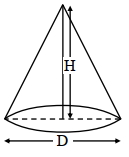
View full question & answer→MCQ 4611 Mark
In an experiment for determination of the focal length of a thin convex lens, the distance of the object from the lens is $10 \pm 0.1 \mathrm{~cm}$ and the distance of its real image from the lens is $20 \pm 0.2 \mathrm{~cm}$. The error in the determination of focal length of the lens is $n \%$. The value of $n$ is. . . . . . .
Answera
$u=10 \pm 0.1 \mathrm{~cm}, \quad v=20 \pm 0.2 \mathrm{~cm}$
$\frac{1}{v}-\frac{1}{u}=\frac{1}{f} \Rightarrow \frac{1}{v^2} d v+\frac{1}{u^2} d u=-\frac{1}{f^2} d f$
$\frac{1}{20}+\frac{1}{10}=\frac{1}{f} \Rightarrow \frac{1}{f}=\frac{3}{20} \Rightarrow f=\frac{20}{3} \mathrm{~cm}$
$\Rightarrow \frac{1}{(20)^2}(0.2)+\frac{1}{(10)^2}(0.1)=\frac{9}{400} d f$
$\text { df }=\frac{1}{9}\left(\frac{400}{400} \times 0.2+\frac{400}{100} \times 0.1\right)$
$d f=\frac{1}{9}(0.2+0.4) \Rightarrow \mathrm{df}=\frac{0.6}{9}$
$\frac{\mathrm{df}}{\mathrm{f}}=\frac{0.6}{9} \times \frac{3}{20}=\frac{1}{100}$
$\% \text { error }=1 \%$
View full question & answer→MCQ 4621 Mark
Young's modulus of elasticity $Y$ is expressed in terms of three derived quantities, namely, the gravitational constant $G$, Planck's constant $h$ and the speed of light $c$, as $Y=c^\alpha h^\beta G^\gamma$. Which of the following is the correct option?
- ✓
$\alpha=7, \beta=-1, \gamma=-2$
- B
$\alpha=-7, \beta=-1, \gamma=-2$
- C
$\alpha=7, \beta=-1, \gamma=2$
- D
$\alpha=-7, \beta=1, \gamma=-2$
AnswerCorrect option: A. $\alpha=7, \beta=-1, \gamma=-2$
a
$Y=c^\alpha h^\beta G^\gamma$
$\mathrm{ML}^{-1} \mathrm{~T}^{-2}=\left(\mathrm{LT}^{-1}\right)^\alpha\left(\mathrm{ML}^2 \mathrm{~T}^{-1}\right)^\beta\left(\mathrm{M}^{-1} \mathrm{~L}^3 \mathrm{~T}^{-2}\right)^\gamma$
$1=\beta-\gamma$ $. . . . . (1)$
$-1=\alpha+2 \beta+3 \gamma$ $. . . . .(2)$
$\frac{-2=-\alpha-\beta-2 \gamma}{-3=\beta+\gamma}$ $. . . .(3)$
$\frac{1=\beta-\gamma}{-2=2 \beta} \Rightarrow \beta=-1, \gamma=-2$
$-1=\alpha-2-6 \quad \therefore \alpha=7 $
View full question & answer→MCQ 4631 Mark
In a particular system of units, a physical quantity can be expressed in terms of the electric charge $c$, electron mass $m_c$, Planck's constant $h$, and Coulomb's constant $k=\frac{1}{4 \pi \in_0}$, where $\in_0$ is the permittivity of vacuum. In terms of these physical constants, the dimension of the magnetic field is $[B]=[c]^\alpha\left[m_c\right]^\beta[h]^\gamma[k]^\delta$. The value of $\alpha+\beta+\gamma+\delta$ is. . . . .
Answerb
$B = e ^\alpha\left( m _e\right)^\beta h ^\gamma k ^\delta$
${[ B ]=\left[ e ^\alpha\right]\left[ m _e\right]^\beta[ h ]^\gamma\left[ k ^\delta\right]}$
${\left[ M ^1 T ^{-2} A ^{-1}\right]=[ AT ]^\alpha[ m ]^\beta\left[ ML ^2 T ^{-1}\right]^\gamma\left[ ML ^3 A ^{-2} T ^{-4}\right]^\delta}$
$M ^1 T ^{-2} A ^{-1}= m ^{\beta+\gamma+\delta} L ^{2 x +38} T ^{\alpha-\gamma-\alpha \delta} A ^{\alpha-28}$
Compare : $\beta+\gamma+\delta=1 ; 2 \gamma+3 \delta=0, \alpha-\gamma-4 \delta=-2, \alpha-2 \delta=-1$
On solving $\alpha=3, \beta=2, \gamma=-3, \delta=2$
$\alpha+\beta+\gamma+\delta=4$
View full question & answer→MCQ 4641 Mark
Area of the cross-section of a wire is measured using a screw gauge. The pitch of the main scale is $0.5 mm$. The circular scale has 100 divisions and for one full rotation of the circular scale, the main scale shifts by two divisions. The measured readings are listed below.
| Measurement condition |
Main scale reading |
Circular scale reading |
| Two arms of gauge touching each other without wire |
$0$ division |
$4$ division |
| Attempt-$1$: With wire |
$4$ division |
$20$ division |
| Attempt-$2$: With wire |
$4$ division |
$16$ division |
What are the diameter and cross-sectional area of the wire measured using the screw gauge?
- A
$2.22 \pm 0.02 mm , \pi(1.23 \pm 0.02) mm ^2$
- B
$2.22 \pm 0.01 mm , \pi(1.23 \pm 0.01) mm ^2$
- ✓
$2.14 \pm 0.02 mm , \pi(1.14 \pm 0.02) mm ^2$
- D
$2.14 \pm 0.01 mm , \pi(1.14 \pm 0.01) mm ^2$
AnswerCorrect option: C. $2.14 \pm 0.02 mm , \pi(1.14 \pm 0.02) mm ^2$
c
$\text { LC }=\frac{0.1}{100}=0.001 mm$
$\text { Zero error }=4 \times 0.001=0.004 mm$
$\text { Reading } 1=0.5 \times 4+20 \times 0.001-0.004=2.16 mm$
$\text { Reading } 2=0.5 \times 4+16 \times 0.001-0.004=2.12 mm$
$\text { Mean value }=2.14 mm$
$\text { Mean absolute error }=\frac{0.02+0.02}{2}=0.02$
$\text { Diameter }=2.14 \pm 0.02$
$\text { Area }=\frac{\pi}{4} d^2$
View full question & answer→MCQ 4651 Mark
A physical quantity $\vec{S}$ is defined as $\vec{S}=(\vec{E} \times \vec{B}) / \mu_0$, where $\vec{E}$ is electric field, $\vec{B}$ is magnetic field and $\mu_0$ is the permeability of free space. The dimensions of $\vec{S}$ are the same as the dimensions of which of the following quantity (ies)?
$(A)$ $\frac{\text { Energy }}{\text { charge } \times \text { current }}$
$(B)$ $\frac{\text { Force }}{\text { Length } \times \text { Time }}$
$(C)$ $\frac{\text { Energy }}{\text { Volume }}$
$(D)$ $\frac{\text { Power }}{\text { Area }}$
- A
$A,B,C$
- B
$A,B,D$
- C
$A,B$
- ✓
$B,D$
Answerd
$\overrightarrow{ S }=[\overrightarrow{ E } \times \overrightarrow{ B }] \frac{1}{\mu_0}$
$S$ is pointing vector denotes flow of energy per unit area per unit time
$\overrightarrow{ S }=\frac{\text { watt }}{ m ^2}$
Hence $B, D$ are correct
View full question & answer→MCQ 4661 Mark
The smallest division on the main scale of a Vernier calipers is $0.1 cm$. Ten divisions of the Vernier scale correspond to nine divisions of the main scale. The figure below on the left shows the reading of this calipers with no gap between its two jaws. The figure on the right shows the reading with a solid sphere held between the jaws. The correct diameter of the sphere is
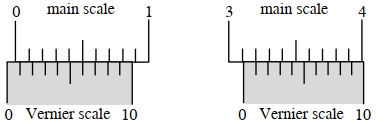
- A
$3.07 cm$
- B
$3.11 cm$
- ✓
$3.15 cm$
- D
$3.17 cm$
AnswerCorrect option: C. $3.15 cm$
c
$\begin{array}{l}\text { Given } 10 VSD =9 MSD \\ \text { Here MSD } \rightarrow \text { Main Scale division } \\ 1 VSD =\frac{9}{10} MSD \\ \text { VSD } \rightarrow \text { Vernier Scale division } \\ \text { Least count }=1 MSD -1 VSD \\ =\left(1-\frac{9}{10}\right) MSD \\ =0.1 MSD \\ =0.1 \times 0.1 cm \\ =0.01 cm \\ \text { As '0' of V.S. lie before '0' of M.S. } \\ \text { Zero error }=-[10-6] \text { L.C. } \\ =-4 \times 0.01 cm \\ =-0.04 cm \\ \text { Reading }=3.1 cm +1 \times LC \\ =3.4 cm +1 \times 0.01 cm \\ =3.11 cm \\ \text { True diameter }=\text { Reading }- \text { Zero error } \\ =3.11-(-0.04) cm =3.15 cm \\\end{array}$
View full question & answer→MCQ 4671 Mark
Sometimes it is convenient to construct a system of units so that all quantities can be expressed in terms of only one physical quantity. In one such system, dimensions of different quantities are given in terms of a quantity $X$ as follows: [position $]=\left[X^\alpha\right] ;[$ speed $]=\left[X^\beta\right]$; [acceleration $]=\left[X^{ p }\right]$; [linear momentum $]=\left[X^{ q }\right]$; [force $]=\left[X^{ I }\right]$. Then -
$(A)$ $\alpha+p=2 \beta$
$(B)$ $p+q-r=\beta$
$(C)$ $p-q+r=\alpha$
$(D)$ $p+q+r=\beta$
Answera
Given $L =x^\alpha$ $. . . . . . (1)$
$LT ^{-1}=x^\beta$ $. . . . . . (2)$
$LT ^{-2}=x^{ p }$ $. . . . . . (3)$
$MLT ^{-1}=x^q$ $. . . . . . (4)$
$MLT ^{-2}=x^{ I }V$ $. . . . . . (5)$
$\quad \frac{(1)}{(2)} \Rightarrow T =x^{\alpha-\beta}$
From $(3)$
$\frac{ x ^\alpha}{ x ^{2(\alpha-\beta)}}= x ^{ p }$
$\Rightarrow \alpha+ p =2 \beta$
From $(4)$
$M=x^{q-\beta}$
From $(5)$ $\Rightarrow x ^{ q }= x ^{ T } x ^{\alpha-\beta}$
$\Rightarrow \alpha+ r - q =\beta$
Replacing value ' $\alpha$ ' in equation $(6)$ from $(A)$
$2 \beta- p + r - q =\beta$
$\Rightarrow p + q - r =\beta$
Replacing value of ' $\beta$ ' in equation $(6)$ from $(A)$
$2 \alpha+2 r-2 q=\alpha+p$
$\alpha=p+2 q-2 r$
View full question & answer→MCQ 4681 Mark
An optical bench has $1.5 m$ long scale having four equal divisions in each $cm$. While measuring the focal length of a convex lens, the lens is kept at $75 cm$ mark of the scale and the object pin is kept at $45 cm$ mark. The image of the object pin on the other side of the lens overlaps with image pin that is kept at $135 cm$ mark. In this experiment, the percentage error in the measurement of the focal length of the lens is. . . . .
- ✓
$0.69$
- B
$0.75$
- C
$0.80$
- D
$0.85$
AnswerCorrect option: A. $0.69$
a
For the given lens
$u =-30 cm$
$v =60 cm$
$\& \frac{1}{ f }=\frac{1}{ v }-\frac{1}{ u }$ on solving $: f =20 cm$
also $\frac{1}{ f }=\frac{1}{ v }-\frac{1}{ u }$
on differentiation
$\frac{d f}{f^2}=\frac{d v}{v^2}+\frac{d u}{u^2}$
$\frac{d f}{f}=f\left[\frac{d v}{v^2}+\frac{d u}{u^2}\right]$
$\& \frac{d f}{f} \times 100=f\left[\frac{d v}{v^2}+\frac{d u}{u^2}\right] \times 100 \%$
$f=20 cm , d u=d v=\frac{1}{4} cm$
Since there are $4$ divisions in $1 cm$ on scale
$\therefore \frac{ df }{ f } \times 100=20\left[\frac{1 / 4}{(60)^2}+\frac{1 / 4}{(30)^2}\right] \times 100 \%$
$=5\left[\frac{1}{3600}+\frac{1}{900}\right] \times 100 \%$
$=5\left[\frac{5}{36}\right] \%=\frac{25}{36} \% \approx 0.69 \%$
View full question & answer→MCQ 4691 Mark
Let us consider a system of units in which mass and angular momentum are dimensionless. If length has dimension of $L$, which of the following statement ($s$) is/are correct ?
$(1)$ The dimension of force is $L ^{-3}$
$(2)$ The dimension of energy is $L ^{-2}$
$(3)$ The dimension of power is $L ^{-5}$
$(4)$ The dimension of linear momentum is $L ^{-1}$
- ✓
$1,2,4$
- B
$1,2,3$
- C
$1,2$
- D
$1,3$
AnswerCorrect option: A. $1,2,4$
a
Mass $= M ^0 L ^0 T ^0$
$MVr = M ^0 L ^0 T ^0$
$M ^0 \frac{ L ^1}{ T ^1} \cdot L ^1= M ^0 L ^0 T ^0$
$L ^2= T ^1$ $. . . . . . .(1)$
Force $= M ^1 L ^1 T ^{-2} \quad \text { (in SI) }$
$= M ^0 L ^1 L ^{-4}$(In new system from equation $(1)) $
$= L ^{-3}$
Energy $= M ^1 L ^2 T ^{-2} \quad \text { (In SI) }$
$= M ^0 L ^2 L ^{-4}$ (In new system from equation $ (1)) $
$= L ^{-2}$
Power $=\frac{\text { Energy }}{\text { Time }}$
$= M ^1 L ^2 T ^{-5} \quad \text { (in SI) }$
$=M^0 L^2 L^{-6} $ (In new system from equation $(1)) $
$= L ^4$
Linear momentum $= M ^1 L ^1 T ^{-1} \text { (in SI) }$
$=M^0 L^1 L^{-2} $ (In new system from equation $(1)) $
$= L ^{-1}$
Ans. $(1,2,4)$
View full question & answer→MCQ 4701 Mark
In electromagnetic theory, the electric and magnetic phenomena are related to each other. Therefore, the dimensions of electric and magnetic quantities must also be related to each other. In the questions below, $[E]$ and $[B]$ stand for dimensions of electric and magnetic fields respectively, while $\left[\varepsilon_0\right]$ and $\left[\mu_0\right]$ stand for dimensions of the permittivity and permeability of free space respectively. $[L]$ and $[T]$ are dimensions of length and time respectively. All the quantities are given in $SI$ units.
($1$) The relation between $[E]$ and $[B]$ is
$(A)$ $[ E ]=[ B ][ L ][ T ]$ $(B)$ $[ E ]=[ B ][ L ]^{-1}[ T ]$ $(C)$ $[ E ]=[ B ][ L ][ T ]^{-1}$ $(D)$ $[ E ]=[ B ][ L ]^{-1}[ T ]^{-1}$
($2$) The relation between $\left[\varepsilon_0\right]$ and $\left[\mu_0\right]$ is
$(A)$ $\left[\mu_0\right]=\left[\varepsilon_0\right][ L ]^2[ T ]^{-2}$ $(B)$ $\left[\mu_0\right]=\left[\varepsilon_0\right][ L ]^{-2}[ T ]^2$ $(C)$ $\left[\mu_0\right]=\left[\varepsilon_0\right]^{-1}[ L ]^2[ T ]^{-2}$ $(D)$ $\left[\mu_0\right]=\left[\varepsilon_0\right]^{-1}[ L ]^{-2}[ T ]^2$
Give the answer or quetion ($1$) and ($2$)
- ✓
$C,D$
- B
$C,A$
- C
$C,B$
- D
$B,C,D$
Answera
($1$) $F = qvB = qE$
$E = vB$
${[ E ]=[ L ][ T ]^{-1}[ B ]}$
($2$) $\mu_0 \in_0=\frac{1}{ c ^2}$
$\mu_0=[ L ]^{-2}[ T ]^2\left[\in_0\right]^{-1}$
View full question & answer→MCQ 4711 Mark
If the measurement errors in all the independent quantities are known, then it is possible to determine the error in any dependent quantity. This is done by the use of series expansion and truncating the expansion at the first power of the error. For example, consider the relation $z=x / y$. If the errors in $x, y$ and $z$ are $\Delta x, \Delta y$ and $\Delta z$, respectively, then
$\mathrm{z} \pm \Delta \mathrm{z}=\frac{\mathrm{x} \pm \Delta \mathrm{x}}{\mathrm{y} \pm \Delta \mathrm{y}}=\frac{\mathrm{x}}{\mathrm{y}}\left(1 \pm \frac{\Delta \mathrm{x}}{\mathrm{x}}\right)\left(1 \pm \frac{\Delta \mathrm{y}}{\mathrm{y}}\right)^{-1} .$
The series expansion for $\left(1 \pm \frac{\Delta y}{y}\right)^{-1}$, to first power in $\Delta y / y$, is $1 \mp(\Delta y / y)$. The relative errors in independent variables are always added. So the error in $\mathrm{z}$ will be $\Delta \mathrm{z}=\mathrm{z}\left(\frac{\Delta \mathrm{x}}{\mathrm{x}}+\frac{\Delta \mathrm{y}}{\mathrm{y}}\right)$.
The above derivation makes the assumption that $\Delta x / x<<1, \Delta \mathrm{y} / \mathrm{y} \ll<1$. Therefore, the higher powers of these quantities are neglected.
($1$) Consider the ratio $\mathrm{r}=\frac{(1-\mathrm{a})}{(1+\mathrm{a})}$ to be determined by measuring a dimensionless quantity a.
If the error in the measurement of $\mathrm{a}$ is $\Delta \mathrm{a}(\Delta \mathrm{a} / \mathrm{a} \ll<1)$, then what is the error $\Delta \mathrm{r}$ in
$(A)$ $\frac{\Delta \mathrm{a}}{(1+\mathrm{a})^2}$ $(B)$ $\frac{2 \Delta \mathrm{a}}{(1+\mathrm{a})^2}$ $(C)$ $\frac{2 \Delta \mathrm{a}}{\left(1-\mathrm{a}^2\right)}$ $(D)$ $\frac{2 \mathrm{a} \Delta \mathrm{a}}{\left(1-\mathrm{a}^2\right)}$
($2$) In an experiment the initial number of radioactive nuclei is $3000$ . It is found that $1000 \pm$ $40$ nuclei decayed in the first $1.0 \mathrm{~s}$. For $|\mathrm{x}| \ll 1$, In $(1+\mathrm{x})=\mathrm{x}$ up to first power in $x$. The error $\Delta \lambda$, in the determination of the decay constant $\lambda$, in $\mathrm{s}^{-1}$, is
$(A) 0.04$ $(B) 0.03$ $(C) 0.02$ $(D) 0.01$
Give the answer quetion ($1$) and ($2$)
- ✓
$B,C$
- B
$B,D$
- C
$B,A$
- D
$B,C,D$
Answera
($1$) $\mathrm{r}=\frac{1-\mathrm{a}}{1+\mathrm{a}}$
$\frac{\Delta \mathrm{r}}{\mathrm{r}}=\frac{\Delta(1-\mathrm{a})}{(1-\mathrm{a})}+\frac{\Delta(1+\mathrm{a})}{(1+\mathrm{a})}$
$\frac{\Delta \mathrm{r}}{\mathrm{r}}=\frac{\Delta \mathrm{a}}{1-\mathrm{a}}+\frac{\Delta \mathrm{a}}{1+\mathrm{a}}$
$\frac{\Delta \mathrm{r}}{\mathrm{r}}=\frac{2 \Delta \mathrm{a}}{(1-\mathrm{a})(1+\mathrm{a})}$
$\Delta \mathrm{r}=\frac{2(\Delta \mathrm{a})}{(1-\mathrm{a})(1+\mathrm{a})} \times \frac{1-\mathrm{a}}{1+\mathrm{a}}$
$\Delta \mathrm{r}=\frac{2 \Delta \mathrm{a}}{(1+\mathrm{a})^2}$
($2$) $\mathrm{N}=\mathrm{N}_0 \mathrm{e}^{-\lambda \mathrm{t}}$
$\ell \mathrm{nN}=\ell \mathrm{nN}_0-\lambda \mathrm{t}$
Differentiate both sides.
$\frac{\mathrm{dN}}{\mathrm{N}}=-\mathrm{d} \lambda \cdot \mathrm{t}$
(There is no error in calculation of time $t$ )
$\Delta \lambda=\frac{\Delta \mathrm{N}}{\mathrm{N} \times \mathrm{t}}-\frac{40}{2000 \times 1}=0.02$
(where ' $\mathrm{N}$ ' is number of atoms remaining)
View full question & answer→MCQ 4721 Mark
If the measurement errors in all the independent quantities are known, then it is possible to determine the error in any dependent quantity. This is done by the use of series expansion and truncating the expansion at the first power of the error. For example, consider the relation $z=x / y$. If the errors in $x, y$ and $z$ are $\Delta x, \Delta y$ and $\Delta z$, respectively, then
$z \pm \Delta z=\frac{x \pm \Delta x}{y \pm \Delta y}=\frac{x}{y}\left(1 \pm \frac{\Delta x}{x}\right)\left(1 \pm \frac{\Delta y}{y}\right)^{-1} .$
The series expansion for $\left(1 \pm \frac{\Delta y}{y}\right)^{-1}$, to first power in $\Delta y / y$, is $1 \mp(\Delta y / y)$. The relative errors in independent variables are always added. So the error in $z$ will be $\Delta z=z\left(\frac{\Delta x}{x}+\frac{\Delta y}{y}\right)$.
The above derivation makes the assumption that $\Delta x / x \ll<1, \Delta y / y \ll<1$. Therefore, the higher powers of these quantities are neglected.
($1$) Consider the ratio $r =\frac{(1- a )}{(1+ a )}$ to be determined by measuring a dimensionless quantity a.
If the error in the measurement of $a$ is $\Delta a (\Delta a / a \ll<1)$, then what is the error $\Delta r$ in
$(A)$ $\frac{\Delta a }{(1+ a )^2}$ $(B)$ $\frac{2 \Delta a }{(1+ a )^2}$ $(C)$ $\frac{2 \Delta a}{\left(1-a^2\right)}$ $(D)$ $\frac{2 a \Delta a}{\left(1-a^2\right)}$
($2$) In an experiment the initial number of radioactive nuclei is $3000$ . It is found that $1000 \pm$ 40 nuclei decayed in the first $1.0 s$. For $|x|<1$, In $(1+x)=x$ up to first power in $x$. The error $\Delta \lambda$, in the determination of the decay constant $\lambda$, in $s ^{-1}$, is
$(A) 0.04$ $(B) 0.03$ $(C) 0.02$ $(D) 0.01$
Give the answer or quetion ($1$) and ($2$)
Answerd
($1$) $r =\frac{1- a }{1+ a }$
$\frac{\Delta r }{ r }=\frac{\Delta(1- a )}{(1- a )}+\frac{\Delta(1+ a )}{(1+ a )}$
$\frac{\Delta r }{ r }=\frac{\Delta a }{1- a }+\frac{\Delta a }{1+ a }$
$\frac{\Delta r }{ r }=\frac{2 \Delta a }{(1- a )(1+ a )}$
$\Delta r =\frac{2(\Delta a )}{(1- a )(1+ a )} \times \frac{1- a }{1+ a }$
$\Delta r =\frac{2 \Delta a }{(1+ a )^2}$
($2$) $N = N _0 e ^{-\lambda t }$
$\ell nN =\ell nN _0-\lambda t$
Differentiate both sides.
$\frac{ dN }{ N }=- d \lambda \cdot t$
(There is no error in calculation of time $t$ )
$\Delta \lambda=\frac{\Delta N }{ N \times t }-\frac{40}{2000 \times 1}=0.02$
(where ' $N$ ' is number of atoms remaining)
View full question & answer→MCQ 4731 Mark
A person measures the depth of a well by measuring the time interval between dropping a stone and receiving the sound of impact with the bottom of the well. The error in his measurement of time is $\delta \mathrm{T}=0.01$ seconds and he measures the depth of the well to be $\mathrm{L}=20$ meters. Take the acceleration due to gravity $\mathrm{g}=10 \mathrm{~ms}^{-2}$ and the velocity of sound is $300 \mathrm{~ms}^{-1}$. Then the fractional error in the measurement, $\delta \mathrm{L} / \mathrm{L}$, is closest to
- A
$0.2 \%$
- ✓
$1 \%$
- C
$3 \%$
- D
$5 \%$
AnswerCorrect option: B. $1 \%$
b
$\mathrm{t}=\sqrt{\frac{2 \mathrm{~L}}{\mathrm{~g}}}+\frac{\mathrm{L}}{\mathrm{C}}$
$\frac{\mathrm{dt}}{\mathrm{dL}}=\sqrt{\frac{\mathrm{L}}{\mathrm{g}}} \times \frac{1}{2 \sqrt{\mathrm{L}}}+\frac{1}{\mathrm{C}}$
$\mathrm{dL}=\frac{\mathrm{dt}}{\frac{1}{\sqrt{2 \mathrm{gL}}}+\frac{1}{\mathrm{C}}}$
$\Rightarrow \frac{\mathrm{dL}}{\mathrm{L}} \times 100=\left(\frac{\mathrm{dt}}{\frac{1}{\sqrt{2 \mathrm{gL}}}+\frac{1}{\mathrm{C}}}\right) \frac{1}{\mathrm{~L}} \times 100$
$=\frac{15}{16 \%} \approx 1 \%$
View full question & answer→MCQ 4741 Mark
A length-scale $(l)$ depends on the permittivity $(\varepsilon)$ of a dielectric material. Boltzmann constant $\left(k_B\right)$, the absolute temperature $(T)$, the number per unit volune $(n)$ of certain charged particles, and the charge $(q)$ carried by each of the particless. Which of the following expression($s$) for $l$ is(are) dimensionally correct?
($A$) $l=\sqrt{\left(\frac{n q^2}{\varepsilon k_B T}\right)}$
($B$) $l=\sqrt{\left(\frac{\varepsilon k_B T}{n q^2}\right)}$
($C$)$l=\sqrt{\left(\frac{q^2}{\varepsilon n^{2 / 3} k_B T}\right)}$
($D$) $l=\sqrt{\left(\frac{q^2}{\varepsilon n^{1 / 3} k_B T}\right)}$
Answerd
The correct options are
$B I=\sqrt{\left(\frac{\in k_{ B } T}{n q^2}\right)}$
$D I=\sqrt{\left(\frac{q^2}{ en ^{1 / 3} k_B T}\right)}$
As given condition $\rightarrow$
$1 \propto \in k_B T$ and $l \propto \frac{1}{q^2}$
So, finding the dimension of the function
${\left[\frac{\varepsilon_0 k_B T}{q^2}\right]=\left[\frac{q^2 F r}{F r^2 q}\right]=\left[\frac{1}{r}\right]=\left[L^{-1}\right]}$
${\left[\frac{q^2}{\in_0 k_B T}\right]=[L]}$
For option $A :\left[\sqrt{\frac{n q^2}{\varepsilon_0 k _{ B } T}}\right]=\left[\sqrt{ L ^{-3} L}\right]=\left[L^{-1}\right]$
For option $B :\left[\sqrt{\frac{\varepsilon_0 k _{ B } T}{ nq ^2}}\right]=\left[\sqrt{\frac{ L ^{-1}}{L^{-3}}}\right]=[ L ]$
For option C: $\left[\sqrt{\frac{ q ^2}{\varepsilon_0 K_{ B } T n^2}}\right]=\left[\sqrt{\frac{ L }{ L ^{-2}}}\right]=\left[ L ^{3 / 2}\right]$
For option D: $\left[\sqrt{\frac{q^2}{\varepsilon_0 K_{ B } n ^2}}\right]=\left[\sqrt{\frac{L}{L^{-1}}}\right]=[L]$
Hence, answer $B$ and $D$ matches correctly.
View full question & answer→MCQ 4751 Mark
In an experiment to determine the acceleration due to gravity $g$, the formula used for the time period of a periodic motion is $T=2 \pi \sqrt{\frac{7(R-r)}{5 g}}$. The values of $R$ and $r$ are measured to be $(60 \pm 1) \mathrm{mm}$ and $(10 \pm 1) \mathrm{mm}$, respectively. In five successive measurements, the time period is found to be $0.52 \mathrm{~s}, 0.56 \mathrm{~s}, 0.57 \mathrm{~s}, 0.54 \mathrm{~s}$ and $0.59 \mathrm{~s}$. The least count of the watch used for the measurement of time period is $0.01 \mathrm{~s}$. Which of the following statement($s$) is(are) true?
($A$) The error in the measurement of $r$ is $10 \%$
($B$) The error in the measurement of $T$ is $3.57 \%$
($C$) The error in the measurement of $T$ is $2 \%$
($D$) The error in the determined value of $g$ is $11 \%$
- A
$A,B,C$
- ✓
$A,B,D$
- C
$B,C$
- D
$A,C$
AnswerCorrect option: B. $A,B,D$
b
The observed values of time period, $T _{ i }=0.52 s, 0.56 s, 0.57 s, 0.54 s$ and $0.59$ s
The mean value of time period, $T =\frac{\sum T _{ i }}{5}=\frac{2.78}{5}=0.56 s$
Magnitude of absolute error in each observation,
$\left|\Delta T _1\right|=|0.56-0.52|=|0.04| s$
Similarly, $\left|\Delta T _2\right|=|0.0| s \left|\Delta T _3\right|=|0.01| s \left|\Delta T _4\right|=|0.02| s \left|\Delta T _5\right|=|0.03| s$
Mean absolute error in time period,
$\Delta T _{ m }=\frac{0.04+0.00+0.01+0.02+0.03}{5}=0.02 s$
$\therefore$ Error in $T , \frac{\Delta T _{ m }}{ T } \times 100=\frac{0.02}{0.56} \times 100=3.57 \%$
Error in the measurement of $r : \frac{\Delta r }{ r } \times 100=\frac{1}{10} \times 100=10 \%$
From the equation given, we get: $g =\frac{28 \pi^2( R - r )}{5 T^2}$
$\therefore$ Error in the measurement of $g$ :
$\frac{\Delta g }{ g } \times 100=\frac{\Delta R +\Delta r }{( R - r )} \times 100+2 \frac{\Delta T _{ m }}{ T } \times 100$
$\Rightarrow \frac{\Delta g }{ g } \times 100=\frac{1+1}{(60-10)} \times 100+2(3.57) \%=11.14 \%$
Thus options $A, B$ and $D$ are correct.
View full question & answer→MCQ 4761 Mark
There are two Vernier calipers both of which have $1 \mathrm{~cm}$ divided into $10$ equal divisions on the main scale. The Vernier scale of one of the calipers $\left(C_1\right)$ has $10$ squal divisions that correspond to $9$ main scale divisions. The Vernier scale of the other caliper $\left(C_2\right)$ has $10$ equal divisions that correspond to $11$ main scale divisions. The readings of the two calipers are shown in the figure. The measured values (in $\mathrm{cm}$ ) by calipers $C_1$ and $C_2$, respectively, are
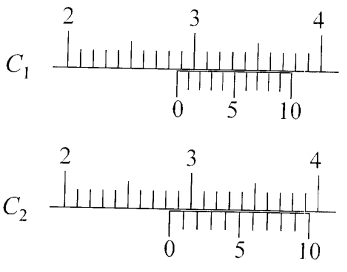
- A
$2.85$ and $2.82$
- ✓
$2.87$ and $2.83$
- C
$2.87$ and $2.86$
- D
$2.87$ and $2.87$
AnswerCorrect option: B. $2.87$ and $2.83$
b
$C_1: 1$ Main scale division MSD $=0.1 cm$
1 vernier scale division VSD $=\frac{0.9}{10}=0.09 cm$
Least count $L C=1 M S D-1 V S D=0.1-0.09=0.01 cm$
Main scale reading MSR $=2.8 cm$
Number of vernier division matching main scale division $n=7$
Reading $R_1=M S R+n \times L C=2.8+7 \times 0.01=2.87 cm$
$C_2: 1$ Main scale division $MSD$ $=0.1 cm$
1 vernier scale division $V S D=\frac{1.1}{10}=0.11 cm$
Least count $L C=1 V S D-1 M S D=0.11-0.1=0.01 cm$
Main scale reading $MSR$ $=2.8 cm$
Here we should note that size of vernier scale division is bigger than main scale division, hence number of vernier division matching main scale division will be counted form back. In given figure we can see that 7th vernier scale division is matching so we shall consider $10-7=3$ rd.
Number of vernier division matching main scale division $(n)=3$
Reading $R_2=M S R+n \times L C=2.8+3 \times 0.01=2.83 cm$
View full question & answer→MCQ 4771 Mark
In terms of potential difference $V$, electric current $I$, permittivity $\varepsilon_0$, permeability $\mu_0$ and speed of light $c$, the dimensionally correct equation$(s)$ is(are)
$(A)$ $\mu_0 I ^2=\varepsilon_0 V ^2$ $(B)$ $\varepsilon_0 I =\mu_0 V$ $(C)$ $I =\varepsilon_0 cV$ $(D)$ $\mu_0 cI =\varepsilon_0 V$
- A
$(B,D)$
- B
$(B,C)$
- ✓
$(A,C)$
- D
$(A,D)$
AnswerCorrect option: C. $(A,C)$
c
$BI \ell c \equiv VI \Rightarrow \mu_0 I ^2 c \equiv VI \Rightarrow \mu_0 Ic = V$
$\Rightarrow \mu_0^2 I ^2 c ^2= V ^2$
$\Rightarrow \mu_0 I ^2=\varepsilon_0 V ^2 \Rightarrow \varepsilon_0 cV = I$
View full question & answer→MCQ 4781 Mark
The energy of a system as a function of time $t$ is given as $E(t)=A^2 \exp (-\alpha t)$, where $\alpha=0.2 s ^{-1}$. The measurement of $A$ has an error of $1.25 \%$. If the error in the measurement of time is $1.50 \%$, the percentage error in the value of $E(t)$ at $t=5 s$ is
Answerd
$E(t)=A^2 e^{-\alpha t}$
$\Rightarrow d E=-\alpha A^2 e^{-\alpha t} d t+2 A d A e^{-\alpha t}$
Putting the values for maximum error,
$\Rightarrow \frac{ dE }{ E }=\frac{4}{100} \Rightarrow \% \text { error }=4$
View full question & answer→MCQ 4791 Mark
Planck's constant $h$, speed of light $c$ and gravitational constant $G$ are used to form a unit of length $L$ and a unit of mass $M$. Then the correct option$(s)$ is(are)
$(A)$ $M \propto \sqrt{ c }$ $(B)$ $M \propto \sqrt{ G }$ $(C)$ $L \propto \sqrt{ h }$ $(D)$ $L \propto \sqrt{G}$
- A
$(A,B,C)$
- B
$(A,B,D)$
- ✓
$(A,C,D)$
- D
$(B,C,D)$
AnswerCorrect option: C. $(A,C,D)$
c
$h \equiv\left[M^2 T^{-1}\right], c \equiv\left[L T^{-1}\right], G \equiv\left[M^{-1} L^3 T^{-2}\right] $
$M \propto \sqrt{\frac{h c}{G}}, L \propto \sqrt{\frac{h G}{c^3}}$
View full question & answer→MCQ 4801 Mark
Consider a Vernier callipers in which each $1 \ cm$ on the main scale is divided into $8$ equal divisions and a screw gauge with $100$ divisions on its circular scale. In the Vernier callipers, $5$ divisions of the Vernier scale coincide with $4$ divisions on the main scale and in the screw gauge, one complete rotation of the circular scale moves it by two divisions on the linear scale. Then:
$(A)$ If the pitch of the screw gauge is twice the least count of the Vernier callipers, the least count of the screw gauge is $0.01 \ mm$.
$(B)$ If the pitch of the screw gauge is twice the least count of the Vernier callipers, the least count of the screw gauge is $0.005 \ mm$.
$(C)$ If the least count of the linear scale of the screw gauge is twice the least count of the Vernier callipers, the least count of the screw gauge is $0.01 \ mm$.
$(D)$ If the least count of the linear scale of the screw gauge is twice the least count of the Vernier callipers, the least count of the screw gauge is $0.005 \ mm$.
- A
$(A,D)$
- B
$(B,D)$
- ✓
$(B,C)$
- D
$(C,D)$
AnswerCorrect option: C. $(B,C)$
c
For vernier callipers, $1$ main scale division $=\frac{1}{8} cm$ $1$ vernier scale division $=\frac{1}{10} cm$
So least count $=\frac{1}{40} cm$
For screw gauge, pitch $(p)=2$ main scale division
So least count $=\frac{ p }{100}$
So option $(B)$ and $(C)$ are correct.
View full question & answer→MCQ 4811 Mark
To find the distance $d$ over which a signal can be seen clearly in foggy conditions, a railways engineer uses dimensional analysis and assumes that the distance depends on the mass density $\rho$ of the fog, intensity (power/area) $S$ of the light from the signal and its frequency $f$. The engineer find that $d$ is proportional to $S ^{1 / n}$. The value of $n$ is:
Answera
$d=k \quad(\rho)^a \quad(S)^b \quad(f)^c $
${\left[\frac{M}{L^3}\right]^a\left[\frac{M^1 L^2 T^{-2}}{L^2 T}\right]^b\left[\frac{1}{T}\right]^c} $
$0=a+b $
$1=-3 a \quad \Rightarrow a=-\frac{1}{3} \quad \text { So : } b=\frac{1}{3} $
$0=-3 b+c$
So : $n=3$
View full question & answer→MCQ 4821 Mark
Durring Searle's experiment, zero of the Vernier scale lies between $3.20 \times 10^{-2} m$ and $3.25 \times 10^{-2} m$ of the main scale. The $20^{\text {th }}$ division of the Vernier scale exactly coincides with one of the main scale divisions. When an additional load of $2 \ kg$ is applied to the wire, the zero of the Vernier scale still lies between $3.20 \times 10^{-2} m$ and $3.25 \times 10^{-2} m$ of the main scale but now the $45^{\text {th }}$ division of Vernier scale coincides with one of the main scale divisions. The length of the thin metallic wire is $2 m$. and its cross-sectional area is $8 \times 10^{-7} m ^2$. The least count of the Vernier scale is $1.0 \times 10^{-5} m$. The maximum percentage error in the Young's modulus of the wire is
Answera
Observation $-1$
Let weight used is $W _1$, extension $\ell_1$
$W_1$, $\ell_1$
$y =\frac{ W _1 / A }{\ell_1 / L } \Rightarrow W _1=\frac{ yA \ell_1}{ L } \quad \ell_1=3.2 \times 10^{-2}+20 \times 10^{-5}$
Observation $-2$
Let weight used is $W _2$ extension $\ell_2$
$W _2$, $\ell_2$
$y =\frac{ W _2 / A }{\ell_2 / L } \Rightarrow W _1=\frac{ yA \ell_2}{ L } \quad \ell_1=3.2 \times 10^{-2}+45 \times 10^{-5}$
$W _2- W _1=\frac{y A}{L}\left(\ell_2-\ell_1\right) \Rightarrow y=\frac{\left(W_2-W_1\right) / L}{y A\left(\ell_2-\ell_1\right)} $
$\left(\frac{\Delta y}{y}\right)_{\max }=\frac{\Delta \ell_2+\Delta \ell_1}{\ell_2-\ell_1}=\frac{2 \times 10^{-5}}{25 \times 10^{-5}} $
$\left(\frac{\Delta y}{y}\right)_{\max } \times 100 \% \quad=\frac{2}{25} \times 100 \%=8 \%$
View full question & answer→MCQ 4831 Mark
Match List $I$ with List $II$ and select the correct answer using the codes given below the lists :
| List $I$ |
List $II$ |
| $P.$ Boltzmann constant |
$1.$ $\left[ ML ^2 T ^{-1}\right]$ |
| $Q.$ Coefficient of viscosity |
$2.$ $\left[ ML ^{-1} T ^{-1}\right]$ |
| $R.$ Planck constant |
$3.$ $\left[ MLT ^{-3} K ^{-1}\right]$ |
| $S.$ Thermal conductivity |
$4.$ $\left[ ML ^2 T ^{-2} K ^{-1}\right]$ |
Codes: $ \quad \quad P \quad Q \quad R \quad S $
- A
$\quad 3 \quad 1 \quad 2 \quad 4 $
- B
$\quad 3 \quad 2 \quad 1 \quad 4 $
- ✓
$\quad 4 \quad 2 \quad 1 \quad 3 $
- D
$\quad 4 \quad 1 \quad 2 \quad 3 $
AnswerCorrect option: C. $\quad 4 \quad 2 \quad 1 \quad 3 $
c
$(p)$ $U =\frac{1}{2} kT \quad \Rightarrow \quad ML ^2 T ^{-2}=[ k ] K \quad \Rightarrow \quad[ K ]= ML ^2 T ^{-2} K ^{-1}$
$(q)$ $F =\eta A \frac{ dv }{ dx } \Rightarrow \quad[\eta]=\frac{ MLT ^{-2}}{ L ^2 LT ^{-1} L ^{-1}}= ML ^{-1} T ^{-1}$
$(r)$ $E = h v \quad \Rightarrow \quad ML ^2 T ^2=[ h ] T ^{-1} \Rightarrow \quad[ h ]= ML ^2 T ^{-1}$
$(s)$ $\frac{ dQ }{ dt }=\frac{ kA \Delta \theta}{\ell} \Rightarrow \quad[ k ]=\frac{ ML ^2 T ^{-3} L }{ L ^2 K }= MLT ^{-3} K ^{-1}$
View full question & answer→MCQ 4841 Mark
The diameter of a cylinder is measured using a vernier callipers with no zero error. It is found that the zero of the vernier scale lies between $5.10 \ cm$ and $5.15 \ cm$ of the main scale. The vernier scale has $50$ division equivalent to $2.45 \ cm$. The $24^{\text {th }}$ division of the vernier scale exactly coincides with one of the main scale divisions. The diameter of the cylinder is :
- A
$5.112 \ cm$
- ✓
$5.124 \ cm$
- C
$5.136 \ cm$
- D
$5.148 \ cm$
AnswerCorrect option: B. $5.124 \ cm$
b
$50 VSD =2.45 \ cm $
$1 VSD =\frac{2.45}{50} cm =0.049 \ cm $
$\text { Least count of vernier }=1 MSD -1 VSD $
$=0.05 cm -0.049 \ cm $
$=0.001 \ cm $
$\text { Thickness of the object }=\text { Main scale reading }+ \text { vernier scale reading } \times \text { least count } $
$=5.10+(24)(0.001) $
$=5.124 \ cm .$
View full question & answer→MCQ 4851 Mark
In the determination of Young's modulus $\left(Y=\frac{4 MLg }{\pi / d ^2}\right)$ by using Searle's method, a wire of length $L=2 \ m$ and diameter $d =0.5 \ mm$ is used. For a load $M =2.5 \ kg$, an extension $\ell=0.25 \ mm$ in the length of the wire is observed. Quantities $d$ and $\ell$ are measured using a screw gauge and a micrometer, respectively. They have the same pitch of $0.5 \ mm$. The number of divisions on their circular scale is $100$ . The contributions to the maximum probable error of the $Y$ measurement
- ✓
due to the errors in the measurements of $d$ and $\ell$ are the same.
- B
due to the error in the measurement of $d$ is twice that due to the error in the measurement of $\ell$.
- C
due to the error in the measurement of $\ell$ is twice that due to the error in the measurement of $d$.
- D
due to the error in the measurement of $d$ is four time that due to the error in the measurement of $\ell$.
AnswerCorrect option: A. due to the errors in the measurements of $d$ and $\ell$ are the same.
a
$\Delta d=\Delta \ell=\frac{0.5}{100} \ mm$
$y =\frac{4 MLg }{\pi \ell d ^2} $
$\left(\frac{\Delta y }{ y }\right)_{\max }=\frac{\Delta \ell}{\ell}+2 \frac{\Delta d }{ d }$
error due to $\ell$ measurement $\frac{\Delta \ell}{\ell}=\frac{0.5 / 100 mm }{0.25 mm }$
error due to d measurement $2 \frac{\Delta d}{d}=\frac{2 \times \frac{0.5}{100}}{0.5 mm }=\frac{0.5 / 100}{0.25}$
So error in y due to $\ell$ measurement $=$ error in $y$ due to $d$ measurement
View full question & answer→MCQ 4861 Mark
The density of a solid ball is to be determined in an experiment. The diameter of the ball is measured with a screw gauge, whose pitch is $0.5 \ mm$ and there are $50$ divisions on the circular scale. The reading on the main scale is $2.5 \ mm$ and that on the circular scale is $20$ divisions. If the measured mass of the ball has a relative error of $2 \%$, the relative percentage error in the density is
- A
$0.9 \%$
- B
$2.4 \%$
- ✓
$3.1 \%$
- D
$4.2 \%$
AnswerCorrect option: C. $3.1 \%$
c
Given
Screw gauge readings
Pitch $=0.5 \ mm$
Circular scale division $=50$
Main scale reading $=2.5 \ mm$
Least count $=\frac{0.5}{50}=0.01 \ mm$
Circular scale division reading $=2$ odivisions
Relative error $=2 \%$
So,
Then dimensions reading from screw gauge $=$ Diameter of a solid ball
S.G. Reading $=$ main scale reading $+\left(\frac{\text { pitch }}{\text { circular scale division }}\right) \times$ circular scale division reading
$\text { Diameter of solid ball }=2.5+\frac{0.5}{50} \times 20=2.7 \ mm$
As density $\rho=\frac{\text { mass }}{\text { Volume }}=\frac{M}{\frac{4 \pi}{3}\left(\frac{D}{2}\right)^3}$
The relative percentage error in the density is
$\frac{\Delta \rho}{\rho} \times 100=\left(\frac{\Delta M }{ M }+\frac{3 \Delta D }{ D }\right) \times 100$
$\% \text { error }=\left(\frac{\Delta M }{ M } \times 100+\frac{3 \Delta D }{ D }\right) \times 100$
$=\left(2+3 \times \frac{0.01}{2.7}\right) \times 100$
$=3.1 \%$
View full question & answer→MCQ 4871 Mark
A student uses a simple pendulum of exactly $1 \mathrm{~m}$ length to determine $\mathrm{g}$, the acceleration due to gravity. He uses a stop watch with the least count of $1 \mathrm{sec}$ for this and records $40$ seconds for $20$ oscillations. For this observation, which of the following statement$(s)$ is (are) true?
$(A)$ Error $\Delta T$ in measuring $T$, the time period, is $0.05$ seconds
$(B)$ Error $\Delta \mathrm{T}$ in measuring $\mathrm{T}$, the time period, is $1$ second
$(C)$ Percentage error in the determination of $g$ is $5 \%$
$(D)$ Percentage error in the determination of $g$ is $2.5 \%$
- A
$(B,D)$
- B
$(A,D)$
- C
$(C,D)$
- ✓
$(A,C)$
AnswerCorrect option: D. $(A,C)$
d
$ \frac{\Delta \mathrm{T}}{\mathrm{T}}=\frac{\Delta \mathrm{t}}{\mathrm{t}}=\frac{1}{40} $
$ \Delta \mathrm{T}=0.05 \mathrm{sec} $
$ \mathrm{g}=\frac{4 \pi^2 \mathrm{Ln}^2}{\mathrm{t}^2} $
$ \frac{\Delta \mathrm{g}}{\mathrm{g}}=\frac{2 \Delta \mathrm{t}}{\mathrm{t}} $
$ \Rightarrow \% \text { error }=\frac{2 \Delta \mathrm{t}}{\mathrm{t}} \times 100=5 \%$
View full question & answer→MCQ 4881 Mark
A Vernier calipers has $1 \mathrm{~mm}$ marks on the main scale. It has $20$ equal divisions on the Vernier scale which match with $16$ main scale divisions. For this Vernier calipers, the least count is
- A
$0.02 \mathrm{~mm}$
- B
$0.05 \mathrm{~mm}$
- C
$0.1 \mathrm{~mm}$
- ✓
$0.2 \mathrm{~mm}$
AnswerCorrect option: D. $0.2 \mathrm{~mm}$
d
$\text { L.C. } $$ =1 \text { M.S.D }-1 \text { V.S.D } $
$ =\left(1-\frac{16}{20}\right) \text { M.S.D } $
$ =\left(1-\frac{4}{5}\right)(1 \mathrm{~mm})=0.2 \mathrm{~mm}$
View full question & answer→MCQ 4891 Mark
Students $I$, $II$ and $III$ perform an experiment for measuring the acceleration due to gravity $(g)$ using a simple pendulum.
They use different lengths of the pendulum and /or record time for different number of oscillations. The observations are shown in the table.
Least count for length $=0.1 \mathrm{~cm}$
Least count for time $=0.1 \mathrm{~s}$
| Student |
Length of the pendulum $(cm)$ |
Number of oscillations $(n)$ |
Total time for $(n)$ oscillations $(s)$ |
Time period $(s)$ |
| $I.$ |
$64.0$ |
$8$ |
$128.0$ |
$16.0$ |
| $II.$ |
$64.0$ |
$4$ |
$64.0$ |
$16.0$ |
| $III.$ |
$20.0$ |
$4$ |
$36.0$ |
$9.0$ |
If $\mathrm{E}_{\mathrm{I}}, \mathrm{E}_{\text {II }}$ and $\mathrm{E}_{\text {III }}$ are the percentage errors in g, i.e., $\left(\frac{\Delta \mathrm{g}}{\mathrm{g}} \times 100\right)$ for students $\mathrm{I}, \mathrm{II}$ and III, respectively,
AnswerCorrect option: B. $E_I$ is minimum
b
$ g=4 \pi^2\left(\frac{\ell}{\mathrm{T}^2}\right) $
$ \frac{\Delta \mathrm{g}}{\mathrm{g}}=\frac{\Delta \ell}{\ell}+2 \frac{\Delta \mathrm{T}}{\mathrm{T}} $
$ \Rightarrow \mathrm{E}=\frac{\Delta \ell}{\ell}+2 \frac{\Delta \mathrm{t}}{\mathrm{t}}, \text { greater the value of } \mathrm{t}, \text { lesser the error }$
Hence, fractional error in the Ist observation is minimum
View full question & answer→MCQ 4901 Mark
A student performs an experiment to determine the Young's modulus of a wire, exactly $2 \mathrm{~m}$ long, by Searle's method. In a particular reading, the student measures the extension in the length of the wire to be $0.8 \mathrm{~mm}$ with an uncertainty of $\pm 0.05 \mathrm{~mm}$ at a load of exactly $1.0 \mathrm{~kg}$. The student also measures the diameter of the wire to be $0.4 \mathrm{~mm}$ with an uncertainty of $\pm 0.01 \mathrm{~mm}$. Take $g=9.8 \mathrm{~m} / \mathrm{s}^2$ (exact). The Young's modulus obtained from the reading is
- A
$(2.0 \pm 0.3) \times 10^{11} \mathrm{~N} / \mathrm{m}^2$
- ✓
$(2.0 \pm 0.2) \times 10^{11} \mathrm{~N} / \mathrm{m}^2$
- C
$(2.0 \pm 0.1) \times 10^{11} \mathrm{~N} / \mathrm{m}^2$
- D
$(2.0 \pm 0.05) \times 10^{11} \mathrm{~N} / \mathrm{m}^2$
AnswerCorrect option: B. $(2.0 \pm 0.2) \times 10^{11} \mathrm{~N} / \mathrm{m}^2$
b
$Y =\frac{4 Fl }{\pi D ^2 e }$
Taking long both the sides
$\log Y =\log 4 Fl -\log \pi D ^2 e$
Now, partially differentiating,
$\frac{\Delta Y }{ Y }=-\left(\frac{2 \Delta D }{ D }+\frac{\Delta e }{ e }\right)$
$\frac{\Delta Y }{ Y }=-\left(\frac{2 \times 0.01}{0.4}+\frac{0.05}{0.8}\right)$
$\frac{\Delta Y }{ Y }=-0.1125$
$\text { Also, } Y =\frac{ Fl }{ Ae }=\frac{9.8 \times 2}{\pi(0.2)^2 \times 0.8}=194.96 \times 10^9 \approx 2 \times 10^{11}$
$\Delta Y =- Y \times\left(\frac{2 \Delta r }{ r }+\frac{\Delta e }{ e }\right)$
$\Delta Y =0.225 \times 10^{11}$
$Y =(2 \pm 0.2) \times 10^{11} Nm ^{-2}$
View full question & answer→MCQ 4911 Mark
Some physical quantities are given in Column $I$ and some possible $SI$ units in which these quantities may be expressed are given in Column $II$. Match the physical quantities in Column $I$ with the units in Column $II$ and indicate your answer by darkening appropriate bubbles in the $4 \times 4$ matrix given in the $ORS$.
| Column $I$ |
Column $II$ |
|
$(A)$ $\mathrm{GM}_e \mathrm{M}_5$
$\mathrm{G} \rightarrow$ universal gravitational constant, $\mathrm{M}_{\mathrm{e}} \rightarrow$ mass of the earth,
$\mathrm{M}_5 \rightarrow$ mass of the Sun
|
$(p)$ (volt) (coulomb) (metre) |
|
$(B)$ $\frac{3 \mathrm{RT}}{\mathrm{M}} ; \mathrm{R} \rightarrow$ universal gas constant, $\mathrm{T} \rightarrow$ absolute temperature,
$\mathrm{M} \rightarrow$ molar mass
|
$(q)$ (kilogram) $(\text { metre) })^3$ (second) $)^{-2}$ |
| $(C)$ $\frac{F^2}{q^2 B^2}$ ;$\quad F \rightarrow$ force, $q \rightarrow$ charge, $B \rightarrow$ magnetic field |
$(r)$ $(\text { meter })^2$ (second) $)^{-2}$ |
|
$(D)$ $\frac{\mathrm{GM}_e}{\mathrm{R}_{\mathrm{e}}}, G \rightarrow$ universal gravitational constant,
$\mathrm{M}_{\mathrm{e}} \rightarrow$ mass of the earth, $\mathrm{R}_{\mathrm{e}} \rightarrow$ radius of the earth
|
$(s)$ (farad) $(\text { volt) })^2(\mathrm{~kg})^{-1}$ |
- A
$A \rightarrow(s) \&(q), B \rightarrow(q) \&(s), C \rightarrow(p) \&(s), D \rightarrow(r) \&(p)$
- B
$A \rightarrow(r) \&(q), B \rightarrow(s) \&(q), C \rightarrow(r) \&(s), D \rightarrow(r) \&(s)$
- ✓
$A \rightarrow(p) \&(q), B \rightarrow(r) \&(s), C \rightarrow(r) \&(s), D \rightarrow(r) \&(s)$
- D
$A \rightarrow(p) \&(s), B \rightarrow(r) \&(s), C \rightarrow(q) \&(s), D \rightarrow(r) \&(p)$
AnswerCorrect option: C. $A \rightarrow(p) \&(q), B \rightarrow(r) \&(s), C \rightarrow(r) \&(s), D \rightarrow(r) \&(s)$
View full question & answer→MCQ 4921 Mark
Which of the following group have different dimension
AnswerCorrect option: D. Dipole moment, electric flux, electric field
d
$Dipole memest=q \times d$
$Flux =A T L$
$Field =E . \Delta S=\frac{F}{q} \cdot \Delta S$
View full question & answer→MCQ 4931 Mark
A wire has a mass $0.3 \pm 0.003\,g$, radius $0.5 \pm 0.005\,mm$ and length $6 \pm 0.06\,cm$. The maximum percentage error in the measurement of its density is .......... $\%$
Answerd
(d) Density, $\rho = \frac{M}{V} = \frac{M}{{\pi {r^2}L}}$
$ \Rightarrow \frac{{\Delta \rho }}{\rho } = \frac{{\Delta M}}{M} + 2\frac{{\Delta r}}{r} + \frac{{\Delta L}}{L}$
$ = \frac{{0.003}}{{0.3}} + 2 \times \frac{{0.005}}{{0.5}} + \frac{{0.06}}{6}$
$ = 0.01 + 0.02 + 0.01 = 0.04$
$\therefore $ Percentage error $ = \frac{{\Delta \rho }}{\rho } \times 100 = 0.04 \times 100 = 4\% $
View full question & answer→MCQ 4941 Mark
In the relation $P = \frac{\alpha }{\beta }{e^{ - \frac{{\alpha Z}}{{k\theta }}}}$ $P$ is pressure, $Z$ is the distance, $k$ is Boltzmann constant and $\theta$ is the temperature. The dimensional formula of $\beta$ will be
- ✓
$[{M^0}{L^2}{T^0}]$
- B
$[{M^1}{L^2}{T^1}]$
- C
$[{M^1}{L^0}{T^{ - 1}}]$
- D
$[{M^0}{L^2}{T^{ - 1}}]$
AnswerCorrect option: A. $[{M^0}{L^2}{T^0}]$
a
(a) In given equation, $\frac{{\alpha z}}{{k\theta }}$ should be dimensionless
$\therefore \alpha = \frac{{k\theta }}{z} \Rightarrow [\alpha ] = \frac{{[M{L^2}{T^{ - 2}}{K^{ - 1}} \times K]}}{{[L]}} = [ML{T^{ - 2}}]$
and $P = \frac{\alpha }{{ \beta }} \Rightarrow [\beta ] = \left[ {\frac{\alpha }{p}} \right] = \frac{{[ML{T^{ - 2}}]}}{{[M{L^{ - 1}}{T^{ - 2}}]}} = [{M^0}{L^2}{T^0}]$.
View full question & answer→MCQ 4951 Mark
A cube has a side of length $1.2 \times 10^{-2}\; m$. Calculate its volume.
- ✓
$1.7× 10^{-6}m^{3}$
- B
$1.73 × 10^{-6}m^{3}$
- C
$1.70 × 10^{-6}m^{3}$
- D
$1.732 ×10^{-6}m^{3}$
AnswerCorrect option: A. $1.7× 10^{-6}m^{3}$
a
$l$ = $1.2 × 10^{-2}m$
$V = l^3$ = $(1.2 ×10^{-2})^3 = 1.732 × 10^{-6}\;m^3$
$V = 1.7 ×10^{-6}\;m^3$
View full question & answer→MCQ 4961 Mark
The quantity $X = \frac{{{\varepsilon _0}LV}}{t}$: ${\varepsilon _0}$ is the permittivity of free space, $L$ is length, $V$ is potential difference and $t$ is time. The dimensions of $X$ are same as that of
Answerd
(d) [${\varepsilon _0}L$] $= [C]$
$⇒$ $X = \frac{{{\varepsilon _0}LV}}{t} $ $= \frac{{C \times V}}{t} $ $= \frac{Q}{t}$= current
View full question & answer→MCQ 4971 Mark
Let $[{\varepsilon _0}]$ denotes the dimensional formula of the permittivity of the vacuum and $[{\mu _0}]$ that of the permeability of the vacuum. If $M = {\rm{mass}}$, $L = {\rm{length}}$, $T = {\rm{Time}}$ and $I = {\rm{electric current}}$, then
- A
$[{\varepsilon _0}] = {M^{ - 1}}{L^{ - 3}}{T^2}I$
- ✓
$[{\varepsilon _0}] = {M^{ - 1}}{L^{ - 3}}{T^4}{I^2}$
- C
$[{\mu _0}] = M{L^2}{T^{ - 1}}I$
- D
AnswerCorrect option: B. $[{\varepsilon _0}] = {M^{ - 1}}{L^{ - 3}}{T^4}{I^2}$
b
Dimension formula of $\varepsilon_0$
$\varepsilon_0=\frac{1}{4 \pi F } \frac{ v _1 v _2}{ r ^2}\left( F = MLT ^{-2}\right)$
$\varepsilon_0=\frac{1}{ MLT ^{-2}} \frac{ LAT \times AT }{1^2}$
$= M ^{-1} L ^{-3} t ^4 A ^2$
Dimension of $\mu_0$
$N / A ^2$ or $WbA A ^{-1} m ^{-1}$
$=[ M ][ L ][ T ]^{-2}[ A ]^{-2}$
View full question & answer→MCQ 4981 Mark
The pair(s) of physical quantities that have the same dimensions, is (are)
- A
Reynolds number and coefficient of friction
- B
Latent heat and gravitational potential
- C
Curie and frequency of a light wave
- ✓
Answerd
(d) Reynolds number and coefficient of friction are dimensionless.
Latent heat and gravitational potential both have dimension $[{L^2}{T^{ - 2}}]$.
Curie and frequency of a light wave both have dimension $[{T^{ - 1}}]$. But dimensions of Planck's constant is $[{T^{ - 1}}]$ and torque is $[M{L^2}{T^{ - 2}}]$.
View full question & answer→MCQ 4991 Mark
Choose the correct match
|
List I
|
List II
|
|
$(i)$ Curie
|
$(A)$ $ML{T^{ - 2}}$
|
|
$(ii)$ Light year
|
$(B)$ $M$
|
|
$(iii)$ Dielectric strength
|
$(C)$ Dimensionless
|
|
$(iv)$ Atomic weight
|
$(D)$ $T$
|
|
$(v)$ Decibel
|
$(E)$ $M{L^2}{T^{ - 2}}$
|
| |
$(F)$ $M{T^{ - 3}}$
|
| |
$(G)$ ${T^{ - 1}}$
|
| |
$(H)$ $L$
|
| |
$(I)$ $ML{T^{ - 3}}{I^{ - 1}}$
|
| |
$(J)$ $L{T^{ - 1}}$
|
- ✓
$(i) G, (ii) H, (iii) C, (iv) B, (v) C$
- B
$(i) D, (ii) H, (iii) I, (iv) B, (v) G$
- C
$(i) G, (ii) H, (iii) I, (iv) B, (v) G$
- D
AnswerCorrect option: A. $(i) G, (ii) H, (iii) C, (iv) B, (v) C$
View full question & answer→MCQ 5001 Mark
If the dimensions of length are expressed as ${G^x}{c^y}{h^z}$; where $G,\,c$ and $h$ are the universal gravitational constant, speed of light and Planck's constant respectively, then
- A
$x = \frac{1}{2},\,\,y = \frac{1}{2}$
- B
$x = \frac{1}{2},\,\,z = \frac{1}{2}$
- C
$y = - \frac{3}{2},\,\,z = \frac{1}{2}$
- ✓
$(b)$ and $(c)$ both
AnswerCorrect option: D. $(b)$ and $(c)$ both
d
(d) Length $\propto$ $G^{x}c^{y}h^{z}$
$L= {[{M^{ - 1}}{L^3}{T^{ - 2}}]^x}\,$${[L{T^{ - 1}}]^y}{[M{L^2}{T^{ - 1}}]^z}$
By comparing the power of $M, L$ and $T$ in both sides we get $ - x + z = 0$, $3x + y + 2z = 1$ and $ - 2x - y - z = 0$
By solving above three equations we get
$x = \frac{1}{2},\,y = - \frac{3}{2},z = \frac{1}{2}$
View full question & answer→