Question
A hollow copper sphere A and a solid sphere B of equal radius are charged with the same potential. The true statement is:
Answer

(c)Both will have equal charge

Need a full question paper?

Generate a complete, print-ready paper with questions like this in minutes — across 16+ boards, with answer keys.

Start Generating Free

Similar questions

The angular frequency of an AC source is $\frac{10\text{radian}}{\text{sec}}$ The reactance of $1\mu\text{F}$ capacitor will be.
A long thin hollow metallic cylinder of radius $'R\ '$ has a current i ampere. The magnetic induction $'B\ '-$away from the axis at a distance $r$ from the axis varies as shown in
A parallel$-$plate capacitor has plates of unequal area. The larger plate is connected to the positive terminal of the battery and the smaller plate to its negative terminal. Let $Q_+$ and $Q_-$ be the charges appearing on the positive and negative plates respectively:
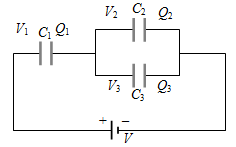
In an adjoining figure are shown three capacitors $C_1, C_2$ and $C _3$ joined to a battery. The correct condition will be $($Symbols have their usual meanings$)$
If in a parallel plate capacitor, which is connected to a battery, we fill dielectrics in whole space of its plates, then which of the following increases?
The fact that electric charge is always an integral multiple of e is termed as:
The gyro-magnetic ratio of an electron in an H-atom, according to Bohr model, is:
The work function of a metal is:
Assertion  : Microwave propagation is better than the sky wave propagation.
Reason      :  Microwaves have frequencies 100 to 300 GHz, which have very good directional properties.(a) If both assertion and reason are true and the reason is the correct explanation of the assertion.(b) If both assertion and reason are true but reason is not the correct explanation of the assertion.(c) If assertion is true but reason is false.(d) If the assertion and reason both are false.


The potential barrier, in the depletion layer, is due to(a) Ions(b) Holes(c) Electrons(d) Both (b) and (c)