Questions

M.C.Q (1 Marks)

Take a timed test

47 questions · self-marked practice — reveal the answer and mark yourself.
Question 11 Mark
A point P is situated on the axis of an electric dipole at a distance x from its mid-point, the electric potential at point P is proportional to:
Answer
(a)$\frac{1}{x^2}$
View full question & answer
Question 21 Mark
The electric potential (V) inside a uniformly charged. spherical shell depends on distance:
Answer
(b)$V =$ constant
View full question & answer
Question 31 Mark
Two capacitors whose capacitances are $C _1$ and $C _2$ If they are given equal charges then the ratio of the energies stored in them will be :
Answer
(a)$\frac{ C _2}{ C _1}$
View full question & answer
Question 41 Mark
In what order should three capacitors be connected so that the energy stored in them at the same potential is maximum?
Answer
(b)All three in parallel
View full question & answer
Question 51 Mark
A hollow copper sphere A and a solid sphere B of equal radius are charged with the same potential. The true statement is:
Answer
(c)Both will have equal charge
View full question & answer
Question 61 Mark
Equal charges are located at three corners of an equilateral triangle. The true statement for electric potential V and electric field intensity E at the centre O of the triangle will be:
Answer
(d)$V \neq 0, E =0$
View full question & answer
Question 81 Mark
The uniform field between the plates of a parallel plate capacitor is E volt/meter. If the distance between the plates is $d ( m )$ and the area of each plate is $A \left( m ^2\right)$, then the total energy stored in it is :
Answer
(a)$\frac{1}{2} \epsilon_0 E ^2 A d$
View full question & answer
Question 91 Mark
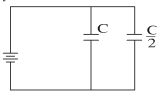
A capacitor of capacitance C and the other of capacitance $C / 2$ are connected to a battery of V volt as shown in the figure. The work done in charging both the capacitors fully is :
Image
Answer
(a)$\frac{3}{4} CV ^2$
View full question & answer
Question 101 Mark
Several capacitors marked $(8 \mu F-250 V)$ have been given. The minimum number of capacitors required to obtain an equivalence of ( $16 \mu F-1000 V$ ) from them will be:
Answer
(c)32
View full question & answer
Question 111 Mark
To reduce the value of capacitance of a parallel plate capacitor, the empty space between the plates:
Answer
(c)by increasing, the area of the plates is reduced
View full question & answer
Question 121 Mark
If both the plates of a charged capacitor are connected with a wire then:
Answer
(c)The capacitor will get discharged
View full question & answer
Question 131 Mark
A parallel combination of two capacitors of capacitance $C_1$ and $C_2$ is given a charge $Q$. If there is $Q_1$ charge on $C_1$ and $Q_2$ charge on $C_2$, the ratio of $\frac{Q_1}{Q_2}$ will be:
Answer
(b)$\frac{C_1}{C_2}$
View full question & answer
Question 151 Mark
The energies stored in two capacitors of capacitances $C _1$ and $C _2$, are equal. The ratio of potential difference across capacitors will be :
Answer
(b)$\sqrt{C_2}: \sqrt{C_1}$
View full question & answer
Question 161 Mark
A capacitor of capacitance 5 micro farads is charged to 1000 volts. The energy stored on the capacitor will be (in joules):
Answer
(c)2.5
View full question & answer
Question 181 Mark
On giving $40 \mu C$ charge to a parallel plate capacitor of $10 \mu F$ capacitance, the value of its total energy in joules will be :
Answer
(a)$8 \times 10^{-5}$
View full question & answer
Question 201 Mark
How can we combine three capacitors of $2 \mu F$ each to get $3 \mu F$ capacitance?
Answer
(c)Two capacitors in series and the third capacitor in parallel
View full question & answer
Question 211 Mark
Three capacitors whose capacitances are 2,4 and $\chi_\mu F$ respectively. They are combine first in series and then in parallel. In both the cases the ratio of their equivalents will be :
Answer
(b)4:49
View full question & answer
Question 221 Mark
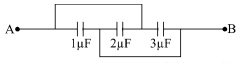
The capacitance of each capacitor is $x$ in the given figure. Equivalence between points A and B will Image
Answer
(c)$\frac{2}{3} x$
View full question & answer
Question 231 Mark
27 small drops of water with equal radius and equal charge comprised to form one big drop. The ratio of capacitance of a big drop and capacitance of a small drop will be:
Answer
(b)3:1
View full question & answer
Question 241 Mark
Electrical energy $U _0$ is stored in a charged parallel plate capacitor. On increasing the distance between the plates of a capacitor, double to initial distance the electrical energy will be :
Answer
(c)$2 U _0$
View full question & answer
Question 261 Mark
The capacitance of an air capacitor is $5 \mu F$. If mica is completely used in place of air in the same capacitor, then the capacitance becomes $30 \mu F$, the dielectric constant of mica will be:
Answer
(b)6
View full question & answer
Question 271 Mark
The capacitance of a capacitor is C. It is charged at a potential difference V. If now it is related to resistance, the amount of energy dilapidation will be:
Answer
(a)$\frac{1}{2} CV ^2$
View full question & answer
Question 291 Mark
A big drop is formed by mixing 64 small drops. If each small drop has charge Q, then the charge on the big drop will be
Answer
(a)64 Q
View full question & answer
Question 301 Mark
Two identical charges q are placed at a distance d from each other. The potential at a point situated at a distance between them will be:
Answer
(c)$4 \frac{k q}{d}$
View full question & answer
Question 311 Mark
Adielectric medium $e_r$ is filled in half of the space between the plates of a parallel plate capacitor. If the capacitance of the part filled with air is C then the capacitance of the entire capacitor system will be :
Answer
(c)$\frac{ C \epsilon_r}{1+\epsilon_r}$
View full question & answer
Question 321 Mark
A parallel plate capacitor is charged from a battery and the battery is removed. Now if the distance between the plates of the capacitor is increased, then in the capacitor:
Answer
(b)Potential difference increases and capacitance decreases
View full question & answer
Question 331 Mark
The relationship between potential difference V, charge Q and capacitance C is:
Answer
(c)$V=\frac{Q}{C}$
View full question & answer
Question 351 Mark
The electric potential at the centre of a charged spherical conductor in comparison with the potential at the surface of the conductor:
Answer
(c)will be the same
View full question & answer
Question 371 Mark
Charge $q$ is distributed on two spheres of radii $r_1$ and $r_2$ in such a way that they have the same surface density. Ratio in their potential :
Answer
(a)$\frac{r_1}{r_2}$
View full question & answer
Question 381 Mark
The dielectric strength of a medium is $2 kV mm ^{-1}$ What is the maximum potential difference that can be established across a $50 \mu m$ sample without binding?
Answer
(c)100 V
View full question & answer
Question 391 Mark
The electric potential at the centre of a charged solid sphere of metal is:
Answer
(c)equal to the potential on the surface of the solid sphere
View full question & answer
Question 401 Mark
When a test charge is brought from infinity to near the dipole along the neutral line of an electric dipole, then the work done will be:
Answer
(c)Zero
View full question & answer
Question 411 Mark
If a positive charge is taken from a region of lower potential to a region of higher potential, then the electrical potential energy:
Answer
(b)increases
View full question & answer
Question 421 Mark
If 64 charged drops of water are mixed to form one big drop, then how many times the value of potential on the big drop will be from the full value?
Answer
(b)16 times
View full question & answer
Question 441 Mark
When the distance between two charges is increased, the potential energy of the charges:
Answer
(d)may increase or decrease
View full question & answer
Question 451 Mark
The distance between two points is 30 cm . If $20 \mu C$ charge is kept at point A and $-10 \mu C$ charge is kept at point B, then at which point between A and B the potential will be zero :
Answer
(a)20 cm away from A
View full question & answer