- ACharge on sphere A will be more
- BCharge on sphere B will be more
- ✓Both will have equal charge
- DCannot be said with certainty.
Generate a complete, print-ready paper with questions like this in minutes — across 16+ boards, with answer keys.
Among the two interfering monochromatic sources A and B; A is ahead of B in phase by 66°. If the observation be taken from point P, such that PB – PA = l/4. Then the phase difference between the waves from A and B reaching P is
|
(a) 156° |
(b) 140° |
(c) 136° |
(d) 126° |
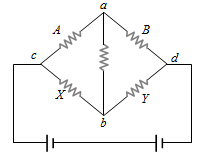
In the Wheatstone's bridge (shown in figure) X = Y and A > B. The direction of the current between ab will be

|
(a) From a to b |
(b) From b to a |
|
(c) From b to a through c |
(d) From a to b through c |
A proton (or charged particle) moving with velocity v is acted upon by electric field E and magnetic field B. The proton will move undeflected if
|
(a) E is perpendicular to B |
|
(b) E is parallel to v and perpendicular to B |
|
(c) E, B and v are mutually perpendicular and |
|
(d) E and B both are parallel to v |
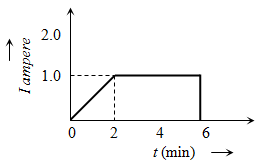
In a copper voltameter, mass deposited in 6 minutes is m gram. If the current-time graph for the voltameter is as shown here, then the E.C.E of the copper is

|
(a) m / 5 |
(b) m / 300 |
(c) 5 m |
(d) m / 18000 |
Assertion : The phenomenon of X-ray production is basically inverse of photoelectric effect.
Reason : X-rays are electromagnetic waves.
|
(a) If both assertion and reason are true and the reason is the correct explanation of the assertion. |
|
(b) If both assertion and reason are true but reason is not the correct explanation of the assertion. |
|
(c) If assertion is true but reason is false. |
|
(d) If the assertion and reason both are false. |
The example of nuclear fusion is
|
(a) Formation of Ba and Kr from U235 |
|
(b) Formation of He from H |
|
(c) Formation of Pu – 235 from U - 235 |
| (d) Formation of water from hydrogen and oxygen |