A hollow copper sphere $S$ and a hollow copper cube $ C$ , both of negligible thin walls of same area, are filled with water at $90°C$ and allowed to cool in the same environment. The graph that correctly represents their cooling is
Diffcult
Download our app for free and get started
(c)$\frac{{d\theta }}{{dt}} = \frac{{\varepsilon A\sigma }}{{mc}}4\theta _0^3\Delta \theta $
For given sphere and cube $\frac{{\varepsilon A\sigma }}{{mc}}4\theta _0^3\Delta \theta $ is constant so for both rate of fall of temperature $\frac{{d\theta }}{{dt}} = $constant
For given sphere and cube $\frac{{\varepsilon A\sigma }}{{mc}}4\theta _0^3\Delta \theta $ is constant so for both rate of fall of temperature $\frac{{d\theta }}{{dt}} = $constant

Download our appand get started for free
Experience the future of education. Simply download our apps or reach out to us for more information. Let's shape the future of learning together!No signup needed.*
Similar Questions
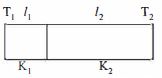
- 1One end of a thermally insulated rod is kept at a temperature $T_1$ and the other at $T_2$ . The rod is composed of two sections of length $l_1$ and $l_2$ and thermal conductivities $K_1$ and $K_2$ respectively. The temperature at the interface of the two section isView Solution
- 2A hollow sphere of inner radius $R$ and outer radius $2R$ is made of a material of thermal conductivity $K$. It is surrounded by another hollow sphere of inner radius $2R$ and outer radius $3R$ made of same material of thermal conductivity $K$. The inside of smaller sphere is maintained at $0^o C$ and the outside of bigger sphere at $100^o C$. The system is in steady state. The temperature of the interface will be ........ $^oC$View Solution
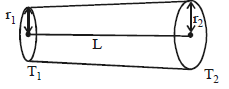
- 3The rate of heat flow through the cross-section of the rod shown in figure is ($T_2 > T_1$ and thermal conductivity of the material of the rod is $K$)View Solution
- 4A small object is placed at the center of a large evacuated hollow spherical container. Assume that the container is maintained at $0 K$. At time $t =0$, the temperature of the object is $200 K$. The temperature of the object becomes $100 K$ at $t = t _1$ and $50 K$ at $t = t _2$. Assume the object and the container to be ideal black bodies. The heat capacity of the object does not depend on temperature. The ratio $\left( t _2 / t _1\right)$ is. . . . .View Solution
- 5A black body of surface area $10cm^2$ is heated to $127°C$ and is suspended in a room at temperature $27°C$ . The initial rate of loss of heat from the body at the room temperature will be ...... $W$View Solution
- 6A room is maintained at ${20^o}C$ by a heater of resistance $20$ ohm connected to $200$ volt mains. The temperature is uniform through out the room and heat is transmitted through a glass window of area $1{m^2}$ and thickness $0.2$ cm. What will be the temperature outside ....... $^oC$ ? Given that thermal conductivity $K=0.2$ for glass is and $J = 4.2 J/cal$View Solution
- 7A body initially at $80^o C$ cools to $64^o C$ in $5$ minutes and to $52^o C$ in $10 $ minutes. The temperature of the body after $15$ minutes will be ...... $^oC$View Solution
- 8Assuming the Sun to be a spherical body of radius $R$ at a temperature of $T\ K$, evaluate the total radiant powerd incident of Earth at a distance $r$ from the SunView Solution
Where $r_{0}$ is the radius of the earth and $\sigma$ is Stefan's constant.
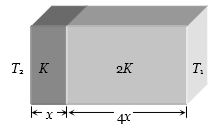
- 9The temperature of the two outer surfaces of a composite slab, consisting of two materials having coefficients of thermal conductivity $K$ and $2K$ and thickness $x$ and $4x$ , respectively are $T_2$ and $T_1$ ($T_2$ > $T_1$). The rate of heat transfer through the slab, in a steady state is $\left( {\frac{{A({T_2} - {T_1})K}}{x}} \right)f$, with $f $ which equal toView Solution
- 10$Assertion :$ A brass tumbler feels much colder than a wooden tray on a chilly day.View Solution
$Reason :$ The thermal conductivity of brass is more than the thermal conductivity of wood.