A hollow copper sphere $S$ and a hollow copper cube $ C$ , both of negligible thin walls of same area, are filled with water at $90°C$ and allowed to cool in the same environment. The graph that correctly represents their cooling is
- A
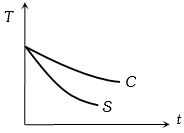
- B
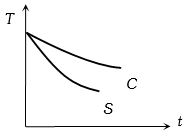
- C
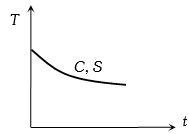
- D
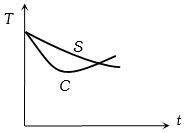
Diffcult


Download our appand get started for free
Experience the future of education. Simply download our apps or reach out to us for more information. Let's shape the future of learning together!No signup needed.*
Similar Questions
- 1Two vessels of different materials are similar in size in every respect. The same quantity of ice filled in them gets melted in $20$ minutes and $40$ minutes respectively. The ratio of thermal conductivities of the materials isView Solution
- 2View SolutionThe energy supply being cut-off, an electric heater element cools down to the temperature of its surroundings, but it will not cool further because
- 3A long metallic bar is carrying heat from one of its ends to the other end under steady-state. The variation of temperature $\theta$ along the length $x$ of the bar from its hot end is best described by which of the following figures?View Solution
- 4A hot black body emits the energy at the rate of $16\ J\ m^{-2}\ s^{-1}$ and its most intense radiation corresponds to $20,000\ Å$ . When the temperature of this body is further increased and its most intense radiation corresponds to $10,000\ Å$ , then the energy radiated in $Jm^{-2}\ s^{-1}$ will beView Solution
- 5View SolutionHalf part of ice block is covered with black cloth and rest half is covered with white cloth and then it is kept in sunlight. After some time clothes are removed to see the melted ice. Which of the following statements is correct
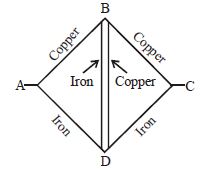
- 6Six wire each of cross-sectional area $A$ and length $l$ are combined as shown in the figure. The thermal conductivities of copper and iron are $K_1$ and $K_2$ respectively. The equivalent thermal resistance between points $A$ and $C$ is :-View Solution
- 7If between wavelength $\lambda $and $\lambda + d\lambda $, ${e_\lambda }$and ${a_\lambda }$ be the emissive and absorptive powers of a body and ${E_\lambda }$ be the emissive power of a perfectly black body, then according to Kirchoff's law, which is trueView Solution
- 8A black body radiates energy at the rate of $1 \times 10^5 J / s \times m^2$ at temperature of $227^o C$. The temperature to which it must be heated so that it radiates energy at rate of $1 \times 10^9J/s m^2$, isView Solution
- 9Ice starts forming in lake with water at ${0^o}C$ and when the atmospheric temperature is $ - {10^o}C$. If the time taken for $1 \;cm$ of ice be $7$ hours, then the time taken for the thickness of ice to change from $1\; cm$ to $2\; cm$ isView Solution
- 10A cylindrical metallic rod in thermal contact with two reservoirs of heat at its two ends conducts an amount of heat $Q$ in time $t$. The metallic rod is melted and the material is formed into a rod of half the radius of the original rod. What is the amount of heat conducted by the new rod, when placed in thermal contact with the two reservoirs in time $t$ ?View Solution