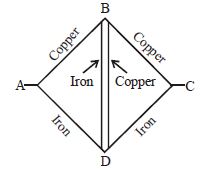
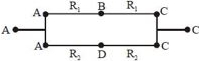
Six wire each of cross-sectional area $A$ and length $l$ are combined as shown in the figure. The thermal conductivities of copper and iron are $K_1$ and $K_2$ respectively. The equivalent thermal resistance between points $A$ and $C$ is :-
Medium


Download our appand get started for free
Experience the future of education. Simply download our apps or reach out to us for more information. Let's shape the future of learning together!No signup needed.*
Similar Questions
- 1The intensity of radiation emitted by the sun has its maximum value at a wavelength of $510\;nm$ and that emitted by the north star has the maximum value at $350\;nm$. If these stars behave like black bodies, then the ratio of the surface temperature of the sun and north star isView Solution
- 2A body cools from ${60^o}C$ to ${50^o}C$ in $10$ minutes when kept in air at ${30^o}C$. In the next $10$ minutes its temperature will beView Solution
- 3A hot black body emits the energy at the rate of $16\ J\ m^{-2}\ s^{-1}$ and its most intense radiation corresponds to $20,000\ Å$ . When the temperature of this body is further increased and its most intense radiation corresponds to $10,000\ Å$ , then the energy radiated in $Jm^{-2}\ s^{-1}$ will beView Solution
- 4The ends $\mathrm{Q}$ and $\mathrm{R}$ of two thin wires, $\mathrm{PQ}$ and $RS$, are soldered (joined) togetker. Initially each of the wires has a length of $1 \mathrm{~m}$ at $10^{\circ} \mathrm{C}$. Now the end $\mathrm{P}$ is maintained at $10^{\circ} \mathrm{C}$, while the end $\mathrm{S}$ is heated and maintained at $400^{\circ} \mathrm{C}$. The system is thermally insulated from its surroundings. If the thermal conductivity of wire $\mathrm{PQ}$ is twice that of the wire $RS$ and the coefficient of linear thermal expansion of $P Q$ is $1.2 \times 10^{-5} \mathrm{~K}^{-1}$, the change in length of the wire $\mathrm{PQ}$ isView Solution
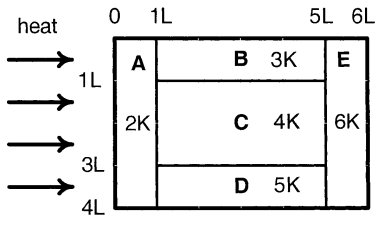
- 5A composite block is made of slabs $A, B, C, D$ and $E$ of different thermal conductivities (given in terms of a constant $K$ ) and sizes (given in terms of length, $L$ ) as shown in the figure. All slabs are of same width. Heat $'Q'$ flows only from left to right through the blocks. Then in steady state $Image$View Solution
$(A)$ heat flow through $A$ and $E$ slabs are same.
$(B)$ heat flow through slab $E$ is maximum.
$(C)$ temperature difference across slab $E$ is smallest.
$(D)$ heat flow through $C =$ heat flow through $B +$ heat flow through $D$.
- 6One end of a copper rod of uniform cross-section and of length $3.1$ m is kept in contact with ice and the other end with water at $100°C $ . At what point along it's length should a temperature of $200°C$ be maintained so that in steady state, the mass of ice melting be equal to that of the steam produced in the same interval of time. Assume that the whole system is insulated from the surroundings. Latent heat of fusion of ice and vaporisation of water are $80 cal/gm$ and $540$ cal/gm respectivelyView Solution

- 7In $MKS$ system, Stefan's constant is denoted by $\sigma $. In $CGS$ system multiplying factor of $\sigma $ will beView Solution
- 8$Assertion :$ For higher temperature the peak emission wavelength of a blackbody shifts to lower wavelengths.View Solution
$Reason :$ Peak emission wavelengths of a black body is proportional to the fourth-power of temperature.
- 9Three discs $A, B$ and $C$ having radii $2\; m, 4\;m,$ and $6 \;m$, respectively are coated with carbon black on their outer surfaces. The wavelengths corresponding to maximum intensity are $300\; nm, 400\; nm$ and $500\; nm$, respectively. The power radiated by them are $Q_A,Q_B$ and $Q_C$ respectively.View Solution
- 10Two bottles $A$ and $B$ have radii $R_{A}$ and $R_{B}$ and heights $h_{A}$ and $h_{B}$ respectively, with $R_{B}=2 R_{A}$ and $h_{B}=2 h_{A}$. These are filled with hot water at $60^{\circ} C$. Consider that heat loss for the bottles takes place only from side surfaces. If the time, the water takes to cool down to $50^{\circ} C$ is $t_{A}$ and $t_{B}$ for bottles $A$ and $B$, respectively. Then, $t_{A}$ and $t_{B}$ are best related asView Solution