A hollow metallic sphere of radius $10 \;cm$ is charged such that potential of its surface is $80\; V$. The potential at the centre of the sphere would be
AIPMT 1994, Easy


Download our appand get started for free
Experience the future of education. Simply download our apps or reach out to us for more information. Let's shape the future of learning together!No signup needed.*
Similar Questions
- 1Aparallel-plate capacitor is connected to a cell. Its positive plate $A$ and its negative plate $B $ have charges $+Q$ and $-Q$ respectively. A third plate $C$, identical to $A$ and $B$, with charge $+Q$, is now introduced midway between $ A$ and $B$, parallel to them. Which of the following are correct?View Solution
- 2The potentials of the two plates of capacitor are $+10\,V$ and $-10\, V$. The charge on one of the plates is $40 \,C$. The capacitance of the capacitor is........$F$View Solution
- 3If the capacity of a spherical conductor is $1$ picofarad, then its diameter, would beView Solution
- 4A parallel plate capacitor with plate separation $5$ $\mathrm{mm}$ is charged up by a battery. It is found that on introducing a dielectric sheet of thickness $2 \mathrm{~mm}$, while keeping the battery connections intact, the capacitor draws $25 \%$ more charge from the battery than before. The dielectric constant of the sheet is_____.View Solution
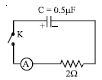
- 5A charged capacitor is allowed to discharge through a resistor by closing the key at the instant $t =0$. At the instant $t = (ln \,4) $ $\mu s$, the reading of the ammeter falls half the initial value. The resistance of the ammeter is equal toView Solution
- 6A proton of mass $m$ and charge $e$ is projected from a very large distance towards an $\alpha$-particle with velocity $v$. Initially $\alpha$-particle is at rest, but it is free to move. If gravity is neglected, then the minimum separation along the straight line of their motion will beView Solution
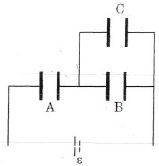
- 7Three capacitors $A,B$ and $C$ are connected with battery $emf\, \varepsilon $. All capacitors are identical initially. If dielectric slab is inserted between plates of capacitor $A$ slowy with help of external force thenView Solution
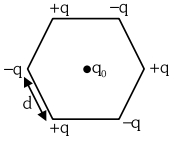
- 8Six charges $+ q ,- q ,+ q ,- q ,+ q$ and $- q$ are fixed at the corners of a hexagon of side $d$ as shown in the figure. The work done in bringing a charge $q _0$ to the centre of the hexagon from infinity is :$\left(\varepsilon_0-\right.$ permittivity of free space)View Solution
- 9A $5\, \mu F$ capacitor is charged fully by a $220\,V$ supply. It is then disconnected from the supply and is connected in series to another uncharged $2.5\;\mu F$ capacitor. If the energy change during the charge redistribution is $\frac{ X }{100} \;J$ then value of $X$ to the nearest integer is$.....$View Solution
- 10The insulated spheres of radii ${R_1}$ and ${R_2}$ having charges ${Q_1}$and ${Q_2}$ respectively are connected to each other. There isView Solution