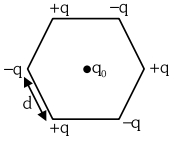
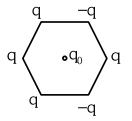
Six charges $+ q ,- q ,+ q ,- q ,+ q$ and $- q$ are fixed at the corners of a hexagon of side $d$ as shown in the figure. The work done in bringing a charge $q _0$ to the centre of the hexagon from infinity is :$\left(\varepsilon_0-\right.$ permittivity of free space)
NEET 2022, Medium


Download our appand get started for free
Experience the future of education. Simply download our apps or reach out to us for more information. Let's shape the future of learning together!No signup needed.*
Similar Questions
- 1View SolutionThree identical capacitors are combined differently. For the same voltage to each combination, the one that stores the greatest energy is
- 2Two capacitor having capacitances $8\ \mu F$ and $16\ \mu F$ have breaking voltages $20\ V$ and $80\ V$. They are combined in series. The maximum charge they can store individually in the combination is...... $\mu C$View Solution
- 3Three concentric spherical shells have radii $a, b$ and $c (a < b < c)$ and have surface charge densities $\sigma ,-\;\sigma $ and $\;\sigma \;$ respectively. If $V_A,V_B$ and $V_C$ denote the potentials of the three shells, then, for $c = a +b,$ we haveView Solution
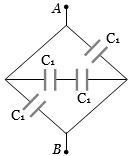
- 4Four identical capacitors are connected as shown in diagram. When a battery of $6 V$ is connected between $A$ and $B$, the charge stored is found to be $1.5\, \mu C$. The value of ${C_1}$ is........$\mu F$View Solution
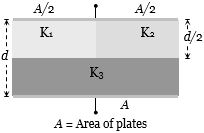
- 5A parallel plate capacitor of area $A$, plate separation $d$ and capacitance $C$ is filled with three different dielectric materials having dielectric constants ${k_1},{k_2}$ and ${k_3}$ as shown. If a single dielectric material is to be used to have the same capacitance $C$ in this capacitor, then its dielectric constant $k$ is given byView Solution
- 6View SolutionTwo equal capacitors are first connected in series and then in parallel. The ratio of the equivalent capacities in the two cases will be
- 7View SolutionThe potential gradient at which the dielectric of a condenser just gets punctured is called
- 8In the circuit shown here $C_1 = 6\,\mu F, C_2 = 3 \,\mu F$ and battery $B = 20\,V$. The switch $S_1$ is first closed. It is then opened and afterwards $S_2$ is closed. What is the charge (in $\mu F$)finally on $C_2$ ?View Solution
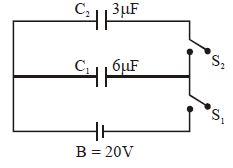
- 9The ratio of momenta of an electron and an $\alpha$-particle which are accelerated from rest by a potential difference of $100\, volts$ isView Solution
- 10Seven capacitors, each of the capacitance $2\,\mu F$, are to be connected in a configuration to obtain an effective capacitance of $\left( {\frac{6}{{13}}} \right)\,\mu F$. Which of the combinations, shown in figures below, will achieve the desired value ?View Solution