A hollow metallic sphere of radius $R$ is given a charge $Q$. Then the potential at the centre is
Easy


Download our appand get started for free
Experience the future of education. Simply download our apps or reach out to us for more information. Let's shape the future of learning together!No signup needed.*
Similar Questions
- 1Three capacitors of $2\,\mu F,\,3\,\mu F$ and $6\,\mu F$ are joined in series and the combination is charged by means of a $24\, volt$ battery. The potential difference between the plates of the $6\,\mu F$ capacitor is.......$volt$View Solution
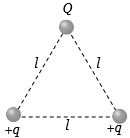
- 2Three charges $Q,( + q)$ and $( + q)$ are placed at the vertices of an equilateral triangle of side l as shown in the figure. If the net electrostatic energy of the system is zero, then $Q$ is equal toView Solution
- 3View SolutionWhen a dielectric material is introduced between the plates of a charged condenser then electric field between the plates
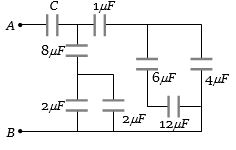
- 4In the following circuit, the resultant capacitance between $A$ and $B$ is $1\,\mu F$. Then value of $C$ isView Solution
- 5A particle of mass $m$ and charge $q$ is placed at rest in a uniform electric field $E$ and then released. The kinetic energy attained by the particle after moving a distance $y$ isView Solution
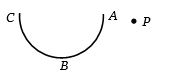
- 6In the following diagram the work done in moving a point charge from point $P$ to point $A$, $B$ and $C$ is respectively as $W_A$, $W_B$ and $W_C$ , thenView Solution
- 7Two equal point charges are fixed at $x = - a$ and $x = + a$ on the $x-$axis. Another point charge $Q$ is placed at the origin. The Change in the electrical potential energy of $Q$, when it is displaced by a small distance $x$ along the $x$-axis, is approximately proportional toView Solution
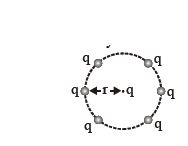
- 8A point charge is surrounded symmetrically by six identical charges at distance $r$ as shown in the figure. How much work is done by the forces of electrostatic repulsion when the point charge $q$ at the centre is removed at infinityView Solution
- 9A charge $+q$ is fixed at each of the points $x = x_0,\,x = 3x_0,\,x = 5x_0$, .... upto $\infty $ on $X-$ axis and charge $-q$ is fixed on each of the points $x = 2x_0,\,x = 4x_0,\,x = 6x_0$, .... upto $\infty $ . Here $x_0$ is a positive constant. Take the potential at a point due to a charge $Q$ at a distance $r$ from it to be $\frac{Q}{{4\pi {\varepsilon _0}r}}$. Then the potential at the origin due to above system of charges will beView Solution
- 10A small conducting sphere of radius $r$ is lying concentrically inside a bigger hollow conducting sphere of radius $R.$ The bigger and smaller spheres are charged with $Q$ and $q (Q > q)$ and are insulated from each other. The potential difference between the spheres will beView Solution