A particle of mass $m$ and charge $q$ is placed at rest in a uniform electric field $E$ and then released. The kinetic energy attained by the particle after moving a distance $y$ is
AIPMT 1998, Easy
Download our app for free and get started
(c) Kinetic energy = Force $×$ Displacement = $qEy$

Download our appand get started for free
Experience the future of education. Simply download our apps or reach out to us for more information. Let's shape the future of learning together!No signup needed.*
Similar Questions
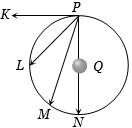
- 1In the figure the charge $Q$ is at the centre of the circle. Work done is maximum when another charge is taken from point $P$ toView Solution
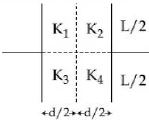
- 2A parallel palate capacitor with square plates is filled with four dielectrics of dielectric constants $K_1, K_2, K_3, K_4$ arranged as shown in the figure. The effective dielectric constant $K$ will beView Solution
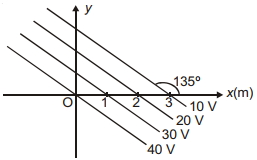
- 3View SolutionFigure shows a set of equipotential surfaces. The magnitude and direction of electric field that exists in the region is .........
- 4An $\alpha$ particle and a proton are accelerated from rest through the same potential difference. The ratio of linear momenta acquired by above two particals will be.View Solution
- 5View SolutionWhich of the following is possible application of an RC circuit?
- 6Two point charges $100\,\mu \,C$ and $5\,\mu \,C$ are placed at points $A$ and $B$ respectively with $AB = 40\,cm$. The work done by external force in displacing the charge $5\,\mu \,C$ from $B$ to $C$, where $BC = 30\,cm$, angle $ABC = \frac{\pi }{2}$ and $\frac{1}{{4\pi {\varepsilon _0}}} = 9 \times {10^9}\,N{m^2}/{C^2}$.........$J$View Solution
- 7Three capacitors $2$ $\mu F$, $3$ $\mu F$ and $5$ $\mu F$ can withstand voltages to $3\,V, 2\,V$ and $1\,V$ respectively. Their series combination can withstand a maximum voltage equal to.....$Volts$View Solution
- 8Electric charges of $ + 10\,\mu C,\; + 5\,\mu C,\; - 3\,\mu C$ and $ + 8\,\mu C$ are placed at the corners of a square of side $\sqrt 2 \,m$. the potential at the centre of the square isView Solution
- 9If $n$ drops, each of capacitance $C$, coalesce to form a single big drop, then the ratio of the energy stored in the big drop to that in each small drop will beView Solution
- 10The electric potential varies in space according to the relation $V = 3x + 4y$. A particle of mass $0.1\,\, kg$ starts from rest from point $(2, 3·2)$ under the influence of this field. The charge on the particle is $+1\,\, μC$. Assume $V$ and $(x, y)$ are in $S.I.$ $units$ . The time taken to cross the $x-$ axis is.....$s$View Solution