A hollow pipe of length $0.8 \mathrm{~m}$ is closed at one end. At its open end a $0.5 \mathrm{~m}$ long uniform string is vibrating in its second harmonic and it resonates with the fundamental frequency of the pipe. If the tension in the wire is $50 \mathrm{~N}$ and the speed of sound is $320 \mathrm{~ms}^{-1}$, the mass of the string is
IIT 2010, Advanced
Download our app for free and get started
$ \frac{\mathrm{v}_{\mathrm{S}}}{4 \mathrm{~L}_{\mathrm{P}}}=\frac{2 \sqrt{\frac{\mathrm{T}}{\mu}}}{2 \ell_{\mathrm{S}}} $
$ \mu \ell_{\mathrm{S}}=10 \ \mathrm{gm}$

Download our appand get started for free
Experience the future of education. Simply download our apps or reach out to us for more information. Let's shape the future of learning together!No signup needed.*
Similar Questions
- 1View SolutionSound travels in rocks in the form of
- 2In an experiment with sonometer when a mass of $180\,g$ is attached to the string, it vibrates with fundamental frequency of $30\,Hz$. When a mass $m$ is attached, the string vibrates with fundamental frequency of $50\,Hz$. The value of $m$ is $.........\,g$.View Solution
- 3The velocity of sound in a gas at pressure $P$ and density $d$ isView Solution
- 4Two wires are fixed in a sonometer. Their tensions are in the ratio $8 : 1$. The lengths are in the ratio $36:35.$ The diameters are in the ratio $4 : 1$. Densities of the materials are in the ratio $1 : 2$. If the lower frequency in the setting is $360 Hz.$ the beat frequency when the two wires are sounded together isView Solution
- 5Two waves are represented by the equations : $y_1 = a\, sin\,(\omega t + kx + 0.57)\, m$ and $y_2 = a\, cos\,(\omega t + kx)\, m$, where $x$ is in $metres$ and $t$ is in $seconds$ . The phase difference between them is ..... $radian$View Solution
- 6Two trains are moving towards each other at speeds of $20 m/s$ and $15 m/s$ relative to the ground. The first train sounds a whistle of frequency $600 Hz.$ the frequency of the whistle heard by a passenger in the second train before the train meets is ...... $Hz$ (the speed of sound in air is $340\, m/s$)View Solution
- 7At standard temperature and pressure the density of a gas is $1.3$ $kg/{m^3}$ and the speed of the sound in gas is $330\, m/sec.$ Then the degree of freedom of the gas will beView Solution
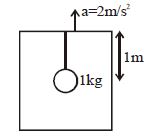
- 8In the figure shown a mass $1\ kg$ is connected to a string of mass per unit length $1.2\ gm/m$ . Length of string is $1\ m$ and its other end is connected to the top of a ceiling which is accelerating up with an acceleration $2\ m/s^2$ . A transverse pulse is produced at the lowest point of string. Time taken by pulse to reach the top of string is .... $s$View Solution
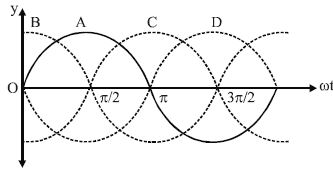
- 9Figure given below shows four progressive waves $A, B, C$ and $D$ with their phases expressed with respect to the wave $A$ . It can be calculated from the figure thatView Solution
- 10A transverse progressive wave on a stretched string has a velocity of $10\,m{s^{ - 1}}$ and a frequency of $100 Hz.$ The phase difference between two particles of the string which are $2.5 cm$ apart will beView Solution