Two wires are fixed in a sonometer. Their tensions are in the ratio $8 : 1$. The lengths are in the ratio $36:35.$ The diameters are in the ratio $4 : 1$. Densities of the materials are in the ratio $1 : 2$. If the lower frequency in the setting is $360 Hz.$ the beat frequency when the two wires are sounded together is
Diffcult
Download our app for free and get started
(d) Frequency in a stretched string is given by
$n = \frac{1}{{2l}}\sqrt {\frac{T}{{\pi {r^2}\rho }}} = \frac{1}{l}\sqrt {\frac{T}{{\pi {d^2}\rho }}} $ ($d =$ Diameter of string)
==> $\frac{{{n_1}}}{{{n_2}}} = \frac{{{l_2}}}{{{l_1}}}\sqrt {\frac{{{T_1}}}{{{T_2}}} \times {{\left( {\frac{{{d_2}}}{{{d_1}}}} \right)}^2} \times \left( {\frac{{{\rho _2}}}{{{\rho _1}}}} \right)} $
$ = \frac{{35}}{{36}}\sqrt {\frac{8}{1} \times {{\left( {\frac{1}{4}} \right)}^2} \times \frac{2}{1}} = \frac{{35}}{{36}}$$ \Rightarrow {n_2} = \frac{{36}}{{35}} \times 360 = 370$
Hence beat frequency = ${n_2} - {n_1} = 10$

Download our appand get started for free
Experience the future of education. Simply download our apps or reach out to us for more information. Let's shape the future of learning together!No signup needed.*
Similar Questions
- 1A student is performing an experiment using a resonance column and a tuning fork of frequency $244 s ^{-1}$. He is told that the air in the tube has been replaced by another gas (assume that the column remains filled with the gas). If the minimum height at which resonance occurs is $(0.350 \pm 0.005) m$, the gas in the tube isView Solution
(Useful information) : $\sqrt{167 R T}=640 j^{1 / 2} mole ^{-1 / 2} ; \sqrt{140 RT }=590 j ^{1 / 2} mole ^{-1 / 2}$. The molar masses $M$ in grams are given in the options. Take the value of $\sqrt{\frac{10}{ M }}$ for each gas as given there.)
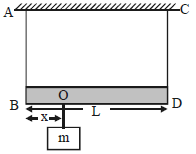
- 2A massless rod of length $L$ is suspended by two identical strings $AB$ and $CD$ of equal length. A block of mass $m$ is suspended from point $O$ such that $BO$ is equal to $‘x’$. Further it is observed that the frequency of $1^{st}$ harmonic in $AB$ is equal to $2^{nd}$ harmonic frequency in $CD$. $‘x’$ isView Solution
- 3A travelling wave passes a point of observation. At this point, the time interval between successive crests is $0.2$ seconds andView Solution
- 4A plane progressive wave is represented by the equation $y = 0.1\sin \left( {200\pi t - \frac{{20\pi x}}{{17}}} \right)$ where y is displacement in $m$, $ t$ in second and $x$ is distance from a fixed origin in meter. The frequency, wavelength and speed of the wave respectively areView Solution
- 5A standing wave pattern is formed on a string. One of the waves is given by equation ${y_1} = a\,\cos \,\left( {\omega t - kx + \pi /3} \right)$ then the equation of the other wave such that at $x = 0$ a node is formedView Solution
- 6A string fixed at both ends vibrates in three loops. The wave length is $10\, cm$ . The length of string is .... $cm$View Solution
- 7The equation of a simple harmonic wave is given by $y = 3sin\frac{\pi }{2}\left( {50t - x} \right)\, $View Solution
where $x$ and $y$ are in metres and $t$ is in seconds. The ratio of maximum particle velocity to the wave velocity is
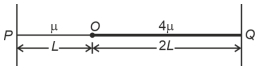
- 8Two uniform strings of mass per unit length $\mu$ and $4 \mu$, and length $L$ and $2 L$, respectively, are joined at point $O$, and tied at two fixed ends $P$ and $Q$, as shown in the figure. The strings are under a uniform tension $T$. If we define the frequency $v_0=\frac{1}{2 L} \sqrt{\frac{T}{\mu}}$, which of the following statement($s$) is(are) correct?View Solution
$(A)$ With a node at $O$, the minimum frequency of vibration of the composite string is $v_0$
$(B)$ With an antinode at $O$, the minimum frequency of vibration of the composite string is $2 v_0$
$(C)$ When the composite string vibrates at the minimum frequency with a node at $O$, it has $6$ nodes, including the end nodes
$(D)$ No vibrational mode with an antinode at $O$ is possible for the composite string
- 9View SolutionThe following phenomenon cannot be observed for sound waves
- 10A wave represented by the given equation $Y = A\sin \left( {10\,\pi \,x + 15\,\pi \,t + \frac{\pi }{3}} \right)$, where $x$ is in meter and $t$ is in second. The expression representsView Solution