Question
A hollow sphere and a solid sphere having same mass and same radii are rolled down a rough inclined plane:
  1. The hollow sphere reaches the bottom first.
  2. The solid sphere reaches the bottom with greater speed.
  3. The solid sphere reaches the bottom with greater kinetic energy.
  4. The two spheres will reach the bottom with same linear momentum.
Answer

  1. The solid sphere reaches the bottom with greater speed.

Explanation:

Acceleration of a sphere on the incline plane is given by:

$\text{a}=\frac{\text{g}\sin\theta}{1+\frac{\text{I}_{\text{COM}}}{\text{mr}^2}}$

ICOM for a solid sphere $=\frac{2}{5}\text{mr}^2$

So, $\text{a}=\frac{\text{g}\sin\theta}{1+\frac{2\text{mr}^2}{5\text{mr}^2}}=\frac{5}{7}\text{g}\sin\theta$

ICOM for a hollow sphere $=\frac{2}{3}\text{mr}^2$

So, $\text{a}'=\frac{\text{g}\sin\theta}{1+\frac{2\text{mr}^2}{3\text{mr}^2}}=\frac{3}{5}\text{g}\sin\theta$

The acceleration of the solid sphere is greater; therefore, it will reach the bottom with greater speed.

Need a full question paper?

Generate a complete, print-ready paper with questions like this in minutes — across 16+ boards, with answer keys.

Start Generating Free

Similar questions

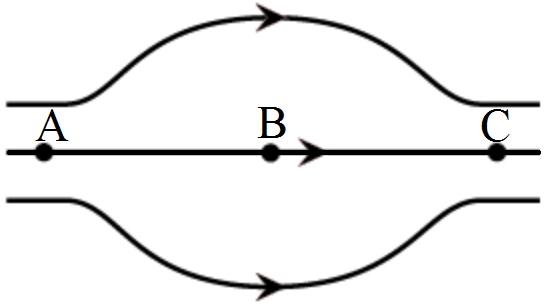
Figure, shows some of the electric field lines corresponding to an electric field. The figure suggests that,

  1. EA > E8 > Ee
  2. EA = EB = Ee
  3. EA = Ec > EB
  4. EA = Ec < EB.
Work done in moving an object through an equipotential surface is:

The electric field between the two spheres of a charged spherical condenser

(a) Is zero

(b) Is constant

(c) Increases with distance from the centre

(d) Decreases with distance from the centre

Four capacitors are connected in a circuit as shown in the figure. The effective capacitance in μF between points A and B will be

(a)  

(b) 4

(c) 5  

(d) 18

A coil having an area  is placed in a magnetic field which changes from  to   in a interval of 2 second. The e.m.f. induced in the coil will be

(a)  4 V

(b) 3 V

(c)  1.5 V 

(d) 2 V

The rate of disintegration was observed to be  disintegrations per sec when its half life period is 1445 years. The original number of particles are

(a) 8.9  

(b) 6.6  

(c) 1.4  

(d) 1.2  

The intensity of gamma radiation from a given source is I. On passing through  36 mm of lead, it is reduced to  . The thickness of lead which will reduce the intensity to   will be

(a) 18 mm

(b) 12 mm

(c) 6 mm 

(d) 9 mm

An electron of mass m and charge q is travelling with a speed v along a circular path of radius r at right angles to a uniform of magnetic field B. If speed of the electron is doubled and the magnetic field is halved, then resulting path would have a radius of

(a)   

(b)  

(c) 2r

(d) 4r

Assertion :  In Young’s double slit experiment, the fringes become indistinct if one of the slits is covered with cellophane paper.

Reason     : The cellophane paper decrease the wavelength of light.

(a) If both assertion and reason are true and the reason is the correct explanation of the assertion.

(b) If both assertion and reason are true but reason is not the correct explanation of the assertion.

(c) If assertion is true but reason is false.

(d) If the assertion and reason both are false.

A nuclear reaction given by   represents

(a) g-decay

(b) Fusion

(c) Fission

(d) b-decay
