MCQ
Work done in moving an object through an equipotential surface is:
- APositive
- BNegative
- CZero
- DDepends on the field direction
Explanation:
Work done is given difference in potentials. In an equipotential surface, all points will have same potential. Thus work done is zero
Generate a complete, print-ready paper with questions like this in minutes — across 16+ boards, with answer keys.
Work done by an external agent in separating the parallel plate capacitor is
|
(a) CV |
(b) |
(c) |
(d) None of these |
$\vec{\text{r}}.\vec{\text{F}}=0$ and $\vec{\text{F}}.\vec{\tau}=0$
$\vec{\text{r}}.\vec{\tau}=0$ but $\vec{\text{F}}.\vec{\tau}\neq0$
$\vec{\text{r}}.\vec{\tau}\neq0$ but $\vec{\text{F}}.\vec{\tau}=0$
$\vec{\text{r}}.\vec{\tau}\neq0$ and $\vec{\text{F}}.\vec{\tau}\neq0$
Two identical batteries, each of e.m.f. 2 volt and internal resistance 1.0 ohm are available to produce heat in an external resistance R = 0.5 ohm by passing a current through it. The maximum Joulean power that can be developed across R using these batteries is
|
(a) 1.28 watt |
(b) 2.0 watt |
(c) |
(d) 3.2 watt |
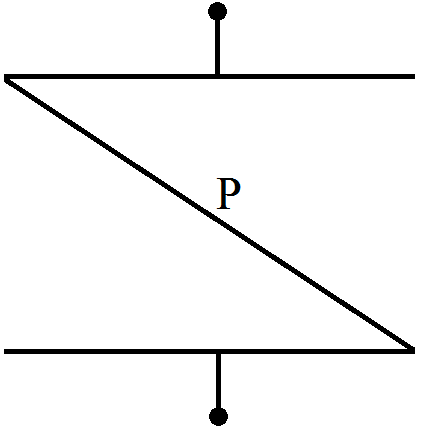
In Millikan's oil drop experiment an oil drop carrying a charge Q is held stationary by a potential difference 2400 V between the plates. To keep a drop of half the radius stationary the potential difference had to be made 600 V. What is the charge on the second drop
|
(a) |
(b) |
(c) Q |
(d) |
When a ray of light passes from a denser to a rarer medium, some part of it gets ....... into the denser medium:
Smaller pieces of heavy stones and metals which on entering earth's atmosphere burns out are
|
(a) Comets |
(b) Meteorites |
(c) Asteroids |
(d) All of these |


