MCQ
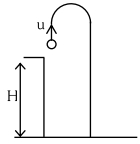
A horizontal bridge is built across a river. A student standing on the bridge throws a small ball vertically upwards with a velocity $4\,m s ^{-1}$. The ball strikes the water surface after $4\,s$. The height of bridge above water surface is $......\,m$ $\left(\right.$ Take $\left.g=10\,m s ^{-2}\right)$
  • A
    $68$
  • B
    $56$
  • C
    $60$
  • $64$

Answer

Correct option: D.
$64$
d
$S = ut +\frac{1}{2} a t^2$

$-H =4 \times 4-\frac{1}{2} \times 10 \times 4^2$

$-H =16-80$

$-H =-64$

$H =64\,m$

Need a full question paper?

Generate a complete, print-ready paper with questions like this in minutes — across 16+ boards, with answer keys.

Start Generating Free

Similar questions

For an adiabatic expansion of an ideal gas, the fractional change in its pressure is equal to (where $\gamma$ is the ratio of specific heats):
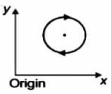
A particle is rotating in a circle with uniform speed as shown. The angular momentum of the particle w.r.t. origin is .........
Two forces ${\vec F_1} = 5\hat i + 10\hat j - 20\hat k$ and ${\vec F_2} = 10\hat i - 5\hat j - 15\hat k$ act on a single point. The angle between ${\vec F_1}$ and ${\vec F_2}$ is nearly ....... $^o$
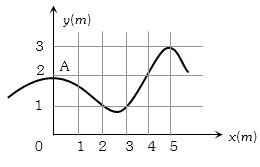
The trajectory of a particle moving in vast maidan is as shown in the figure. The coordinates of a position A are $(0,2)$. The coordinates of another point at which the instantaneous velocity is same as the average velocity between the points are
The fundamental frequency of a string is proportional to:
  1. Inverse of its length.
  2. The diameter.
  3. The tension.
  4. The density.
$105$ calories of heat is required to raise the temperature of $3$ moles of an ideal gas at constant pressure from $30^{\circ} C$ to $35^{\circ} C$. The amount of heat required in calories to raise the temperature of the gas through the range $\left(60^{\circ} C\right.$ to $\left.65^{\circ} C \right)$ at constant volume is ........ $cal$ $\left(\gamma=\frac{C_p}{C_v}=1.4\right)$
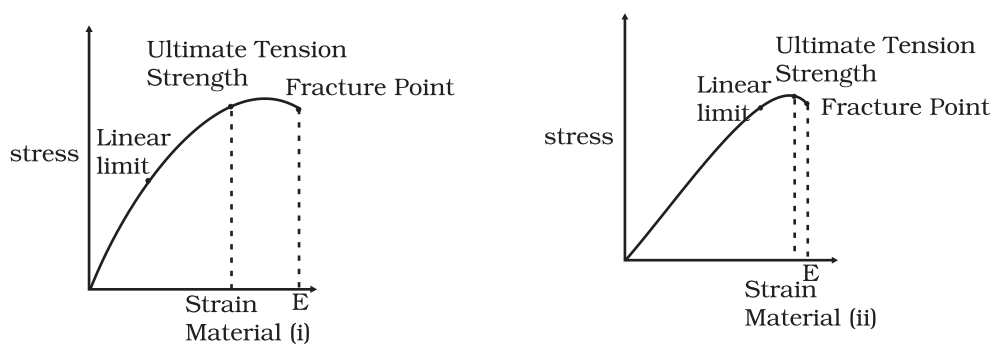
The stress - strain graphs for two materials are shown in (assume same scale).

  1. Material (ii) is more elastic than material (i) and hence material (ii) is more brittle.
  2. Material (i) and (ii) have the same elasticity and the same brittleness.
  3. Material (ii) is elastic over a larger region of strain as compared to (i).
  4. Material (ii) is more brittle than material (i).
$16$ tunning forks are arranged in the order of increasing frequencies. Any two successive forks give $8$ beats per sec when sounded together. If the frequency of the last fork is twice the first, then the frequency of the first fork is
A body is projected vertically upwards from the surface of earth with a velocity sufficient enough to carry it to infinity. The time taken by it to reach height $h$ is $....\,S.$
A solid cylinder and a solid sphere of same mass and radius roll without slipping on a rough inclined plane. The force of friction is ..........