Question
A horizontal cesium plate ($\phi$ = 1.9eV) is moved vertically downward at a constant speed u in a room full of radiation of wavelength 250 run and above. What should be the minimum value of u so that the vertically upward component of velocity is nonpositive for each photoelectron?
Answer

When $\lambda=250\text{nm}$Energy of photon
$=\frac{\text{hc}}{\lambda}=\frac{1240}{250}=4.96\text{ev}$
$\therefore\text{K.E.}=\frac{\text{hc}}{\lambda}-\text{w}=4.96-1.9\text{ev.}$
Velocity to be non positive for each photo electron
The minimum value of velocity of plate should be = velocity of photo electron
$\therefore$ Velocity of photo electron $=\sqrt{\frac{2\text{KE}}{\text{m}}}$
$=\sqrt{\frac{3.06}{9.1\times10^{-31}}}$
$=\sqrt{\frac{3.06\times1.6\times10^{-19}}{9.1\times10^{-31}}}=1.04\times10^6\text{m/sec.}$

Need a full question paper?

Generate a complete, print-ready paper with questions like this in minutes — across 16+ boards, with answer keys.

Start Generating Free

Similar questions

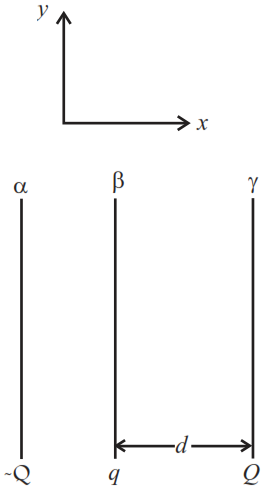
Two fixed, identical conducting plates $(\alpha\ \&\ \beta)$, each of surface area S are charged to -Q and q, respectively, where Q > q > 0. A third identical plate $(\gamma)$, free to move is located on the other side of the plate with charge q at a distance d (Fig.). The third plate is released and collides with the plate $\beta$. Assume the collision is elastic and the time of collision is sufficient to redistribute charge amongst $\beta\ \&\ \gamma$.

Find the charges on $\beta$ and $\gamma$ after the collision.
A disc of radius R is cut out from a larger disc of radius 2R in such a way that the edge of the hole touches the edge of the disc. Locate the centre of mass of the residual disc.
A current of 1.0A is established in a tightly wound solenoid of radius 2cm having 1000 turns/ metre. Find the magnetic energy stored in each metre of the solenoid.
A block of mass 200g is suspended through a vertical spring. The spring is stretched by 1.0cm when the block is in equilibrium. A particle of mass 120g is dropped on the block from a height of 45cm. The particle sticks to the block after the impact. Find the maximum extension of the spring. Take $g = 10m/s^2.$​​​​​​​
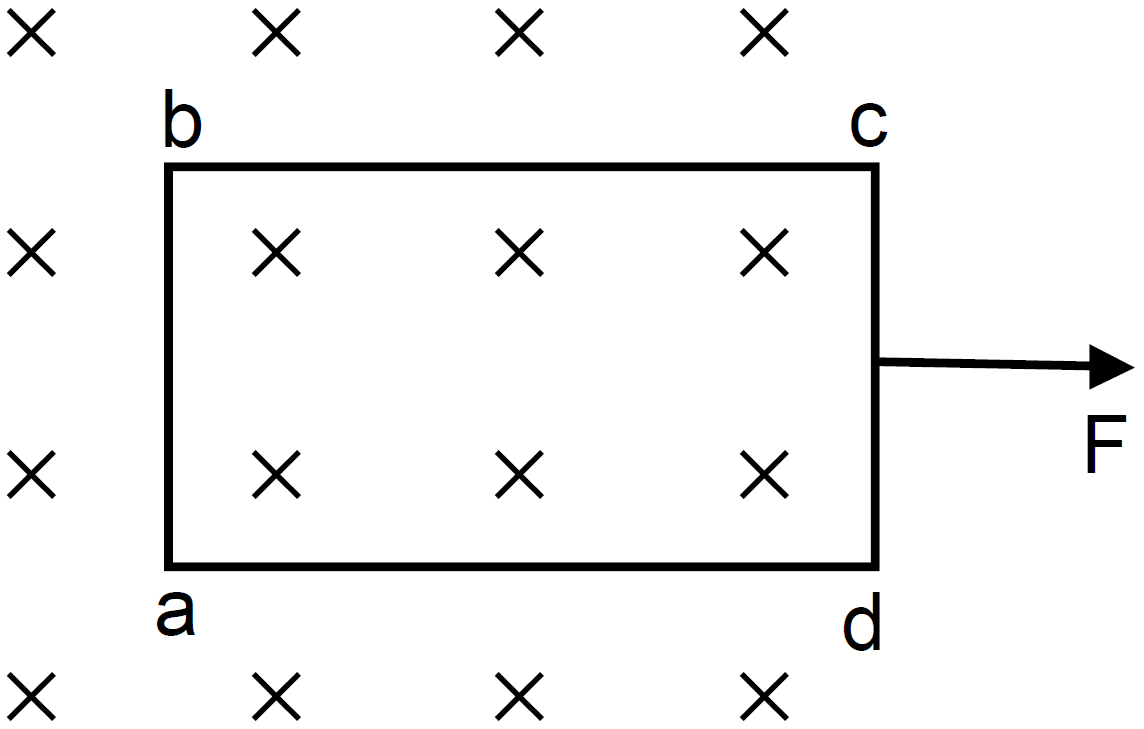
A rectangular frame of wire abcd has dimensions $32cm × 8.0cm$ and a total resistance of $2.0\Omega.$ It is pulled out of a magnetic field $B = 0.020T$ by applying a force of $3.2 \times 10^{-5}N$ (figure). It is found that the frame moves with constant speed. Find
  1. This constant speed.
  2. The emf induced in the loop.
  3. The potential difference between the points a and b.
  4. The potential difference between the points c and d.
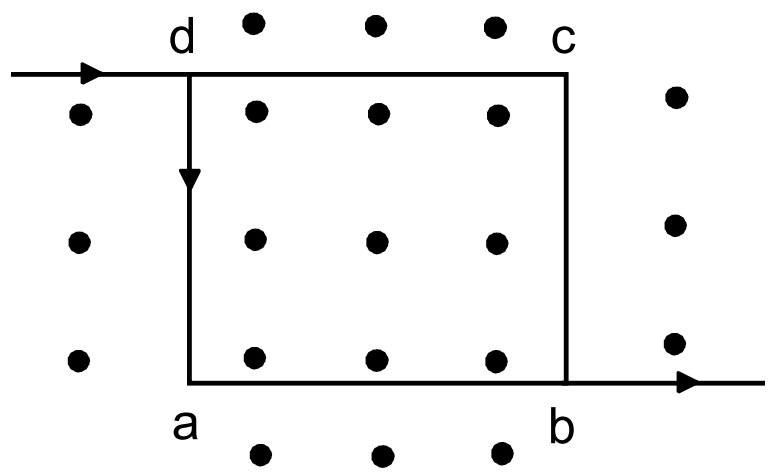
A current of 2A enters at the corner d of a square frame abcd of side 20cm and leaves at the opposite corner b. A magnetic field B = 0.1 T exists in the space in a direction perpendicular to the plane of the frame, as shown in the figure. Find the magnitude and direction of the magnetic forces on the four sides of the frame.
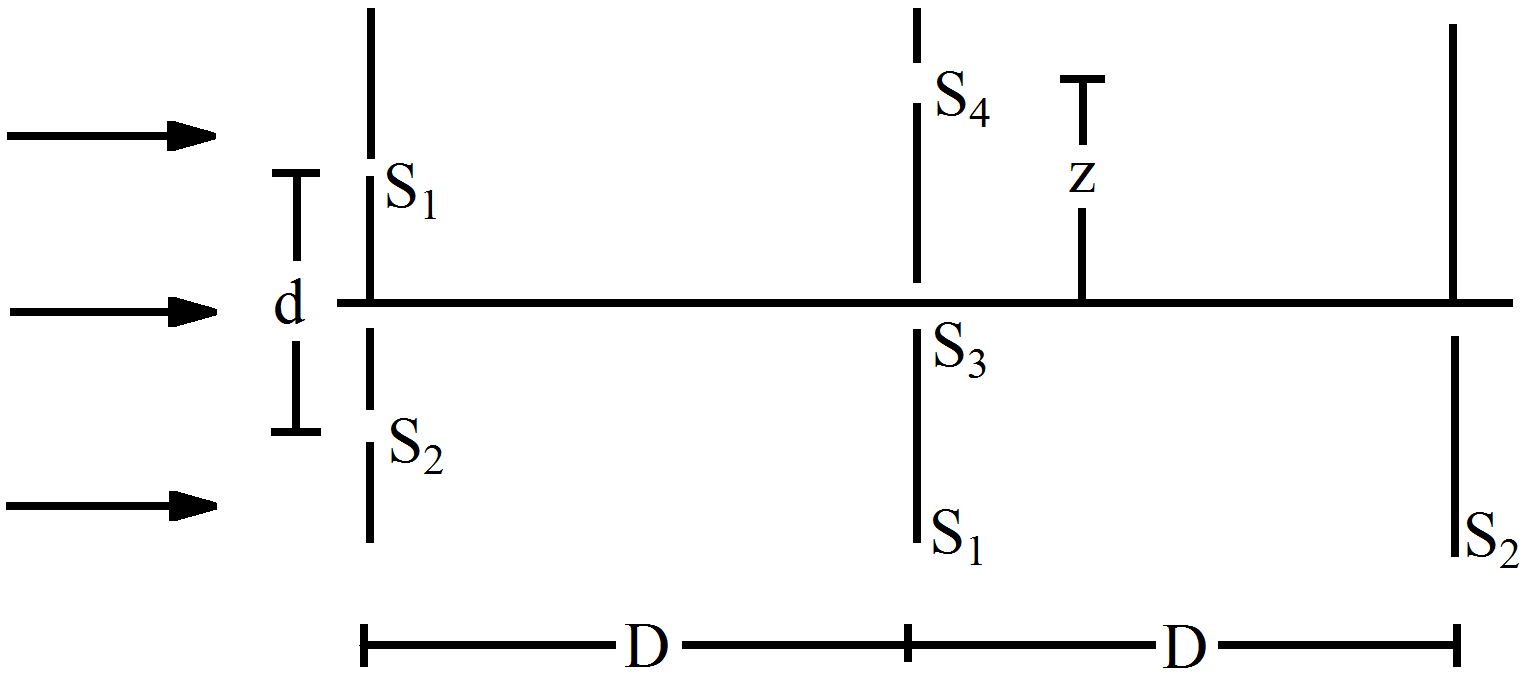
Consider the situation shown in figure (17-E6). The two slits $S_1$ and $S_2 $ p laced symmetrically around the central line are illuminated by a monochromatic light of wavelength $\lambda$. The separation between the slits is d . The light transmitted by the slits falls on a screen $E_1$ placed at a distance $D$ from the slits. The slit $\mathrm{S}_3$ is at the central line and the slit $S_4$ is at a distance $z$ from $S_3$. Another screen $\sum_2$ is placed a further distance $D$ away from $\sum_1$. Find the ratio of the maximum to minimum intensity observed on $\sum_2$, if $z$ is equal to,
  1. $\text{z}=\frac{\lambda\text{D}}{2\text{d}}$
  2. $\frac{\lambda\text{D}}{\text{d}}$
  3. $\frac{\lambda\text{D}}{4\text{d}}$
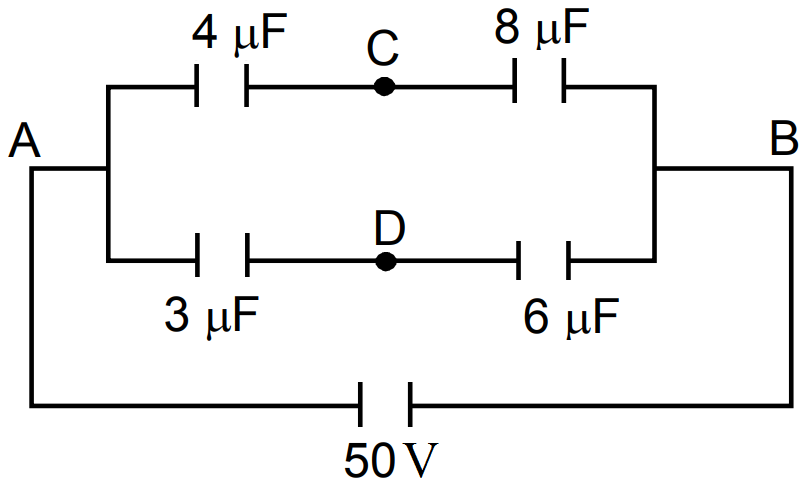
Take the potential of the point B in figure to be zero:
  1. Find the potentials at the points C and D.
  2. If a capacitor is connected between C and D, what charge will appear on this capacitor?
For the same objective, find the ratio of the least separation between two points to be distinguished by a microscope for light of 5000A and electrons accelerated through 100V used as the illuminating substance.
A force $F_1$ acts on a particle so as to accelerate it from rest to $a$ velocity $v$. The force $F_1$ is then replaced by $F_2$ which decelerates it to rest: