Question
For the same objective, find the ratio of the least separation between two points to be distinguished by a microscope for light of 5000A and electrons accelerated through 100V used as the illuminating substance.

Answer

Resolving power of a microscope $=\frac{2\sin\beta}{1.22\lambda}$ where $\mu$ is refractive index of the medium, $\lambda$ is the wavelength of light and $\beta$ is the angle subtended by the objective at the object.
Now, $\frac{1}{\text{d}}=\frac{2\sin\beta}{1.22\lambda}$
$\Rightarrow\ \text{d}_\text{min}=\frac{1.22\lambda}{2\sin\beta}$
For the light of wavelength 5000A,
$\text{d}_\text{min}=\frac{1.22\times5000\times10^{-10}}{2\sin\beta}\Big[\because\ 1\text{A}=10^{-10}\text{m}\Big]\ .....(\text{i})$
Now, the de-Broglie wavelenght is given by $\lambda=\frac{12.27}{\sqrt{\text{V}}}$
Substituting V = 100 in $\lambda=\frac{12.27}{\sqrt{\text{V}}}$, we get
$\frac{12.27}{\sqrt{100}}=1.227\times10^{-10}\text{m}$
$\therefore\ \text{d}'_\text{min}=\frac{1.22\times1.227\times10^{-10}}{2\sin\beta}$
Ratio of the least separation
$\frac{\text{d}_\text{min}}{\text{d}'_\text{min}}=\frac{\frac{1.22\times5000\times10^{-10}}{2\sin\beta}}{\frac{1.22\times1.227\times10^{-10}}{2\sin\beta}}$
$=\frac{5000}{1.227}$
$=4075.$

Need a full question paper?

Generate a complete, print-ready paper with questions like this in minutes — across 16+ boards, with answer keys.
Start Generating Free

Similar questions

The half-life of $^{40}K$ is $1.30 \times 10^9y$. A sample of 1.00g of pure KCI gives 160 counts/ s. Calculate the relative abundance of $^{40}K$ (fraction of $^{40}K$ present) in natural potassium.
  1. With the help of a suitable ray diagram, derive the mirror formula for a concave mirror.
  2. The near point of a hypermetropic person is 50 cm from the eye. What is the power of the lens required to enable the person to read clearly a book held at 25 cm from the eye?
A card sheet divided into squares each of size $1\ mm^2$ is being viewed at a distance of 9 cm through a magnifying glass (a converging lens of focal length 9 cm) held close to the eye.
  1. What is the magnification produced by the lens? How much is the area of each square in the virtual image?
  2. What is the angular magnification (magnifying power) of the lens?
  3. Is the magnification in (a) equal to the magnifying power in (b)? Explain.
Two current-carrying wires may attract each other. In absence of other forces, the wires will move towards each other increasing the kinetic energy. Does it contradict the fact that the magnetic force cannot do any work and hence cannot increase the kinetic energy?
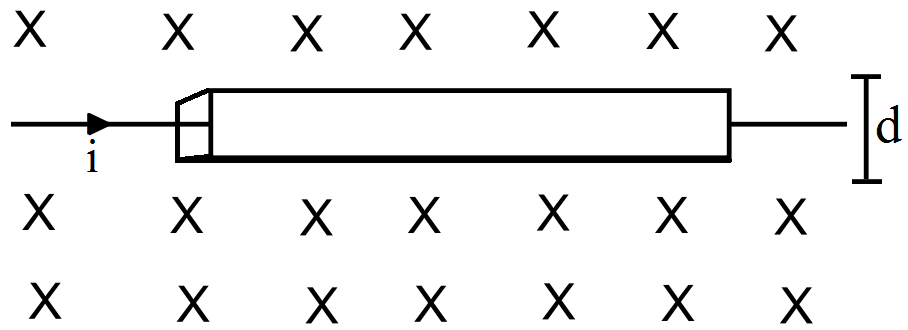
A current i is passed through a silver strip of width d and area of cross-section A. The number of free electrons per unit volume is n.
  1. Find the drift velocity v of the electrons.
  2. If a magnetic field B exists in the region, as shown in the figure, what is the average magnetic force on the free electrons?
  3. Due to the magnetic force, the free electrons get accumulated on one side of the conductor along its length. This produces a transverse electric field in the conductor, which opposes the magnetic force on the electrons. Find the magnitude of the electric field which will stop further accumulation of electrons.
  4. What will be the potential difference developed across the width of the conductor due to the electron-accumulation? The appearance of a transverse emf, when a current-carrying wire is placed in a magnetic field, is called Hall effect.
The bob of a simple pendulum has a mass of 40g and a positive charge of $4.0 \times 10^{-6}C$. It makes 20 oscillations in 45s. A vertical electric field pointing upward and of magnitude $2.5 \times 10^4NC^{-1}$ is switched on. How much time will it now take to complete 20 oscillations?
(II) (a) Using Kirchhoff'᾿s laws obtain the equation of the balanced state in Wheatstone bridge.
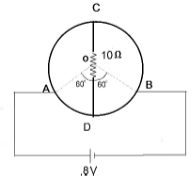
b) A wire of uniform cross-section and resistance of 12 ohm is bent in the shape of circle as shown in the figure. A resistance of 10 ohms is connected to diametrically opposite ends C and D. A battery of emf 8V is connected between A and B. Determine the current flowing through arm AD.

Image
An ideal gas at pressure $2.5 \times 10^5Pa$ and temperature 300K occupies 100cc. It is adiabatically compressed to half its original volume. Calculate,
  1. The final pressure.
  2. The final temperature.
  3. The work done by the gas in the process. Take $\gamma=1.5.$
A series $\text{LCR}$ circuit is connected to an $a.c$. source having voltage $V=V_m \sin \omega t$. Derive the expression for the instantaneous current $I$ and its phase relationship to the applied voltage. Obtain the condition for resonance to occur. Define power factor. State the conditions under which it is
$i$. maximum and
$ii$. minimum.
A block of mass m is kept on a horizontal ruler. The friction coefficient between the ruler and the block is g. The ruler is fixed at one end and the block is at a distance L from the fixed end. The ruler is rotated about the fixed end in the horizontal plane through the fixed end.
  1. What can the maximum angular speed be for which the block does not slip?
  2. If the angular speed of the ruler is uniformly increased from zero at an angular acceleration $\alpha,$ at what angular speed will the block slip?