Question
A horizontal cesium plate ($\phi$ = l.9 eV) is moved vertically downward at a constant speed u in a room full of radiation of wavelength 250 run and above. What should be the minimum value of u so that the vertically upward component of velocity is nonpositive for each photoelectron?
Answer

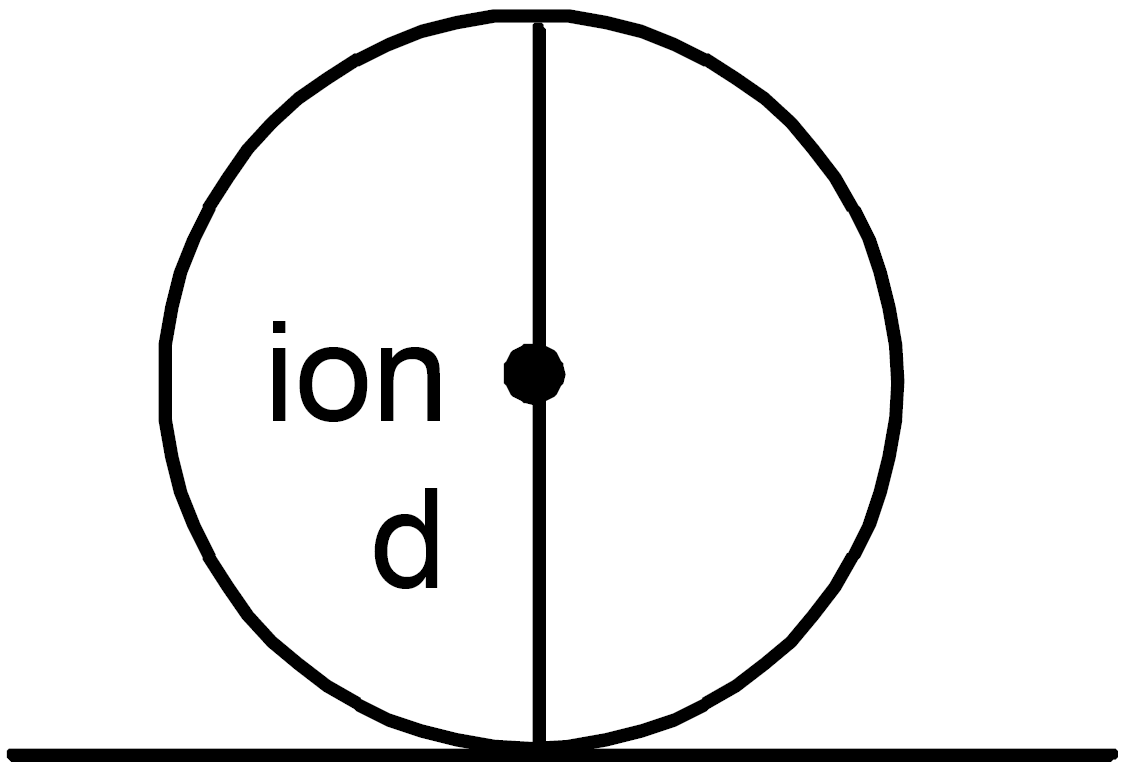
Work function $=\phi,$ distance = dThe particle will move in a circle
When the stopping potential is equal to the potential due to the singly charged ion at that point.
$\text{eV}_0=\frac{\text{hc}}{\lambda}-\phi$
$\Rightarrow\text{v}_0=\Big(\frac{\text{hv}}{\lambda}-\phi\Big)\frac{1}{\text{e}}$
$\Rightarrow\frac{\text{ke}}{2\text{d}}=\Big(\frac{\text{hc}}{\lambda}-\phi\Big)\frac{1}{\text{e}}$
$\Rightarrow\frac{\text{ke}}{\text{2d}}=\frac{\text{hc}}{\lambda}-\phi$
$\Rightarrow\frac{\text{hc}}{\lambda}=\frac{\text{ke}^2}{2\text{d}}+\phi=\frac{\text{ke}^2+2\text{d}\phi}{2\text{d}}$
$\Rightarrow\lambda=\frac{\text{hc 2d}}{\text{ke}^2+2\text{d}\phi}=\frac{2\text{hcd}}{\frac{1}{4\pi\omega_0\text{e}^2}2\text{d}\phi}=\frac{8\pi\omega_0\text{hcd}}{\text{e}^2+8\pi\omega_0\text{d}\phi}$

Need a full question paper?

Generate a complete, print-ready paper with questions like this in minutes — across 16+ boards, with answer keys.

Start Generating Free

Similar questions

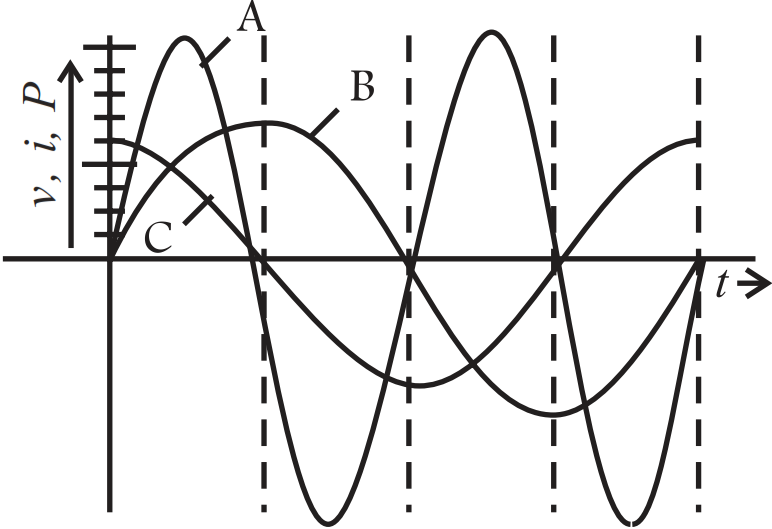
A device 'X' is connected to an a.c source. The variation of voltage, current and power in one complete cycle is shown in Fig.
  1. Which curve shows power consumption over a full cycle?
  2. What is the average power consumption over a cycle?
  3. Identify the device 'X'.
In $1959$ Lyttleton and Bondi suggested that the expansion of the Universe could be explained if matter carried a net charge. Suppose that the Universe is made up of hydrogen atoms with a number density $N,$ which is maintained a constant. Let the charge on the proton be: $\ce{e_p = -(1 + y)e}$ where e is the electronic charge.
Find the critical value of $y$ such that expansion may start.
Radiation coming from transition $n = 2$ to $n = 1$ of hydrogen atoms falls on helium ions in $n = 1$ and $n = 2$ states. What are the possible transitions of helium ions as they absorbs energy from the radiation?
A projectile is fired with a speed u at an angle $\theta$ above a horizontal field. The coefficient of restitution of collision between the projectile and the field is e. How far from the starting point, does the projectile makes its second collision with the field?
Verify the Ampere's law for magnetic field of a point dipole of dipole moment $\text{m}=\text{m}\hat{\text{k}}$. Take C as the closed curve running clockwise along:
  1. The z-axis from z = a > 0 to z = R.
  2. Along the quarter circle of radius R and centre at the origin, in the first quadrant of x-z plane.
  3. Along the x-axis from x = R to x = a.
  4. Along the quarter circle of radius a and centre at the origin in the first quadrant of x-z plane.
A wire of length l is bent in the form of an equilateral triangle and carries an electric currrent i.
  1. Find the magnetic field B at the centre.
  2. If the wire is bent in the form of a square, what would be the value of B at the centre?
An electron gun with its collector at a potential of $100 V$ fires out electrons in a spherical bulb containing hydrogen gas at low pressure $(\sim 10^{–2} mm$ of $Hg)$. A magnetic field of $2.83 \times 10^{–4} T$ curves the path of the electrons in a circular orbit of radius $12.0 \ cm. \ ($The path can be viewed because the gas ions in the path focus the beam by attracting electrons, and emitting light by electron capture; this method is known as the ‘fine beam tube’ method.$)$ Determine $e/m$ from the data.
A metre scale is made up of steel and measures correct length at $16^\circ C$. What will be the percentage error if this scale is used:
  1. On a summer day when the temperature is $46^\circ C$.
  2. On a winter day when the temperature is $6^\circ C$? Coefficient of linear expansion of steel $= 11 \times 10^{-6^\circ} C^{-1}.$
A sound wave of frequency 100Hz is travelling in air. The speed of sound in air is 350m/s.
  1. By how much is the phase changed at a given point in 2.5ms?
  2. What is the phase difference at a given instant between two points separated by a distance of 10.0cm along the direction of propagation?
Natural water contains a small amount of tritium $\big(\text{ }^3_1\text{H}\big).$ This isotope beta-decays with a half-life of $12.5$ years. A mountaineer while climbing towards a difficult peak finds debris of some earlier unsuccessful attempt. Among other things he finds a sealed bottled of whisky. On returning, he analyses the whisky and finds that it contains only $1.5$ per cent of the $\text{}^3_1\text{H}$ radioactivity as compared to a recently purchased bottle marked $'8$ years old$'.$ Estimate the time of that unsuccessful attempt.