Question
A projectile is fired with a speed u at an angle $\theta$ above a horizontal field. The coefficient of restitution of collision between the projectile and the field is e. How far from the starting point, does the projectile makes its second collision with the field?
Answer

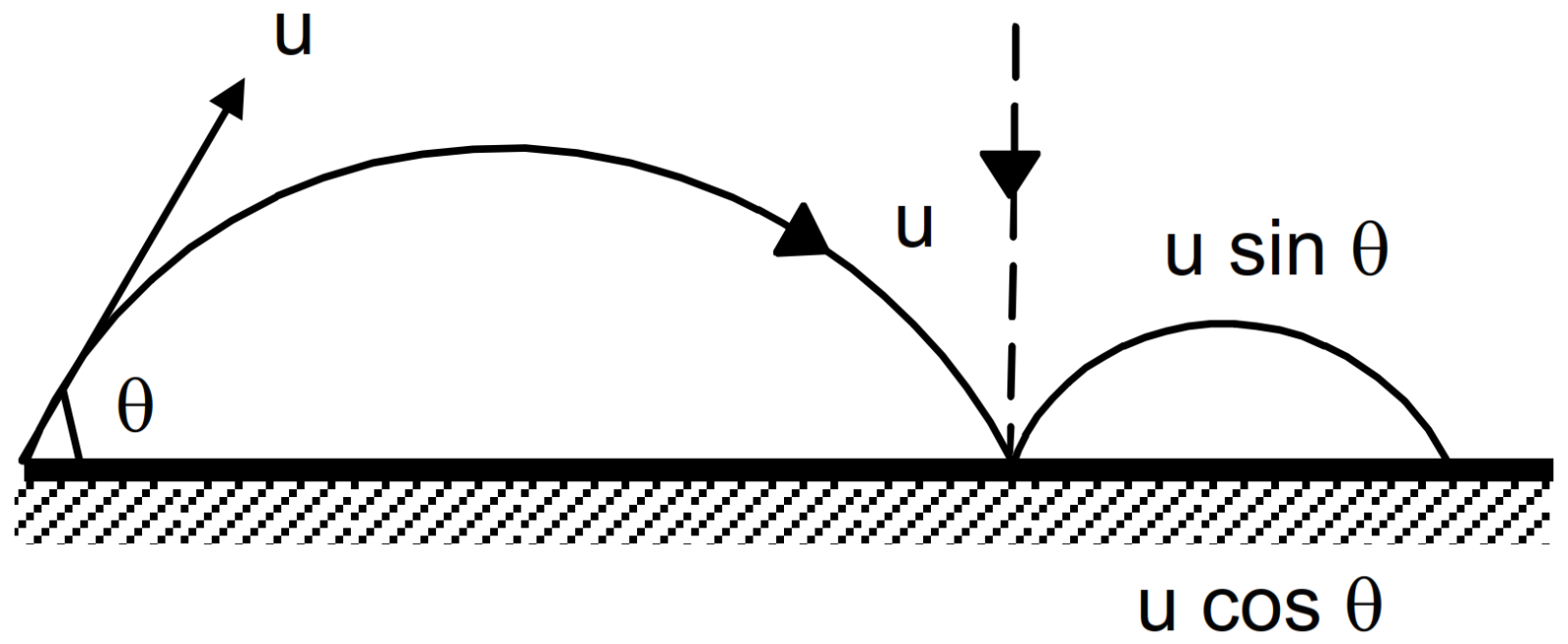
The projected velocity $= u$.
The angle of projection $=\theta.$
When the projectile hits the ground for the $1^{st}$ time, the velocity would be the same i.e. $u$.
Here, the component of velocity parallel to ground, $\text{u}\cos\theta$ should remain constant.
But the vertical component of the projectile undergoes a change after the collision.
$\Rightarrow\text{e}=\frac{\text{u}\sin\theta}{\text{v}}$
$\Rightarrow\text{v}=\text{eu}\sin\theta.$
Now for the $2^{nd}$ projectile motion $, U = $ velocity of projection $=\sqrt{(\text{u}\cos\theta)^2+(\text{eu}\sin\theta)^2}$ and Angle of projection $=\alpha=\tan^{-1}\Big(\frac{\text{eu}\sin\theta}{\text{u}\cos\theta}\Big)=\tan^{-1}(\text{e}\tan\theta)$ or $\tan\alpha=\text{e}\tan\theta\ \dots(2)$
Because, $\text{y}=\text{x}\tan\alpha-\frac{\text{gx}^2\sec^2\alpha}{\text{2u}^2}\ \dots(3)$
Here, $\text{y}=0,\ \tan\alpha=\text{e}\tan\theta,\ \sec^2\alpha=1+\text{e}^2\tan^2\theta$ And $\text{u}^2=\text{u}^2\cos^2\theta+\text{e}^2\sin^2\theta$
Putting the above values in the equation $(3),$ $\text{xe}\tan\theta=\frac{\text{gx}^2(1+\text{e}^2\tan^2\theta)}{\text{2u}^2(\cos^2\theta+\text{e}^2\sin^2\theta)}$
$\Rightarrow\text{x}=\frac{2\text{eu}^2\tan\theta(\cos^2\theta+\text{e}^2\sin^2\theta)}{\text{g}(1+\text{e}^2\tan^2\theta)}$
$\Rightarrow\text{x}=\frac{2\text{eu}^2\tan\theta-\cos^2\theta}{\text{g}}=\frac{\text{eu}^2\sin2\theta}{\text{g}}$
$\Rightarrow$ So, from the starting point $O,$ it will fall at a distance $=\frac{\text{u}^2\sin2\theta}{\text{g}}+\frac{\text{eu}^2\sin2\theta}{\text{g}}=\frac{\text{u}^2\sin2\theta}{\text{g}}(1+\text{e})$

Need a full question paper?

Generate a complete, print-ready paper with questions like this in minutes — across 16+ boards, with answer keys.

Start Generating Free

Similar questions

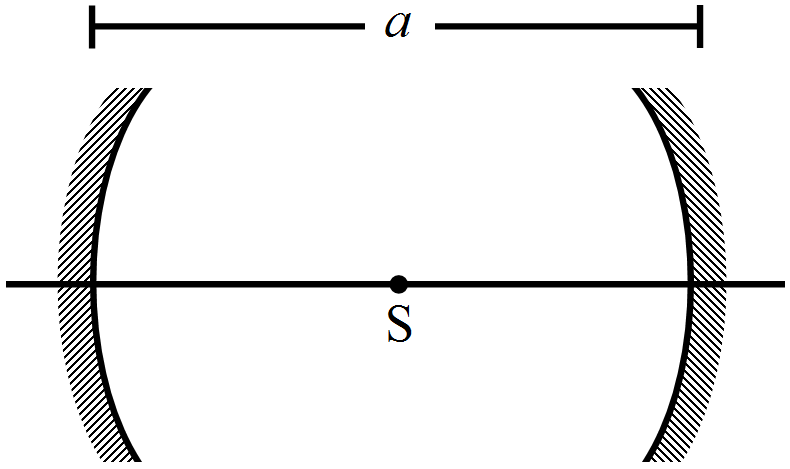
A point source S is placed midway between two converging mirrors having equal focal length f. Find the values of d for which only one image is formed.
An electron makes $3 \times 10^5$ revolutions per second in a circle of radius $0.5$ angstrom. Find the magnetic field $B$ at the centre of the circle.
Draw a simple circuit of a $CE$ transistor amplifier. Explain its working. Show that the voltage gain $, A_V,$ of the amplifier is given by $\text{A}_{V} = - \frac{\beta_{ac}\text{R}_{L}}{\text{r}_{i}},$ where $ \beta_{ac}$ is the current gain $, R_L$ is the load resistance and $r_i$ is the input resistance of the transistor. What is the significance of the negative sign in the expression for the voltage gain?
Define magnifying power of a telescope. Write its expression.
A small telescope has an objective lens of focal length 150 cm and an eye piece of focal length 5 cm. If this telescope is used to view a 100m high tower 3 km away, find the height of the final image when it is formed 25 cm away from the eye piece.
A coil of resistance $40\Omega$ is connected across a 4.0V battery 0.10s after the battery is connected, the current in the coil is 63mA. Find the inductance of the coil.
State Ampere's circuital law. Using Ampere's circuital law, derive an expression for the magnetic field along the axis of a toroidal solenoid.
Check that the ratio $\ce{ke^2/G m_em_p}$ is dimensionless. Look up a Table of Physical Constants and determine the value of this ratio. What does the ratio signify?
A car moving at a speed of 36 km/hr is taking a turn on a circular road of radius 50m. A small wooden plate is kept on the seat with its plane perpendicular to the radius of the circular road (figure In). A small block of mass 100g is kept on the seat which rests against the plate. The friction coefficient between the block and the plate is $\mu=0.58.$
  1. Find the normal contact force exerted by the plate on the block.
  2. The plate is slowly turned so that the angle between the normal to the plate and the radius of the road slowly increases. Find the angle at which the block will just start sliding on the plate.
  1. Using Ampere's circuital law, obtain the expression for the magnetic field due to a long solenoid at a point inside the solenoid on its axis.
  2. In what respect is a toroid different from a solenoid? Draw and compare the pattern of the magnetic field lines in the two cases.
  3. How is the magnetic field inside a given solenoid made strong?
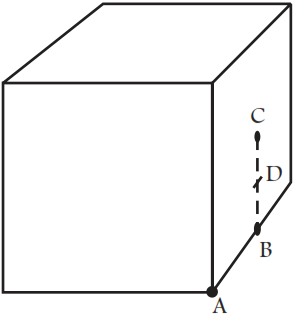
What will be the total flux through the faces of the cube (Fig.) with side of length a if a charge q is placed at:
  1. A: a corner of the cube.
  2. B: mid-point of an edge of the cube.
  3. C: centre of a face of the cube.
  4. D: mid-point of B and C.