Question
A horizontal cesium plate ($\phi$ = l.9 eV) is moved vertically downward at a constant speed u in a room full of radiation of wavelength 250 run and above. What should be the minimum value of u so that the vertically upward component of velocity is nonpositive for each photoelectron?
Answer

Work function $=\phi,$ distance = d

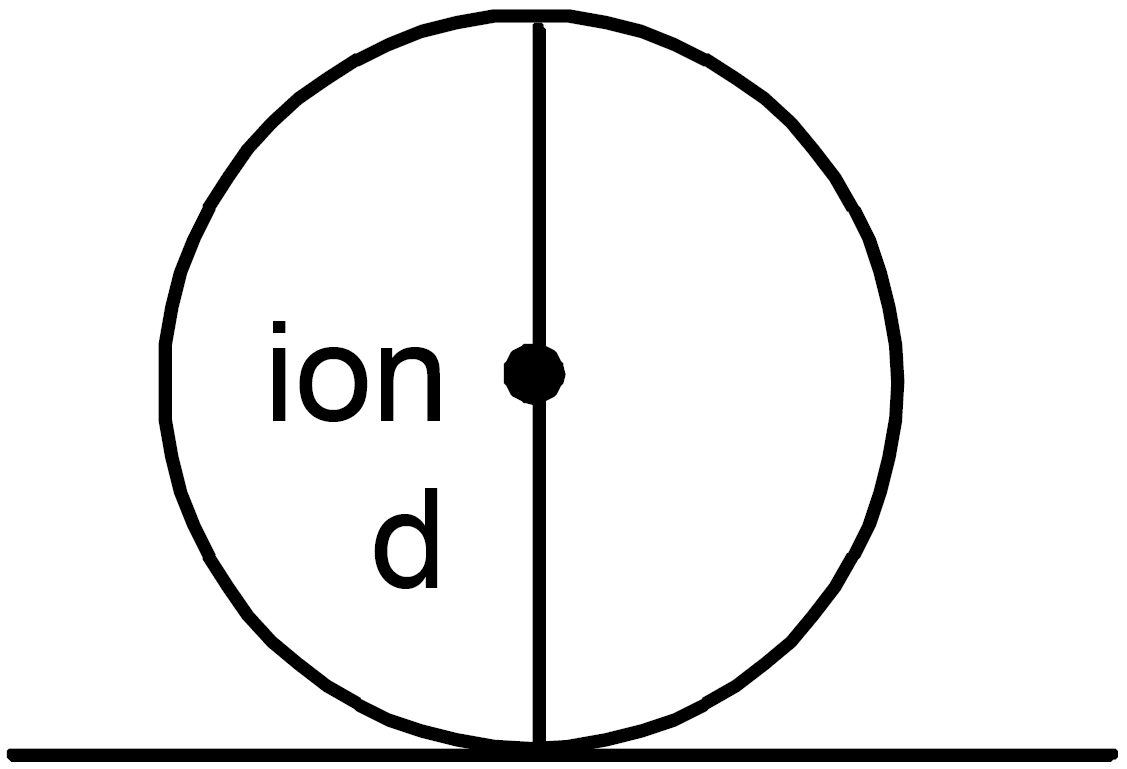
The particle will move in a circle

When the stopping potential is equal to the potential due to the singly charged ion at that point.

$\text{eV}_0=\frac{\text{hc}}{\lambda}-\phi$

$\Rightarrow\text{v}_0=\Big(\frac{\text{hv}}{\lambda}-\phi\Big)\frac{1}{\text{e}}$

$\Rightarrow\frac{\text{ke}}{2\text{d}}=\Big(\frac{\text{hc}}{\lambda}-\phi\Big)\frac{1}{\text{e}}$

$\Rightarrow\frac{\text{ke}}{\text{2d}}=\frac{\text{hc}}{\lambda}-\phi$

$\Rightarrow\frac{\text{hc}}{\lambda}=\frac{\text{ke}^2}{2\text{d}}+\phi=\frac{\text{ke}^2+2\text{d}\phi}{2\text{d}}$

$\Rightarrow\lambda=\frac{\text{hc 2d}}{\text{ke}^2+2\text{d}\phi}=\frac{2\text{hcd}}{\frac{1}{4\pi\omega_0\text{e}^2}2\text{d}\phi}=\frac{8\pi\omega_0\text{hcd}}{\text{e}^2+8\pi\omega_0\text{d}\phi}$

Need a full question paper?

Generate a complete, print-ready paper with questions like this in minutes — across 16+ boards, with answer keys.

Start Generating Free

Similar questions

Given below are some famous numbers associated with electromagnetic radiations in different contexts in physics. State the part of the electromagnetic spectrum to which each belongs.
  1. 21 cm (wavelength emitted by atomic hydrogen in interstellar space).
  2. 1057 MHz (frequency of radiation arising from two close energy levels in hydrogen; known as Lamb shift).
  3. 2.7 K [temperature associated with the isotropic radiation filling all space-thought to be a relic of the ‘big-bang’ origin of the universe].
  4. 5890 Å - 5896 Å [double lines of sodium]
  5. 14.4 keV [energy of a particular transition in 57Fe nucleus associated with a famous high resolution spectroscopic method (Mössbauer spectroscopy)].
An eye can distinguish between two points of an object if they are separated by more than 0.22mm when the object is placed at 25cm from the eye. The object is now seen by a compound microscope having a 20D objective and 10D eyepiece separated by a distance of 20cm. The final image is formed at 25cm from the eye. What is the minimum separation between two points of the object which can now be distinguished?
Two particles A and B, each carrying a charge Q, are held fixed with a separation d between them. A particle C having mass m and charge q is kept at the middle point of the line AB.
  1. If it is displaced through a distance x perpendicular to AB, what would be the electric force experienced by it.
  2. Assuming x << d, show that this force is proportional to x.
  3. Under what conditions will the particle C execute simple harmonic motion if it is released after such a small displacement?
Find the time period of the oscillations if these conditions are satisfied.
A wire of length l is bent in the form of an equilateral triangle and carries an electric currrent i.
  1. Find the magnetic field B at the centre.
  2. If the wire is bent in the form of a square, what would be the value of B at the centre?
a. Show that an ideal inductor does not dissipate power in an ac circuit.
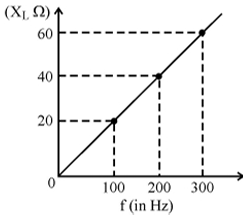
b. The variation of inductive reactance $\left( X _{ L }\right)$ of an inductor with the frequency ( $f$ ) of the ac source of 100 V and variable frequency is shown in the fig.
Image

i. Calculate the self-inductance of the inductor.
ii. When this inductor is used in series with a capacitor of unknown value and a resistor of $10 \Omega$ at $300 s^{-1}$, maximum power dissipation occurs in the circuit. Calculate the capacitance of the capacitor.
Derive the expression for the magnetic field at the site of a point nucleus in a hydrogen atom due to the circular motion of the electron. Assume that the atom is in its ground state and give the answer in terms of fundamental constants.
A pendulum bob of mass 80mg and carrying a charge of 2 × 10-8C is at rest in a uniform, horizontal electric field of 20kVm-1. Find the tension in the thread.
  1. For a ray of light travelling from a denser medium of refractive index n1 to a rarer medium of refractive index nprove that  $\frac{\text{n}_{2}}{\text{n}_{1}} = \sin \text{i}_{c} ,$ where ic is the critical angle of incidence for the media.
  2. Explain with the help of a diagram, how the above principle is used for transmission of video signals using optical fibres.

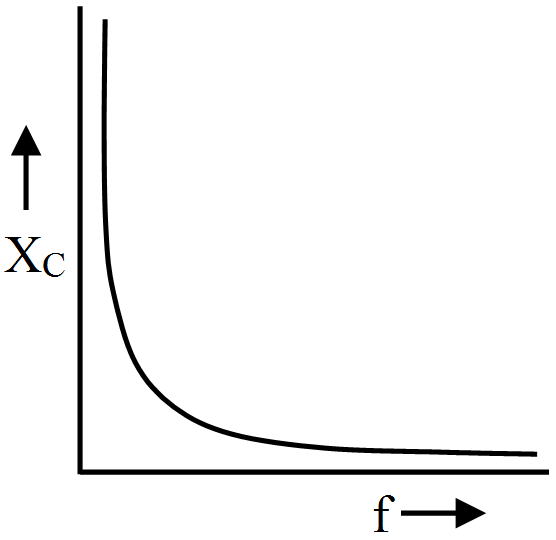
Define the term capacitive reactance. Show graphically the variation of capacitive reactance with frequency of applied alternating voltage.

An ac voltage $\text{V = V}_0\sin\omega\text{t}$ is applied across a pure capacitor of capacitance C. Find an expression for current flowing through it. Show mathematically the current flowing through it leads the applied voltage by angle $\frac{\pi}{2}.$

A point object is placed at a distance of 15cm from a convex lens. The image is formed on the other side at a distance of 30cm from the lens. When a concave lens is placed in contact with the convex lens, the image shifts away further by 30cm. Calculate the focal lengths of the two lenses.