A horizontal force of $4\,N$ is needed to keep a block of mass $0.5\, kg$ sliding on a horizontal surface with a constant speed. The coefficient of sliding friction must be :- $[g = 10\, m/s^2]$
Medium
Download our app for free and get started
For sliding the block
$\mathrm{F}_{\mathrm{ext}}=\mathrm{F}_{\mathrm{r}} \Rightarrow \mathrm{F}_{\mathrm{ext}}=\mu \mathrm{mg}$
$\Rightarrow \mu=\frac{F_{e x t}}{m g}=\frac{4}{0.5 \times 10}$
$\Rightarrow \mu=0.8$

Download our appand get started for free
Experience the future of education. Simply download our apps or reach out to us for more information. Let's shape the future of learning together!No signup needed.*
Similar Questions
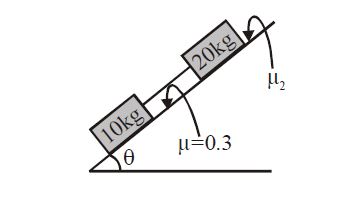
- 1A cyclist riding the bicycle at a speed of $14\sqrt 3 ms^{-1}$takes a turn around a circular road of radius $20\sqrt 3 $ m without skidding. Given $g = 9.8 ms^{-2},$ what is his inclination to the vertical ....... $^o$View Solution
- 2View SolutionWhen two surfaces are coated with a lubricant, then they
- 3A body of mass $40\,kg$ resting on rough horizontal surface is subjected to a force $P$ which is just enough to start the motion of the body. If $\mu_{ s }=5, \mu_{ x }=0.4$, $g =10\,m / s ^2$ and the force $P$ is continuously applied on the body, then the acceleration of the body is $.........m/s^{2}$View Solution
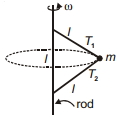
- 4In the figure, a ball of mass $m$ is tied with two strings of equal length as shown. If the rod is rotated with angular velocity $\omega$, thenView Solution
- 5A body $B$ lies on a smooth horizontal table and another body $A$ is placed on $B$. The coefficient of friction between $A$ and $B$ is $\mu $. What acceleration given to $B$ will cause slipping to occur between $A$ and $B$View Solution
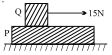
- 6$A$ long plank $P$ of the mass $5\, kg$ is placed on a smooth floor. On $P$ is placed a block $Q$ of mass $2\, kg$. The coefficient of friction between $P$ and $Q$ is $0.5$. If a horizontal force $15N$ is applied to $Q$, as shown, and you may take $g$ as $10N/kg.$View Solution
- 7A ball of mass $0.25\, kg$ attached to the end of a string of length $1.96 \,m$ is moving in a horizontal circle. The string will break if the tension is more than $25 \,N$. .......... $m/s$ is the maximum speed with which the ball can be movedView Solution
- 8For a body moving in a circular path, a condition for no skidding if $\mu $ is the coefficient of friction, isView Solution
- 9A force of $750 \,N$ is applied to a block of mass $102\, kg$ to prevent it from sliding on a plane with an inclination angle $30°$ with the horizontal. If the coefficients of static friction and kinetic friction between the block and the plane are $0.4 $ and $0.3$ respectively, then the frictional force acting on the block is...... $N$View Solution
- 10Value of $\theta$ is increased gradually from $\theta = 0$ At $\theta=tan^{-1}(\frac{1}{2})$ both the block just start slipping. Then value of $\mu_2$ is : $(g = 10 m/s^2)$View Solution