A cyclist riding the bicycle at a speed of $14\sqrt 3 ms^{-1}$takes a turn around a circular road of radius $20\sqrt 3 $ m without skidding. Given $g = 9.8 ms^{-2},$ what is his inclination to the vertical ....... $^o$
Medium
Download our app for free and get started
(d)$\theta = {\tan ^{ - 1}}\left( {\frac{{{v^2}}}{{rg}}} \right) = {\tan ^{ - 1}}\left[ {\frac{{{{(14\sqrt 3 )}^2}}}{{20\sqrt 3 \times 9.8}}} \right] = {\tan ^{ - 1}}[\sqrt 3 ]$$ = 60^\circ $

Download our appand get started for free
Experience the future of education. Simply download our apps or reach out to us for more information. Let's shape the future of learning together!No signup needed.*
Similar Questions
- 1A block of mass $2 kg$ slides down an incline plane of inclination $30^o$. The coefficient of friction between block and plane is $0.5$. The contact force between block and plank is :View Solution
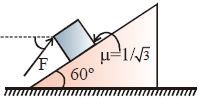
- 2The minimum value of $‘F’$ so that block is in equilibrium isView Solution
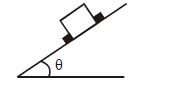
- 3A railway line is taken round a circular arc of radius $1000\ m$, and is banked by raising the outer rail $h\ m$ above the inner rail. If the lateral force on the inner rail when a train travels round the curve at $10 \ ms^{-1}$ is equal to the lateral force on the outer rail when the train's speed is $20\ ms^{-1}$. The value of $4g\ tan\theta$ is equal to : (The distance between the rails is $1.5 \ m$).View Solution
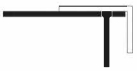
- 4A uniform rope of total length $l$ is at rest on a table with fraction $f$ of its length hanging (see figure). If the coefficient of friction between the table and the chain is $\mu$, thenView Solution
- 5View SolutionAmong the forces in nature, friction can be classified into
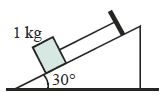
- 6The coefficient of friction between two surfaces is $\mu = 0.8$.The tension in the string shown in the figure is ........ $N$View Solution
- 7In a conical pendulum, the bob is rotated with different angular velocities and tension in the string is calculated for different values of $\omega$ . Which of them is correct graph between $T$ & $\omega .$View Solution
- 8A pen of mass $m$ is lying on a piece of paper of mass $M$ placed on a rough table. If the coefficients of friction between the pen and paper and the paper and the table are $\mu_1$ and $\mu_2$, respectively. Then, the minimum horizontal force with which the paper has to be pulled for the pen to start slipping is given byView Solution
- 9View SolutionMaximum force of friction is called
- 10View SolutionMeena applies the front brakes, while riding on her bicycle along a flat road. The force that slows her bicycle is provided by the