Question
A horizontal platform with an object placed on it is executing SHM in the vertical direction. The amplitude of oscillation is 2.5cm. What must be the least period of these oscillations so that the object is not detached from the platform? Take g = 10ms-2?
Answer

The object will not detach from the platform, if the angular frequency $\omega$is such that, during the downward motion, the maximum acceleration equals the acceleration due to gravity, i.e.,

$\omega^2_\text{max}\text{A}=\text{g}$

$\omega_\text{max}=\sqrt{\frac{\text{g}}{\text{A}}}$

$\text{T}_\text{min}=\frac{2\pi}{\omega_\text{max}}$

$=2\pi\sqrt{\frac{\text{A}}{\text{g}}}$

Now $\text{A}=2.5\text{cm}$

$=2.5\times10^{-2}\text{m}$

$\text{g}=10\text{ms}^{-2}$

Substituting thesa values we get 

$\text{T}_\text{min}=\frac{\pi}{10}$

Need a full question paper?

Generate a complete, print-ready paper with questions like this in minutes — across 16+ boards, with answer keys.

Start Generating Free

Similar questions

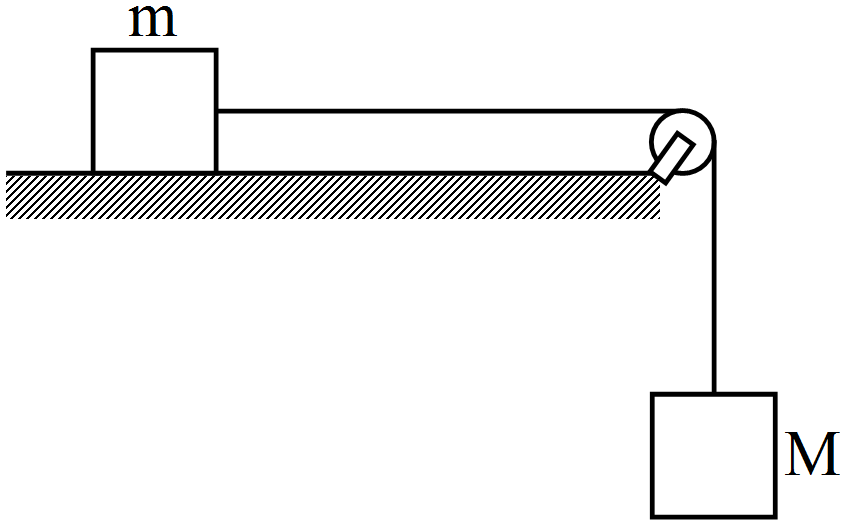
Figure shows two blocks of masses m and M connected by a string passing over a pulley. The horizontal table over which the mass m slides is smooth. The pulley has a radius r and moment of inertia I about its axis and it can freely rotate about this axis. Find the acceleration of the mass M assuming that the string does not slip on the pulley.

A simple pendulum of lerigth 1 feet suspended from the ceiling of an elevator takes $\frac{\pi}{3}$ seconds to complete one oscillation. Find the acceleration of the elevator.
Distinguish between a cyclic process and a non-cyclic process.
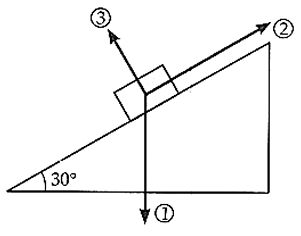
A block of wood of mass 3 kg is resting on the surface of a rough inclined surface, inclined at an angle $\theta$ as shown in the figure.
Image
a. Name the forces $(1,2,3)$.
b. If the coefficient of static friction is 0.2 , calculate the value of all three forces.
$
\text { (use } g=10 m / s^2 \text { ) }
$
A uniform slab of dimension 10cm × 10cm × 1cm is kept between two heat reservoirs at temperatures 10°C and 90°C. The larger surface areas touch the reservoirs. The thermal conductivity of the material is $ 0.80\text{wm}^{-1}{^{\circ}}\text{C}^{-1}.$ Find the amount of heat flowing through the slab per minute.
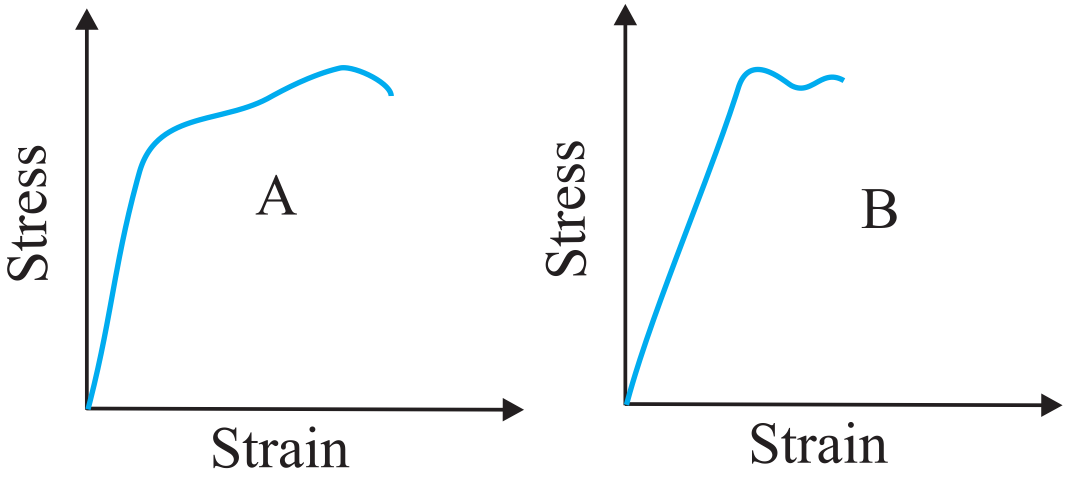
The stress-strain graphs for materials A and B are shown in Fig.

The graphs are drawn to the same scale.
  1. Which of the materials has the greater Young’s modulus?
  2. Which of the two is the stronger material?
Earth can be thought of as a sphere of radius 6400km. Any object (or a person) is performing circular motion around the axis of earth due to earth’s rotation (period 1 day). What is acceleration of object on the surface of the earth (at equator) towards its centre? what is it at latitude $\theta?$ How does these accelerations compare with g = 9.8m/ s2?
The specific heat capacities of hydrogen at constant volume and at constant pressure are 2.4cal-g-1 °C−1 and 3.4cal-g-1 °C-1 respectively. The molecular weight of hydrogen is 2g-mol-1 and the gas constant, R = 8.3 × 10⁷ erg°C-1 mol-1. Calculate the value of J.
A block hangs from a string wrapped on a disc of radius 20cm free to rotate about its axis which is fixed in a horizontal position. If the angular speed of the disc is 10rad/s at some instant, with what speed is the block going down at that instant?
A steel rod is rigidly clamped at its two ends. The rod is under zero tension at 20°C. If the temperature rises to 100°C, what force will the rod exert on one of the clampa? Area of Cross section of the rod = 2.00mm2. Coefficient of linear expansion of steel  12.0 × 10⁻⁶ °C-1 and Young's modulus of steel = 2.00 × 10¹¹N m-2.