MCQ
A horizontal right angle pipe bend has crosssectional area $=$ $10 $ $cm^2$ and water flows through it at speed $=$ $20$ $m/s$. The force on the pipe bend due to the turning of water is ........ $N$
  • $565.7$
  • B
    $400$
  • C
    $20$
  • D
    $282.8$

Answer

Correct option: A.
$565.7$
a
Mass flowing per sec through pipe is $=$ density $\times$ area $\times$ velocity change in velocity $V \times 2^{\frac{1}{2}}$

force$=(\text {density} \times \text {area} \times \text {velocity}) \times\left(\text {velocity} \times 2^{\frac{1}{2}}\right)$

$=565.7 N$

Need a full question paper?

Generate a complete, print-ready paper with questions like this in minutes — across 16+ boards, with answer keys.
Start Generating Free

Similar questions

A capacitor acts as an infinite resistance for:
  1. DC.
  2. AC.
  3. DC as well as AC.
  4. Neither AC nor DC.
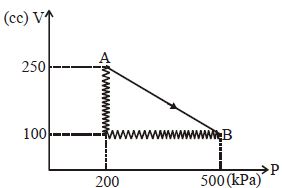
A monoatomic gas is taken along path $AB$ as shown. Calculate change in internal energy of system
To a person, going eastward in a car with a velocity of $25\, km/hr$, a train appears to move towards north with a velocity of $25\sqrt 3 $ $km/hr$. The actual velocity of the train will be..........$km/hr$
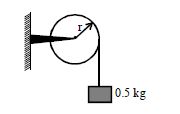
As shown in figure, a mass $m$ = $500\  g$ hangs from the rim of a wheel of radius $r$ = $20\  cm$. When released from rest, the mass falls $2.0\  m$ in $8\  sec$. Then moment of inertia of the wheel is.......... $kg-m^2$. $(g = 10\  m/s^2)$
Starting from the origin at time $t=0,$ with initial velocity $5 \hat{ j }\, ms ^{-1},$ a particle moves in the $x-y$ plane with a constant acceleration of $(10 \hat{ i }+4 \hat{ j })\, ms ^{-2}$. At time $t$, its coordinates are $\left(20\, m , y _{0}\, m \right) .$ The values of $t$ and $y _{0},$ are respectively
A person sitting firmly over a rotating stool has his arms stretched. If he folds his arms, his angular momentum about the axis of rotation:
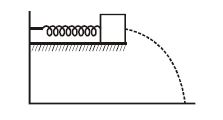
As shown in figure there is a spring block system. Block of mass $500\,g$ is pressed against a horizontal spring fixed at one end to compress the spring through $5.0\,cm$ . The spring constant is $500\,N/m$ . When released, calculate the distance where it will hit the ground $4\,m$ below the spring ? $(g = 10\,m/s^2)$
What is the mass of $2$ litres of nitrogen at $22.4$ atmospheric pressure and $273\,K$
In $a$ one dimensional collision between two identical particles $A$ and $B, B$ is stationary and $A$ has momentum $p$ before impact. During impact, $B$ gives impulse $J$ to $A.$
Two masses of 1g and 4g are moving with equal kinetic energy. The ratio of the magnitudes of their momentum is: