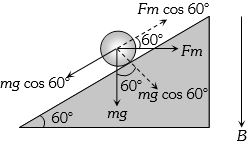
A horizontal rod of mass $10\, gm$ and length $10\, cm$ is placed on a smooth plane inclined at an angle of $60^\circ $ with the horizontal, with the length of the rod parallel to the edge of the inclined plane. A uniform magnetic field of induction $B$ is applied vertically downwards. If the current through the rod is $1.73$ $ampere$, then the value of $B$ for which the rod remains stationary on the inclined plane is......$Tesla$
Diffcult


Download our appand get started for free
Experience the future of education. Simply download our apps or reach out to us for more information. Let's shape the future of learning together!No signup needed.*
Similar Questions
- 1A charged particle is moving with velocity $v$ in a magnetic field of induction $B$. The force on the particle will be maximum whenView Solution
- 2$A$ microammeter has a resistance of $100\,\Omega$ and $a$ full scale range of $50\,\mu$ $A$. It can be used as a voltmeter or a higher range ammeter provided a resistance is added to it. Pick the correct range and resistance combination $(s)$.View Solution
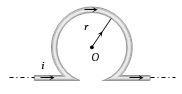
- 3An infinitely long straight conductor is bent into the shape as shown in the figure. It carries a current of $i$ $ampere$ and the radius of the circular loop is $r$ $metre$. Then the magnetic induction at its centre will beView Solution
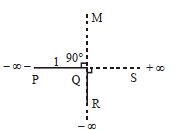
- 4An infinitely long conductor $PQR$ is bent to from a right angle as shown. A current $I$ flows through $PQR$ . The magnetic field due to this current at the point $M$ is $H_1$ . Now, another infinitely long straight conductor $QS$ is connected at $Q$ so that the current in $PQ$ remaining unchanged. The magnetic field at $M$ is now $H_2$ . The ratio $H_1/H_2$ is given byView Solution
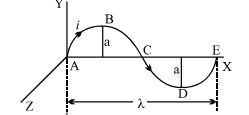
- 5A conductor $ABCDE$, shaped as shown, carries a current i. It is placed in the $xy$ plane with the ends $A$ and $E$ on the $x$-axis. $A$ uniform magnetic field of magnitude $B$ exists in the region. The force acting on it will beView Solution
- 6Two ions having masses in the ratio $1 : 1$ and charges $1 : 2$ are projected into uniform magnetic field perpendicular to the field with speeds in the ratio $2 : 3$. The ratio of the radii of circular paths along which the two particles move isView Solution
- 7An electron and a proton enter region of uniform magnetic field in a direction at right angles to the field with the same kinetic energy. They describe circular paths of radius ${r_e}$ and ${r_p}$ respectively. ThenView Solution
- 8An infinitely long hollow conducting cylinder with radius $R$ carries a uniform current along its surface. Choose the correct representation of magnetic field $(B)$ as a function of radial distance $(r)$ from the axis of cylinderView Solution
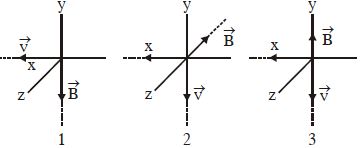
- 9The figure shows three situations when an electron moves with velocity $\vec v$ travels through a uniform magnetic field $\vec B$. In each case, what is the direction of magnetic force on the electronView Solution
- 10A charge $q$ is moving in a magnetic field then the magnetic force does not depend uponView Solution