MCQ
A horizontal straight conductor kept in north-south direction falls under gravity, then
  • A
    A current will be induced from South to North
  • B
    A current will be induced from North to South
  • No induce e.m.f. along the length of conductor
  • D
    An induced e.m.f. is generated along the length of conductor
Answer

Correct option: C.
No induce e.m.f. along the length of conductor
c
(c) No induced emf is set up as the magneitc field line of earth is not cut br the failling conductor.

Need a full question paper?

Generate a complete, print-ready paper with questions like this in minutes — across 16+ boards, with answer keys.

Start Generating Free

Similar questions

If $A$ and $B$ are two inputs in $AND $ gate, then $AND$ gate has an output of $1$ when the values of $A$ and $B$ are
A metallic rod of length $I$ and cross-sectional area $A$ is made of a material of Young's modulus $Y$. If the rod is elongated by an amount $y$, then the work done is proportional to ......
If velocity of flow is $4 \,m / s$, then velocity head is .........$m$
The atmospheric pressure is $1.01 \times 10^5 Pa$. How much force (in N) does the air in a room exert on the side of a window pane whose size is $50 \times 100$ $cm ^2$
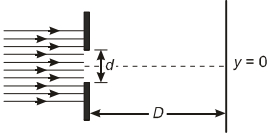
In an experiment, electrons are made to pass through a narrow slit of width '$d$' comparable to their de Broglie wavelength. They are detected on a screen at a distance '$D$' from the slit (see figure).

Which of the following graphs can be expected to represent the number of electrons '$N$' detected as a function of the detector position '$y$'($y = 0$ corresponds to the middle of the slit)

Center of mass of a system of three particles of masses $1, 2, 3\, kg$ is at the point $(1\, m, 2\, m, 3\, m)$ and center of mass of another group of two particles of masses $2 \,kg$ and $3\, kg$ is at point $(-1 \,m, 3\, m, -2\, m)$ . Where a $5\, kg$ particle should be placed, so that center of mass of the system of all these six particles shifts to center of mass of the first system?
$\beta$- rays emitted by a radioactive material are
A ray of light is incident at an angle of $60^o $ on one face of a prism of angle $30^o $. The ray emerging out of the prism makes an angle of $30^o $ with the incident ray. The emergent ray is
$A$ ball of mass $m = 60gm$ is shot with speed $v_0 = 22m/s$ into the barrel of spring gun of mass $M = 240g$ initially at rest on $a$ frictionless surface. The ball sticks in the barrel at the point of maximum compression of the spring. The speed of the spring gun after the ball stops relative to the barrel, is
For three vectors $\vec{A}=(-x \hat{i}-6 \hat{j}-2 \hat{k})$, $\vec{B}=(-\hat{i}+4 \hat{j}+3 \hat{k})$ and $\vec{C}=(-8 \hat{i}-\hat{j}+3 \hat{k})$, if $\overrightarrow{\mathrm{A}} \cdot(\overrightarrow{\mathrm{B}} \times \overrightarrow{\mathrm{C}})=0$, them value of $\mathrm{x}$ is. . . . . ..