A hot and a cold body are kept in vacuum separated from each other. Which of the following causes decrease in temperature of the hot body?
Easy
Download our app for free and get started
(a)
There are only three forms of heat transfer: Conduction, but the two bodies need to be in contact Convection, but there needs to be a medium between them Radiation, this is possible even in vacuum Hence, radiation is the only form of heat transfer possible

Download our appand get started for free
Experience the future of education. Simply download our apps or reach out to us for more information. Let's shape the future of learning together!No signup needed.*
Similar Questions
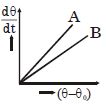
- 1Two circular discs $A$ and $B$ with equal radii and equal mass are blackened. They are heated to same temperature and are cooled under identical conditions.What inference do you draw from their cooling curves ?View Solution
- 2In Newton's experiment of cooling, the water equivalent of two similar calorimeters is $10 $ gm each. They are filled with $350 gm$ of water and $300 gm$ of a liquid (equal volumes) separately. The time taken by water and liquid to cool from ${70^o}C$ to ${60^o}C$ is $3$ min and $95$ sec respectively. The specific heat of the liquid will be ...... $Cal/gm\,^oC$View Solution
- 3An object kept in a large room having air temperature of $25^{\circ} \mathrm{C}$ takes $12$ minutes to cool from $80^{\circ} \mathrm{C}$ to $70^{\circ} \mathrm{C}$. The time taken to cool for the same object from $70^{\circ} \mathrm{C}$ to $60^{\circ} \mathrm{C}$ would be nearly.....$min$View Solution
- 4A container with $1 kg$ of water in it is kept in sunlight, which causes the water to get warmer than the surroundings. The average energy per unit time per unit area received due to the sunlight is $700 Wm ^{-2}$ and it is absorbed by the water over an effective area of $0.05 m ^2$. Assuming that the heat loss from the water to the surroundings is governed by Newton's law of cooling, the difference (in ${ }^{\circ} C$ ) in the temperature of water and the surroundings after a long time will be. . . . . . . . (Ignore effect of the container, and take constant for Newton's law of cooling $=0.001 s ^{-1}$, Heat capacity of water $\left.=4200 J kg ^{-1} K ^{-1}\right)$View Solution
- 5View SolutionThe quantity of heat which crosses unit area of a metal plate during conduction depends upon
- 6A solid copper sphere (density $\rho $ and specific heat capacity $c$ ) of radius $r$ at an initial temperature $200K$ is suspended inside a chamber whose walls are at almost $0K$ . The time required (in $\mu s$) for the temperature of the sphere to drop to $100\, K$ isView Solution
- 7A body takes $T$ minutes to cool from ${62^o}C$ to ${61^o}C$ when the surrounding temperature is ${30^o}C$. The time taken by the body to cool from ${70^o}$ to $({A_1}\,{\rm{and }}{A_{\rm{2}}})$ isView Solution
- 8A cubic metal block of mass $5 \,kg$ and edge length $0.1 \,m$ and at an initial temperature of $100^{\circ} C$ is placed on a thermally insulating flat surface and exposed to air at $0^{\circ} C$. The time in seconds required to cool the block to a temperature of $37^{\circ} C$ is closest toView Solution
(Note: Specific heat of the metal $=500 \,J / kg /{ }^{\circ} C$; Heat transfer coefficient from block to air $=50 \,W / m ^2 /{ }^{\circ} C$ )
- 9View SolutionFour pieces of iron heated in a furnace to different temperatures show different colours listed below. Which one has the highest temperature
- 10Suppose the sun expands so that its radius becomes $100$ times its present radius and its surface temperature becomes half of its present value. The total energy emitted by it then will increase by a factor ofView Solution