The quantity of heat which crosses unit area of a metal plate during conduction depends upon
Easy


Download our appand get started for free
Experience the future of education. Simply download our apps or reach out to us for more information. Let's shape the future of learning together!No signup needed.*
Similar Questions
- 1View SolutionWhich of the following cylindrical rods will conduct most heat, when their ends are maintained at the same steady temperature
- 2View SolutionThe spectrum from a black body radiation is a
- 3A small object is placed at the center of a large evacuated hollow spherical container. Assume that the container is maintained at $0 K$. At time $t =0$, the temperature of the object is $200 K$. The temperature of the object becomes $100 K$ at $t = t _1$ and $50 K$ at $t = t _2$. Assume the object and the container to be ideal black bodies. The heat capacity of the object does not depend on temperature. The ratio $\left( t _2 / t _1\right)$ is. . . . .View Solution
- 4A body cools from ${50.0^o}C$ to ${49.9^o}C$ in $5\;s$. How long will it take to cool from ${40.0^o}C$ to ${39.9^o}C$? Assume the temperature of surroundings to be ${30.0^o}C$ and Newton's law of cooling to be valid ....... $\sec$View Solution
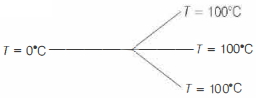
- 5A metallic prong consists of $4$ rods made of the same material, cross-sections and same lengths as shown below. The three forked ends are kept at $100^{\circ} C$ and the handle end is at $0^{\circ} C$. The temperature of the junction is ............. $^{\circ} C$View Solution
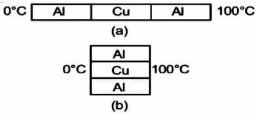
- 6The three rods shown in figure have identical dimensions. Heat flows from the hot end at a rate of $40 \,W$ in the arrangement $(a)$. Find the rates of heat flow when the rods are joined as in arrangement $(b)$ is ......... $W$ (Assume $K_al=200 \,W / m ^{\circ} C$ and $\left.K_{c u}=400 \,W / m ^{\circ} C \right)$View Solution
- 7If a liquid takes $30 \;sec$ in cooling from $80^{\circ} C$ to $70^{\circ} C$ and $70 \;sec$ in cooling from $60^{\circ} C$ to $50^{\circ} C$, then find the room temperature.View Solution
- 8View SolutionWe consider the radiation emitted by the human body. Which of the following statements is true
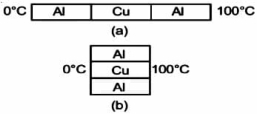
- 9The three rods shown in figure have identical dimensions. Heat flows from the hot end at a rate of $40 \,W$ in the arrangement $(a)$. Find the rates of heat flow when the rods are joined as in arrangement $(b)$ is ......... $W$ (Assume $K_al=200 \,W / m ^{\circ} C$ and $\left.K_{c u}=400 \,W / m ^{\circ} C \right)$View Solution
- 10According to Newton’s law of cooling, the rate of cooling of a body is proportional to ${(\Delta \theta )^n}$, where $\Delta \theta $ is the difference of the temperature of the body and the surroundings, and n is equal toView Solution