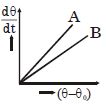
A hot metallic sphere of radius $r$ radiates heat. It's rate of cooling is
Medium


Download our appand get started for free
Experience the future of education. Simply download our apps or reach out to us for more information. Let's shape the future of learning together!No signup needed.*
Similar Questions
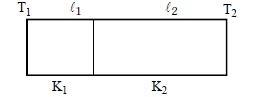
- 1One end of a thermally insulated rod is kept at a temperature $T_1$ and the other at $T_2$. The rod is composed of two sections of lengths $l_1$ and $l_2$ and thermal conductivities $K_1$ and $K_2$ respectively. The temperature at the interface of the two sections isView Solution
- 2Three rods of identical area of cross-section and made from the same metal form the sides of an isosceles triangle $ABC$, right angled at $B$. The points $A$ and $B$ are maintained at temperatures $T$ and $\sqrt 2 T$ respectively. In the steady state the temperature of the point C is ${T_C}$. Assuming that only heat conduction takes place, $\frac{{{T_C}}}{T}$ is equal toView Solution
- 3Liquid is filled in a vessel which is kept in a room with temperature ${20^o}C$. When the temperature of the liquid is ${80^o}C$, then it loses heat at the rate of $60\;cal/\sec $. What will be the rate of loss of heat when the temperature of the liquid is ${40^o}C$ ....... $cal/\sec $View Solution
- 4If a metallic sphere gets cooled from ${62^o}C$ to ${50^o}C$ in ${40^o}C$and in the next $10\;\min utes$gets cooled to ${42^o}C$, then the temperature of the surroundings is ......... $^oC$View Solution
- 5Bottom of a lake is at $0^{\circ} C$ and atmospheric temperature is $-20^{\circ} C$. If $1 cm$ ice is formed on the surface in $24 \,h$, then time taken to form next $1 \,cm$ of ice is ......... $h$View Solution
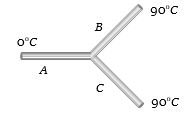
- 6Three rods made of the same material and having the same cross section have been joined as shown in the figure. Each rod is of the same length. The left and right ends are kept at ${0^o}C$ and ${90^o}C$ respectively. The temperature of the junction of the three rods will be ...... $^oC$View Solution
- 7The temperature of a piece of iron is ${27^o}C$ and it is radiating energy at the rate of $Q\;kW{m^{ - 2}}$. If its temperature is raised to ${151^o}C$, the rate of radiation of energy will become approximately ....... $Q\,kW\,{m^{ - 2}}$View Solution
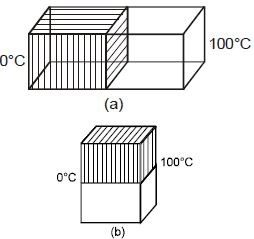
- 8Two identical square rods of metal are welded end to end as shown in figure $(a)$. Assume that $10\, cal$ of heat flows through the rods in $2\, min$. Now the rods are welded as shown in figure, $(b)$. The time it would take for $10$ cal to flow through the rods now, is ........ $\min$View Solution
- 9A black body is heated from ${27^o}C$ to ${127^o}C$. The ratio of their energies of radiations emitted will beView Solution
- 10Two circular discs $A$ and $B$ with equal radii and equal mass are blackened. They are heated to same temperature and are cooled under identical conditions.What inference do you draw from their cooling curves ?View Solution